
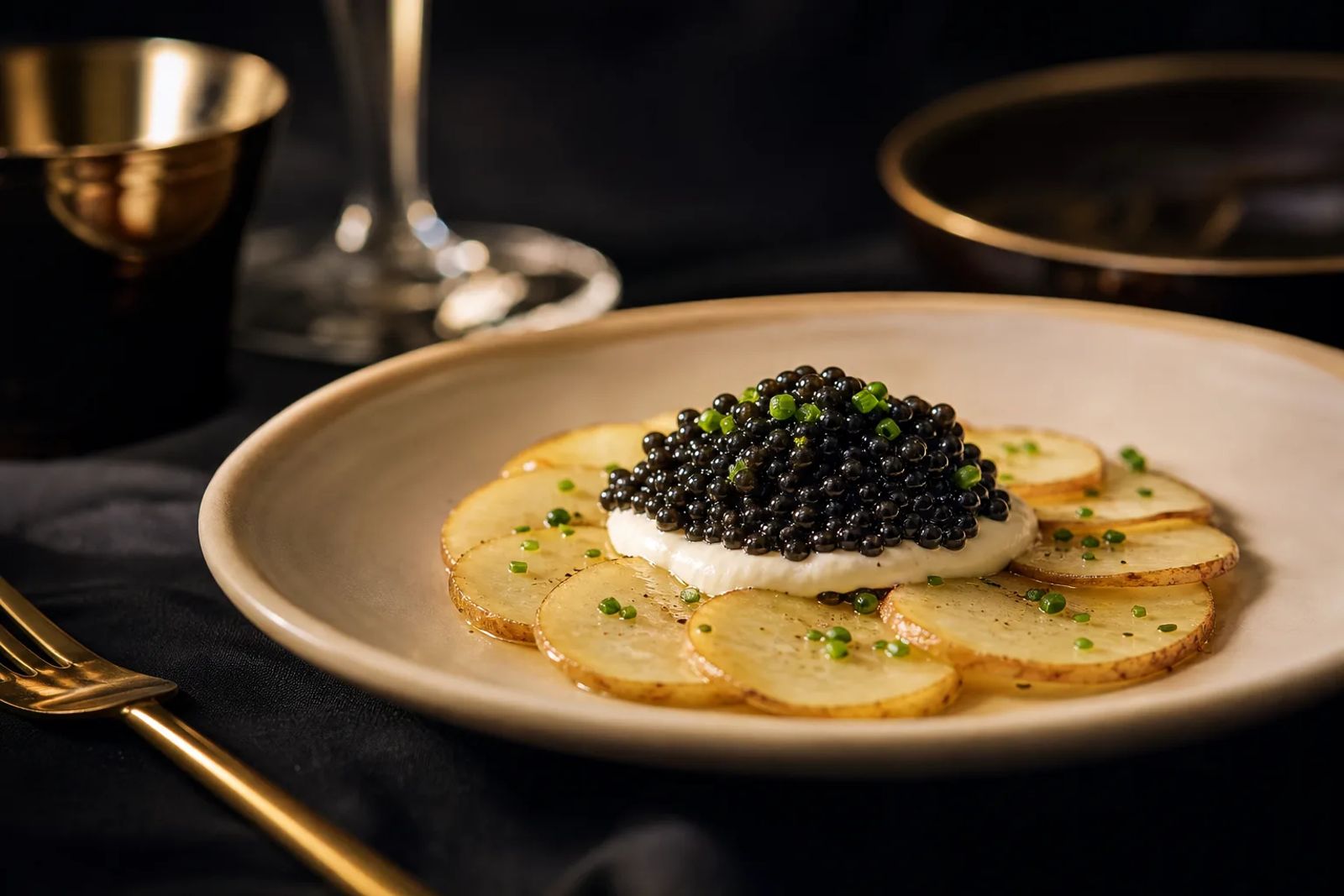
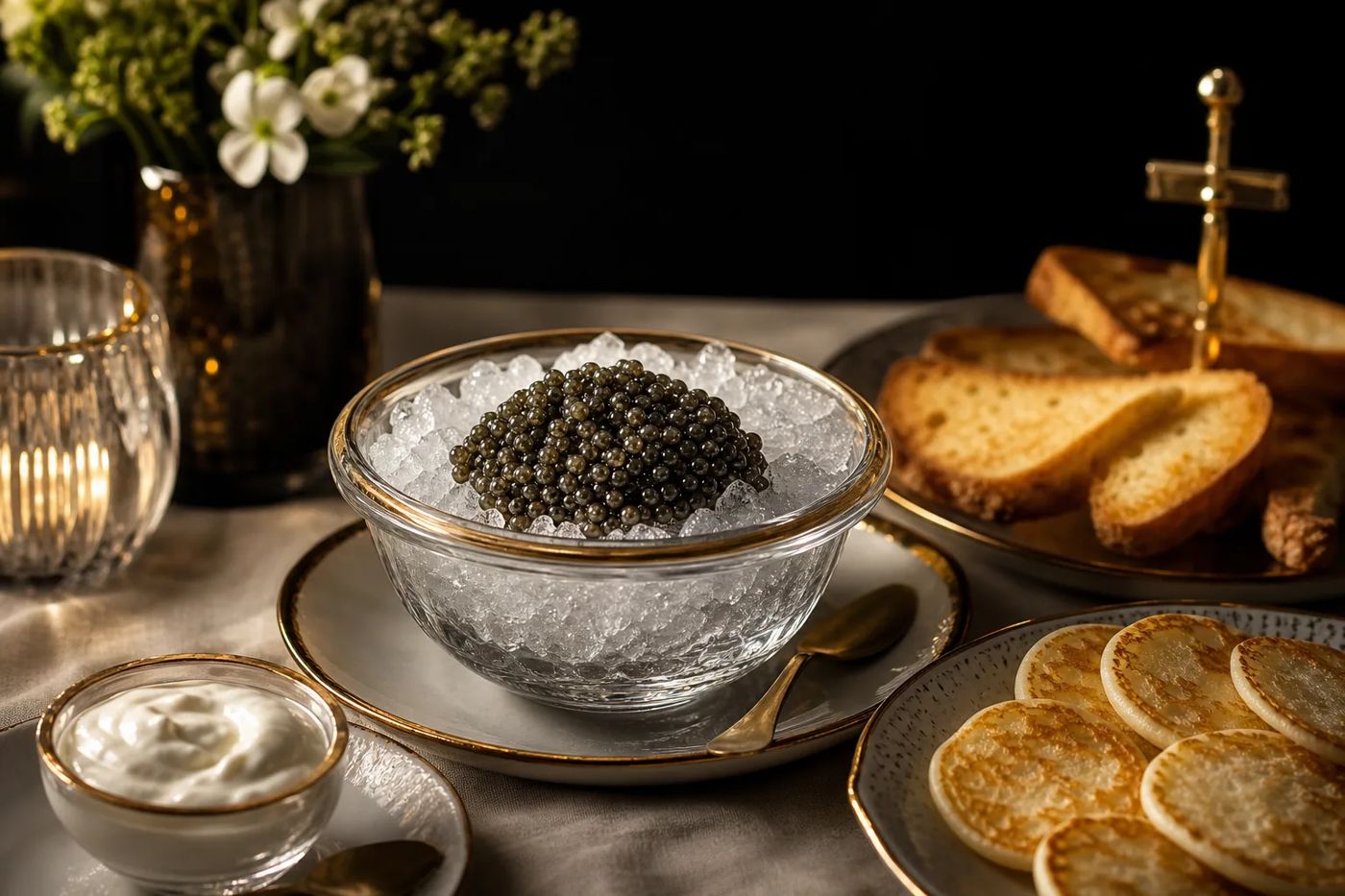
Caviar, blini, toast points and crème fraîche: one published restaurant menu specifies a 30 g (about 1 oz) presentation with these accompaniments. Elsewhere, caviar is served in a tasting-menu course, added as a supplement or offered in a single mouthful.
The first decision is what kind of experience you want. Before ordering, establish which fish produced the roe, where it came from, how many grams you will receive and whether the caviar is the focus or part of a dish.
Caviar dining today: choose your format
Choose a separate service to explore the roe, a composed dish to discover a chef's combination, or a single bite for a brief introduction. Published restaurant menus document all these approaches. Format tells you how you will eat the caviar, rather than how good it will be.
| Format | What it is | What to ask |
|---|---|---|
| By the tin | A stated container size, with accompaniments included or listed separately. | Is this a sealed tin for the table, and what comes with it? |
| By weight | A portion measured from a larger container. | How many grams, and is that per person or per table? |
| Tasting-menu course | A dish with caviar as an ingredient or centrepiece. | Is the roe separate or already combined with other ingredients? |
| Supplement | An optional addition to a dish or menu. | Does it add a course, replace one or garnish a dish? |
| Bump | A single mouthful, without a full accompaniment service. | Which caviar is it, and can I have it on a spoon? |
| Trolley service | Caviar brought to the table on a mobile service station. | Which selection and portion, and how is it chilled? |
| Comfort-food pairing | Roe with familiar dishes, such as scrambled eggs or a bagel. | Can I taste the caviar separately first? |
For a first encounter, let one question decide: can you taste the roe on its own? Choose a separate service or a course that leaves some roe accessible. You can taste it plain, then with its accompaniments, without asking the kitchen to redesign a finished dish.
With a tasting menu, ask where the caviar course falls in the sequence and whether it arrives hot, cold or in two parts. If the roe is your main interest, tell the team before service. They may be able to explain it before pouring a sauce or combining the components. That conversation helps you understand the dish on its own terms: a caviar course may be designed as a complete composition rather than a standalone tasting.
Know your portion before ordering
Ask for the weight of the caviar in grams, not the weight of the finished dish. The 30 g presentation above, recorded in source 8, is one restaurant's serving, not a standard portion you can expect everywhere.
Shared equally between two people, that 30 g gives each diner 15 g. Establish whether the stated quantity is for one person, a couple or the whole table, then use our portion guide to judge how it fits the meal.
A tasting-menu description may name caviar without giving its weight. Ask how much is included and whether it constitutes a separate serving. For a supplement, clarify what happens to the rest of dinner: will everyone receive the same course, and will the drinks pairing change if you choose it?
Read beyond the trade names
Imperial, Royal and Reserve tell you less than the species name. These and similar words are trade names, not species or legally standardised grades. A supplier may use them to distinguish its own selections. The revealing question is simple: what does this particular name mean here?
Ask for the species and its scientific name, rather than stopping at the selection name. The guide to caviar trade names explains why a familiar adjective cannot reliably compare the selections of different houses.
Blini, toast, crème fraîche, chopped egg and chives are possibilities, not a checklist that every service must complete.
“Kaluga Beluga” deserves particular attention. Treat it as potentially misleading trade language rather than a biological identity. Beluga is the species CITES lists as Huso huso. Kaluga is a different species, listed as Huso dauricus.
For a hybrid, a cross between species, ask staff to identify both the male and female parent, each with its scientific name. A phrase containing “beluga” does not establish the parents, and menus using “kaluga” may be describing different fish.
Other fish roe has pleasures of its own, but it is not sturgeon caviar. Codex's caviar standard covers the sturgeon family. US FDA naming guidance says other roe should identify the fish alongside “caviar”; if the menu leaves that unclear, ask which fish it means.
Ask where it came from, and when the tin was opened
One compact question gets the conversation moving: “Which species is this, where was the roe produced, and which farm or caviar house supplied it?” There is no need to turn dinner into a questionnaire.
The supplier and the country of origin are separate pieces of information. A house name alone does not answer both. If staff know the house but not the farm, ask them to check the product information rather than guess.
Next, establish whether the caviar is in its original tin or has been repacked, and whether your portion comes from a sealed tin or an already opened container. Repacking is a recognised practice: Codex permits transfer from larger to smaller containers under controlled conditions that maintain quality and safety.
Ask when the current tin was opened and how it has been kept cold between services. “Opened today” is useful, but handling must still follow the producer's instructions. The guide to original tins and repacking explains what each tells you about the caviar being served.
What good service looks like
Good service keeps the caviar chilled from arrival to the last spoonful. Look for a tin or serving dish supported by an appropriate chilled vessel or ice. Ice belongs around the container, never mixed into the roe. A large open tin left warming beside the table is no substitute for controlled chilling.
Storage and tasting are distinct. Codex specifies 2 to 4 °C (36 to 39 °F) during storage and retail. That is an international reference standard, not a universal restaurant serving temperature; the product's validated instructions should guide its handling.
Mother-of-pearl is familiar, but the spoon need not become a ceremony. In the MICHELIN Guide's service interview, the producer's representative also accepts porcelain, wood and plastic. Clean, suitable utensils matter more than matching the tableware.
Where the format allows, accompaniments should arrive separately, with their own utensils. Blini, toast, crème fraîche, chopped egg and chives are possibilities, not a checklist that every service must complete. Ask for a plain first taste if you want one, then follow how to taste caviar and explore the accompaniments at your own pace.
At a trolley, the containers matter more than the performance. Look for protected containers, controlled chilling and a clear explanation of your portion. For a bump, ask for a spoon if you prefer; the caviar bump explains the format without turning it into an etiquette test.
If the service looks poorly managed, ask staff to address it. Do not try to establish safety by tasting: a pleasant smell and tidy presentation cannot establish whether chilled ready-to-eat food has been handled safely.
Choose the dish and drink together
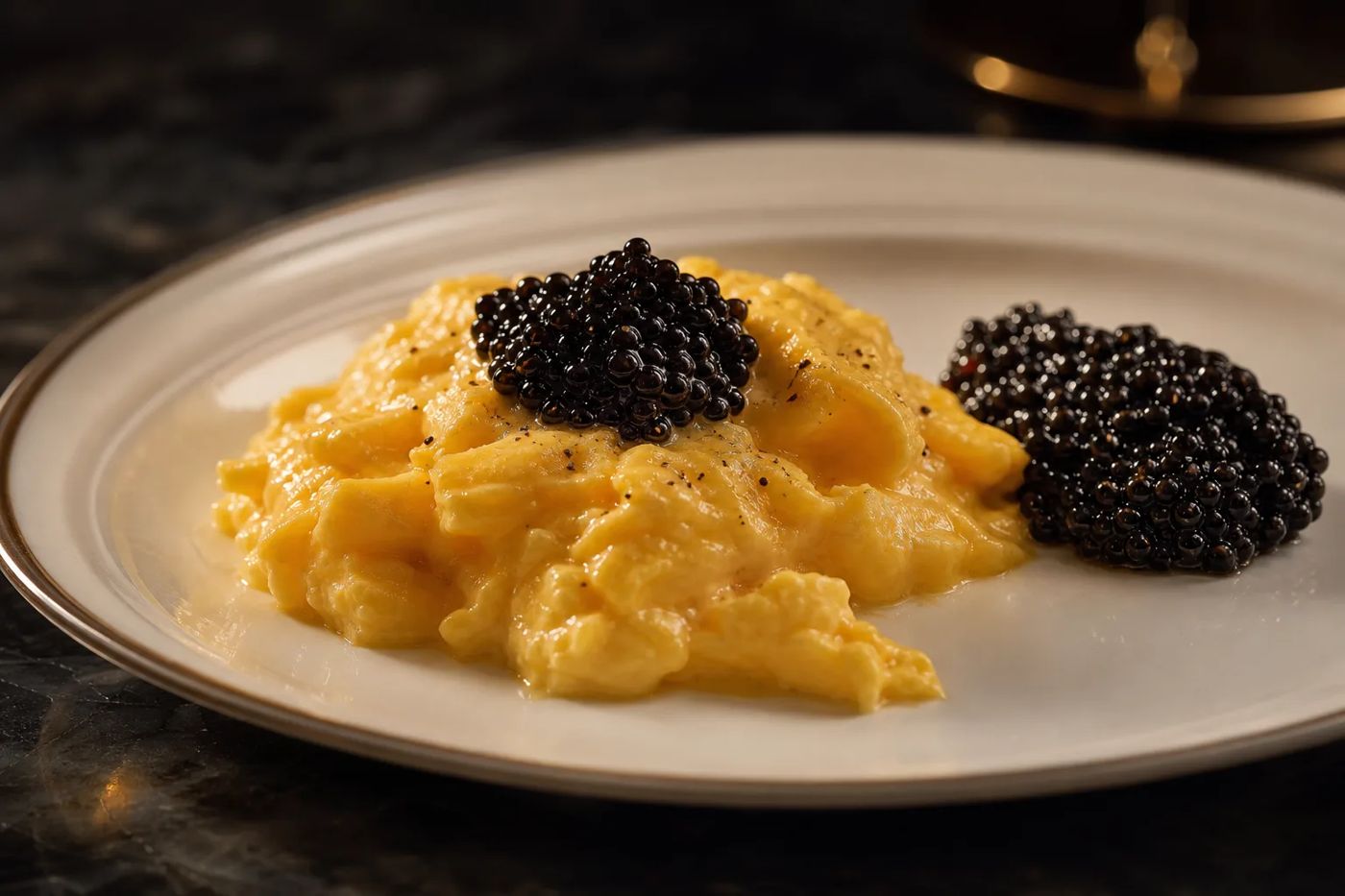
Caviar with soft scrambled eggs or a bagel offers a different pleasure from a plain service. Published menus document both pairings. Ask whether you are ordering a composed dish or caviar with a familiar accompaniment, especially if you want to taste the roe on its own first.
Make the same distinction when choosing a drink. In a published interview, sommelier Lucian Obreja describes offering Champagne or chilled vodka alongside an optional caviar dish. Ask whether the restaurant's recommendation is intended for the roe alone or for the complete plate.
Still wine and non-alcoholic drinks are options too. There is no prescribed pairing to follow. Tell the sommelier whether you want to concentrate on the caviar itself or enjoy it as one element of dinner, and let that preference guide the conversation.
Dietary questions to raise before ordering
Raise dietary needs when booking and confirm them before the order reaches the kitchen. Ask about the complete dish, including its garnishes, rather than only the roe named on the menu.
- Pregnancy, US guidance: FDA advises avoiding raw or undercooked seafood during pregnancy and says Listeria can grow in chilled ready-to-eat seafood. Ask how the roe was treated and consult your midwife or doctor.
- Fish allergy, US guidance: FDA identifies fish as a major allergen. Declare your allergy before ordering and seek your clinician's advice about eating roe.
- Restaurant allergen duties: In the EU and Northern Ireland, Regulation (EU) No 1169/2011, Article 44, requires allergen information for food sold without packaging. Great Britain has corresponding food information rules. In the US, duties depend on applicable state and local law, and the FDA Food Code is a model for adoption.
Where to go next
- How Restaurants Portion and Serve Caviar: the kitchen and dining-room perspective on organised service.
- Caviar Bars and Restaurants: the wider guide to choosing a caviar dining experience.
Sources
-
FAO and WHO, Codex Alimentarius. Standard for Sturgeon Caviar, CXS 291-2010. Listed by the Codex register as last modified in 2026; storage and repackaging provisions checked November 2026.
-
US Food and Drug Administration. CPG Sec. 540.150: Caviar, Use of Term, Labeling. October 1989 reissue; nonbinding compliance guidance. FDA guidance.
-
European Parliament and Council. Regulation (EU) No 1169/2011 on the provision of food information to consumers. 2011; retrieved consolidation dated 12 December 2011. Article 44, read with Article 9(1)(c). EUR-Lex text.
-
Food Standards Agency. Food allergen labelling and information requirements technical guidance. Live guidance, retrieved November 2026; Part 2, non-prepacked food. Government guidance.
-
US Food and Drug Administration. Food Code 2026. 2026 edition landing page, including explanation of adoption by governmental jurisdictions. FDA publication.
-
US Food and Drug Administration. Selecting and Serving Fresh and Frozen Seafood Safely. Live consumer guidance, undated; retrieved November 2026. Sections on serving, cross-contamination and at-risk groups. FDA seafood guidance.
-
US Food and Drug Administration. Have Food Allergies? Read the Label. Live consumer guidance, undated; retrieved November 2026. Major food allergens. FDA allergy guidance.
-
Petrossian Restaurants. Menu. Undated live menu, retrieved November 2026. Dine-in caviar presentation, caviar scrambled eggs and smoked salmon bagel. This is an operator's description of its own service. Published menu.
-
Claridge's. Spring/Summer 2024 Corporate Menu. 2024 edition; the retrieved autumn/winter menu address redirected to this document. Food stations, including caviar and bump trolleys, printed page 15. This is an operator's description of its own service. Published service menu.
-
London Wine Competition. Q & A with Lucian Obreja, Head Sommelier. Undated interview, retrieved November 2026. Discussion of an optional caviar dish, Champagne and chilled vodka. Published interview.
-
MICHELIN Guide. Ask the Expert: How to Buy and Enjoy Caviar. Undated retrieved article; checked November 2026. Section 7, spoon materials, reporting a producer representative's advice. Service interview.
-
Sterling Caviar. FAQ. Undated live company guidance; retrieved search extract, November 2026. Company-specific grading by size, texture and, for its Imperial selection, colour. Company explanation.
This piece was researched from official standards and guidance, published service menus and attributed interviews; no restaurant visit, tasting or comparative service assessment is claimed.
Last checked: November 2026