

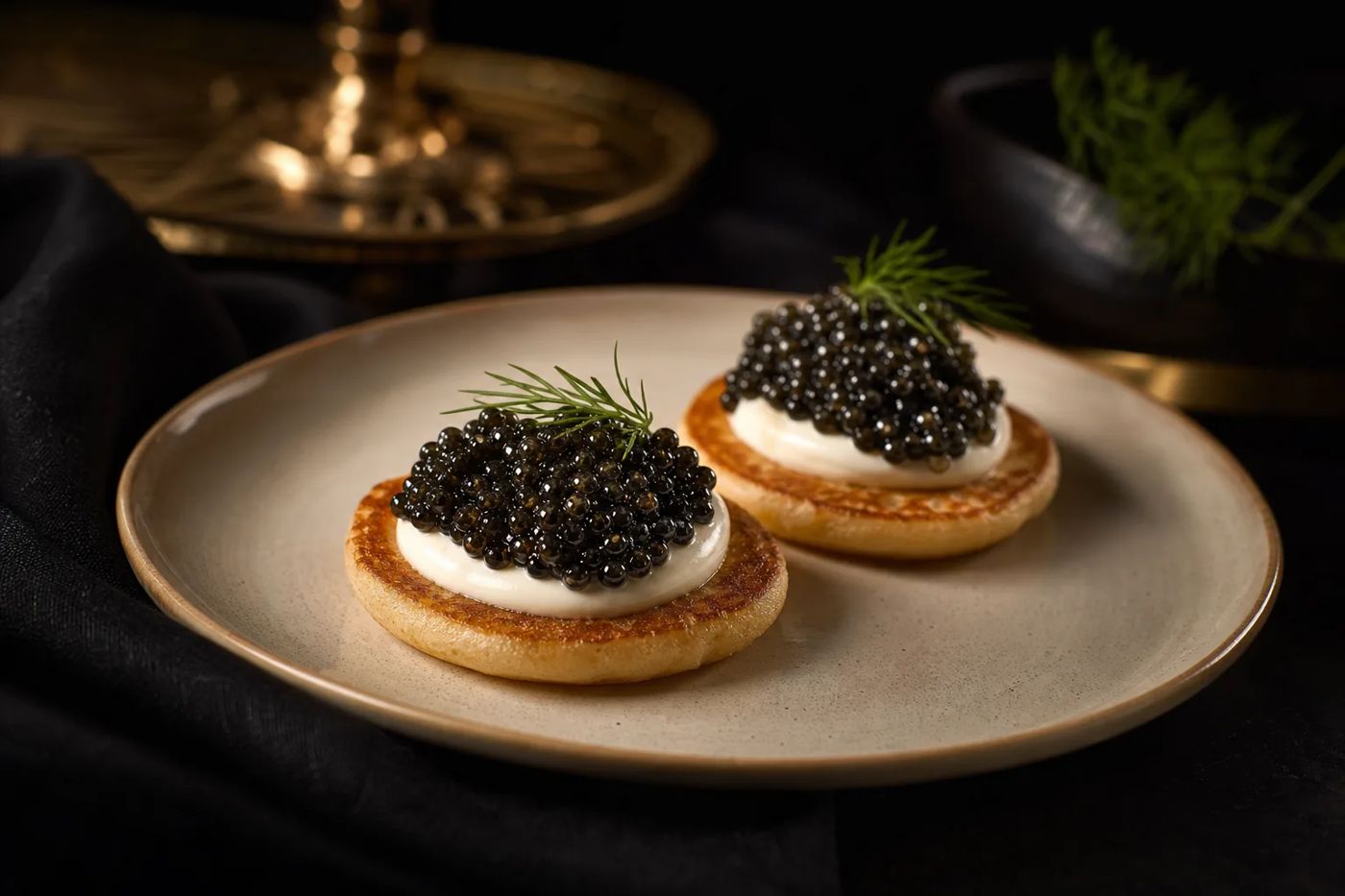
A loose mound of intact caviar beats a sharply sculpted quenelle of crushed eggs. Chef Thomas Wenger recommends delicate scooping rather than stirring or spreading: the beads should remain intact until eaten.
Caviar can arrive in an unopened individual tin or be weighed from an opened working tin kept cold. Either way, preparation and tableside service should keep time outside refrigeration short and reserve stock cold.
In short
- Set a gram weight for every dish. The site's 15 g serving is a reference, not a restaurant rule.
- Label opened tins with their opening time and follow the producer's instructions.
- Apply the foodservice temperature and time controls for your jurisdiction.
Set the portion before service
A quenelle is a shape, not a measure. The same spoon can carry different amounts depending on how it is filled, so write a gram weight into each dish specification instead of asking staff to reproduce a spoonful by eye.
Published recipes and service guides offer illustrations, not an industry-wide portion standard. Richard Corrigan's blini recipe on Great British Chefs specifies 35 g for two people: 17.5 g (about 0.6 oz) each, calculated by dividing the recipe total by its stated servings.
Browne Trading Company's service guide allocates a 30 g tin (about 1 oz) to one or two people for medium hors d'oeuvres, equivalent to 15 to 30 g per person (about 0.5 to 1 oz). These are the distributor's recommendations, rather than a legal or nutritional serving size.
The site's reference serving is 15 g (about half an ounce). For help choosing a portion, see portions by occasion. The task here is simpler: deliver the weight the menu promises.
Choose tools that protect the beads
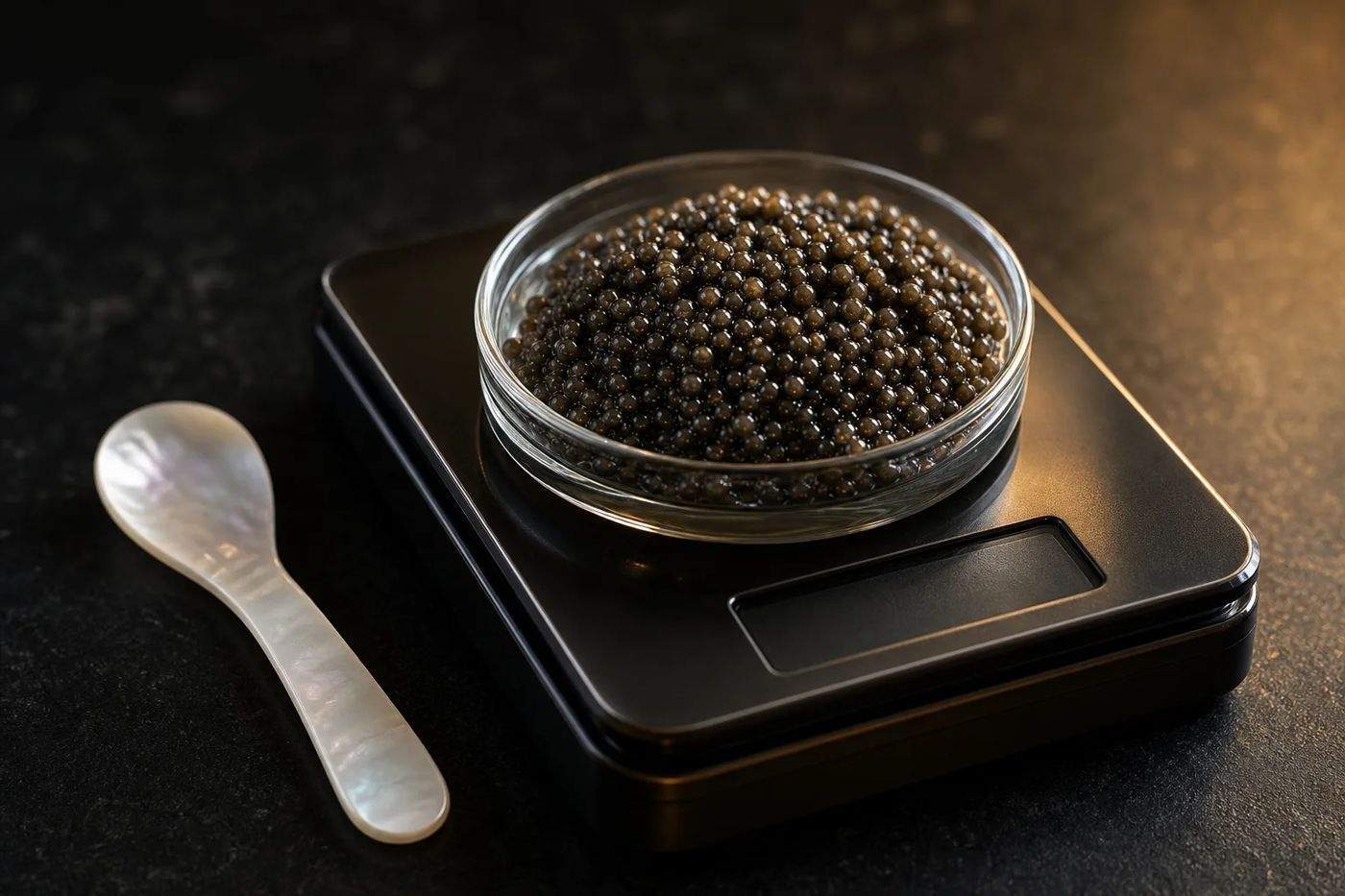
Weigh the caviar, not its surroundings. Use a scale suited to the small portions on your menu, a clean weighing surface and a vessel that can be tared to zero. Check accuracy through the kitchen's equipment programme, and exclude the plate, garnish and spoon from the portion weight.
Smooth, non-reactive food-contact utensils help protect the eggs; mother-of-pearl and glass are options. Choose tools that can be cleaned effectively, then follow Wenger's gentle approach to scooping.
For a quenelle, the oval shape made with two spoons, weigh first and shape gently. Repeatedly working the roe for a sharper outline risks crushing the beads. A loose, intact mound is better than a compressed shape.
A caviar bump is a small serving eaten from the hand, with no standard weight. Use a separate utensil for that portion. A working spoon must never touch a guest's skin and then return to the tin.
Keep storage and serving temperatures distinct
The product's validated storage instructions come first. Codex CXS 291-2010 gives 2 to 4 °C (36 to 39 °F) during packaging, storage and retail, and -4 to 0 °C (25 to 32 °F) for wholesale storage and transport. This is an international reference standard, not automatically national law.
For tasting, Wenger suggests about 8 °C (46 °F), followed by immediate service over crushed ice. That sensory recommendation concerns the portion being served, not the temperature at which to hold a working tin.
Keep reserve stock refrigerated. Nest the serving container in a chilled presenter over ice. Corrigan likewise serves caviar in a bowl over ice; check that your arrangement maintains the temperature required by the product and your food safety plan.
Ice alone cannot tell you whether the caviar is cold enough. Keep meltwater outside the food container, replenish the ice as needed and check food temperatures with a clean, disinfected probe under the kitchen's monitoring procedure.
See keeping caviar cold for the detailed temperature discussion. The limits below govern foodservice controls; they do not call for warming caviar before every order.
Apply the rules where you serve
Cold holding rules change across borders. The following sources were checked in November 2026; build the local authority's requirements into your documented food safety management system rather than importing another country's limits.
| Jurisdiction | Cold holding and service control | Source |
|---|---|---|
| EU | Maintain the cold chain. Limited periods outside temperature control are permitted only without a health risk; this provision gives no universal four-hour allowance. Check Member State catering guidance for numeric limits. | Regulation (EC) No 852/2004, Annex II, Chapter IX(5). |
| England, Wales and Northern Ireland | General chilled-food limit: 8 °C (46 °F). Refrigeration at 5 °C (41 °F) or below is recommended. Follow lower product-specific instructions. | FSA, Safer food, better business; GOV.UK catering guidance. |
| Scotland | CookSafe recommends refrigerators at 5 °C (41 °F) or below, with food at 8 °C (46 °F) or below. Follow stricter product instructions. | Food Standards Scotland, CookSafe, section 3. |
| United States | The 2026 model Code holds time/temperature control for safety food at 5 °C (41 °F) or below. Check the edition and amendments adopted locally. | FDA Food Code 2026, section 3-501.16. |
In England, Wales and Northern Ireland, FSA display guidance allows one period outside chilled storage of up to four hours. Mark the removal time. The guidance permits return before four hours, but not repeated four-hour displays; food exceeding the limit must be discarded.
The US model Code's four-hour option requires written procedures, time marking and an appropriate initial temperature, normally no more than 5 °C (41 °F) for chilled food. Serve or discard by the deadline. Do not return it to stock. A separate six-hour route carries additional conditions and is not the method recommended here.
Repeatedly working the roe for a sharper outline risks crushing the beads.
Treat these as outer limits, not service targets. Routine caviar service should retain temperature control and bring out small quantities against actual orders. The hygiene and time-out guide explains the distinctions in full.
A portioning method for the pass
Prepare the station before the first order, so weighing and service can move promptly. This operating template assumes refrigerated service, not a time-only display system. Enter the product's actual storage limit and opening instructions in the kitchen record.
- Prepare the station. Clean and disinfect the work area, wash hands, and set out the scale, clean spoons, covered containers and chilled presenter. Keep the station separate from raw-fish preparation.
- Check the tin. Confirm its identity, use-by date and producer's instructions before opening. Label it with the opening date and time and the resulting discard deadline. Preserve the original lot information.
- Weigh the order. Tare the clean serving vessel, then gently lift the specified weight into it. For a menu specification of 15 g (about half an ounce), the scale should show 15 g of caviar, excluding the vessel.
- Cover the reserve. Close the working tin and return it promptly to its specified refrigeration. Browne Trading recommends gently levelling the remaining eggs and applying food wrap close to the surface, limiting air space without breaking them.
- Send the portion. Set the bowl or tin securely over ice, keeping water outside it, and serve immediately. If using a permitted four-hour display procedure instead, record the removal time and deadline as specified above.
- Control every utensil. Give staff a separate spoon for each taste, with no double dipping. A spoon that has touched a mouth, hand or used plate must never return to the working tin.
Give every opened tin a clear history
An opened tin's lifetime belongs to that product. Follow the producer's instructions and the earliest applicable deadline, including its use-by date. Moving caviar to another container or adding a fresh label does not restart the clock.
Rotate usable stock first in, first out, checking dates before opening another tin. At shift handover, pass on each tin's identity, opening time, discard deadline and any recorded temperature deviation. The incoming team should have its history, not have to reconstruct it.
Present the tin at the table
Tableside presentation can be straightforward and elegant. Wenger describes opening the tin in front of guests and leaving its lid visible beside the ice. Explain the species and portion accurately, and keep the service spoon separate from individual eating spoons. See classic caviar service for the Russian and French arrangements.
Reduce loss without compromising service
Track the grams as carefully as the portions. Order and open against expected demand, then reconcile the caviar issued with portions sold, staff tastings and discarded product. Record actual losses rather than assuming every gram in a tin reaches a guest; this is a kitchen control, not a promised yield.
Gentle handling and reliable cold storage address different problems. Wenger recommends delicate scooping to protect the eggs; the FSA supplies corrective guidance when chilled storage fails.
| Problem | Likely cause | Fix |
|---|---|---|
| Presenter fails to keep caviar cold | Inadequate temperature control | Stop service. Check recorded time and temperature, then follow the kitchen's corrective action or discard rule. |
| Crushed beads | Rough or repeated handling | Scoop gently. Do not keep reshaping damaged roe. |
Smell and appearance cannot establish safety. Never return guest-exposed leftovers to reserve stock. For the wider operational setting, see restaurant, hotel and airline service within the caviar industry guide.
Sources
- Codex Alimentarius Commission, FAO and WHO. Standard for Sturgeon Caviar, CXS 291-2010, last modified 2026, checked November 2026.
- Richard Corrigan, Great British Chefs. Ossetra caviar with blinis and sour cream, first published 2015, current online recipe. Recipe and service method.
- Browne Trading Company. How to Serve Caviar: Guide to Caviar Care, undated, current online edition. Commercial distributor guidance, attributed as such;
- Thomas Wenger, Chef's Pencil. How to Serve Caviar, 4 May 2011, current online article. Chef's service guidance.
- Great British Chefs. Quenelle versus rocher: What's the difference?, 14 February 2025. Shaping technique.
- European Parliament and Council. Regulation (EC) No 852/2004 on the hygiene of foodstuffs, consolidated text dated 24 March 2021, especially Annex II, Chapters V and IX. EUR-Lex text.
- Food Standards Agency. Safer food, better business for caterers: Chilled storage and display, current online safe-method sheet, undated. Catering guidance.
- UK Government. Food hygiene for businesses: Chilling and freezing, current online guidance, undated. Jurisdiction and temperature guidance.
- Food Standards Scotland. CookSafe: Section 3, online edition of the guide published 8 April 2019. Temperature control, cleaning and cross-contamination guidance.
- US Food and Drug Administration. Food Code 2026, 2026 edition, especially sections 3-301.12, 3-501.16 and 3-501.19. Official Food Code.
- Food Standards Agency. Safer food, better business for caterers: Stock control, current online safe-method sheet, undated. Stock rotation and date controls.
This piece combines published chef techniques and one distributor's handling guidance with official foodservice hygiene sources; the operating method is an editorial synthesis, not a reported kitchen trial.
Last checked: November 2026