
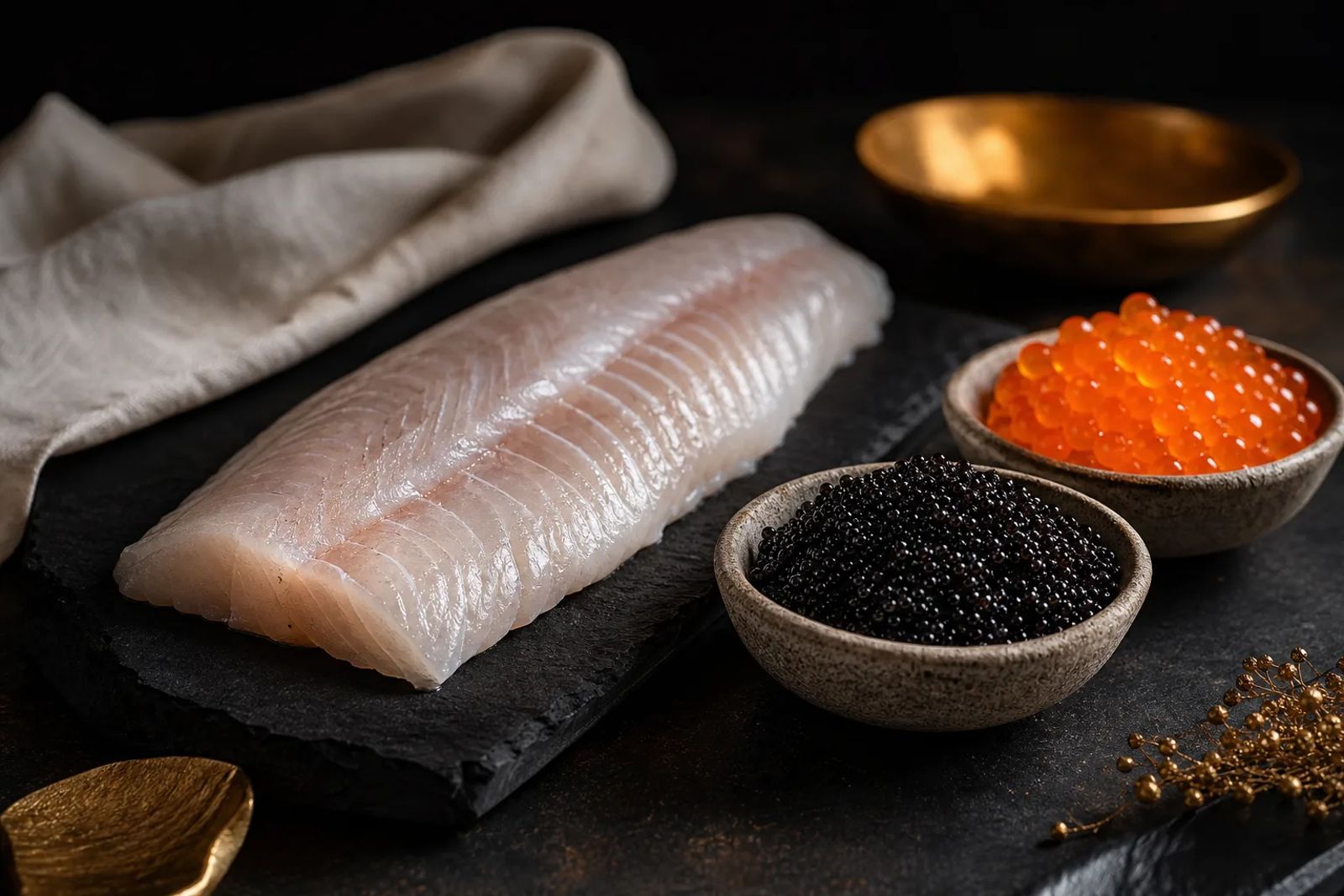
Two patients in a Finnish report published in 2003 could eat fish flesh, yet both reacted to roe. One reaction involved anaphylaxis. The distinction matters: fish eggs can cause an allergy separate from reactions to the flesh.
If you have a fish allergy, do not try caviar unless an allergist has assessed it for you. Being able to eat a fillet does not establish that its roe is safe.
- Fish and shellfish are separate allergy groups.
- Japan recommends declaring salmon roe on packaged processed foods.
- Ask caterers about hidden roe and the risk of cross-contact.
What happens in fish and roe allergy
Fish flesh and fish roe contain different important allergens. Parvalbumin, a muscle protein, is a major allergen in fish flesh. Roe research has identified important allergens among yolk proteins, including fragments of the precursor protein vitellogenin. That difference helps explain why an allergy to fish flesh and an allergy to roe do not always occur together.
The American College of Allergy, Asthma & Immunology (ACAAI) describes fish allergy as an immune reaction to fish proteins. In immediate allergic reactions, antibodies called immunoglobulin E, or IgE, can trigger hives, vomiting, breathing difficulty or anaphylaxis, a potentially life-threatening reaction.
Fish, crustaceans and molluscs are distinct seafood groups, not interchangeable allergy diagnoses. ASCIA, the Australasian Society of Clinical Immunology and Allergy, explains that a person may react to fish, shellfish or both. Allergy to one fish usually means allergy to most fish, but there are exceptions.
What the roe studies reveal
Roe allergens can resemble one another closely enough for the same antibodies to recognise them. This is called cross-reactivity, and laboratory studies have explored it across several kinds of fish eggs.
In a Japanese laboratory study published in 2009, Shimizu and colleagues tested blood sera from 20 people allergic to chum salmon roe against extracts from four salmonid roes. Immunoblotting identified proteins recognised by IgE, while competitive ELISA tested whether one extract blocked IgE binding to another. The beta-prime component, a vitellogenin fragment, was a major allergen. The extracts showed strong laboratory cross-reactivity.
The Finnish report from 2003 investigated whitefish and rainbow trout roe in the two patients who could eat fish flesh. Researchers used skin-prick tests, specific-IgE measurements, immunoblotting and inhibition experiments. The patients' roe-binding patterns differed: cross-reactivity between the two roes was demonstrated in one patient, but not the other.
Laboratory cross-reactivity does not establish that everyone will react when eating each food. These small studies cannot identify a safe sturgeon-caviar choice for an individual. For a closer look at the ingredient itself, see the guide to salmon roe.

Reading fish and roe allergen labels
Read the ingredients as well as any separate allergen statement. Roe generally falls under fish or fish-products rules where those categories are listed. Japan goes further in naming salmon roe specifically within its recommended allergen system.
If an oral food challenge is appropriate, it belongs under medical supervision, not at home with a few beads.
The table covers consumer allergen information, rather than customs descriptions or wildlife-trade codes.
| Jurisdiction | How fish or roe is listed | Legal source | Date checked |
|---|---|---|---|
| EU | Prepacked: fish and products thereof are Annex II allergens, emphasised in ingredients. Non-prepacked: allergen information is mandatory, with national rules determining how. | Regulation (EU) No 1169/2011, Articles 21 and 44, Annex II. | November 2026 |
| Great Britain | Prepacked labels must identify and emphasise fish. PPDS food needs its name and full ingredients with emphasised allergens. Loose-food allergen information is required. | Assimilated Regulation 1169/2011; national Food Information Regulations, as amended. | November 2026 |
| Northern Ireland | Fish declaration, PPDS ingredients and loose-food information duties apply. The underlying EU food-information regulation continues to apply. | EU Regulation 1169/2011; Food Information Regulations (Northern Ireland) 2014, as amended. | November 2026 |
| United States | FDA-regulated packaged foods must name the fish species in ingredients or a Contains statement. These federal provisions do not require equivalent restaurant menu declarations. | FD&C Act sections 201(qq), 403(w), amended by FALCPA and FASTER. | November 2026 |
| Japan | Salmon, mackerel and salmon roe (ikura) are recommended, not mandatory, declarations on packaged processed foods. Equivalent restaurant declarations are not required by this system. | Food Labeling Standards; CAA allergen guidance. | November 2026 |
| Australia and New Zealand | Fish is a required name under PEAL. Packaged foods need bold ingredient declarations and a bold Contains summary. Unlabelled food needs displayed information or information on request. | Food Standards Code, Standard 1.2.3 and Schedule 9. | November 2026 |
| Switzerland | Fish and fish products require allergen declaration. Loose-food information is written by default; oral information is permitted under specified conditions. | Food Information Ordinance (LIV), Articles 5 and 10, Annex 6. | November 2026 |
| China | Current GB 7718-2011 recommends fish-allergen warnings on prepacked food. GB 7718-2025 makes fish-ingredient declarations mandatory from 16 March 2027. | GB 7718-2011; GB 7718-2025. | November 2026 |
| UAE: verified Abu Dhabi scope | Official prepacked-food guidance requires a clear reference to fish where used. This does not establish a UAE-wide restaurant disclosure rule. | ADAFSA Code of Practice No. 5 of 2019, section 3.3. | November 2026 |
Fish eggs belong under fish, not poultry egg. UK guidance explicitly defines the egg category as birds' eggs, while fish products fall under fish. The EU and UK list crustaceans and molluscs separately. US major allergen law includes crustacean shellfish but not molluscs.
PPDS means prepacked for direct sale: for example, food packaged at the place where it is offered for sale before the customer orders or selects it. In the UK, those label requirements took effect on 1 October 2021. For the other details on a tin, see how to read a caviar label.
“May contain” refers to possible unintended presence, not an intentional ingredient. An absent warning does not rule out cross-contact, and this wording should not be used to decide a personal threshold. Caviar labelling laws explains the wider legal framework.
Restaurants, events and hidden roe
Removing the visible garnish is not enough. Tell the restaurant or caterer about your specific allergy before ordering, including roe if that is your diagnosis. Ask them to check the actual ingredient label and recipe. At a reception, speak to the catering lead rather than relying on someone carrying a tray.
Check sushi toppings and fillings, taramasalata and other roe dips, and sauces or spreads containing caviar. Recognise bottarga, too: it is a fish-roe product. Ask about shared spoons, preparation surfaces and garnishing stations. These are places to consider cross-contact, where an allergen is transferred unintentionally into another food.
A caviar substitute is not necessarily fish-free. Another fish's roe is still fish. With plant-based alternatives, check the complete recipe for fish-derived flavourings and any other relevant allergens, such as soya, wheat or milk. A vegan description cannot replace allergy information or cross-contact controls. The guide to seaweed and vegan caviar explains the different products.
If staff cannot establish the ingredients or explain how they will handle the allergy, do not eat the dish. That remains the practical decision even when a business has an allergen chart. The chart describes ingredients; it does not, by itself, show that your portion has avoided cross-contact.
If a reaction happens
Stop eating and follow your prescribed allergy action plan. Sudden tongue or throat swelling, difficulty breathing, marked dizziness or collapse can indicate anaphylaxis. A rash need not be present. Do not wait for every possible symptom before taking emergency action.
Under UK NHS guidance, if you suspect anaphylaxis:
- Use your adrenaline auto-injector immediately if you have one, then call 999 and say “anaphylaxis”.
- If you do not have an injector, call 999 immediately.
- Lie down with your legs raised. If breathing is difficult, raise your shoulders or sit up slowly.
- If you are pregnant, lie on your left side.
- Do not stand or walk.
- If symptoms have not improved after five minutes, use a second auto-injector if available.
Elsewhere, use the local emergency number and follow your country's emergency guidance and your clinician's plan. Adrenaline is called epinephrine in some countries. Antihistamines do not replace adrenaline in anaphylaxis. Emergency assessment is still needed after an injection, even if you start to feel better.

What to discuss with an allergist
Ask the allergist to assess roe specifically. A general fish test should not be assumed to answer the caviar question.
Bring a description of the food, its ingredient list if available, the amount eaten and the timing of symptoms. These details help the clinician distinguish a suspected allergic reaction from other adverse reactions to food.
Skin-prick testing and blood tests can support the investigation, but a positive result needs to be interpreted alongside your history. If an oral food challenge is appropriate, it belongs under medical supervision, not at home with a few beads. Ask whether you need prescribed emergency medication and a written plan. Make sure those serving you understand it.
The wider caviar and health hub separates allergy questions from nutrition and other health concerns. Use it to find the relevant topic: a food's nutritional profile does not establish whether it is safe for someone with an allergy.
Sources
-
American College of Allergy, Asthma & Immunology. Fish Allergy. Undated online patient guidance, retrieved 2026. ACAAI guidance.
-
Journal of Allergy and Clinical Immunology: In Practice. Patients Allergic to Fish Tolerate Ray Based on the Low Allergenicity of Its Parvalbumin. Research article, 2019. Research paper.
-
Shimizu, Y., et al. Major allergen and its IgE cross-reactivity among salmonid fish roe allergy. Journal of Agricultural and Food Chemistry, 57(6), 2314 to 2319, 2009. PubMed record and abstract.
-
Mäkinen-Kiljunen, S., Kiistala, R., and Varjonen, E. Severe reactions from roe without concomitant fish allergy. Annals of Allergy, Asthma & Immunology, 91(4), 413 to 416, 2003. PubMed record and abstract.
-
Australasian Society of Clinical Immunology and Allergy. Allergic and Toxic Reactions to Seafood. Patient guidance, updated April 2024. ASCIA guidance.
-
European Parliament and Council. Regulation (EU) No 1169/2011 on the provision of food information to consumers. 2011, Articles 21 and 44 and Annex II. EUR-Lex record.
-
Food Standards Agency. Food allergen labelling and information requirements technical guidance. Current online edition, retrieved 2026. Technical guidance.
-
Food Standards Agency. Prepacked for direct sale (PPDS) allergen labelling changes for restaurants, cafés and pubs. Guidance on rules effective in 2021, current online edition retrieved 2026. PPDS guidance.
-
US Food and Drug Administration. Questions and Answers Regarding Food Allergens, Including the Food Allergen Labeling Requirements of the Federal Food, Drug, and Cosmetic Act. Edition 5, January 2025. FDA guidance PDF.
-
Consumer Affairs Agency, Japan. Allergen labeling. Undated English explanatory sheet, retrieved 2026; read alongside the agency's Information on food allergy labelling, including its April 2026 update. English sheet; current agency information.
-
Food Standards Australia New Zealand. Allergen labelling for consumers. Current online guidance, retrieved 2026, including PEAL, required since 25 February 2024. FSANZ guidance.
-
NSW Food Authority. Food allergen rules. Current online guidance, retrieved 2026. Food-business requirements.
-
Cantonal Laboratory Zurich. Merkblatt Allergenkennzeichnung im Offenverkauf. Version 01, effective 1 January 2020. Swiss allergen guidance PDF.
-
Federal Food Safety and Veterinary Office, Switzerland. Informationen im Offenverkauf. Current online guidance, retrieved 2026. Loose-food information requirements.
-
Ministry of Health, China. National Food Safety Standard: General Standard for the Labeling of Prepackaged Foods, GB 7718-2011. Published 2011, effective 2012. Official standard PDF.
-
National Health Commission, China. Questions and answers on GB 7718-2025. 25 September 2025, particularly questions 2, 3, 38 and 39. Official explanatory guidance.
-
National Health Commission and State Administration for Market Regulation, China. GB 7718-2025: General Standard for the Labeling of Prepackaged Foods. Published 2025, implementation 16 March 2027. Government-hosted standard PDF.
-
Abu Dhabi Agriculture and Food Safety Authority. General Food Labelling Requirements. Code of Practice No. 5 of 2019, particularly scope and section 3.3. Official code PDF.
-
Allergy & Anaphylaxis Australia. Fish Allergen Card. Undated patient resource, retrieved 2026. Fish avoidance card.
-
Health Canada. Fish: Priority food allergens. Online consumer guidance, 2017, retrieved 2026. Fish-allergen information.
-
NHS. Anaphylaxis. Current online patient guidance, retrieved 2026. Emergency guidance.
-
Medicines and Healthcare products Regulatory Agency. Adrenaline auto-injectors (AAIs): new guidance and resources for safe use. Drug Safety Update, 19 June 2023. MHRA guidance.
-
Allergy UK incorporating Anaphylaxis UK. Adrenaline. Current online patient factsheet, retrieved 2026. Adrenaline guidance.
This article was researched using allergy-authority guidance, original roe-allergy study abstracts, official food-labelling sources and national emergency advice, keeping laboratory findings separate from individual clinical conclusions.
Last checked: November 2026