
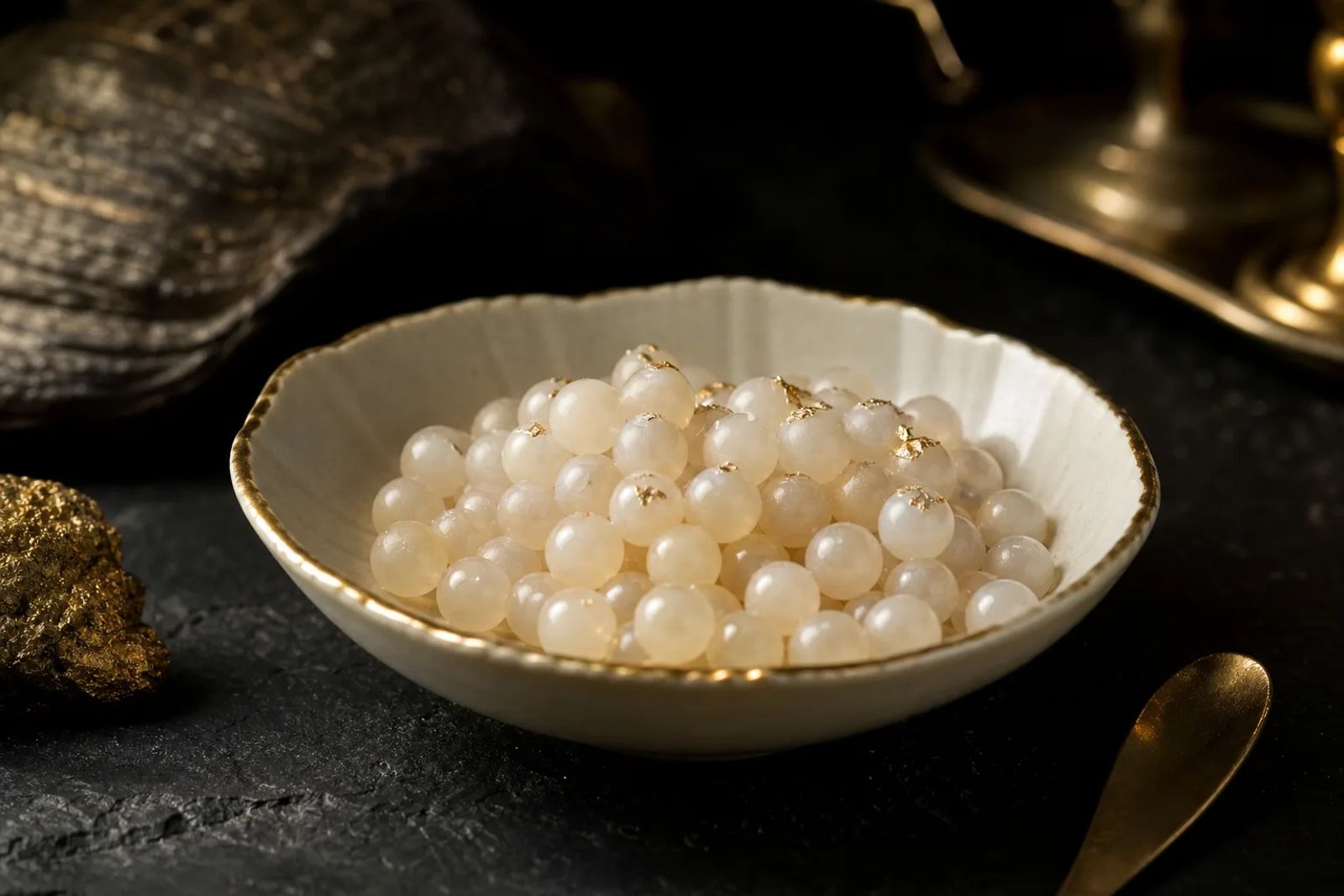
White beads collected after laying, cleaned and usually prepared with salt or brine: snail caviar comes from edible land snails, not fish. Also called escargot pearls, these eggs are a separate food with their own character, not a version of sturgeon caviar.
Which snails provide the eggs?
Commercial studies document eggs from the common garden snail, Cornu aspersum, formerly Helix aspersa. Production research uses Cornu aspersum aspersum and Cornu aspersum maxima for the smaller and larger farmed forms, respectively.
Snail farming is called heliciculture. Research in Poland sampled farmed eggs and their finished, jarred product, directly documenting the country’s production. A European production review also records snail-egg production in France, Italy and Chile. These are documented examples, rather than a current production ranking.
For the wider choice of ingredients, explore caviar alternatives and lookalikes or the substitutes comparison.
From the snail farm to the jar
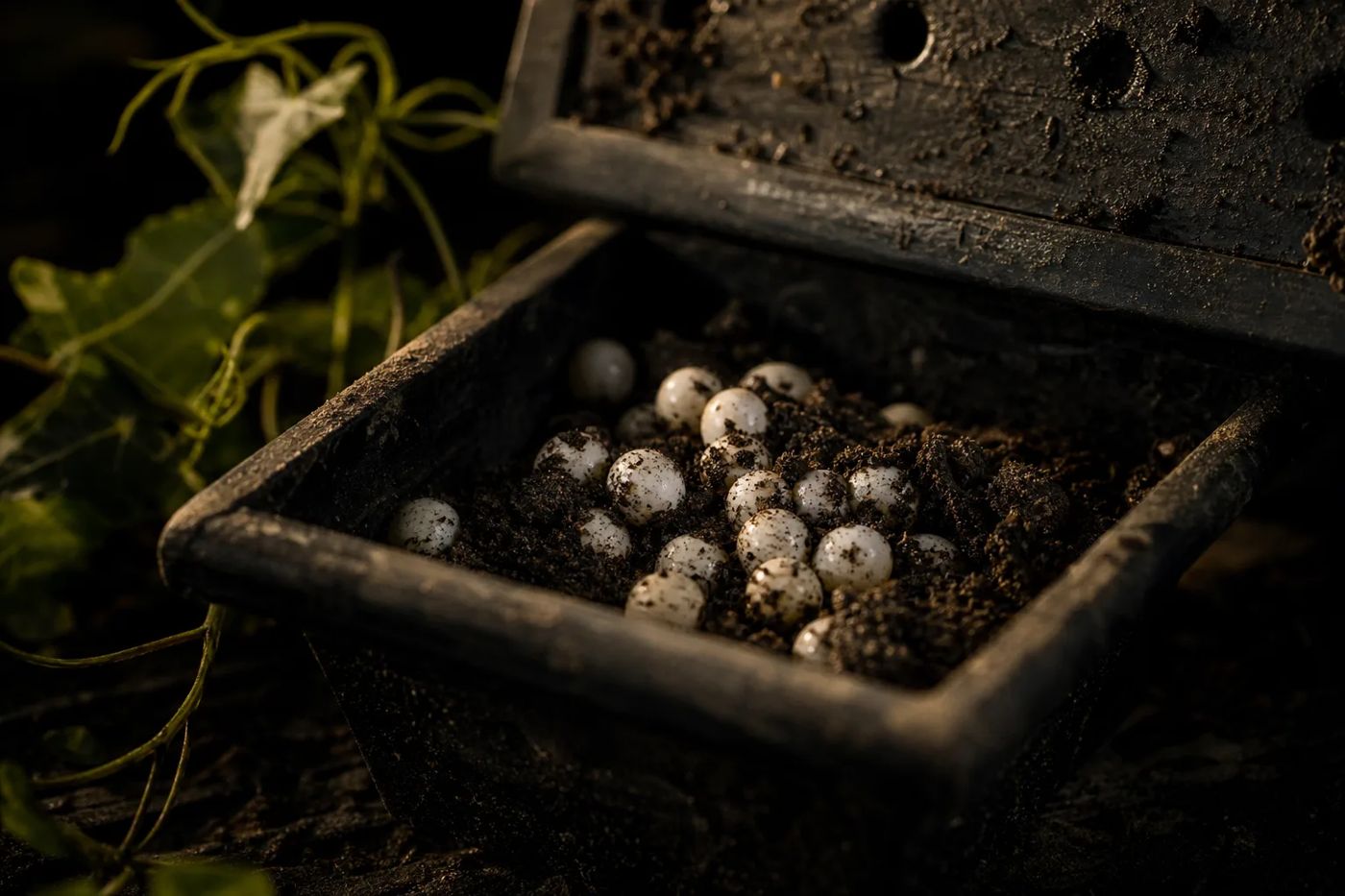
Farmers collect eggs that breeding snails have laid in soil-filled containers. They do not remove them from the animal. A Polish study describes the next steps: sorting the eggs by hand, then rinsing them repeatedly with cold water.
One Polish study describes a finished product containing 50 g of processed eggs in a small glass jar. Other published production descriptions include pasteurisation, salting and flavouring before packaging. The name “snail caviar” therefore tells you little about the precise process behind a particular jar.
Pasteurisation uses heat to reduce harmful microorganisms, with results that depend on the treatment. Neither pasteurisation nor packaging in a jar or brine automatically makes a product safe for room-temperature storage. Check whether the eggs are pasteurised, what has been added and how they must be stored.
What snail caviar tastes and feels like
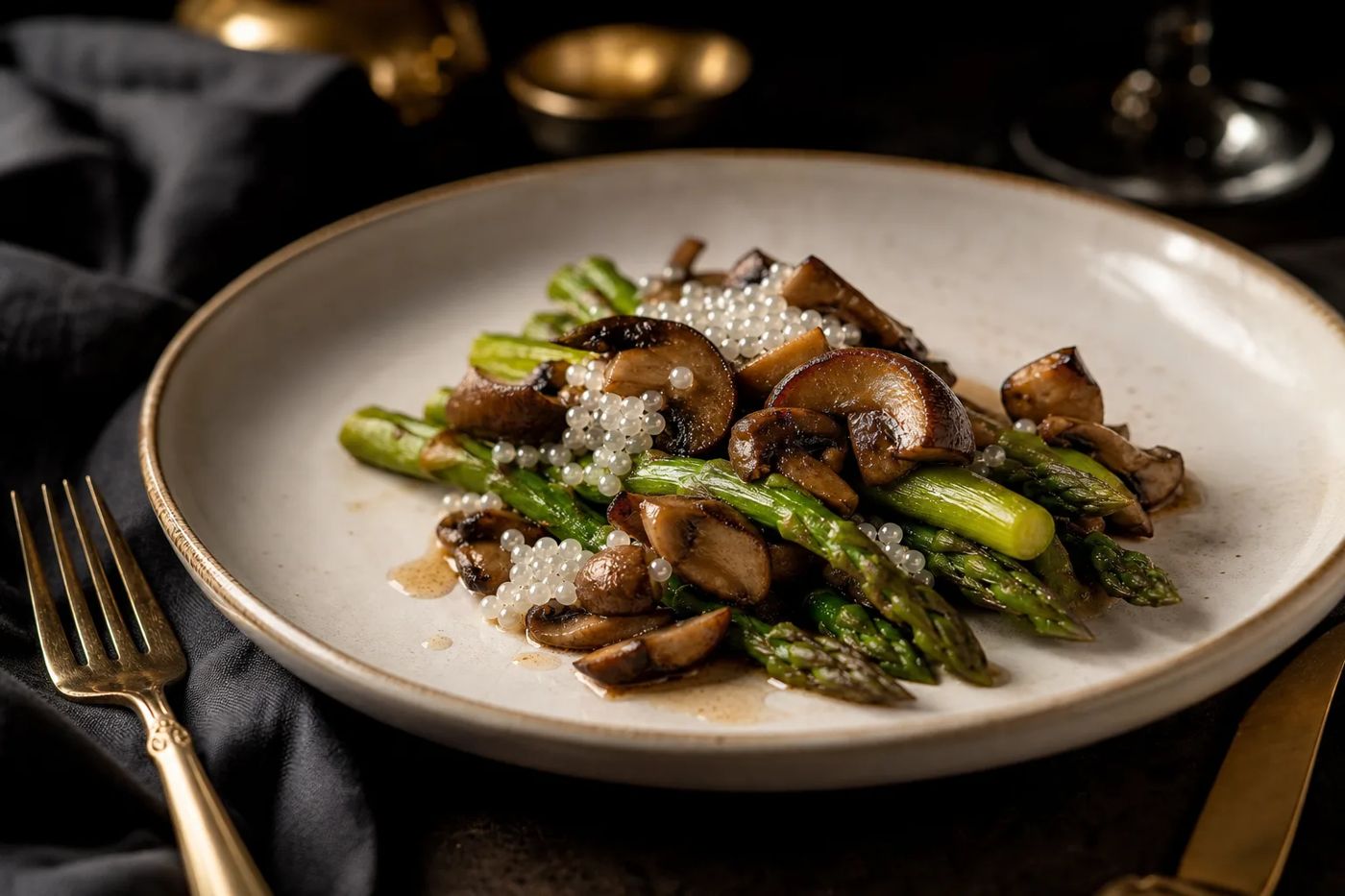
Mushroom and asparagus are chef Zacharie Ong’s reference points for snail eggs. In a Michelin Guide interview, he described earthy, woody flavours alongside pronounced texture and mouthfeel. These are his tasting notes, not a promise about every jar: processing and any added flavourings help explain how a particular product tastes.
Published descriptions give the eggs a diameter of 3 to 6 mm and a spherical, opaque, milky-white or pearlescent appearance. That is a reported range, rather than a specification for every finished product.
The wider farming cycle is another matter: the European production review also describes breeding snails being removed from breeding stock and sent for slaughter after a season.
Snail eggs differ from fish roe in origin, texture and reported flavour. Neither colour nor appearance alone can identify or authenticate them.
Can the label call it caviar?
“Snail eggs” is the clearest description. A phrase such as “escargot pearls” needs explaining so that it does not suggest fish roe. Retail naming is governed by food-information rules, rather than settled by a customs tariff category.
EU: Regulation (EU) No 1169/2011, Articles 7 and 17, requires information that does not mislead about a food’s nature, alongside an appropriate legal, customary or descriptive name. A fanciful name cannot replace the required food name. These general provisions do not specifically authorise “snail caviar”.
UK: Great Britain applies its assimilated, amended version of Regulation 1169/2011; Northern Ireland generally follows the EU regulation. A marketing phrase does not remove the obligation to identify the food accurately and without misleading consumers.
US: FDA’s nonbinding CPG Sec. 540.150 says unqualified “caviar” applies to sturgeon roe. Other fish eggs need the fish name in substantially the same size and prominence, and added colour must be declared. This guidance does not establish permission for snail eggs. Under 21 CFR 102.5, a common or usual name must accurately describe the food and avoid confusion with another.
Who should avoid it?
Anyone with a known snail or mollusc allergy should avoid snail eggs unless their allergy specialist has advised otherwise. Their different origin from fish roe does not make them a safe substitute for someone with food allergies. Fish allergy and caviar explains why the animal source matters.
In the EU, Annex II of Regulation 1169/2011 lists molluscs and products thereof. Article 21 sets allergen declaration requirements, including emphasis in the ingredients list. UK guidance likewise includes land snails among molluscs, under assimilated law in Great Britain and EU law in Northern Ireland.
In the US, molluscs are not among the nine statutory major food allergens, unlike fish and crustacean shellfish. Ordinary ingredient naming still matters. The absence of a “Contains” warning does not mean a food is free of snail ingredients or safe for a mollusc-allergic person.
Food safety and storage
A Polish study detected Listeria monocytogenes in finished snail-egg caviar samples. The researchers examined raw eggs, intermediate products and finished caviar using culture-based testing and PCR confirmation. The finding makes hygiene and validated processing essential: cleaning and salting alone cannot establish microbiological safety.
Follow the product’s storage temperature, use-by date and instructions after opening. UK FSA household guidance recommends a fridge at 0 to 5°C (32 to 41°F); US FDA guidance recommends 4°C (40°F) or below. If the product requires colder storage, follow its instructions.
Use clean utensils, keep the eggs away from raw-food contamination and return chilled products promptly to the fridge. A pleasant smell or intact appearance cannot establish safety. If you are pregnant or immunocompromised and unsure about a ready-to-eat product’s processing, ask your doctor or midwife before eating it.
Welfare and environmental claims
Collecting laid eggs does not itself require killing the parent snail. The wider farming cycle is another matter: the European production review also describes breeding snails being removed from breeding stock and sent for slaughter after a season. Egg collection alone therefore says little about welfare across the whole farm.
“Farmed” is equally insufficient as an environmental claim. Look for evidence about the egg-production system: what was measured, which life stages and processing steps were included, and what it was compared with. The cited sources do not establish that snail eggs are universally more sustainable than fish roe.
Sources
-
University of Florida, IFAS Extension. Brown Garden Snail, Cornu aspersum (Müller, 1774) (Gastropoda: Helicidae). Publication EENY240/IN396, web edition checked 2026.
https://ask.ifas.ufl.edu/publication/IN396 -
Maćkowiak-Dryka, M., Szkucik, K. and Pyz-Łukasik, R.; Journal of Veterinary Research. Snail Eggs as a Raw Material for the Production of a Caviar Substitute. Volume 64, issue 4, 2020, pages 543 to 547.
https://pmc.ncbi.nlm.nih.gov/articles/PMC7734689/ -
Maćkowiak-Dryka, M., Szkucik, K., Ziomek, M. and Klimek, K.; Journal of Veterinary Research. Fatty acid profile in edible eggs of snails from the Cornu genus. Volume 64, 2020, pages 137 to 140.
https://www.sciendo.com/pdf/10.2478/jvetres-2020-0005 -
Animals, published by MDPI. Edible Snail Production in Europe. Review article, 2022.
https://pmc.ncbi.nlm.nih.gov/articles/PMC9597773/ -
Tan, R.; Michelin Guide. Ingredient Spotlight: Snails. Interview feature, 25 February 2019. Used only for chef-attributed sensory descriptions.
https://guide.michelin.com/us/en/article/features/ingredient-snails-escargot -
European Parliament and Council. Regulation (EU) No 1169/2011 on the provision of food information to consumers. Adopted text, 2011, Articles 7, 17 and 21 and Annex II.
https://www.legislation.gov.uk/eur/2011/1169/pdfs/eur_20111169_adopted_en.pdf -
Food Standards Agency. Packaging and labelling. Web guidance updated 4 September 2026.
https://www.gov.uk/government/publications/packaging-and-labelling/packaging-and-labelling -
US Food and Drug Administration. CPG Sec. 540.150 Caviar, Use of Term: Labeling. October 1989 edition, current web publication checked 2026.
https://www.fda.gov/regulatory-information/search-fda-guidance-documents/cpg-sec-540150-caviar-use-term-labeling -
Electronic Code of Federal Regulations. 21 CFR 102.5: General principles. Current electronic edition checked 2026.
https://www.ecfr.gov/current/title-21/chapter-I/subchapter-B/part-102/subpart-A/section-102.5 -
Food Standards Agency. Food allergen labelling and information requirements technical guidance. Current web edition checked 2026; and GOV.UK, Understanding food labelling: Allergen labelling, current web edition checked 2026.
https://www.gov.uk/government/publications/food-allergen-labelling-and-information-requirements-technical-guidance/food-allergen-labelling-and-information-requirements-technical-guidance
https://www.gov.uk/understanding-food-labelling/allergen-labelling -
US Food and Drug Administration. Questions and Answers Regarding Food Allergens, Including the Food Allergen Labeling Requirements of the Federal Food, Drug, and Cosmetic Act. Guidance for industry, Edition 5, 2025, question B.9; and Food Allergies, current web edition checked 2026.
https://www.fda.gov/media/117410/download
https://www.fda.gov/food/nutrition-food-labeling-and-critical-foods/food-allergies -
Journal of Veterinary Research. Occurrence of Selected Pathogenic Microorganisms in Raw and Processed Eggs of Snails of The Cornu Genus. Research article, 2021.
https://pmc.ncbi.nlm.nih.gov/articles/PMC8775735/ -
Food Standards Agency. How to chill, freeze and defrost food safely. Web edition checked 2026; and Food poisoning, web edition checked 2026.
https://www.gov.uk/government/publications/how-to-chill-freeze-and-defrost-food-safely/how-to-chill-freeze-and-defrost-food-safely
https://www.food.gov.uk/food-safety-and-hygiene/food-poisoning -
US Food and Drug Administration. Refrigerator Thermometers: Cold Facts about Food Safety. Web edition checked 2026.
https://www.fda.gov/food/buy-store-serve-safe-food/refrigerator-thermometers-cold-facts-about-food-safety
The piece was researched using snail-production studies, a production review, a chef interview, food-information legislation and official allergen and food-safety guidance.
Last checked: November 2026