
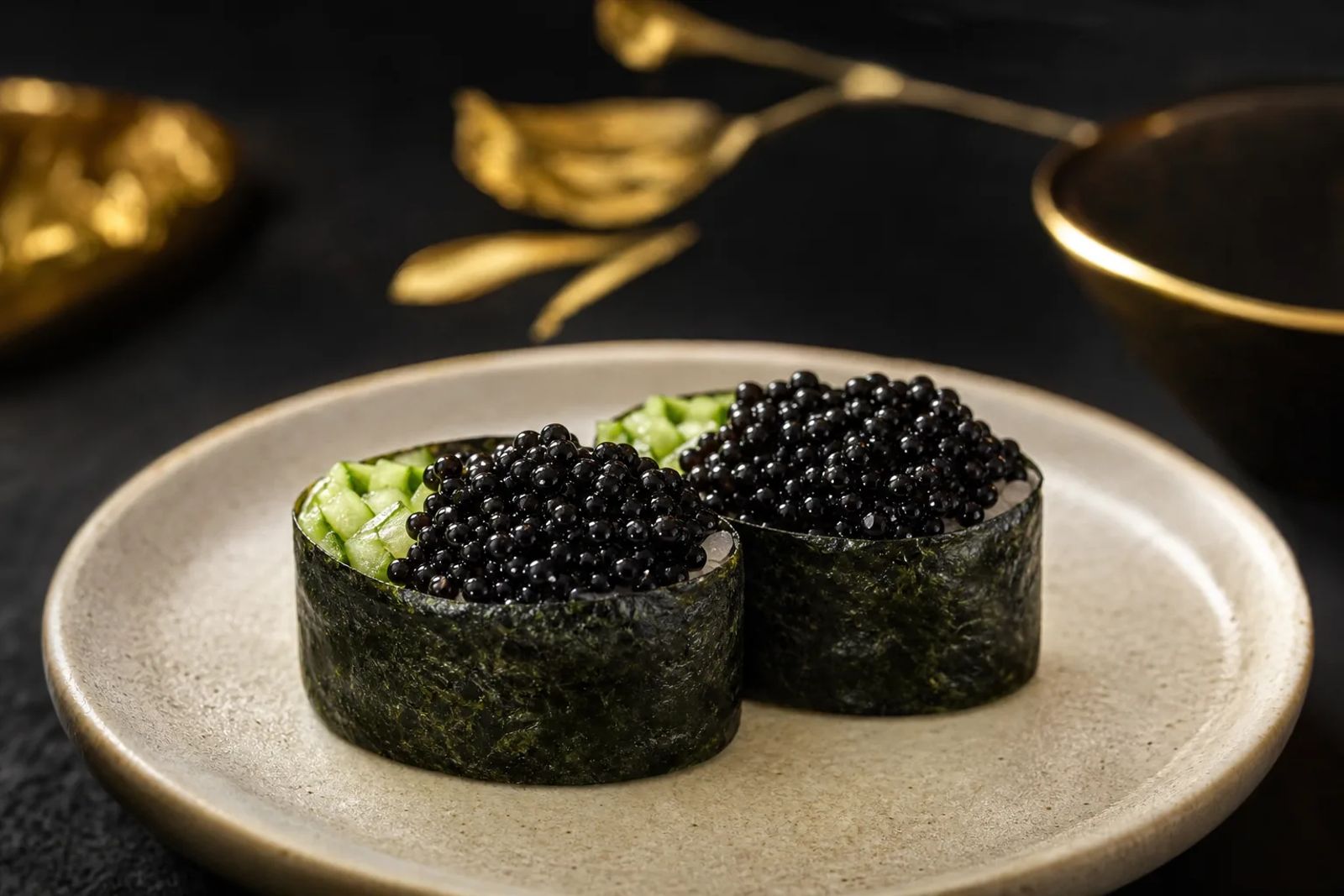
Gunkan means “battleship”. Its wall of dried nori rises above a small oval of rice, holding loose roe in place without crushing it. Spoon chilled caviar into that collar and serve it straight away, with the topping intact.
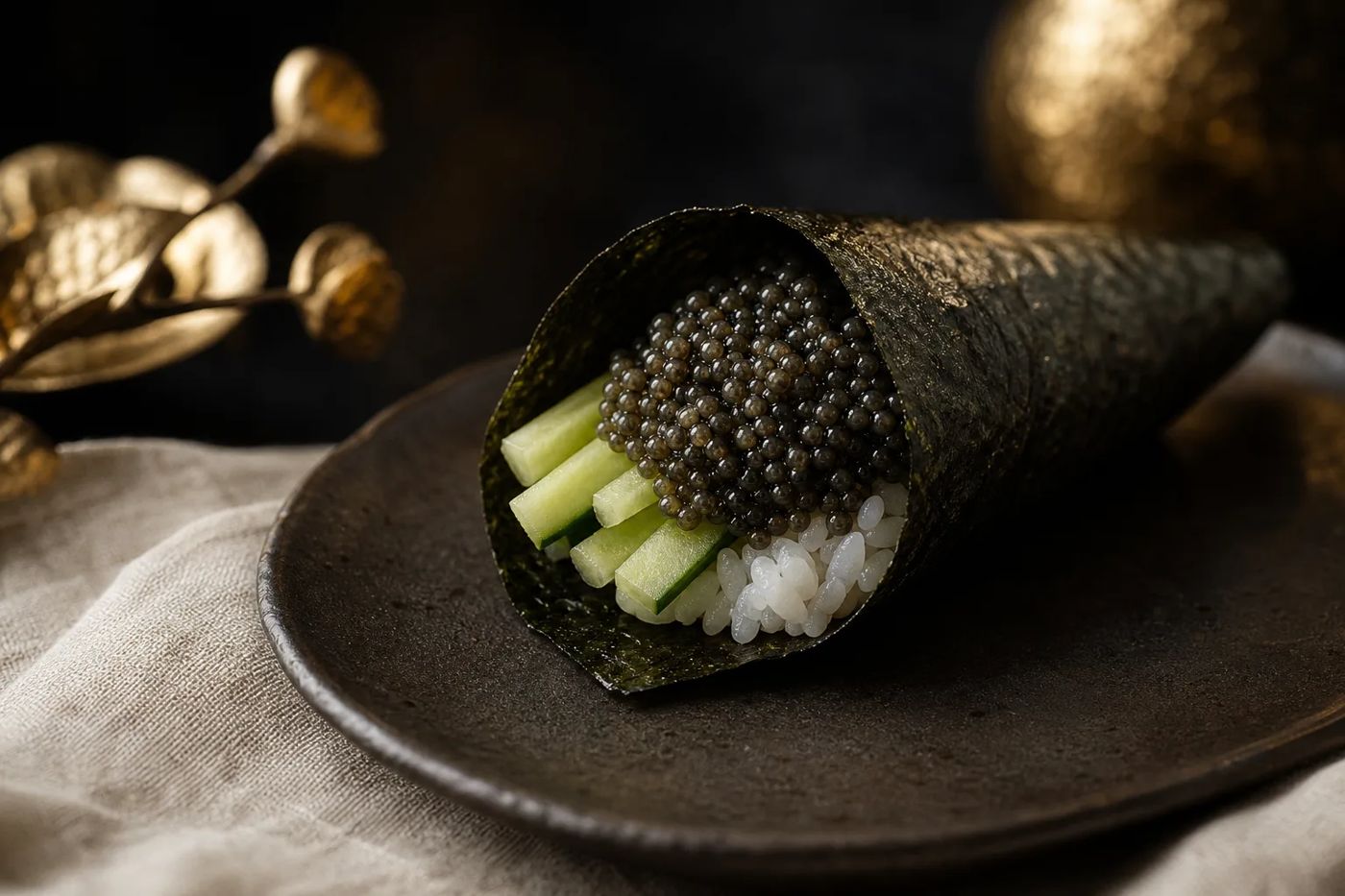
Gunkan maki and temaki, cones rolled by hand, are the best formats for the job. Start with seasoned Japanese short-grain rice, cool it promptly and spoon on chilled caviar just before eating.
Why these caviar sushi formats work
Neither format asks you to spread caviar across a mat or cut through it with a knife. The nori collar contains the topping on gunkan; a temaki cone gathers rice and fillings beneath an open mouth, ready for a spoonful of roe.
Just One Cookbook’s sushi guide, by Reese Lee, lists ikura, salmon roe, and tobiko, flying fish roe, among typical gunkan toppings. Sturgeon caviar is a distinct ingredient.
Recipe: cucumber and caviar gunkan
The 6 g caviar portion follows MayaBay’s published menu allowance of 12 g for two gunkan; its separate hand roll portion is 12 g. This editorial adaptation of Chen’s rice method and Japanese gunkan techniques has not been tested by this site. Find more small dishes in caviar recipes.
- Serves: 4 as a starter, two gunkan each.
- Caviar: 48 g total, or 12 g per person.
- Time: Chen’s rice recipe allows 1 hour 30 minutes, including soaking and cooking, before assembly.
- Equipment: rice cooker, sieve, wide bowl or tray, rice paddle, clean scissors, scales and a small spoon.
- Allergens: fish. For soy sauce, check for soya and wheat; check wasabi and vinegar labels too.
Ingredients
- 150 g uncooked Japanese short-grain white rice.
- 180 ml water, plus water for washing.
- 30 ml seasoned rice vinegar, containing sugar and salt.
- 48 g salted Siberian sturgeon (Acipenser baerii) caviar.
- 2 sheets toasted nori.
- 8 thin cucumber slices.
- Soy sauce and wasabi, optional, served separately.
Make the rice
-
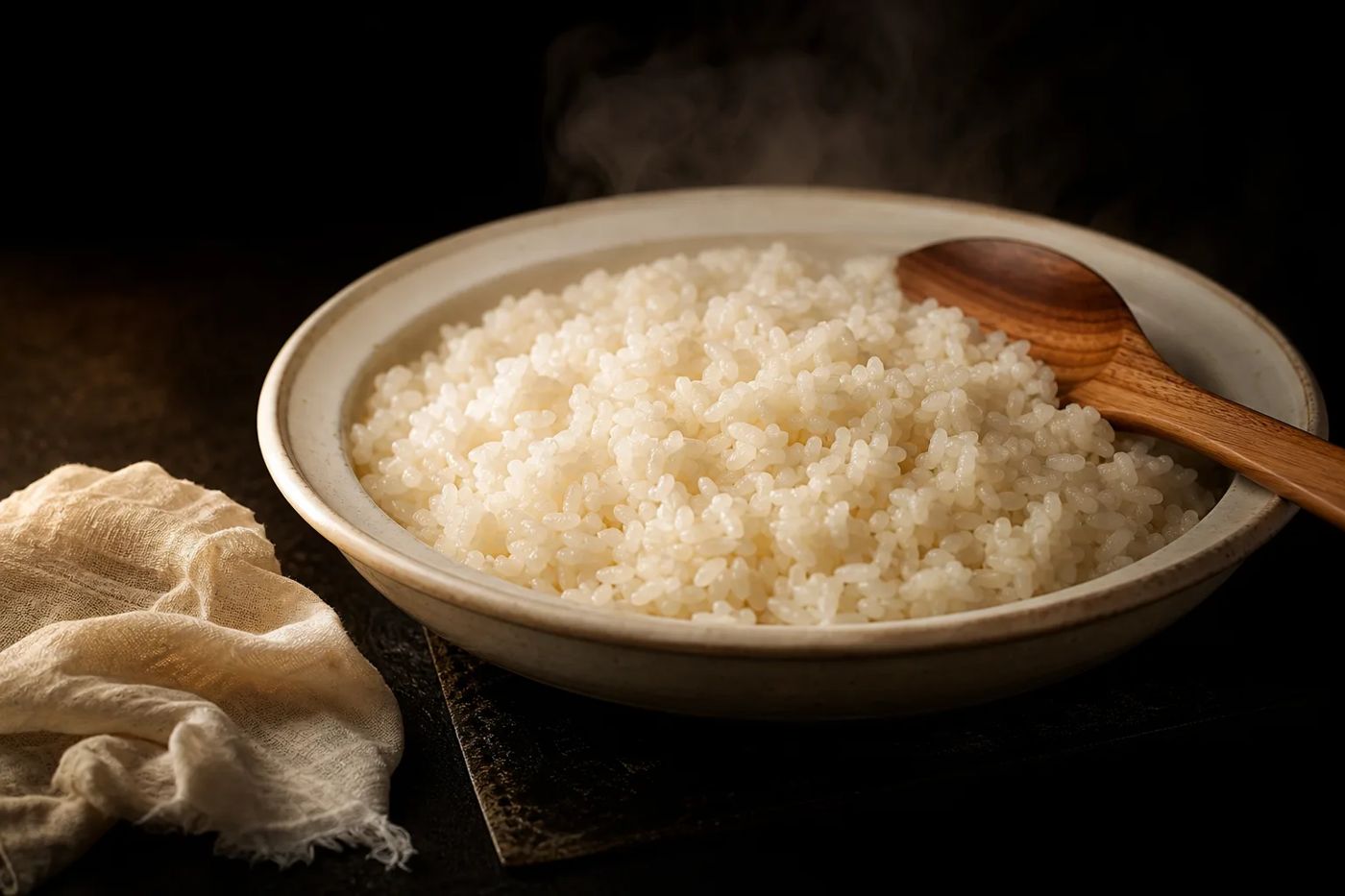
Rinse the rice several times until the water is almost clear, then drain well. Put it in the cooker with 180 ml water. Soak for 20 to 30 minutes, then cook on the appropriate rice setting.
-
Transfer the hot rice to a wide, lightly moistened bowl or tray. Add the seasoned vinegar. Cut and fold it through the grains with the paddle while fanning, without mashing or stirring vigorously.
-
For immediate assembly, keep cooling until the rice is no longer hot. Cover it with a clean damp cloth during this brief working period. For rice you are not using immediately, follow the holding guidance below.
Shape and fill the gunkan
-
Weigh out eight 20 g portions of seasoned rice. Lightly dampen your hands and shape each portion into a small oval, without squeezing hard. Refrigerate the unused rice promptly; do not leave the whole batch on the table.
-
Cut nori strips wide enough to stand above the rice. Wrap one around each oval, overlapping the ends. Press a grain of rice onto the overlap to hold it closed.
-
Set a cucumber slice inside each collar and spoon 6 g caviar alongside it. Serve each small batch straight away. Keep the remaining caviar refrigerated according to its producer’s instructions.
Keep the nori sealed and dry until needed. Moisture softens the seaweed: Chen advises making hand rolls immediately before eating, and the same principle applies to the gunkan collar.
How to make caviar hand rolls
For four temaki, divide the same 48 g caviar into 12 g per cone. Halve each nori sheet and keep the rice layer modest, leaving room for cucumber and caviar. There is no need to use every grain of the batch.
-
With dry hands, hold a half sheet in your palm, rough side upwards. Spread rice across its left third.
-
Lay cucumber sticks diagonally across the rice. Bring the bottom left corner over the filling, then roll the remaining nori around it to form a cone.
-
Seal the loose corner with a grain of rice. Spoon caviar into the open top and eat immediately, rather than standing the cones on a platter.
Cucumber is the simplest starting point. Kikkoman uses cucumber and caviar to garnish its smoked salmon and cream cheese gunkan, while Chen’s temaki selection includes cucumber, tuna, salmon and ikura. Raw fish is optional here. If adding it, use fish supplied for raw consumption and prepare it separately from the other ingredients.
Just One Cookbook’s sushi guide recommends using soy sauce sparingly, so it does not overpower the fish and rice, and keeping wasabi out of the sauce. Taste one piece, then decide whether either condiment is needed. Leave the caviar undressed.
Raw fish: arrange parasite control before slicing
Supplier checks: ask which parasite treatment the fish has received, or which documented exemption applies. A domestic freezer cannot be assumed to deliver a commercial process. The freezing guidance here concerns optional raw fish; check local rules for salted roe. Freezing cannot eliminate all harmful bacteria.
- EU: Regulation 853/2004 covers raw or insufficiently treated finfish and cephalopods, subject to exemptions. For parasites other than trematodes, freeze throughout at -20°C for at least 24 hours or -35°C for at least 15 hours.
- UK: FSA guidance for England, Wales and Northern Ireland and Food Standards Scotland guidance give the same treatments. These are business requirements, rather than instructions for a domestic freezer.
- US: The 2026 FDA model code specifies seven days at -20°C or alternative processes at -35°C. Where adopted, exemptions include specified tuna, qualifying farmed fish and roe removed from the skein and rinsed.
- Japan: MHLW advises freezing at -20°C (-4°F) for at least 24 hours against Anisakis. This is public health advice rather than a universal Japanese freezing law.
- Australia and New Zealand: FSANZ consumer advice recommends buying sashimi grade fish from a reputable supplier and says freezing for at least seven days kills parasites. Have the supplier confirm treatment; this advice does not provide a complete home-freezer specification.
The FDA advises pregnant people, children, older adults and people with weakened immunity to avoid raw seafood.
Cooked rice and the serving clock
Vinegar seasons rice. It does not, by itself, make room-temperature storage safe. Bacillus cereus spores can survive cooking, and bacteria can grow as rice cools slowly. FSANZ says acidifying rice to pH 4.6 or lower inhibits pathogens, but the fillings are not acidified to pH 4.6 or lower, so sushi remains potentially hazardous. Toppings also make the finished sushi perishable.
At home, make rice for the meal, cool it promptly and assemble small batches. Do not leave a large bowl out for guests to use all evening. Commercial acidification requires a validated process and checks: a sour taste, or vinegar in the recipe, is not enough.
Rice cooling and storage: UK FSA advice is to chill leftover rice as quickly as possible, ideally within one hour, and use refrigerated rice within 24 hours. Divide it into small portions rather than leaving it to cool in the cooker.
The 2026 FDA model code normally requires cooling from 57°C to 21°C within two hours, then to 5°C within six hours total. Section 3-501.15(C) allows an approved alternative. The code’s controlled time-only holding procedures do not give households a general allowance to leave rice out.
Japan’s Tokyo Metropolitan Government advises against keeping large batches of cooked rice for long periods. It recommends immediate storage in small portions at 8°C (46°F) or below, a different published target from the colder one used by the FDA.
Time outside refrigeration: FSANZ counts time between 5°C and 60°C for potentially hazardous food. Refrigerate before two hours, use immediately from two to under four hours, and discard at four hours. Cooling rules are separate. Australia’s Chapter 3 business standards apply to Australia, not as New Zealand law.
Finished sushi at home: follow the FDA’s consumer limit for this recipe: no more than two hours unrefrigerated, reduced to one hour above 32°C (90°F). Count preparation and serving time together and follow any stricter instructions on the caviar. These are maximum limits; serve as soon as the sushi is made.
Keep fish and caviar refrigerated at 4°C (40°F) or below, or colder if the caviar label requires it. Rice can be briefly warmer for assembly, but that is not a storage temperature.
Sources
-
Namiko Hirasawa Chen, Just One Cookbook. How to Make Sushi Rice, revision dated 31 October 2026. Rice type, proportions, seasoned-vinegar substitution, washing, soaking, seasoning and cooling. Source.
-
Namiko Hirasawa Chen, Just One Cookbook. Temaki Sushi (Hand Roll), online edition retrieved November 2026. Hand-rolling method, filling suggestions and immediate assembly. Source.
-
Reese Lee, Just One Cookbook. Ultimate Sushi Guide: Sushi Types, Recipes & Etiquette*, online edition retrieved November 2026. Gunkan description, customary roe toppings and condiment advice. Source.
-
Kikkoman UK. Japanese Gunkan Maki Recipe, recipe UK17, undated online edition. Attributed caviar and cucumber combination. Source.
-
Zojirushi. Gunkan-maki Sushi, undated online recipe, indexed text retrieved November 2026. Rice shaping, nori wrapping and rice-grain seal. Source.
-
MayaBay, Jumeirah Al Naseem. À la carte menu, undated PDF retrieved November 2026. Caviar quantities for two gunkan and one temaki. Menu.
-
European Union. Regulation (EC) No 853/2004, consolidated text dated 7 May 2026, Annex III, Section VIII, Chapter III, Part D. Parasite controls and exemptions. Source.
-
Food Standards Agency. Freezing fish, fishery products and treatment for parasites, 2018, current online guidance retrieved November 2026. Source.
-
Food Standards Scotland. Freezing fish and fishery products, current online guidance retrieved November 2026. Business scope and parasite controls. Source.
-
US Food and Drug Administration. Food Code 2026, sections 3-402.11, 3-501.14, 3-501.16 and 3-501.19. Model business provisions for freezing, cooling and holding. Source.
-
US Food and Drug Administration. Selecting and Serving Fresh and Frozen Seafood Safely, current online edition retrieved November 2026. Consumer refrigeration, serving limits and vulnerable groups. Source.
-
Japan Ministry of Health, Labour and Welfare. Prevent food poisoning caused by Anisakis, current Japanese-language guidance retrieved November 2026. Source.
-
Food Standards Agency. Home food fact checker, current online edition retrieved November 2026, rice section. Source.
-
Food Standards Australia New Zealand. Raw fish dishes, current online edition retrieved November 2026. Supplier selection, parasite-control advice and limitations of freezing. Source.
-
Food Standards Australia New Zealand. Safe Food Australia, fourth edition, February 2023, Appendix 4, “Sushi”. Acidification, contamination and temperature control. Source.
-
Food Standards Australia New Zealand. 2-hour / 4-hour rule, current online edition retrieved November 2026. Cumulative holding time and distinction from cooling requirements. Source.
-
Tokyo Metropolitan Government, Bureau of Public Health. Bacillus cereus, undated English-language guidance retrieved November 2026. Cooked cereal storage advice. Source.
The piece combines attributed Japanese cooking methods with official food-safety guidance; the assembled recipe is an editorial adaptation and has not been tested by the site.
Last checked: November 2026