
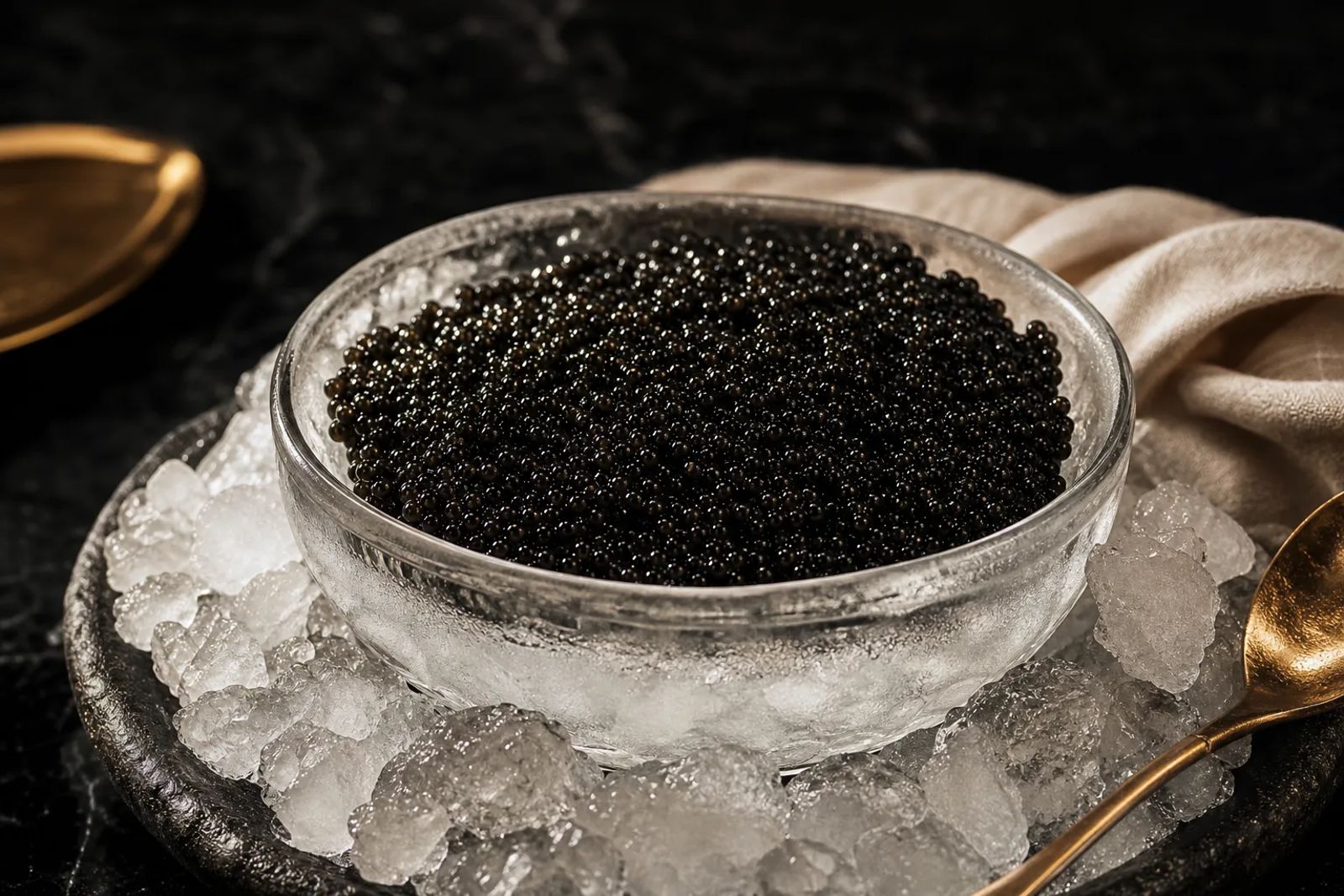
A tin nestled in crushed ice, a clean spoon, the first mouthful plain: caviar needs very little ceremony. Leave the eggs undisturbed and let guests try them before reaching for the accompaniments. The pleasure is in the caviar, not an elaborate performance.
Keep the caviar refrigerated while you prepare the table. Open it gently, offer clean spoons and simple accompaniments, and return any safely handled remainder promptly to the fridge, following the instructions on your tin.
How to serve caviar, step by step
- Read the tin before planning the service
Start with the use-by date, storage temperature and instructions for use after opening. Petrossian's current FAQ specifies 0 to 4°C (32 to 39°F) for its unopened caviar. Follow the label on your own tin if its producer gives different instructions.
Next, decide whether caviar will be the main event or a garnish. Petrossian suggests 15 to 20 g per person for a tasting on its own. This is a serving convention rather than a food standard; the portion guide covers other occasions.
Let a small tin shape the occasion rather than stretching it across a large plate. A spoon tasting and a canapé service offer different pleasures. Choose which you want, then set out only the accompaniments you intend to serve. Give the caviar room to be the focus.
- Set the table while the caviar stays cold
Have everything ready before the tin leaves the fridge: a shallow outer dish for crushed ice, the tin or an inner serving bowl, a caviar key, clean serving spoons and small plates. If transferring the eggs, chill the receiving bowl first. Great British Chefs recommends a cold bowl set over ice.
Arrange the accompaniments and pour the drinks now. Give each accompaniment its own serving utensil, keeping butter, crumbs and cream out of the eggs. Leave space around the ice dish so guests can help themselves without reaching across hot food.
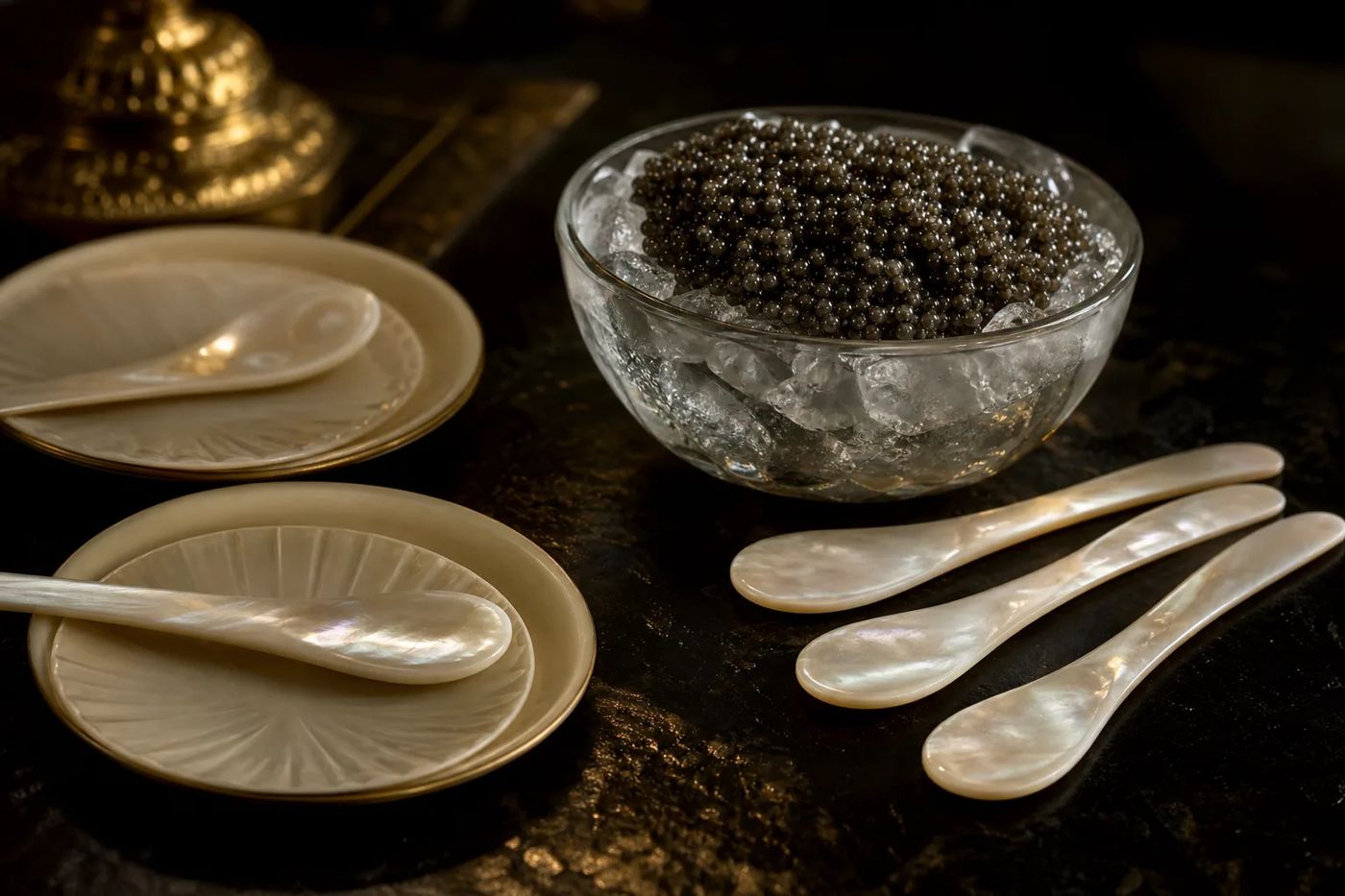
For a shared service, put a clean serving spoon beside the caviar and give each diner a separate eating spoon. Explain the arrangement at the start, particularly to first-time guests. A spoon that has touched someone's mouth should never return to the communal tin or bowl.
- Bring it out when the table is ready
There is no universal warming time for every tin. Petrossian's French serving guide says tins up to 125 g (about 4.4 oz) need only the time taken to remove them from the fridge, open them and present them. For tins of 250 g (about 8.8 oz) or more, it recommends taking them out 10 minutes before tasting.
The same guide recommends a tasting temperature of 8 to 9°C (46 to 48°F). Keep that sensory preference separate from safe holding: the US FDA's buffet guidance calls for cold food to remain at 40°F (4.4°C) or colder.
Keep the main supply cold rather than warming the whole tin to a tasting target. The guide to temperature and ice service explains how tasting temperature and cold holding fit together.
- Open the tin gently
Work at the rim, not among the eggs. First wipe the outside of the tin and check that the opening tool is clean. For a vacuum-sealed tin of the type shown in Petrossian's instructions, slip a caviar key under the lid's rim and lever gently to release the seal.
Lift the lid clear without dragging it through the surface. Leave the eggs undisturbed: do not stir them or press them to loosen them. Nor should you force an unfamiliar closure with a sharp knife. Tin designs differ, so use the opening guide for the type in front of you.
- Serve from the tin or a chilled bowl
The original tin is the simplest serving vessel. There is no transfer, and the product information stays beside the caviar. Nest it securely in crushed ice, with the rim above the meltwater. Petrossian recommends serving directly from the tin; a separate chilled glass bowl also suits a shared table.
If using a bowl, transfer only what you intend to offer. Lift the eggs gently with a clean spoon rather than packing them down. Set the bowl securely in ice and keep the water away from the caviar.
- Choose a suitable spoon, not a ritual
Mother-of-pearl, horn, glass and food-safe plastic are straightforward choices. Scoop gently, without smearing the beads against the side of the tin or bowl.
The International Wine & Food Society's Sid Cross advises avoiding active metals because of concerns about tarnish, oxidation and interference with flavour. This is culinary advice, not a quantified finding from a controlled caviar tasting experiment.
Stainless steel need not be banished from the table: Petrossian explicitly accepts it while advising against silver. A non-reactive spoon makes the choice simple. For the reasoning behind the tradition and the evidence, see the silver spoon explanation.
- Let accompaniments and drinks play a supporting role
Make the first mouthful plain. Then offer blinis, lightly buttered bread or plain boiled potatoes, with a little sour cream for anyone who wants it. Great British Chefs describes these established accompaniments; choose what suits the occasion rather than feeling obliged to provide them all.
Keep strongly flavoured garnishes separate. Guests can add them to their own portions without seasoning the whole tin for everyone. The serving guides offer other ways to build the plate.
Let a small tin shape the occasion rather than stretching it across a large plate.
Champagne and chilled vodka are conventional partners recommended by Great British Chefs; neither is necessary. Plain water deserves a place too, especially at a first tasting, so nobody needs alcohol to take part. Put drinks within easy reach before opening the tin, leaving guests free to concentrate on tasting the caviar.
- Keep each caviar distinct in a tasting
Start with the mildest and move towards the most intense. London Caviar Company recommends this order for a side-by-side tasting. Choose the sequence from the descriptions of the actual tins, or ask their supplier for advice, rather than treating species as a fixed ranking.
Give every caviar its own spoon and its own place on the ice. Keep each lid or other product information beside the corresponding dish, so guests can follow what they are tasting. Compare the caviars without garnishes first, and use the same order for everyone. The pleasure lies in noticing differences, not declaring a winner.
Plan quantities across the whole tasting rather than treating every tin as a separate course. Leave any reserve you do not need immediately in the fridge, then bring out another cold dish when required. This small-batch approach follows the FDA's buffet guidance and keeps the table manageable.
- Put leftovers away before clearing the table
Deal with the caviar first, not after the plates. Separate anything suitable to keep from food already spread on bread or mixed with garnishes. Close the original container, or cover the clean serving container, and refrigerate promptly. Never pour a partly served dish back into an untouched reserve.
Follow the maker's after-opening instructions: the unopened use-by date no longer tells the whole story. Petrossian says to consume its opened caviar within 24 hours, refrigerated, and advises against freezing because it changes the texture. Those instructions apply to its products; other preparations may have different requirements.
Mark the opening time if it is not already clear, and decide when you will use the remainder before putting it away. The home storage guidance covers refrigerator placement, closures and opened tins. A pleasant smell or an intact-looking surface cannot establish that caviar is safe to eat.
A brief food safety check
Keep the service clean, cold and timed. The US FDA advice followed here calls for clean hands and utensils, and for perishable food to be discarded after more than 2 hours at room temperature, or 1 hour above 32°C (90°F).
Add together all the time spent at room temperature during preparation, service and clearing up. Returning the tin to the fridge does not restart the clock. Time held at 40°F (4.4°C) or below counts as cold holding, not room temperature time.
Refrigeration has limits. Hong Kong's Centre for Food Safety notes that Listeria can survive and multiply at refrigerator temperatures. The US FDA identifies pregnant people, children, older adults and people with weakened immunity as groups at higher risk of foodborne illness, and advises them to avoid raw or undercooked seafood.
Readers in the UK, EU and elsewhere should check their national food safety authority's advice for the particular roe product, and ask a doctor or midwife if unsure. Check the caviar and every accompaniment for fish allergy concerns too. The hygiene and service guide sets out the fuller precautions.
Sources
-
Petrossian. Frequently Asked Questions. Undated live web edition, consulted November 2026. Seller guidance on portions, refrigeration, opening, serving utensils and use after opening. Source page.
-
Petrossian. À quelle température servir le caviar ? Undated live web edition, consulted November 2026. Seller recommendations for tasting temperature and preparation time by tin size. Source page.
-
US Food and Drug Administration. Serving Up Safe Buffets. Live consumer guidance, consulted November 2026. Cold holding, small batches, replacement dishes and room-temperature time limits. Source page.
-
Great British Chefs. What to Serve with Caviar. 14 February 2025 web edition. Chilled bowls over ice, accompaniments and conventional drinks pairings. Source page.
-
International Wine & Food Society. Ask Sid: What's the Best Serving Utensil for Caviar? 12 November 2014. Sid Cross's culinary advice on spoon materials and active metals. Source page.
-
London Caviar Company. Caviar FAQs: Varieties, Sourcing & Serving. Undated live web edition, consulted November 2026. Used only for its attributed tasting-order recommendation. Source page.
-
US Food and Drug Administration. Selecting and Serving Fresh and Frozen Seafood Safely. Live consumer guidance, consulted November 2026. Clean handling and advice for groups at greater risk of foodborne illness. Source page.
-
US Food and Drug Administration. Food Allergies: What You Need to Know. Live consumer guidance, consulted November 2026. Fish and other major food allergens, label checking and avoidance. Source page.
-
US Food and Drug Administration. Refrigerator Thermometers: Cold Facts about Food Safety. Live consumer guidance, consulted November 2026. Refrigeration and the distinction between apparent quality and safety. Source page.
-
Hong Kong Centre for Food Safety, Food and Environmental Hygiene Department. CFS Urges Public Not to Consume Batch of Prepackaged Caviar Suspected to Be Contaminated with Listeria monocytogenes. 5 May 2023. Used for the authority's general statement about Listeria at refrigerator temperatures, not as evidence about sturgeon caviar specifically. Source page.
The piece was researched using national food safety guidance, attributed culinary advice and Petrossian's handling instructions, with tasting conventions kept separate from safety requirements.
Last checked: November 2026