
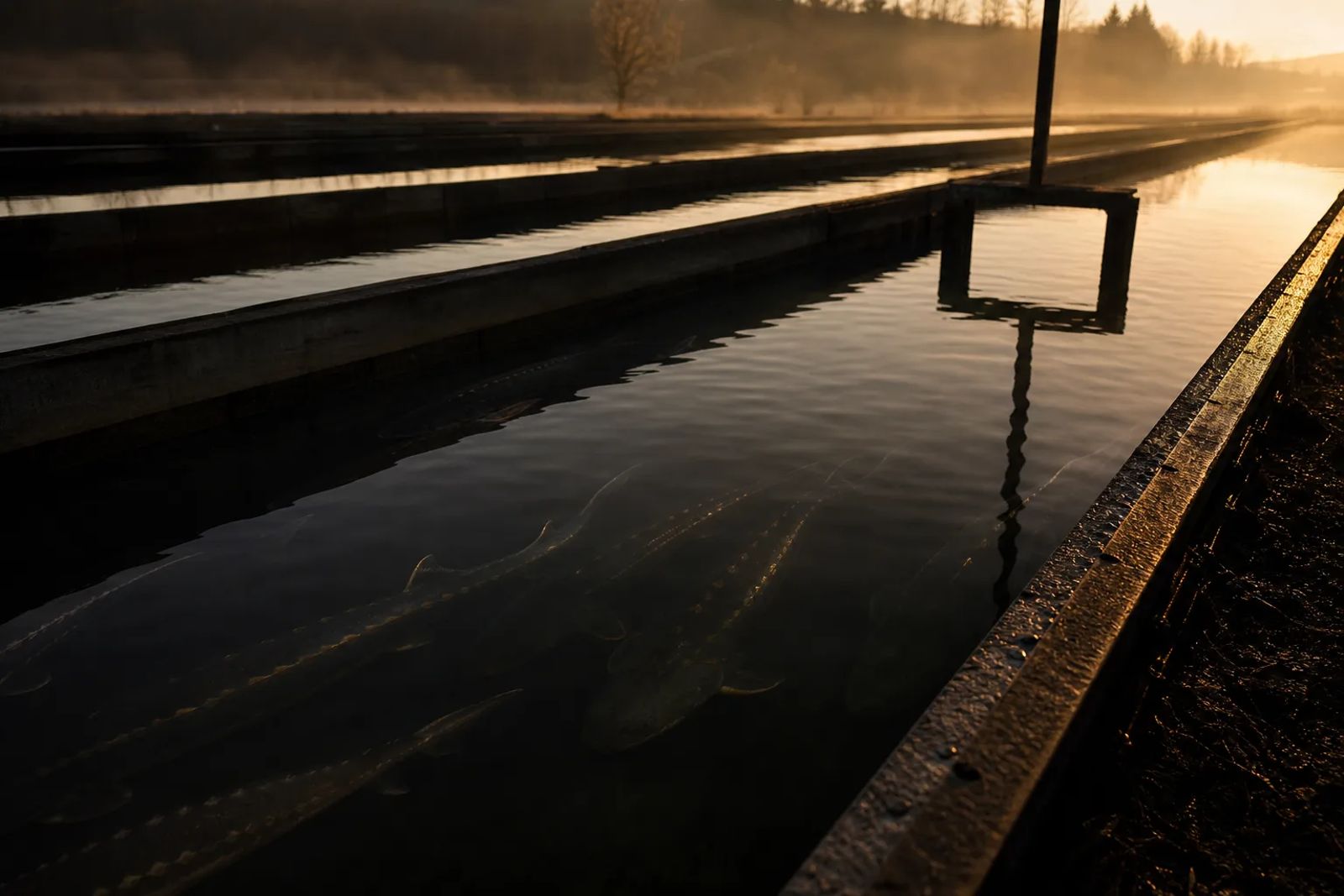
One European producer reported first caviar harvest at 7 years for Siberian sturgeon, 8 for Russian sturgeon and 14 for beluga. The same producer estimated colleagues' ages at 8, 9 to 10 and over 16 years respectively; these reports do not establish a universal range for any species.
First maturity is not first harvest
First maturity means the first reproductive development judged mature by the study concerned. In females, that might mean ovaries containing developed eggs, readiness for induced spawning, or evidence of having spawned; those endpoints are not interchangeable. Caviar harvest is a production decision about eggs suitable for processing, usually before ovulation, the release of eggs from their follicles.
A hatchery figure therefore cannot automatically become a first-harvest figure. A female retained as broodstock, meaning a breeding fish, may be mature without ever supplying food caviar. The distinction also matters in the wild: ages of fish caught on spawning grounds can include repeat breeders, not just females reproducing for the first time.
How long sturgeon take to produce caviar, species by species
The table separates documented harvest reports from reproductive observations. All wild ages refer to females. Harvest ages describe particular farms, not universal species ranges; Gille and colleagues documented white sturgeon harvests at seven and eight years.
| Species, using CITES names | Wild first maturity, years | Farm first harvest, years | Conditions and source |
|---|---|---|---|
| Siberian, Acipenser baerii | 11 to 12 in the Lena; earliest 19 to 20 in other Siberian waters | 7 reported by one producer; 8 estimated for colleagues | FAO species account; European producer interviews |
| Russian, Acipenser gueldenstaedtii | 12 to 16, Caspian populations | 8 reported by one producer; 9 to 10 estimated for colleagues | FAO manual; European producer interviews |
| White, Acipenser transmontanus | 12 to 20, wild comparison in North American hatchery proceedings | Farm maturity, not harvest: mostly 7 to 10; Van Eenennaam and colleagues | |
| Beluga, Huso huso | 16 to 18; 14 to 16 in the Azov population | 14 reported by one producer; over 16 estimated for colleagues | FAO manual; European producer interviews |
| Stellate, Acipenser stellatus | 8 to 10, with regional variation | FAO manual: cultured first maturity 5 to 7, not harvest | |
| Sterlet, Acipenser ruthenus | 3 to 12, broad wild range | FAO manual: cultured first maturity 3 to 5, not harvest | |
| Amur, Acipenser schrenckii | Chinese study: wild females first spawn at 9 to 10; farm maturity expected at 5 to 6 |
Names follow the CITES convention used in this site's species overview. Readers will also encounter Acipenser dauricus, rather than Huso dauricus, for kaluga in newer published taxonomy. The Sturgeon Specialist Group and World Sturgeon Conservation Society rejected two 2025 taxonomic proposals and put forward their own classification, which uses Acipenser huso for beluga and Acipenser dauricus for kaluga. WoRMS accepts Acipenser dauricus for kaluga. These naming differences do not alter recorded maturation ages.
Why the wait varies
Species sets the broad reproductive pattern, but population matters too. FAO describes earlier maturation in Azov beluga than in other populations, while Siberian sturgeon in the Lena mature earlier than the colder-water comparison in its species account. These differences are a warning against treating a species name as a complete explanation: inherited background and environment are entangled in many wild comparisons.
Water temperature affects growth and the seasonal signals associated with ovarian development. Reliable feeding and managed water conditions can bring puberty forward compared with wild populations, but continuous warmth and feeding are not a simple accelerator. FAO documents delayed final maturation and fatty ovaries under unsuitable constant rearing conditions. The practical mechanisms belong in water temperature, light and maturation, rather than in a universal temperature-to-age formula.
A recirculating system, which treats and reuses water, offers different environmental control from an outdoor pond or cage. Nevertheless, the system's name alone cannot predict first harvest: actual temperature history, feeding, fish health and ovarian development still need recording. Nor does evidence that genetics affects caviar yield establish how many years a particular strain will need; a maturation claim requires maturation data.
Sex is another essential distinction: male maturity is not an age-to-caviar measure. Females must complete the prolonged development of yolk-rich ovarian eggs, whereas males produce sperm, and the sexes follow different reproductive schedules. For example, white-sturgeon hatchery observations put most males at maturity by four years, earlier than most females. For farm implications, see what happens to male sturgeon.
What hybrids do and do not tell us
A hybrid's age cannot be calculated by averaging its parents' maturity ages. The common cross used in commercial caviar production has a female kaluga, Huso dauricus, and a male Amur sturgeon, Acipenser schrenckii.
A different cross shows why faster maturation should not be assumed. Rachek and colleagues studied 35 females from a female sterlet, Acipenser ruthenus, crossed with a male kaluga, Huso dauricus, across 46 spawning campaigns involving two year classes. First maturation began at 9 to 12 years, and fertile females were a minority of the original replacement stock. This is evidence about that cross and setting, not the common kaluga and Amur hybrid.
How the figures are measured
The strongest farm records link an individual fish's hatch date to repeated maturity assessments and its eventual harvest. Ultrasound can show ovarian development; a biopsy, a small tissue or egg sample, provides closer examination. Neither a large body nor a particular birthday is a substitute for examining reproductive condition. For the stages themselves, follow how sturgeon eggs develop.
Research design also determines what a number can answer. Williot and Brun followed a cultured Siberian-sturgeon cohort using biopsies of marked fish from 8.5 to 12.5 years of age, initially identifying 268 females. That study established variation in ovarian cycles, not a complete first-harvest schedule from hatching. Finding mature eight-year-old fish does not prove that eight was their earliest possible harvest age.
Published evidence is uneven: broodstock research, population accounts and producer statements answer different questions. The 2026 European interview study behind the harvest reports conducted eight interviews with producers in four countries. Its participant P3 supplied both their own ages and estimates for colleagues, without a matched dataset of individual fish. Those reports describe commercial experience; they are not measured minimum and maximum ages across Europe.
Does an older fish mean larger or better eggs?
Age alone is not a dependable quality grade. Egg development must have reached the appropriate stage, but the evidence does not establish a rule that each additional year produces larger beads or better flavour. Egg size differs among species and individuals, and maturity assessment examines more than diameter. Avoid turning the large size of a late-maturing species into proof that age caused its bead size.
Egg development must have reached the appropriate stage, but the evidence does not establish a rule that each additional year produces larger beads or better flavour.
Feed and genetics have better documented connections with particular production traits. Gille and colleagues examined more than 2,000 mature female white sturgeon in a finishing-diet trial, measuring ovarian fat and caviar yield, and also investigated genetic effects. Their findings support attention to diet and inherited variation, not a general sensory ranking by age. Yield, meaning the amount of caviar obtained, is not the same measurement as bead size, firmness or flavour.
Reading an age claim usefully
When a producer gives a harvest age, ask what was counted: years since hatching or years at that farm, first harvest or a later collection, and one individual or a whole cohort. Ask whether the figure describes observed production or an expectation for fish still growing. A useful claim names the species, the endpoint and the rearing context, rather than presenting the youngest fish as the timetable for every female.
Use the species guide to distinguish the fish involved, and sturgeon biology for the wider explanation of growth and reproduction.
Sources
-
FAO. Williot and colleagues, Cultured aquatic species fact sheets: Acipenser baerii, 2009. Species account covering temperate farm conditions, female selection and maturity assessment. Account.
-
FAO, archived in the US federal regulatory docket. Species Fact Sheets: Acipenser baerii, copy dated 8 December 2011. Wild female maturity, including the Lena comparison. Archived account.
-
FAO. Chebanov and Galich, Sturgeon Hatchery Manual, Fisheries and Aquaculture Technical Paper 558, 2013 reprint. Species life histories, Tables 56 and 58, and broodstock-management discussion. Manual.
-
Frontiers in Fish Science. Emam and Unerman, Animal welfare in European caviar production: insights from sturgeon producers, volume 4, article 1828234, 5 June 2026. Interview methods and participant P3's harvest-age reports. Research article.
-
Fisheries and Oceans Canada digital library. Spawning and reproductive performance of domestic white sturgeon, contribution by Van Eenennaam and colleagues in archived workshop proceedings, 1996, printed pages 116 to 117. Proceedings.
-
U.S. Geological Survey publication record. Overview of biology and aquaculture of Amur sturgeon (Acipenser schrenckii) in China, 2002. Farmed female maturity was expected at five to six years. Publication record.
-
World Sturgeon Conservation Society. IUCN SSG summary report, 13 November 2025, reporting the workshop of 22 October 2025. Workshop report.
-
World Register of Marine Species. Huso dauricus (Georgi, 1775), live taxonomic record, accessed November 2026. Accepted-name relationship to Acipenser dauricus. Taxonomic record.
-
Fish Breeding and Fisheries. Rachek, Amvrosov and Svidersky, Assessment of biological and productive parameters of female hybrids between the Volga sterlet (Acipenser ruthenus) and amur kaluga (Huso dauricus). Part 1, 2024, issue 6, pages 416 to 428. Publisher's abstract. Article record.
-
University of Florida IFAS Extension. Chapman and Van Eenennaam, Sturgeon Aquaculture: Specialized Techniques: Determining the Stage of Sexual Maturity in Female Sturgeon for Artificial Spawning: The Egg Polarization Index or PI, FA153, reviewed August 2025. Maturity assessment and species differences in egg diameter. Extension publication.
-
Aquatic Living Resources. Williot and Brun, Ovarian development and cycles in cultured Siberian sturgeon, Acipenser baeri, 1998, volume 11, issue 2, pages 111 to 118. Publisher's abstract. Research article.
-
Aquaculture. Gille and colleagues, Finishing diet, genetics, and other culture conditions affect ovarian adiposity and caviar yield in cultured white sturgeon (Acipenser transmontanus), 2017, volume 474, pages 121 to 129. University-hosted paper.
-
PLOS ONE. Gonadotropins in the Russian Sturgeon: Their Role in Steroid Secretion and the Effect of Hormonal Treatment on Their Secretion, 2016. Experimental husbandry and discussion of seasonal ovarian development. Research article.
Last checked: November 2026