
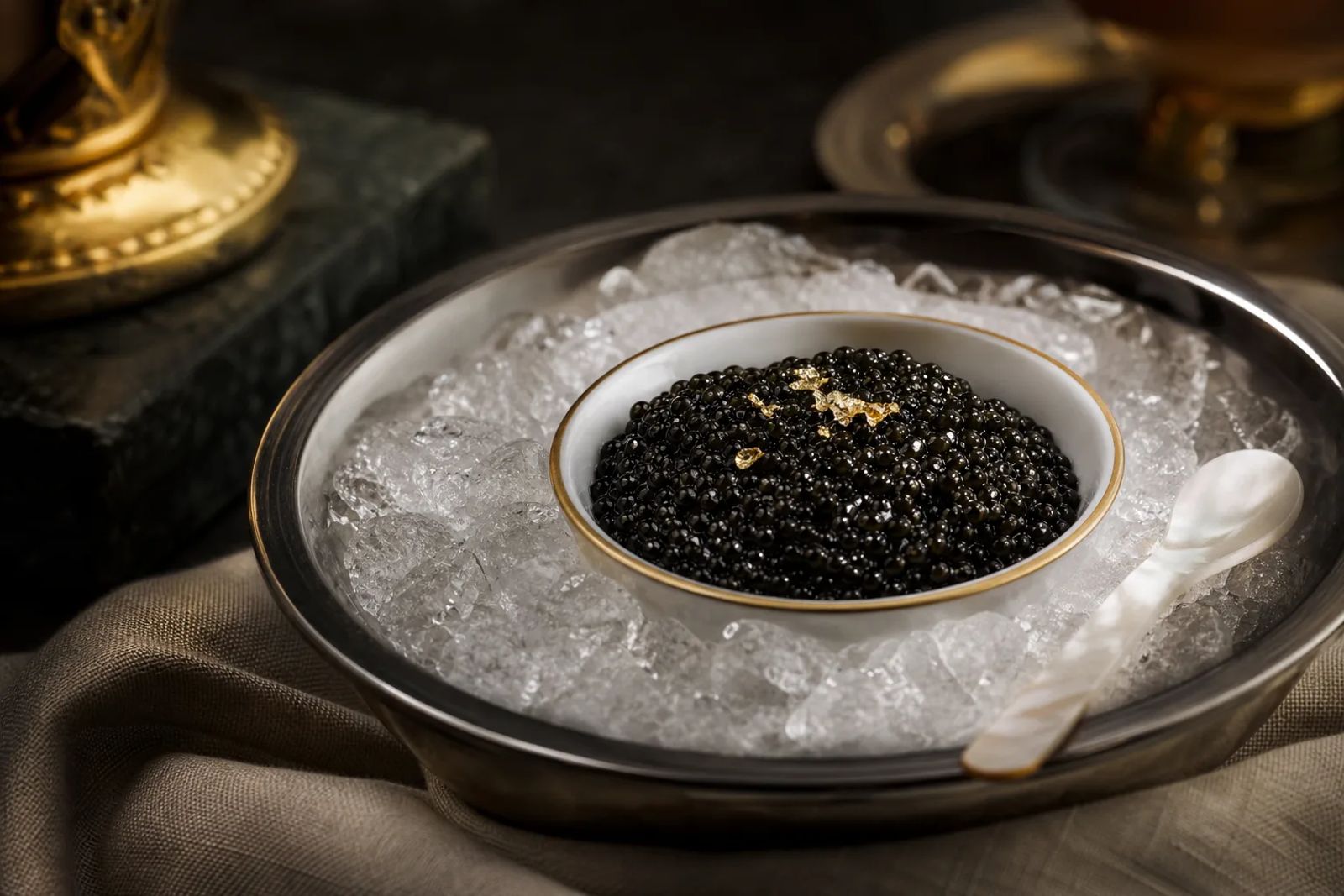
Caviar House puts its caviar's most expressive aromas at 8°C to 9°C (46°F to 48°F). That is a recommendation for tasting, not a general food-safety holding temperature or a reason to leave a whole tin through dinner. The pleasure belongs to the spoonful; the supply belongs in the cold.
Serve caviar chilled, bring out only what you are about to eat, and keep that portion on ice while the reserve stays refrigerated. Storage, cold holding at the table and the release of aromas each ask something different of temperature. Start with the instructions on the tin.
Serving temperature is not storage temperature
Keep the tin cold and let the spoonful do the warming. There is no need to warm the whole supply to explore its flavour. Indeed, an ice-supported serving dish may be colder than the fridge, not warmer.
Codex CXS 291-2010 specifies a product temperature of 2°C to 4°C (36°F to 39°F) during packaging, storage and retail. Its separate range for wholesale storage and transport is -4°C to 0°C (25°F to 32°F). That wholesale range is not an instruction to adjust a household fridge.
Codex is an international reference standard, not automatically domestic law. For the full sequence, from preparation to the table, see the complete serving guide.
Read the tin before setting the table
Before preparing the ice, read three things: the storage range, the use-by date and the instructions for use after opening. Those directions belong to the caviar in your hand. A general temperature range or another product's shelf life cannot replace them.
“Keep refrigerated” means exactly that. It is not permission to leave the tin on the table until it feels warm. If a temperature range or opening instruction is missing or unclear, ask the producer. If the label appears to conflict with local safety guidance, consult the producer or the relevant food safety authority.
What cold and warmth do to caviar
A little warmth can give aroma more room. Caviar House's advice supports a modest point: very cold caviar may be less aromatically expressive than a spoonful allowed to warm slightly for tasting. It does not establish a temperature at which every caviar tastes only of salt or every bead turns soft.
Texture changes have been studied over a much longer timescale. Liu and colleagues followed salted sturgeon caviar through six weeks of storage at -4°C (25°F), using texture measurements, microscopy, chemical analysis and a trained sensory panel. In later storage, they reported reduced membrane elasticity and increased viscosity, alongside changes in aroma compounds.
Those findings describe storage, not a tin warming over dinner, so they cannot give a minute-by-minute rule for texture at the table. The pressing reason to prevent prolonged warming is food safety: inadequate chilling allows harmful bacteria to multiply.
Check the fridge zone, not just the dial
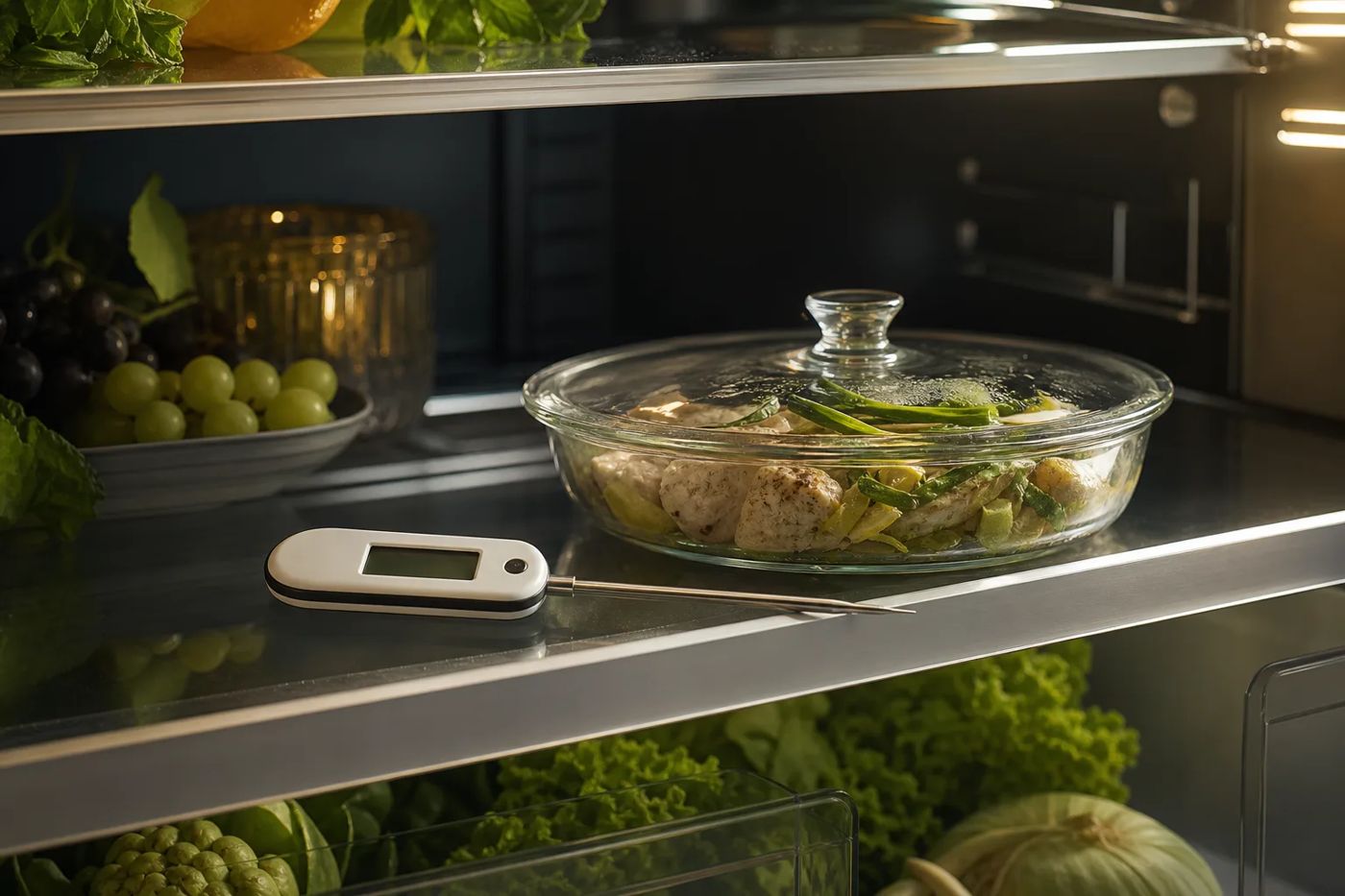
Measure where the tin will sit. A fridge setting is not necessarily a temperature reading, and a refrigerator that meets general household guidance may still fall outside a particular caviar's narrower storage range.
The UK Food Standards Agency recommends 0°C to 5°C (32°F to 41°F) for domestic refrigeration and advises using a fridge thermometer. Its guidance cited here applies to England, Wales and Northern Ireland.
Elsewhere, the US FDA specifies 4.4°C (40°F) or below, while EFSA advises refrigerating perishable food below 5°C (41°F). France's agriculture ministry identifies a cold zone at no more than 4°C (39°F). Australian consumer advice from the NSW Food Authority says below 5°C (41°F). These are household recommendations; the tin's product specification still governs its storage.
Check the appliance manual, then use a thermometer in the intended position. France's ministry notes that the coldest zone can be at the top or bottom, depending on the model. Germany's BfR recommends checking different parts of the fridge and leaving space for air circulation.
Indeed, an ice-supported serving dish may be colder than the fridge, not warmer.
Choose a measured, suitable spot rather than assuming the door or back wall will do. For longer storage, opening dates and fridge organisation, see storing caviar at home.
Keep the table cold, not just handsome
An ice bath is cooling equipment, not decoration. Build it before the caviar leaves the fridge, and keep the reserve refrigerated under its labelled conditions.
-
Build a stable ice bed. Fill a wide outer bowl with crushed ice and nest a smaller food-safe dish securely inside. Bring the ice around its base and sides, with the inner rim above the meltwater. Water must not spill into the roe.
-
Bring out a small, chilled portion. Take only what is needed for the next serving and leave the rest refrigerated. Put out 30 g (about 1 oz), for example, rather than the entire supply. This helps with portioning; it does not establish how long that portion can safely remain out.
-
Check the cooling. Follow the product's instructions and applicable national guidance for cold holding, rather than the warmer tasting recommendation. FSANZ recommends placing a probe in the food where possible, or laying a thermometer along the package when food is packed. Use a cleaned and sanitised food thermometer without contaminating the roe. Its Australian business guidance specifies 5°C (41°F) or colder for potentially hazardous cold food.
-
Cover between helpings. Replace the tin's lid or cover the inner dish when nobody is serving. A cover protects the food but provides neither insulation nor refrigeration. If the course pauses, return the caviar to the fridge.
-
Keep the ice working. As it melts, check that the dish remains supported and surrounded by ice. Replenish as needed. Keep the inner dish from floating or tipping, and never stir ice or meltwater into the caviar.
-
Plate only for immediate eating. Chilled plates spare the caviar a warm surface, but they gradually warm too. Use them for individual helpings, not in place of the ice-supported reserve.
Dish size, ice quantity and room conditions all affect this setup, so there is no reliable universal number of minutes it will work. Choose equipment that allows you to maintain and check cooling.

Warm rooms, outdoor tables and hot climates
Smaller batches are the answer to a warm setting. In a heated room or outdoors, keep the reserve in a fridge or properly cooled insulated box. Set the serving bowl away from direct sun and cooking heat, with replacement ice ready before guests begin eating.
Health Canada recommends keeping a cooler at or below 4°C (40°F), out of direct sunlight, and opening it as little as possible. Give drinks their own cooler so guests can help themselves without repeatedly exposing the food to warm air.
Heat also shortens some national time limits. The US FDA allows one hour for perishable food left unrefrigerated when the air temperature exceeds 32.2°C (90°F), compared with its usual two-hour limit. Treat these as safety limits, not display times to aim for.
Returning caviar to ice does not reset the accumulated time outside safe temperature control. Count preparation and serving together, and follow the jurisdiction-specific guidance in serving caviar safely. A pleasant smell, neat beads or an intact seal cannot establish that the food is safe.
Taking caviar to someone else's house
Check the arrangements before you leave. Ask your host about fridge space, ice and a suitable bowl. Pack the already chilled tin in a clean insulated carrier with ice or gel packs, and take a thermometer to check that the carrier maintains the product's required conditions.
Keep the carrier closed on the journey. On arrival, put the tin into suitable refrigeration rather than leaving it among coats or gifts. The FDA's outdoor food guidance supports chilled transport with ice or frozen gel packs, but gives no guaranteed journey time for an insulated bag.
For packing arrangements and longer journeys, see travelling with caviar. Once at the destination, prepare the serving bowl first and bring out the tin last. Keep the cooling plan intact all the way to the table.
Sources
-
FAO and WHO, Codex Alimentarius Commission. Standard for Sturgeon Caviar, CXS 291-2010, modified 2026, sections 2.3 and 7.2. The official PDF retrieved displayed amendments through 2024; the current register's search record indicated a 2026 modification. Official Codex text register.
-
Caviar House. Caviar FAQ: Storage, Tasting and Choosing, undated live edition, retrieved November 2026, “Tasting”. Used solely as an attributed producer recommendation. Published FAQ.
-
Liu, L., and colleagues, Ocean University of China and collaborating organisations. Multi-omics combined approach to analyze the mechanism of flavor evolution in sturgeon caviar (Acipenser gueldenstaedtii) during refrigeration storage. Food Chemistry: X, volume 23, article 101688, 2024. DOI: 10.1016/j.fochx.2024.101688. Full article.
-
Food Standards Agency. How to chill, freeze and defrost food safely, published 2017, live edition retrieved November 2026. Consumer guidance.
-
US Food and Drug Administration. Refrigerator Thermometers: Cold Facts about Food Safety, live edition retrieved November 2026. Consumer guidance.
-
European Food Safety Authority. Proper food handling, reviewed 24 March 2025. Safe2Eat guidance.
-
French Ministry of Agriculture. Des conseils pour bien ranger votre frigo, live edition retrieved November 2026. Domestic refrigerator guidance.
-
German Federal Institute for Risk Assessment, BfR. Correct cooling: Frequently asked questions on refrigerating foods in private households, FAQ dated 13 February 2023, live edition retrieved November 2026. Household cooling guidance.
-
NSW Food Authority. Key tips, undated live edition retrieved November 2026. Consumer food-safety guidance.
-
Food Standards Australia New Zealand. Keeping food at the right temperature, live edition retrieved November 2026. Australian food-business guidance, not a statement of identical domestic requirements in New Zealand. Temperature-control guidance.
-
Health Canada. Summer food safety tips, live edition retrieved November 2026. Outdoor food-safety guidance.
-
US Food and Drug Administration. Selecting and Serving Fresh and Frozen Seafood Safely, live edition retrieved November 2026, “Picnic Tips” and “Serving”. Seafood guidance.
-
US Food and Drug Administration. Eating Outdoors, Handling Food Safely, consumer factsheet, retrieved November 2026. Official factsheet.
This piece was researched using official food-safety guidance, the retrieved Codex text, one peer-reviewed storage study and one explicitly attributed producer recommendation.
Last checked: November 2026