
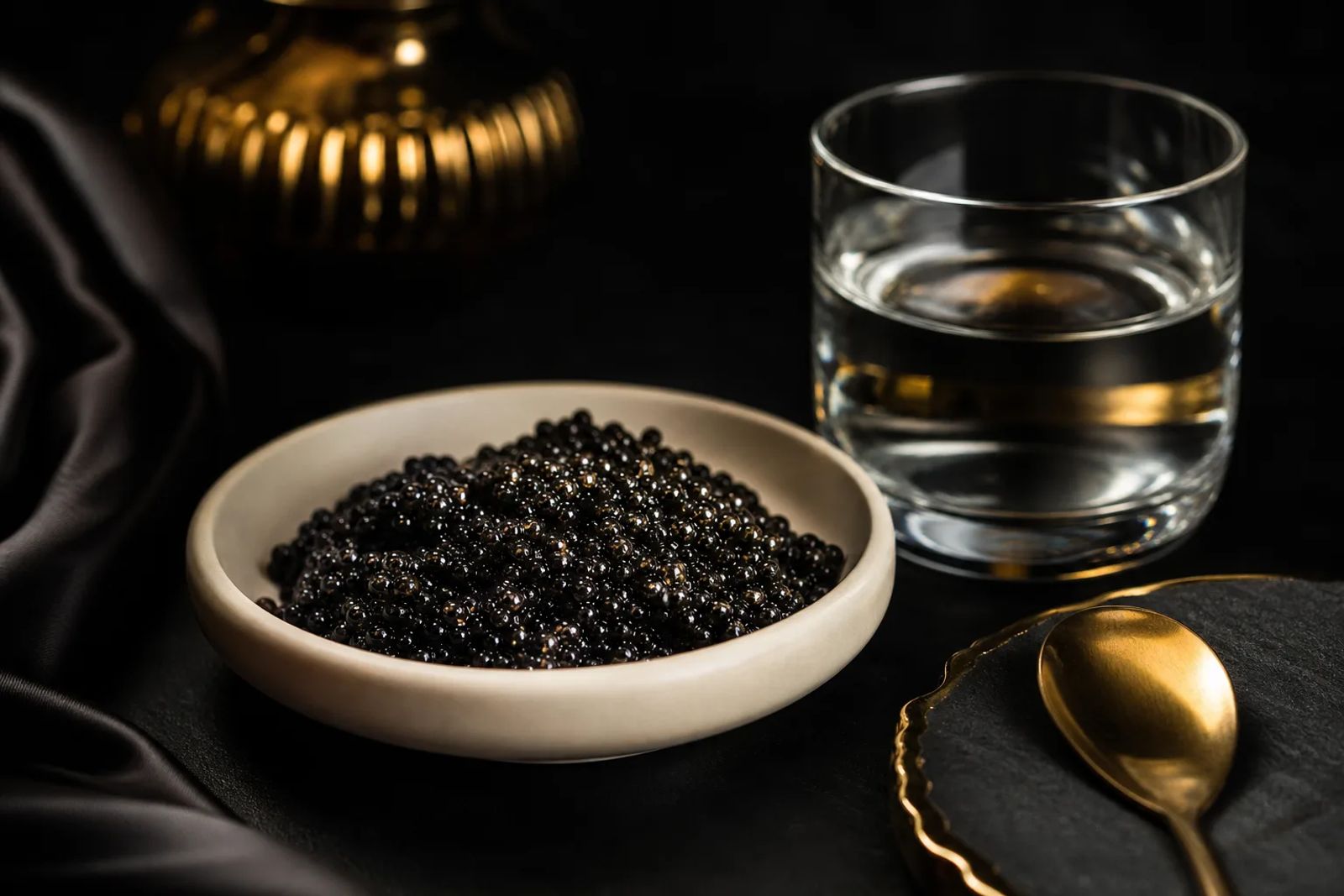
Water and farm practice can shape caviar flavour, but origin alone is not a dependable tasting note. Studies connect husbandry and processing with chemical or sensory differences; they do not establish a universal ranking of geography, genetics, feed and salting.
Does caviar have terroir?
By terroir, readers usually mean a recognisable character associated with a place: its water, climate and local farming traditions. For caviar, the useful question is whether that character persists when species, feed, harvest stage and processing are held constant.
Research does approach that question. A 2024 exploratory study followed 51 caviar samples from Prunier Manufacture over a year, using sensory assessment and selected ion flow tube mass spectrometry, a rapid method for measuring volatile compounds. It found associations with production site, water quality, species, season and storage, but was not a controlled experiment isolating place from all the other variables.
The distinction matters: a farm signature is not necessarily a geographical signature. The broader science of caviar flavour explains how composition, aroma and texture combine in the mouth.
Start with species and genetics
Species is the first comparison to control, not a proven winner in a hierarchy of flavour influences. In a study published in Food Chemistry in 2025, researchers compared eight caviar types from six sturgeon species using untargeted metabolomics, sensory assessment and texture measurements. They detected differences associated with species and processing, including differences in lipids, nucleotides and peptides.
Genetic background also deserves attention, although evidence about yield must not be presented as evidence about taste. A white sturgeon (Acipenser transmontanus) feeding trial involving more than 2,000 mature females found that diet and culture conditions mattered to ovarian fat and roe yield; a subset was used to investigate genetic effects.

Water source is not a flavour code
Spring, river and lake describe where water comes from; recirculation describes how a farm reuses it. These are not four mutually exclusive categories. A recirculating aquaculture system, or RAS, can begin with spring water, while treatment and management change the conditions experienced by the fish.
The Prunier study supports investigating actual water quality alongside site, rather than treating a water source as a tasting descriptor. The Prunier study examined two farms, two species, seasonal production and storage.
Feed can affect composition without predicting taste
A particularly useful dietary experiment examined 20 caviar samples from white sturgeon fed diets containing different lipid sources, soybean oil or squid oil, for three or six months before harvest. Caprino and colleagues analysed chemical composition and fatty acids, and extracted volatile compounds using simultaneous distillation and extraction followed by gas chromatography and mass spectrometry.
The result was restrained: the roe's fatty acid composition was only minimally influenced by the dietary treatments. That finding is more useful than the sweeping claim that caviar simply tastes of its feed. Chemical differences require sensory confirmation before they become tasting notes; the extraction method can also generate compounds through heat and oxidation.
For the farming context, see feed and water quality. Here, the evidence supports asking what was fed and what was measured, rather than predicting flavour from a feed ingredient.
Temperature and age affect readiness for harvest
Climate matters through the conditions fish actually experience, particularly water temperature. Webb and colleagues experimentally studied thermal regimes in farmed white sturgeon and documented temperature sensitivity during ovarian development. This supports a biological effect on maturation, not the claim that a colder country automatically produces firmer or better tasting caviar.
Growth and reproductive readiness are different outcomes. In a university thesis, 92 individually marked white sturgeon females underwent dietary treatments at two farms followed by communal coldwater conditioning. The study found no significant farm or diet effect on egg texture or developmental stage at harvest.
Age in years is likewise not an independent quality grade. Egg development at harvest matters: immature eggs have not completed growth, while overmature eggs can lose firmness as their contents are resorbed. Read temperature, light and maturation for the distinction between growing a fish quickly and bringing its eggs to the right stage.
Purging addresses a specific waterborne problem
Geosmin and 2-methylisoborneol, often shortened to MIB, are associated with earthy and musty off-flavours. A 2005 study identified them instrumentally in white sturgeon flesh from recirculating systems and linked one geosmin source to cyanobacteria growing on tank walls. This is evidence of a waterborne taint mechanism, not a desirable regional character.
Purging, or depuration, means holding fish in suitable water before harvest to reduce unwanted compounds. A 2026 Russian sturgeon (Acipenser gueldenstaedtii) study compared recirculating and flow-through depuration systems under fed and unfed conditions, using chromatography, mass spectrometry and olfactometry, where assessors smell separated compounds. Its findings concerned fillets, water and feed, not finished roe; feeding produced mixed effects on the odour profile. See purging and earthy off-flavours for methods and limitations.
What happens after harvest
Processing deserves at least as much scrutiny as the farm story. In a white sturgeon study, researchers followed raw eggs and caviar through five ripening stages, up to 240 days, using headspace extraction and gas chromatography and mass spectrometry. Volatile profiles changed during maturation; salt concentration and container size also varied, complicating attribution.
Salt, heat treatment and maturation therefore cannot be treated as neutral finishing steps. The multispecies Food Chemistry study also detected processing effects, but neither investigation supplies a universal numerical comparison of processing against geography. Processing may explain differences attributed to place; saying it always outweighs place would go beyond these results.
A separate white sturgeon storage experiment compared salt and preservative formulations, tracking microbiology and volatile compounds over prolonged storage. Differences emerged between treatments as storage continued. This is direct evidence that the post-harvest environment can change the product, but it does not tell us which farm's water would taste different under identical processing.
Codex CXS 291-2010, the international reference standard for sturgeon caviar, specifies 3 to 5 g salt per 100 g of finished product. It is not automatically binding national law. For flavour comparisons, obtain the product's actual salt content and distinguish it from the amount initially added; handling history and maturation time belong alongside that figure.
What the evidence says about caviar flavour
| Factor | What is documented | Evidence | Source |
|---|---|---|---|
| Species and processing | Chemical, sensory and texture differences | Eight product types, not a fully separated causal test | Food Chemistry, 2025. |
| Farm and water | Associations with volatile profiles | Observational sampling with sensory assessment | Food Control, 2024. |
| Feed | Minimal fatty acid response in one experiment | White sturgeon dietary trial | Caprino et al., 2008. |
| Temperature | Effects on ovarian maturation | Experimental white sturgeon research | Webb et al., 2001. |
| Purging | Changes in odour-active compounds | Russian sturgeon fillets, not caviar | Journal of Agriculture and Food Research, 2026. |
| Ripening | Changes in volatile profiles over time | Single-producer caviar study | Molecules, 2020. |
These studies answer different questions, so their results cannot be combined into a league table of flavour drivers. Small sample sets, commercial product selection and overlapping treatments limit generalisation. The authors of the 2025 Food Chemistry study declared no known competing financial interests or personal relationships.
A chemical fingerprint can distinguish samples without proving that diners perceive a difference. For the analytical detail behind that distinction, see caviar aroma compounds.
Read origin as provenance, not a tasting promise
Producer accounts can suggest worthwhile hypotheses. Pisani Dossi, for example, credits conditioning in spring water, selection of females and careful preparation together for its caviar's quality. That is the producer's explanation of a combined process, not an experiment demonstrating a spring-water flavour.
A country of origin is useful provenance information, but does not specify feed, water treatment, harvest readiness or maturation. On repacked caviar, roe origin and repacker details identify different things. A traceability label does not prove the contents of the tin, and a brand's national identity does not establish where its roe was produced. Use caviar producing countries to explore origins, then ask about the particular farm and batch rather than assigning a national flavour.
Comparing documented farm practices focuses attention on production variables rather than national stereotypes. For a meaningful comparison, match species, processing style, salt content and maturation as closely as possible, taste without seeing the origin, and repeat across batches before attributing a difference to place.
Sources
- Elsevier, Food Control. Rapid analysis of VOCs with SIFT-MS as a decision-making support tool for caviar producers. Volume 155, article 110094, 2024.
- Elsevier, Food Chemistry. The contribution of sturgeon species and processing conditions on caviar texture, metabolomic profile and sensory traits. Original research article, 2025 journal edition, indexed in 2024.
- Gille et al., Elsevier, Aquaculture. Finishing diet, genetics, and other culture conditions affect ovarian adiposity and caviar yield in cultured white sturgeon (Acipenser transmontanus). Volume 474, pages 121 to 129, 2017.
- Caprino et al., Elsevier, Analytica Chimica Acta. Fatty acid composition and volatile compounds of caviar from farmed white sturgeon (Acipenser transmontanus). Volume 617, pages 139 to 147, 2008.
- Webb et al., Elsevier, Aquaculture, author record hosted by USGS. Effects of thermal regime on ovarian maturation and plasma sex steroids in farmed white sturgeon, Acipenser transmontanus. Volume 201, pages 137 to 151, 2001.
- Zhang, Yue, University of California eScholarship. Husbandry and Dietary Effects on Sturgeon (Acipenser transmontanus) Farmed for Caviar. Thesis, 2011.
- University of Florida IFAS Extension. Technically Speaking, What Is Sturgeon Caviar?. FA194, first published June 2016, reviewed February 2025.
- Schrader, Rubio, Piedrahita and Rimando, North American Journal of Aquaculture, author record hosted by USDA ARS. Geosmin and 2-Methylisoborneol Cause Off-Flavors in Cultured Largemouth Bass and White Sturgeon Reared in Recirculating-Water Systems. Volume 67, pages 177 to 180, 2005.
- Elsevier, Journal of Agriculture and Food Research. Feeding during off-flavour purging in recirculating aquaculture systems? An exploratory characterisation of waterborne and feedborne odour-active compounds in Russian sturgeon (Acipenser gueldenstaedtii). Volume 26, article 102615, 2026.
- MDPI, Molecules. Volatile Organic Compounds Profile in White Sturgeon (Acipenser transmontanus) Caviar at Different Stages of Ripening by Multiple Headspace Solid Phase Microextraction. Volume 25, article 1074, 2020.
- MDPI, Foods. Evolution of Food Safety Features and Volatile Profile in White Sturgeon Caviar Treated with Different Formulations of Salt and Preservatives during a Long-Term Storage Time. Volume 10, article 850, 2021.
- FAO and WHO, Codex Alimentarius Commission. Standard for Sturgeon Caviar, CXS 291-2010, sections 2.2 and 2.3.
- Azienda Agricola Pisani Dossi. Caviar. Company account of its production practices.
Last checked: November 2026