
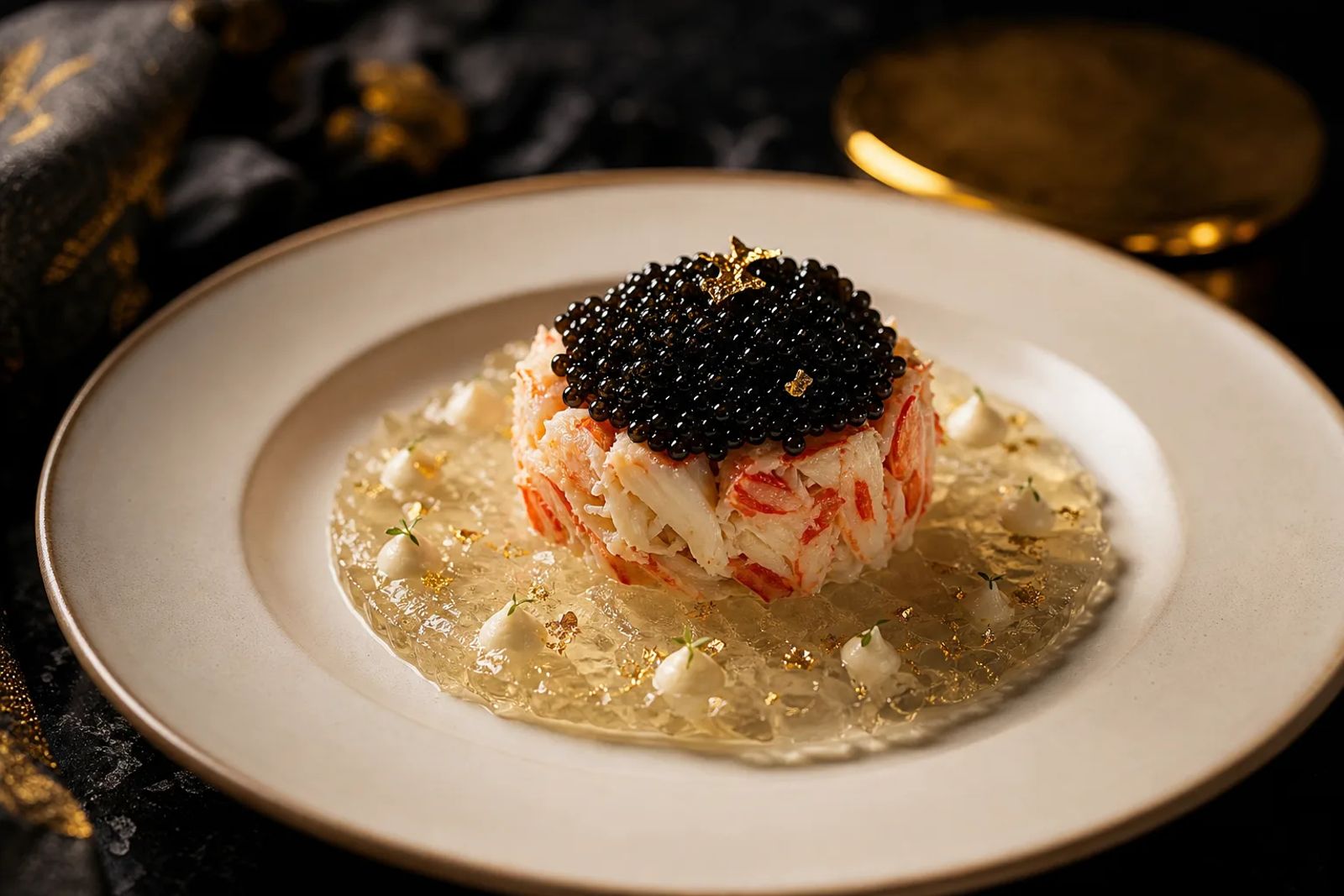
Joël Robuchon's Caviar Impérial and Thomas Keller's “Oysters and Pearls” are recognised restaurant caviar dishes because their chefs made the roe part of a distinctive composition, not just a finishing garnish. Robuchon combined caviar with shellfish jelly and cauliflower cream; Keller paired it with oysters and savoury pearl tapioca.
What makes a restaurant caviar dish a signature
Here, a signature means a dish repeatedly associated with a named chef through their own cookbook, restaurant menu or detailed reporting. A signature dish has a recognisable composition and an enduring association with its chef. It does not establish a ranking of fame.
The dishes below offer three different ideas for cooking with caviar: constructing a chilled plate, building a savoury custard, and finishing a baked base. Their dates refer to identifiable documents, not an assumed moment of invention; a restaurant's opening year is not automatically a dish's birthday.
Joël Robuchon's Caviar Impérial
Robuchon's restaurants use several closely related names, including Le Caviar Impérial and La fameuse gelée de caviar de Joël Robuchon. Gelée means jelly: in this case, a savoury shellfish preparation rather than a sweet jelly. The restaurant's official Japanese Menu Découverte describes imperial caviar in lobster jelly topped with smooth cauliflower cream.
The crab version is particularly well documented. In September 2016, Ambrosia, the magazine of Hong Kong's International Culinary Institute, described Le Caviar at Robuchon au Dôme in Macau as king crab topped with caviar, surrounded by crustacean jelly and dots of cauliflower cream. An official Hong Kong Signature menu from 2019 also named Le Caviar Imperial and king crab.
These records establish the dish at named restaurants by those dates. A January 2026 South China Morning Post interview with Hong Kong executive chef Julien Tongourian described an earlier version without crab, so the familiar crab plate should not be treated as an unchanged original.
In a Michelin interview published on 27 August 2026, Restaurant de Joël Robuchon in Las Vegas described Le Caviar Impérial as part of its tasting experience, bringing together crab, crustacean gelée, cauliflower cream and caviar.
What the technique shows
My reading of the composition is that the jelly does structural work: it carries shellfish flavour while keeping the plate distinct from a bowl of sauce. Cauliflower supplies another texture, and the caviar remains a separate element. The precise dots are memorable, but they are not the whole idea.
For a home cook, the useful lesson is to design the spoonful before copying the decoration. A modest composition of a smooth vegetable base, a separately prepared shellfish element and caviar can explore the same relationships without claiming to reproduce Robuchon's dish. For its wider setting, see French caviar culture.
Thomas Keller's "Oysters and Pearls"
Keller's published version combines savoury pearl tapioca, oysters and caviar. The dish appears in The French Laundry Cookbook, published by Artisan in 1999; the publisher records 1 November as the publication date. That gives a firm documentary anchor at The French Laundry in Yountville, California, rather than an inferred creation date.
The book's formulation names Malpeque oysters and osetra caviar. An official Keller tasting menu dated 27 February 2026 instead names Island Creek oysters and Regiis Ova caviar. The enduring identity is therefore the composition, not a claim that the suppliers or every ingredient description have remained identical.
Keller gave his own account of the idea in a Galerie interview published on 1 March 2024. A box of pearl tapioca in a grocery shop prompted the connection between oysters and pearls; he then turned familiar sweet tapioca pudding towards a savoury dish. It is his retrospective account, not a contemporaneous record of the first service.
Per Se, Keller's New York restaurant, opened in 2004, according to its official history. The 2024 Galerie anniversary feature identifies “Oysters and Pearls” among its signature dishes. Relais & Châteaux lists “Oysters and Pearls” among Per Se's representative dishes, while Keller's menu of 27 February 2026 also names it.
What the technique shows
A sabayon is a whisked egg yolk preparation; here it helps form the savoury tapioca base. Keller's published method keeps the caviar out of the heating stages and places it on top at the end. The dish is not oysters baked beneath a caviar crust, despite the presence of cooked components.
A box of pearl tapioca in a grocery shop prompted the connection between oysters and pearls; he then turned familiar sweet tapioca pudding towards a savoury dish.
My suggested home lesson is contrast without clutter: let a soft base, a distinct piece of shellfish and the roe each have a role. Borrow the principle rather than calling an unrelated oyster garnish “Oysters and Pearls”. Our guide to oysters, scallops and crudo with caviar explores the broader pairing, rather than this restaurant recipe.
Wolfgang Puck's smoked salmon and caviar pizza
Puck's pizza offers a different kind of signature: a familiar format whose toppings change its character. In a 2014 Eater interview, Eric Klein, then executive chef at Spago in Las Vegas, described a crisp baked base finished with dill crème fraîche, smoked salmon, roe and chives. The toppings went on after the base was cooked.
Klein explicitly allowed salmon roe or sturgeon caviar. That detail matters: not every documented version of Puck's pizza used the same roe. Michelin's 2018 account described the combination with caviar as an enduring Spago signature and traced it back to 1982. Its story of improvisation for a guest is retrospective history, not proof of an exact first night.
The pizza was demonstrably served at Spago's Las Vegas restaurant in 2014 and described again by Michelin in 2018. Michelin described the pizza as an enduring Spago signature in October 2018. That distinction separates a dish's reputation from what a particular restaurant serves tonight.
For home cooking, take the order of operations rather than the restaurant's exact assembly. Bake the base separately, then add the finishing ingredients: heat can firm the roe and alter its texture and flavour. The lesson is a finishing sequence, not permission to substitute any topping and retain the dish's name.
A short documentary timeline
The dates below identify publications describing each dish. They are not claims of historical priority: later interviews can describe earlier events, but a recollection and a dated menu answer different questions.
| Dish and chef | Restaurant | Earliest verified documentation | Source |
|---|---|---|---|
| “Oysters and Pearls”, Thomas Keller | The French Laundry, Yountville | 1999 | The French Laundry Cookbook |
| Smoked salmon and caviar pizza, Wolfgang Puck | Spago, Las Vegas | 2014 | Eater interview, 2014 |
| Le Caviar, Joël Robuchon | Robuchon au Dôme, Macau | 2016 | Ambrosia, September 2016 |
The cookbook publication record, executive chef interview and culinary institute feature supply these documentary anchors.
Reading the dishes as a home cook
These dishes suggest three useful questions before adding caviar to food. Does the base leave room for the roe, as Robuchon's smooth components do? Is the texture contrast purposeful, as in Keller's pairing of tapioca and oysters? Have you separated cooking from finishing, as in the documented Spago pizza? These are editorial interpretations of the compositions, not claims to reveal the chefs' private intentions.
At home, I would begin with one of those questions, not attempt all three plates at once. A dish can be instructive without becoming a template to copy: changing the vessel, decoration or roe does not necessarily preserve the balance that made the original recognisable. For more detailed discussion of preparation, continue with chef techniques with caviar.
For restaurant context rather than technique, famous caviar bars and restaurants worldwide looks at the places. For how such dishes fit into a meal, caviar dining today considers tasting menus and service. Neither a famous name nor a photograph alone tells you which version will arrive at the table.
Sources
- Joël Robuchon Japan. Menu Découverte, official English menu, January 2026 file. Lists the caviar gelée with lobster jelly and cauliflower cream. Official menu.
- International Culinary Institute, Hong Kong. Tama Lung, “French lessons”, Ambrosia, September 2016, “Plat du jour”, page 58. Describes Le Caviar at Robuchon au Dôme. Magazine issue.
- L'Atelier de Joël Robuchon, Hong Kong. Menu “Signature”, official menu, December 2019 file. Documents the named caviar and king crab preparation. Official menu.
- South China Morning Post. Grace Brewer, “Dish in Focus: Le Caviar Impérial at L’Atelier de Joël Robuchon”, 22 January 2026. Includes executive chef Julien Tongourian's account. Article.
- Michelin Guide. “In Las Vegas, Award-Winning Service Means a Tower of Butter and Carts Loaded With Bakery Treats”, 27 August 2026. Restaurant interview documenting continued service. Interview.
- Artisan / Hachette Book Group. The French Laundry Cookbook, Thomas Keller, first edition, 1999, ISBN 9781579651268. Publisher's bibliographic record gives 1 November 1999.
- Thomas Keller / Epicurious. “Oysters and Pearls”, credited to The French Laundry Cookbook, online edition dated 20 August 2004. Keller's recipe describes the composition and finishing sequence. Published recipe.
- Thomas Keller Restaurant Group. Chef's tasting menu, 27 February 2026. Official dated menu naming the dish, Island Creek oysters and Regiis Ova caviar. Official menu.
- Galerie. Jacqueline Terrebonne, “Thomas Keller Shares 4 Signature Dishes That Define Per Se”, 1 March 2024. Includes Keller's first-person account of the tapioca inspiration. Interview.
- Thomas Keller Restaurant Group. “Restaurant”, Per Se, Undated official history stating that Per Se opened in 2004. Restaurant history.
- Relais & Châteaux. “Per Se”, Undated restaurant listing identifying “Oysters and Pearls” as a representative dish. Restaurant listing.
- Eater Vegas. Susan Stapleton, “Eric Klein Talks About Spago’s Legendary Smoked Salmon and Caviar Pizza”, 20 March 2014. Executive chef interview documenting ingredients, alternatives and assembly. Interview.
- Michelin Guide. Rachel Tan, “My Signature Dish: Wolfgang Puck’s Smoked Salmon Pizza”, 15 October 2018. Documents the dish's restaurant association and retrospective origin account. Article.
Last checked: November 2026