
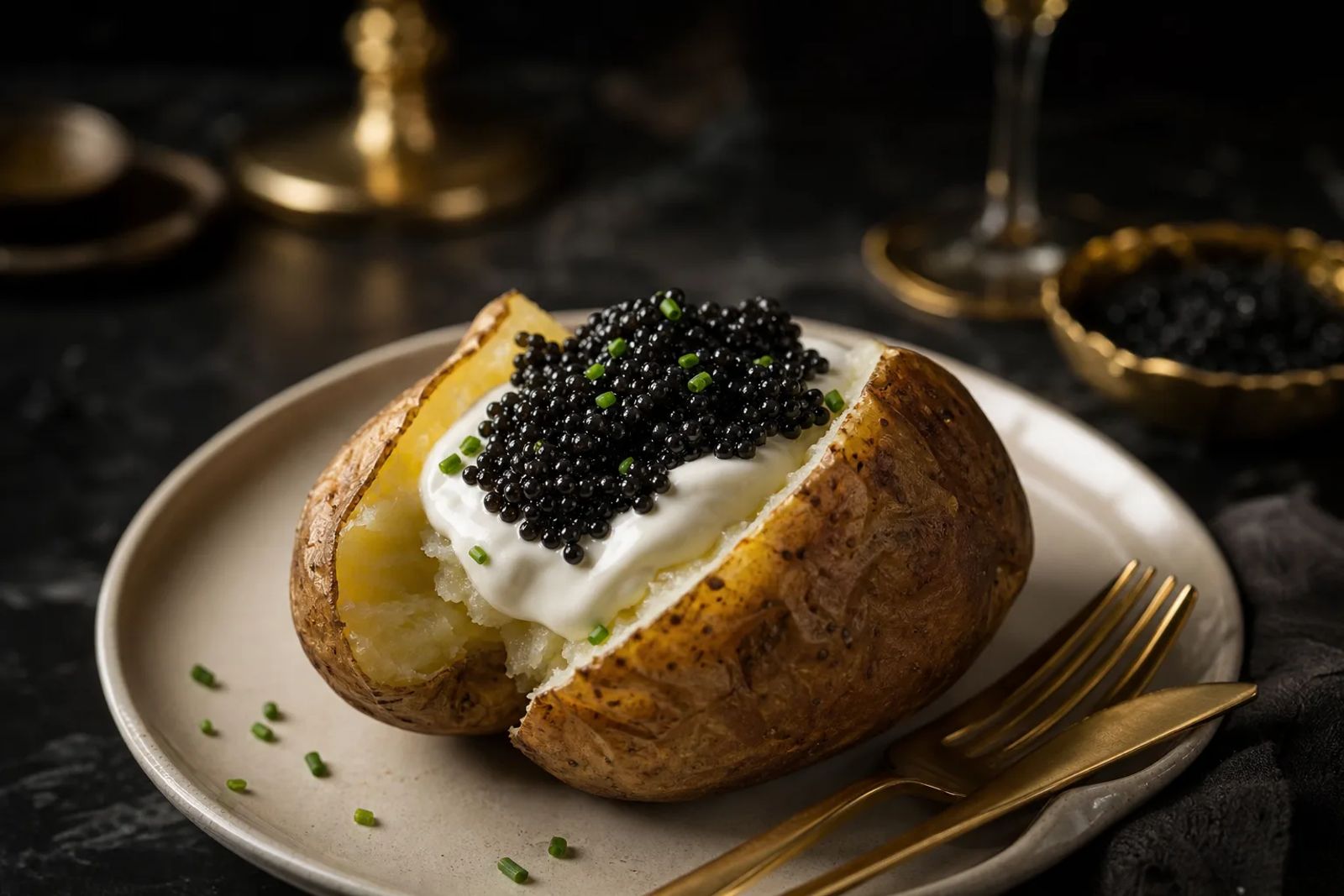
Yes, you can put caviar on warm food, but prolonged or strong heat changes the eggs rather than simply warming them. For intact beads and a soft centre, the practical rule is to finish cooking first, take the dish off the heat and add caviar just before serving.
Can you cook caviar without changing it?
Not completely: warmth and cooking are different aims. A spoonful meeting a freshly plated dish receives residual heat, whereas caviar stirred into a simmering sauce is exposed to sustained heating; the longer, hotter treatment gives its proteins more opportunity to change.
Protein denaturation means that a protein loses its original folded structure. Heating can then encourage proteins to aggregate, or join together, so that the liquid or soft material inside an egg becomes more set. This is the useful scientific explanation for cooked roe, although a fish egg is not simply a miniature hen's egg.
Reinhard Schubring's 2004 research used differential scanning calorimetry, a method that measures heat absorbed during structural changes, to study rainbow trout roe. Measurements were made in at least triplicate, and the work examined maturation, salting and heating. It demonstrates why processing history matters, not a universal cooking temperature for sturgeon caviar.
What heat changes in the eggs
| What changes | What the evidence supports | Source |
|---|---|---|
| Proteins | Fish roe proteins undergo heat denaturation; the response depends on the roe and its treatment. | Schubring, 2004 |
| Texture and pop | Setting the contents changes the contrast between a yielding centre and an intact envelope. | Scientific interpretation, not a measured universal effect |
| Colour | Ripert and Ruhlman's recipe warns that overcooking makes caviar hard and white. | A Return to Cooking, 2002 |
| Aroma and flavour | A study of eight caviars found differences in texture, sensory characteristics and chemical composition associated with species and processing. | Caviar processing study, 2024 |
The familiar clean pop depends on more than the toughness of the outside: what is inside the bead matters too. Once the centre sets, a firmer bead need not give the same release in the mouth. For the separate mechanics of the egg envelope, see why caviar pops.
The familiar clean pop depends on more than the toughness of the outside: what is inside the bead matters too.
Aroma deserves a less absolute answer than the instruction to avoid boiling. The 2024 study combined sensory assessment, texture testing and untargeted metabolomics, a broad survey of small chemical compounds, across products from six sturgeon species. Because species and processing differed, it cannot show that briefly warming any given caviar will produce one predictable aroma change.
Is there a temperature where damage begins?
According to Schubring's research, thermal changes in roe proteins depend on species and processing history. Species, salt, prior processing, exposure time and the particular protein being measured complicate the question. A laboratory denaturation peak is also not the same thing as the first change a diner can notice.
For that reason, use “warm, not hot” as a serving instruction, not a numerical guarantee. Neither the oven setting nor the temperature at the centre of a potato tells you exactly how much heat the caviar on its surface will receive.
How to put caviar on warm food
Finish the hot component before opening the caviar. Take the pan off the heat, plate the food and let its surface cool from hot to warm before topping it. Resting reduces the heat reaching the beads and helps preserve their texture. Serve as soon as the caviar is added.
With a baked potato, split it and add the crème fraîche before the roe. With eggs or pasta, finish the cooking and plating first rather than stirring caviar around a hot pan. These are texture-preserving kitchen choices, not substitutes for cooking the underlying food properly.
For sauces, distinguish the sauce-making stage from the finishing stage. Reduce, thicken and adjust the sauce before adding roe, then avoid further boiling unless you are following a documented recipe that specifically requires it. The wider cooking with caviar guide covers dishes, while caviar as a finishing seasoning explains its role at the last moment.
Chefs do sometimes warm caviar deliberately
In A Return to Cooking, published in 2002 and excerpted by Epicurious in January 2005, Eric Ripert and Michael Ruhlman deliberately warm caviar in a scallop sauce. Their method reheats the sauce first, then removes it from the heat before adding the roe and serving immediately.
Kuba Winkowski's sturgeon, caviar, fennel and dill recipe, first published by Great British Chefs in 2019, takes another approach. The caviar garnishes the plated fish, and hot fennel sauce is poured at the table. This is documented contact with hot food, but not an instruction to simmer the caviar in the saucepan.
The distinction is intention: a chef may want caviar integrated into a warm sauce, rather than perched on top as separate cool beads. Neither approach makes high heat harmless. Follow the order of operations in the actual recipe instead of assuming that the finished dish's temperature tells the whole story.
Why pasteurised caviar is a different case
Pasteurisation is a controlled heat treatment used in processing, not a recommendation to cook caviar at home. A 2026 study of farmed Russian sturgeon caviar compared four combinations of salting, borax and pasteurisation, using 60°C (140°F) for 20 minutes for the heated treatments. That is a documented experimental process, not a serving temperature or a home preservation method.
Pasteurisation can reduce microbial populations and alter texture, but it does not sterilise the product. In the study, the researchers tracked microbial counts, oxidation and sensory acceptance during refrigerated storage. Pasteurisation is a preservation treatment, rather than preparation as a conventionally cooked roe dish. The distinction, including possible texture changes, is covered in fresh, unpasteurised and pasteurised caviar.
Other roes are sometimes cooked
Roe simply means fish eggs, and not every roe dish aims for separate beads. In Danish cookery, fresh cod roe can be poached in its enclosing sac, then sliced; Mia Irene Kristensen's published method also suggests frying the cooked slices in butter. See cod roe, fresh, smoked and cured for the different preparations.
American shad roe is another deliberate cooked preparation. Monahan's Seafood's May 2021 recipe dredges the sacs and pan-fries them, serving them with bacon and lemon. The aim is a cooked roe dish, not preserving the texture of salted sturgeon beads; shad roe has its own handling and cooking traditions.
Japanese mentaiko, chilli-seasoned pollock roe, can also be grilled. Cookery writer Namiko Hirasawa Chen describes cooked and grilled uses, and Fukuoka City's official tourist guide documents grilled mentaiko on a hotpot in its July 2026 reporting. These dishes show why “never heat fish eggs” is too broad a rule.
Heating is not a rescue for spoiled caviar
Do not cook caviar to rescue a product that has spoiled or been mishandled. US USDA FSIS guidance explains that some bacteria can leave toxins that reheating does not destroy; the US FDA advises rejecting seafood with spoilage odours and keeping chilled seafood refrigerated until serving. A pleasant smell does not establish safety.
Follow the producer's storage, use-by and after-opening instructions. The UK Food Standards Agency and the EU's EFSA both advise against eating food after its use-by date even if it looks and smells normal; Belgium's public health authority likewise tells consumers to follow storage instructions. This is safety guidance, separate from a cook's preference for warm food.
For Australian food businesses, FSANZ's temperature-control guidance distinguishes food reheated for hot holding from food reheated for immediate service. That distinction matters here: letting a freshly cooked portion settle before topping it is not an instruction to keep caviar lukewarm on a buffet. Assemble only what you are ready to serve.
FAQ
Can I reheat leftovers that already have caviar on them?
Yes, if the leftovers have been stored safely and are suitable for reheating, but expect the caviar's texture to change further. Do not underheat the meal merely to protect the garnish: follow the reheating instructions appropriate to the underlying dish. For a meal you intend to save, a better kitchen plan is to keep the remaining caviar separate and add it only to the portion being eaten.
Sources
-
Schubring, R.; Thermochimica Acta. “Differential scanning calorimetric (DSC) measurements on the roe of rainbow trout (Oncorhynchus mykiss): influence of maturation and technological treatment.” Volume 415, pages 89 to 98, 2004.
-
Food Chemistry; PubMed record. “The contribution of sturgeon species and processing conditions on caviar texture, metabolomic profile and sensory traits.” Published online 2 October 2024. Publication record.
-
Erkan Özden, N., and colleagues; European Food Research and Technology. “Caviar from aquacultured Acipenser gueldenstaedtii: effects of additives and thermal processing on product quality.” Volume 252, issue 2, 2026. University record.
-
Ripert, E., and Ruhlman, M.; Artisan and Epicurious. “Poached Scallops with Caviar Sauce.” From A Return to Cooking, 2002; authorised excerpt published 27 January 2005. Recipe excerpt.
-
Winkowski, K.; Great British Chefs. “Sturgeon with caviar, fennel and dill.” First published 2019; current online recipe. Chef's recipe.
-
Kristensen, M. I.; Honest Cooking. “What Is Cod Roe? How to Poach and Serve It.” Current online version of the author's Nordic cod roe recipe and accompanying explanation; original publication 2013. Recipe and explanation.
-
Monahan's Seafood Market. “Shad Roe.” Recipe, 21 May 2021. Published preparation.
-
Hirasawa Chen, N.; Just One Cookbook. “Karashi Mentaiko (Spicy Pollock/Cod Roe).” Online ingredient guide, updated 5 July 2024. Ingredient guide.
-
Fukuoka City Official Tourist Guide. “Go Yatai Hopping in Nagahama!” Online feature, information current to July 2026. Official feature.
-
UK Food Standards Agency. “Food poisoning.” Online food safety guidance. FSA guidance.
-
US Food and Drug Administration. “Selecting and Serving Fresh and Frozen Seafood Safely.” Online consumer guidance. FDA guidance.
-
US Department of Agriculture, Food Safety and Inspection Service. “If I forget to put food away in the refrigerator, will proper heating or reheating kill its bacteria content?” Ask USDA food safety guidance. USDA guidance.
-
European Food Safety Authority. “Food date labelling.” Safe2Eat consumer guidance. EFSA guidance.
-
Belgian Federal Public Service Health, Food Chain Safety and Environment. “Five keys to safer food.” Online food safety guidance. National guidance.
-
Food Standards Australia New Zealand. “Food safety standards: temperature control requirements.” Updated 25 February 2025. FSANZ guidance.
Last checked: November 2026