
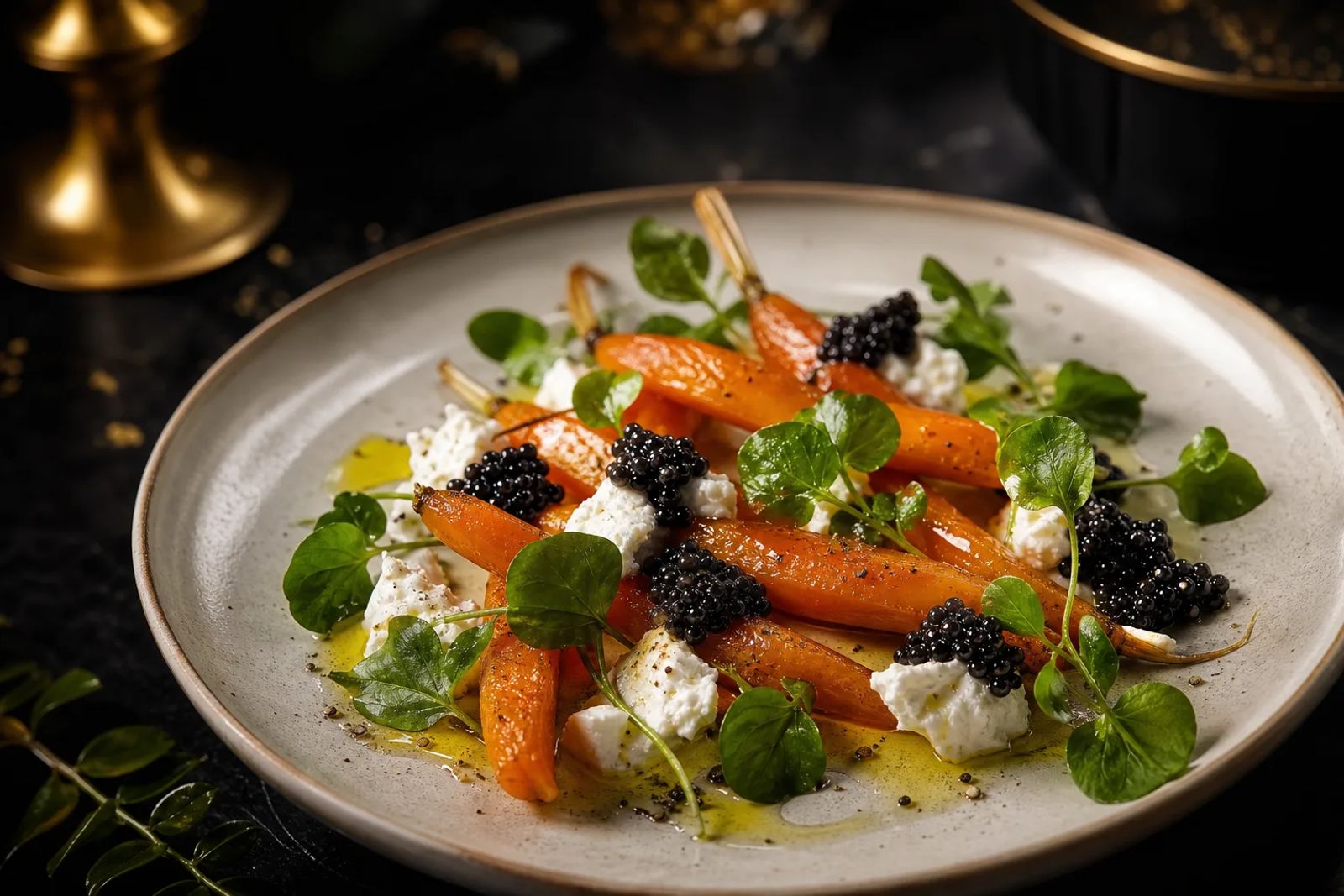
Caviar as a finishing seasoning means adding it to a completed dish just before serving, so its saltiness, flavour and separate beads become part of each mouthful. Think of finishing salt as a culinary analogy, not a gram-for-gram substitution: the garnish should season a bite, not take responsibility for the whole plate.
- Add caviar to finished sauces off the heat, immediately before serving.
- Published chef examples use 2 g per person with eggs and 10 g per person with carrot starters.
- Trout roe can add texture and salinity to a cold fish dish.
Why a little can make a difference
Roe means fish eggs. Cook and food writer Amelia Rampe describes caviar in beurre blanc as bringing little bursts of marine salinity; chef Nate Kuester explicitly uses trout roe for texture and salinity in his cold salmon dish. These are useful models for finishing: the roe contributes a recognisable flavour and a change of texture, rather than merely decorating the food.
Chef Thomas Wenger advises adding caviar to a finished sauce immediately before serving because heating diminishes its delicate flavour. The practical aim is to preserve that contribution alongside the salt and texture, not to cook the roe until it disappears into the base.
Food science offers a useful parallel, not a caviar-specific proof. Noort and colleagues studied bread with unevenly distributed salt and found that sensory contrast could maintain saltiness with less sodium. That helps explain the logic of distinct salty accents, but it does not establish how much salt a caviar garnish replaces in soup, fish or eggs.
Season the dish around the garnish
Start with the product you have, not an assumed salt level. Read its declared salt content where available, and taste a little with the food it will accompany; for the distinction between curing salt and perceived saltiness, see salt in caviar.
Chef Jacques Haeringer's sea bass recipe provides a sensible sequence: season the fish lightly, finish the cream reduction, remove it from the heat, stir in caviar, then taste and adjust. Following that approach at home, hold back some of your usual salt until you have tasted the combined mouthful, rather than making the base deliberately bland.
Our cooking recommendation is to make the seasoning decision on a representative forkful: fish with sauce and roe, or vegetable with its dressing and roe. If that combination already tastes balanced, leave the salt alone; if the ungarnished food tastes empty, adjust the base rather than assuming more caviar is the answer.
Dishes that suit a caviar finish
Cold fish can carry a sharply defined roe garnish. In Kuester's salmon mulhwe, a cold Korean fish preparation, trout roe sits on a pile of salmon and vegetables surrounded by broth. The useful lesson is separation: the roe remains a finishing component rather than being mixed through everything.
For a home version, choose one of those established combinations and treat the caviar as the final spoonful, not an ingredient for the blender.
Warm fish and sauces offer another route. Haeringer puts some caviar into an off-heat cream sauce for sea bass and reserves the rest for a dollop on top. Rampe's beurre blanc similarly receives its roe after the butter sauce has been made, giving a published model for finishing rather than simmering.
Chilled soups are particularly straightforward starting points. Wenger recommends caviar with cold cauliflower soup, potato soup and vichyssoise, the chilled leek and potato soup. For a home version, choose one of those established combinations and treat the caviar as the final spoonful, not an ingredient for the blender.
Vegetables need not be a secondary option. Kevin Mangeolles finishes carrots cooked in goat's whey with goat's curd, watercress and caviar, bringing the roe into a dish built around vegetables and dairy. Borrow the relationship, rather than all the restaurant technique: a distinct vegetable, a dairy element and a final roe garnish.
Eggs provide a useful small-portion example. Raymond Blanc and Gary Jones's published scrambled egg dish finishes with caviar after the eggs, sea urchin cream and other components are assembled. It demonstrates that the roe can be a brief final accent within a savoury dish, rather than the principal ingredient.
How much caviar should you use?
Use a published dish as your reference, because there is no single garnish weight that suits every plate. The Blanc and Jones recipe lists 4 g of caviar for two portions: 4 divided by two gives 2 g per person, in a dish that also contains sea urchin and seaweed.
Mangeolles lists 60 g for six carrot starters, which is 10 g per person by division. These are examples of different dishes, not the endpoints of a recommended range, and the carrot recipe's teaspoon instruction should not be treated as a universal conversion from spoonfuls to grams.
Choose where the beads land
A quenelle is an oval scoop formed with spoons, a presentation Great British Chefs describes for caviar and other soft foods. A small, unshaped spoonful is equally useful; Wenger's advice is to scoop caviar onto food rather than spread it, keeping the eggs intact.
A central mound keeps the garnish together, while several small deposits or scattered beads distribute it across the plate. Choose the pattern for how the dish will be eaten, not just how it looks from above.
Temperature and timing at the pass
At the pass means at the final plating stage, immediately before the food goes to the diner. Wenger says caviar should enter a finished sauce just before service, with no subsequent boiling or reheating; Haeringer likewise removes his sauce from the heat before adding it.
For warm dishes, the useful instruction is warm, not hot, at the point of contact with the roe. Rampe specifies warming beurre blanc only enough to serve alongside warm food, without simmering it. According to Rampe, warm the butter sauce gently without simmering, then stir in the roe.
A short method for finishing
-
Prepare the base completely. Cook the fish, vegetables or eggs, or finish and chill the soup according to its recipe; do not ask the roe garnish to complete the cooking.
-
Measure before plating. Weigh the recipe's caviar allowance and divide it between the dishes: Blanc and Jones's example uses 4 g across two portions. Keep the rest refrigerated according to its label.
-
Check a combined mouthful. Following Haeringer's seasoning sequence, taste the base with some roe before adding the last salt. Make any adjustment to the food or sauce, rather than salting the garnish.
-
Finish off the heat. Complete any reduction or reheating first, then plate the warm food or ladle the chilled soup. Put the caviar where a spoon or fork will naturally collect it.
-
Serve straight away. Have the other garnishes and the diners ready before the roe goes on; this is the final action, not something to do before finishing the rest of the meal.
Which roes work as finishing seasonings?
In May 2015, Giselle Wellman, then Petrossian's executive chef, recommended starting with caviar's flavour profile in the American Culinary Federation's magazine. The useful home-cooking lesson is to choose your prepared roe for the food beside it, rather than expecting a name to do the seasoning.
Trout roe has a clear chef precedent as a finishing seasoning: Kuester uses 5 g on each assembled salmon mulhwe for texture and salinity. Smoked trout roe changes the flavour direction, not just the colour; Rampe recommends it in beurre blanc specifically for the smoky note it brings.
The same magazine describes salmon roe as having a stronger flavour and being useful on pasta or baked potatoes. That makes it a distinct choice, not a neutral replacement; taste it against the base. For more elaborate restaurant applications, continue with chef techniques with caviar and the cooking with caviar hub.
Pressed, dried and powdered alternatives
Pressed caviar offers a way to season a condiment: Jean-Philippe Blondet pairs it with Greek yoghurt beneath scallops, an application to explore in pressed caviar. Dried caviar is another finishing format, documented by the American Culinary Federation as a product chefs can incorporate into dishes.
Powdered caviar applies the same idea in a ground form; the magazine describes Petrossian's dried caviar powder, and dried, grated and powdered caviar explains these formats separately from fresh beads. Grated bottarga is a parallel rather than the same ingredient: the Culinary Institute of America's Sicilian recipes use salted, dried roe as a seasoning, a technique to follow in bottarga pasta.
Sources
-
Amelia Rampe. Beurre Blanc with Caviar (or Smoked Trout Roe). Online recipe, 12 October 2026. Recipe.
-
StarChefs, chef Nate Kuester. New Zealand Salmon Mulhwe. Online recipe. Recipe.
-
Chef's Pencil, Thomas Wenger. How to Serve Caviar. Published 4 May 2011. Article.
-
Wageningen University & Research; Noort, M. W. J., Bult, J. H. F., Stieger, M. A. and Hamer, R. J. Saltiness enhancement in bread by inhomogeneous spatial distribution of sodium chloride. Journal of Cereal Science, volume 52, issue 3, pages 378 to 386, 2010. Research record.
-
Jacques Haeringer. Two for Tonight, PDF recipe collection, 2001, “Sea bass with caviar”, printed page 51. Recipe collection.
-
Great British Chefs, Kevin Mangeolles. Organic carrots cooked in goat's whey with caviar, watercress and goat's curd. First published 2015; retrieved web edition, November 2026. Recipe.
-
Great British Chefs, Gary Jones; recipe credited to Raymond Blanc and Gary Jones. Sea urchin with scrambled eggs and ossetra caviar. First published 2015; retrieved web edition, November 2026. Recipe.
-
Great British Chefs. Quenelle Versus Rocher: What's The Difference? Online edition, 2025. Article.
-
American Culinary Federation. National Culinary Review, May 2015, caviar feature. Includes Wellman's chef commentary, roe descriptions and attributed coverage of Petrossian's dried powder. Issue PDF.
-
The Staff Canteen, Jean-Philippe Blondet. Hand-dived scallop, citrus beurre blanc and Kristal caviar. Online recipe. Recipe.
-
The Culinary Institute of America. Sicily, PDF recipe collection, with recipes by Nancy Harmon Jenkins. Recipe collection.
Last checked: November 2026