
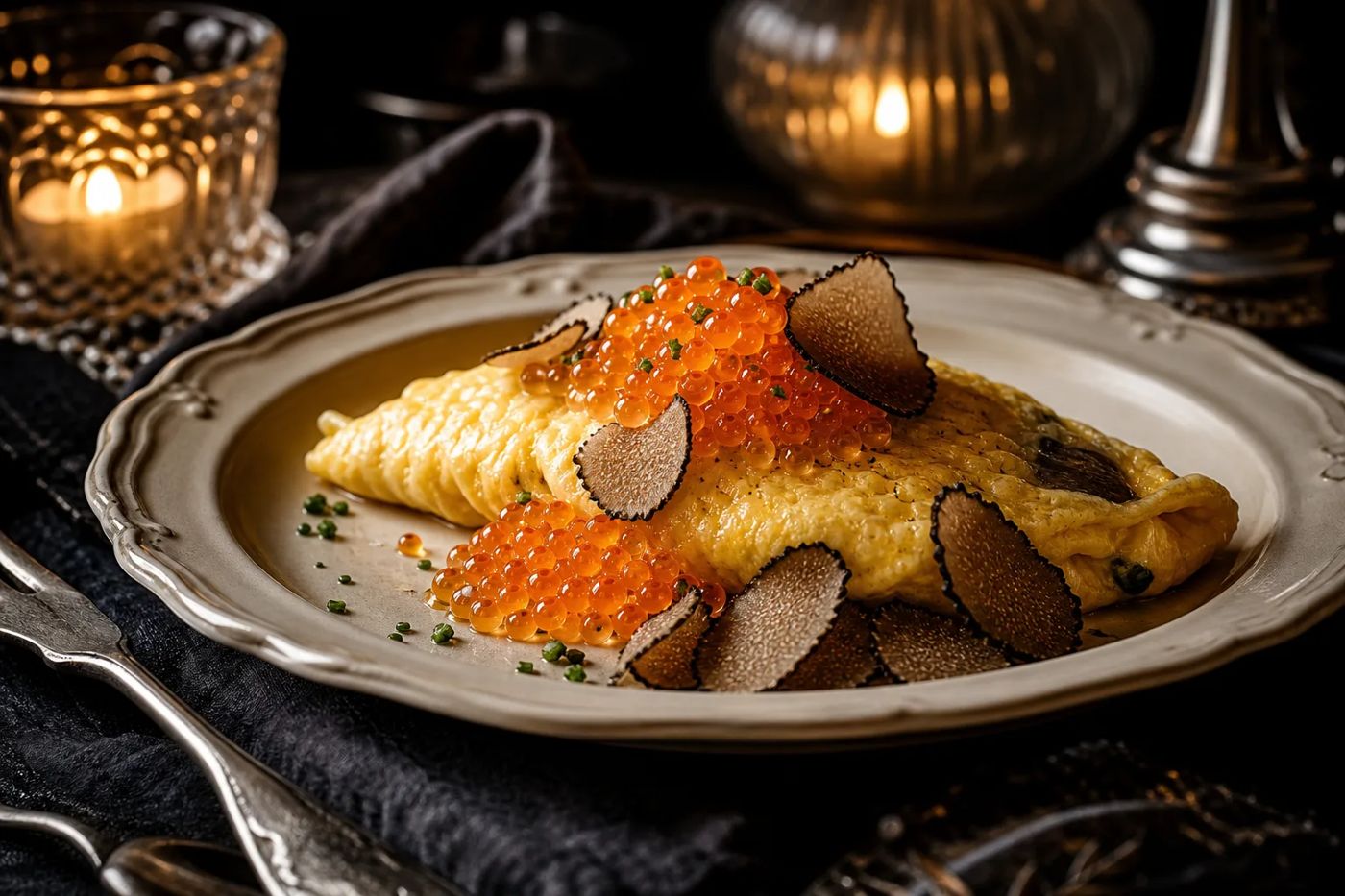
A truffle omelette with red caviar: in Isabel Allende's Aphrodite, that is the plan for an erotic overture. Food can send a powerful romantic signal. Whether it changes sexual desire is another question.
There is no reliable clinical evidence that caviar is an aphrodisiac, a substance that increases sexual desire or improves sexual performance. Its reputation belongs to culture rather than to a demonstrated effect of eating the roe.
What research says about caviar and desire
The decisive question is simple: does eating caviar change desire? A list of nutrients cannot answer it, nor can an effect observed in isolated cells. A persuasive study would compare people eating caviar with an appropriate control group, use validated measures of sexual function and account for expectations.
In their 2015 review, Elizabeth West and Michael Krychman searched English-language PubMed literature on sexuality, sex, aphrodisiacs and sexual enhancers. They covered selected foods, plant and animal products, vitamins, minerals and supplements. This was a review of research, not a single food trial or a pooled participant sample. Support varied between substances; the review did not establish caviar as an aphrodisiac.
Even promising findings need careful reading. Consider maca, an edible Andean root often marketed for sexual function. Shin and colleagues searched 17 databases to April 2010 for a systematic review, including four placebo-controlled randomised trials involving 131 participants. Some results favoured maca, but small samples and methodological weaknesses left the authors judging the evidence limited. Those findings concern maca preparations, not caviar or aphrodisiac foods as a group.
The romance behind the reputation
Rarity, status and special occasions offer a plausible explanation for caviar's romantic reputation. They help explain the association, although they do not establish where it began.
The distinction matters without diminishing the scene: food can express an intention without acting as a drug.
Allende's omelette gives that association a memorable literary form. In the excerpt from Aphrodite published on her own website, she describes planning the dish as an erotic overture. The caviar is part of a romantic message, not a measured physiological response. And the roe in this scene is red roe, rather than sturgeon caviar undergoing a clinical test.
The distinction matters without diminishing the scene: food can express an intention without acting as a drug.
Nutrients are not a shortcut to desire
Zinc, omega-3 fats and protein often carry the nutritional argument for caviar as an aphrodisiac. Each has nutritional roles. That does not mean a serving of caviar increases libido, particularly when a person's nutritional needs are already met.
Zinc makes the distinction clear. West and Krychman discuss its role in reproductive biology, but report insufficient human evidence that vitamin or mineral supplementation enhances libido. Normal fertility, testosterone levels, sexual desire and sexual performance are different outcomes. Evidence about one cannot stand in for evidence about another.
Omega-3 fats and protein face the same test. A figure showing what a food contains cannot tell us what it does to sexual function. There are therefore no nutrient amounts or supposed aphrodisiac doses given here. For the separate questions of dietary contribution and micronutrients, see caviar's health evidence and vitamins and minerals.
What expectation can change
Expectation can shape how people experience and report a change. That makes it important in research on sexual function, where feeling different and identifying the cause are separate tasks.
A 2018 meta-analysis by Weinberger and colleagues examined eight randomised trials using the Female Sexual Function Index, a questionnaire covering several aspects of sexual function. Across those studies, 1,723 women receiving placebo improved on that measure.
These were treatment trials, not experiments with romantic dinners. They illustrate why an improvement alone cannot identify what caused it. Nor should every improvement in a placebo group be credited to belief: changes over time, attention from researchers and altered behaviour can also contribute.
A shared meal may matter because of the relationship, the attention and the setting. Those are reasonable ways to understand a personal experience. They do not establish that caviar contains an aphrodisiac substance.
What food and advertising law allow
Calling a dish romantic is different from promising that eating it will increase sexual desire. Commercial claims face legal tests that a literary description or an independent discussion of a belief does not. The precise wording matters.
EU: Article 10 of Regulation (EC) No 1924/2006 generally prohibits commercial health claims unless they meet the regulation and are authorised. The EU register includes claims about zinc contributing to normal fertility and reproduction, subject to conditions. That does not permit a claim that caviar increases desire. No caviar aphrodisiac claim is authorised.
UK: Great Britain applies Regulation (EC) No 1924/2006 as amended for its market and uses the GB nutrition and health claims register. Northern Ireland generally follows the EU framework. An authorised nutrient claim does not authorise an aphrodisiac claim for caviar. Businesses must check the proposed wording and its conditions rather than rely on the food's reputation.
US: Under 21 CFR 310.528, labelling that promises increased sexual desire or improved sexual performance makes a product an aphrodisiac drug product. An over-the-counter aphrodisiac drug requires an approved new drug application; without it, the product is also misbranded. Under section 201(g) of the Federal Food, Drug, and Cosmetic Act, promotional claims can therefore affect whether a product is regulated as a drug.
Separately, the US Federal Trade Commission requires advertising claims to be truthful, not misleading and supported by competent and reliable scientific evidence. Its health-products guidance generally expects randomised controlled human clinical testing for health-benefit claims. Testimonials and speculation based on nutrients cannot replace that evidence.
Australia: FSANZ Standard 1.2.7 requires substantiated food-health relationships and other conditions for health claims. Some general level relationships can be substantiated through systematic review, but businesses must notify FSANZ before using them in claims. Traditional reputation alone does not meet the evidence requirement.

Enjoy caviar without the medical promise
Caviar does not need to be a remedy to have a place at a shared meal. Enjoying it with someone is a separate question from whether it changes sexual function. Treat the aphrodisiac story as a cultural association, and bring the same distinction between a plausible explanation and demonstrated evidence to other caviar myths and facts.
If changes in desire or sexual function concern you, speak to a doctor rather than using caviar as a remedy. That conversation is about your health and circumstances, not whether you have chosen the right food.
Sources
- West, E. and Krychman, M.; International Society for Sexual Medicine. Natural Aphrodisiacs: A Review of Selected Sexual Enhancers. Sexual Medicine Reviews, volume 3, issue 4, pages 279 to 288, 2015. Bibliographic record and abstract; retrieved full-text copy.
- Shin, B. C. and colleagues; BioMed Central. Maca (L. meyenii) for improving sexual function: a systematic review. BMC Complementary and Alternative Medicine, volume 10, article 44, 2010. Full text.
- Isabel Allende. Aphrodite, excerpt on the author's official website, undated web edition, retrieved 2026. Author's excerpt.
- Weinberger, J. M. and colleagues; American College of Obstetricians and Gynecologists. Female Sexual Dysfunction and the Placebo Effect: A Meta-analysis. Obstetrics & Gynecology, volume 132, issue 2, pages 453 to 458, 2018. Article and abstract.
- European Parliament and Council; EUR-Lex. Regulation (EC) No 1924/2006 on nutrition and health claims made on foods, 2006, particularly Articles 1 and 10. Official legal record.
- European Commission. EU register of health claims, information page and an EU Register on nutrition and health claims PDF generated on 14 February 2013. Register information; retrieved register PDF.
- Department of Health and Social Care. Great Britain nutrition and health claims (NHC) register, publication page updated 19 May 2026. Register publication page.
- Department of Health and Social Care. Nutrition and health claims: guidance to compliance with Regulation (EC) 1924/2006, web edition retrieved 2026, particularly sections 1.5, 1.6 and 6. Official guidance.
- US Food and Drug Administration. Rulemaking History for OTC Aphrodisiac Drug Products, web edition retrieved 2026, recording the final rule of 7 July 1989 and 21 CFR 310.528. FDA rulemaking record.
- US Food and Drug Administration. Label Claims for Conventional Foods and Dietary Supplements, web guidance retrieved 2026. FDA guidance.
- US Federal Trade Commission. Health Products Compliance Guidance, 2022. Official guidance.
- Food Standards Australia New Zealand. Nutrition, health and related claims, web guidance on Standard 1.2.7 and Schedule 6, retrieved 2026. FSANZ guidance.
Last checked: November 2026