
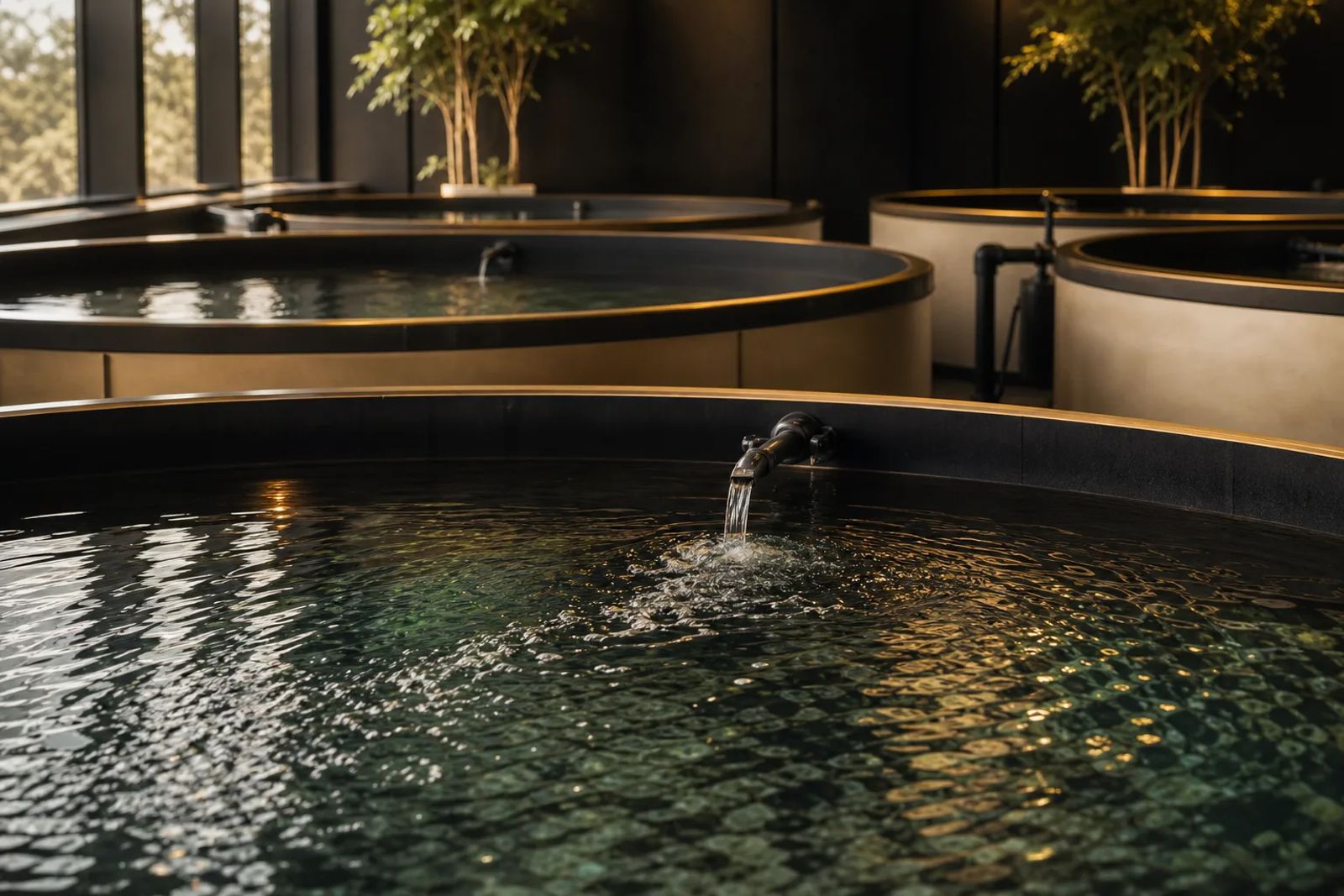
No, farmed caviar is not inherently worse. In a 2002 study using a trained IFREMER panel, species appeared to matter more than whether the fish were farmed or wild.
Quality depends on species, the fish's age and condition, water, feed, off-flavour control, handling and salting. Most legal caviar is now farmed. Lawful wild sources still exist, but “wild” on a label is only the beginning of their story.
Farming's rise is a production shift, not a new quality grade. EUMOFA's 2021 market report described nearly all marketed caviar as farmed, drawing on production evidence centred on 2018. It captures the broad direction, rather than a precise worldwide percentage for 2026: production estimates, reported CITES cross-border trade and annual export quotas measure different things. The distinction belongs among caviar myths and facts: provenance and quality answer different questions.
What makes farmed caviar different?
The differences begin with what the fish eat and where they live. Wild sturgeon encounter changing food supplies, temperatures and habitats; farmed fish receive managed diets under controlled husbandry. These conditions can change growth, maturation and the fats deposited in eggs. They do not create a simple quality ladder. For the biology behind this, see how farmed sturgeon differ from wild sturgeon.
| Difference | What research shows | Source |
|---|---|---|
| Diet and egg fats | Caviar from 34 wild and 12 farmed fish differed in fatty acids, with more linoleic acid in farmed samples. | Wirth and colleagues, 2002. |
| Species and rearing | In a preliminary comparison, a trained sensory panel found species appeared more influential than rearing. | Cardinal and colleagues, 2002. |
| Salting and processing | Processing changed water, protein and fat concentrations. Salt levels can complicate comparisons of wild and farmed caviar. | Gessner and colleagues, 2002. |
The fatty-acid study compared actual wild and farmed material, rather than marketing descriptions. Its species were not perfectly matched between groups, however. Higher linoleic acid tells us something specific about those samples' composition, not which caviar someone would prefer or whether farmed roe is uniformly fattier.
Age alone is no shortcut to quality, either. An older wild fish is not automatically a better source of roe. Comparing fish of different species, maturity or reproductive condition cannot isolate the effect of farming. What matters is collecting eggs at the right developmental stage and processing them well, rather than finding the fish that lived longest.
Does wild caviar taste better?
The sensory evidence establishes no general preference for either origin. Cardinal, Cornet and Vallet's 2002 study used a trained IFREMER panel to assess appearance, odour, flavour and texture. Its samples included caviar from pond-reared and Danube-caught starry sturgeon, processed under the same conditions.
Across their samples, the authors found that species appeared to matter more than rearing. Some farmed caviar had earthy flavours, but farmed Siberian sturgeon did not inevitably have that character. The study was preliminary, could not fully separate species and processing effects, and was not a worldwide consumer preference trial.
The useful test is a matched, blind comparison. Match species, maturity, salt, processing, storage and sample age, then conceal the origin from tasters. That is the fair way to compare wild and farmed caviar.
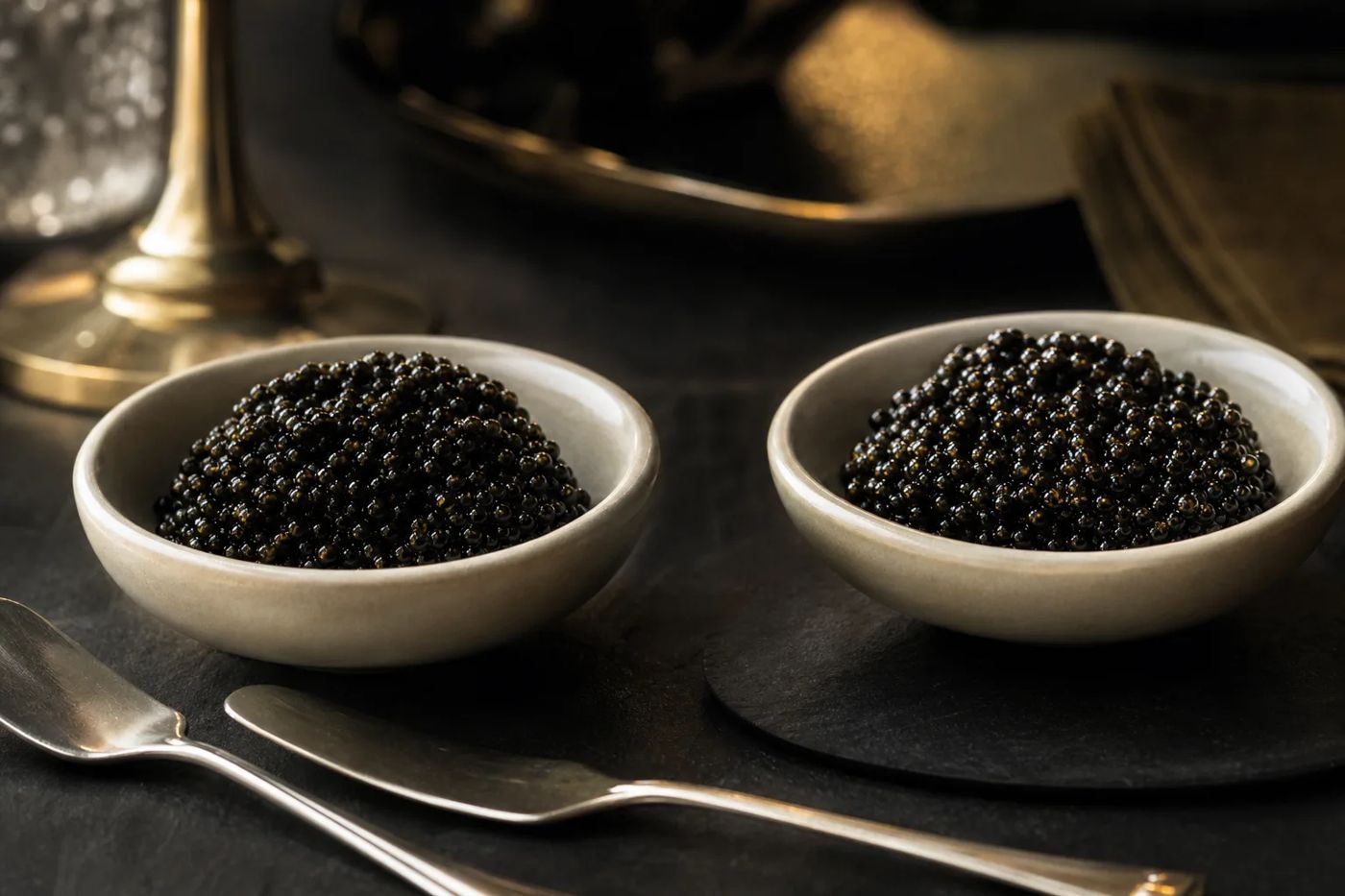
Earthy flavour is a management question
Earthiness is a real quality concern. It is also a reason to ask better questions about a farm, rather than dismiss farmed caviar altogether. The sensory study found it in some samples, not as an unavoidable consequence of farming. Water management and pre-harvest checks tell a reader more than a romantic account of the fish's surroundings.
Ask about purging: the clean-water holding stage before harvest. Then ask how the producer assesses the resulting roe. A stated holding time alone cannot guarantee that off-flavour has gone; the procedure and the evidence behind it matter. See purging farmed sturgeon: earthy off-flavours and the evidence for the mechanisms and limits.
Why processing can outweigh provenance
Salt changes the comparison. Gessner's processing research found that salt-driven water loss concentrated proteins and fats, altering the apparent composition of finished caviar. Analysis of the processed roe therefore cannot automatically describe the living fish.
Set a freshly prepared farmed sample beside an older, more heavily salted wild sample and several differences compete for attention. Origin is only one of them. Handling and salting belong alongside the fish's history in any serious quality discussion. Ask how the particular lot was prepared, rather than whether the seller considers wild or farmed caviar superior.
Can you legally buy wild caviar today?
Yes, in some circumstances. Identify the species, fishery, country and destination before going further. In March 2026, Missouri's conservation department reported that regulated commercial shovelnose sturgeon harvest continued in specified Mississippi River pools upstream of St Louis. Permission for a domestic harvest does not also grant permission to export it.
Tennessee's commercial rules also provide for licensed paddlefish roe harvest, subject to restrictions.
Paddlefish is not a sturgeon, although CITES and US wildlife controls cover both groups. The Codex Standard for Sturgeon Caviar covers sturgeon roe, not paddlefish roe. FDA guidance recommends naming nonsturgeon fish equally prominently alongside “caviar” and prominently declaring artificial colour. Neither American fishery creates a legal route for wild Caspian roe.
On 27 November 2025, Russia's fisheries agency reported that the Caspian fishing and caviar export ban had been extended through 2026, except for research and breeding. The reported agreement concerns shared Caspian sturgeon stocks.
CITES export quotas concern international trade, not retail quality. For shared stocks, check the applicable quota and other trade conditions for the species, origin and year. CITES publishes export quotas by species, country and year.
Importing wild caviar
- EU: Commercial imports of Annex B caviar normally require an export or re-export document and an EU import permit under Regulation (EC) No 338/97. Shared-stock quota requirements and import restrictions also apply.
- Great Britain: APHA requires CITES import and export documentation for relevant movements, including trade with the EU. Check current import suspensions and the species listing. An overseas seller's assurance is not clearance.
- Northern Ireland: According to APHA, relevant movements between Northern Ireland and Great Britain require CITES permits.
- United States: Commercial international trade in wild sturgeon or paddlefish products requires the applicable CITES documentation. Imports of beluga caviar originating in the Caspian Sea and Black Sea basins were suspended in 2005. According to the US Fish and Wildlife Service, those basin suspensions also cover personal effects.
Switzerland, the UAE, China, Japan, Russia and Australia also have national CITES requirements. Personal exemptions may cover 125 g in labelled containers, subject to national prohibitions.
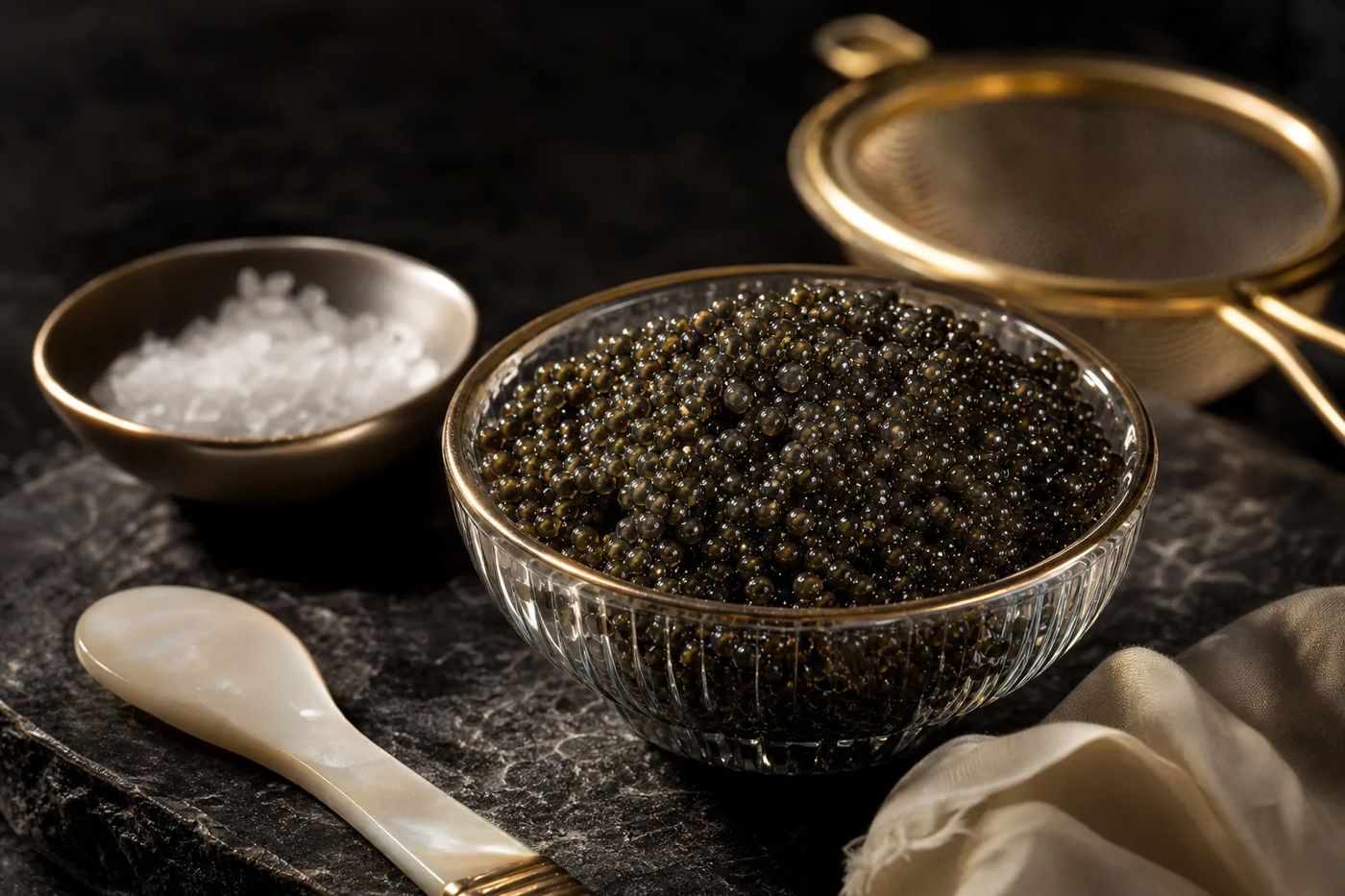
What “wild” on a label actually means
A CITES source code records documented origin. It is not a sensory grade. Resolution Conf. 12.3 (Rev. CoP20) distinguishes the following categories:
- W: Taken from the wild.
- C: Bred in captivity according to Resolution Conf. 10.16, with its breeding-stock and breeding-operation criteria.
- F: Born in captivity, but not meeting that resolution's definition of bred in captivity.
- R: Ranched: reared under controlled conditions after collection as wild eggs or juveniles that otherwise had a very low probability of reaching adulthood.
C and F are not interchangeable. Nor does R simply mean “farmed”. These four codes are part of a longer CITES list; see CITES source codes explained: W, R, F and C. CITES Decisions 20.153 and 20.154 commission a review of aquatic ranching. Neither a source code nor the word “natural” proves flavour or quality.
A wild claim needs evidence, not romance
Undocumented “wild Caspian” claims are a serious provenance problem. TRAFFIC's 2018 market assessment documented weaknesses in caviar labelling and opportunities for illegally sourced wild roe to enter trade. A CITES label supplies traceability information; it does not independently verify the contents.
Scrutiny should work in both directions.The attractive story on the label must stand up to the documented origin.
Quality and conservation are different questions
Good caviar and healthy wild stocks are separate achievements. Farming now dominates production, but overexploitation and disrupted river habitats remain central conservation concerns. Producing roe on farms does not, by itself, restore migration routes or prevent poaching.
Assess environmental claims through is farmed caviar sustainable?. Neither “wild” nor “farmed” is a complete environmental verdict, any more than either word is a reliable tasting note.
Sources
-
European Commission, EUMOFA. The caviar market. 2021 edition, production evidence principally for 2018 and trade evidence through 2020. Publication record and summary.
-
Wirth, M., and colleagues. Fatty Acid Composition in Sturgeon Caviar from Different Species: Comparing Wild and Farmed Origins. International Review of Hydrobiology, volume 87, pages 629 to 636, 2002. Research article.
-
Cardinal, M., Cornet, J., and Vallet, J. L., IFREMER. Sensory Characteristics of Caviar from Wild and Farmed Sturgeon. International Review of Hydrobiology, volume 87, pages 651 to 659, 2002. Research article.
-
Gessner and colleagues. Processing techniques for caviar and their effect on product composition. International Review of Hydrobiology, volume 87, pages 645 to 650, 2002. Research article.
-
Fishes. Sturgeon Meat and Caviar Quality from Different Cultured Species. Volume 5, article 9, 2020. Research article.
-
CITES Secretariat. Export quotas. Live explanatory page, undated, checked November 2026. Official guidance.
-
CITES Secretariat and UNEP-WCMC. CITES Trade Database. Database version 2026.1. Database.
-
CITES, reproduced by UNEP InforMEA. Permits and certificates, Resolution Conf. 12.3 (Rev. CoP20). Resolution record and text.
-
CITES Secretariat. CITES glossary. Undated live reference, checked November 2026. Official glossary.
-
European Commission. EU Wildlife Trade Reference Guide, section 3.5, export and re-export documents and shared-stock caviar quotas; and Wildlife trade. Live editions, checked November 2026. Reference guide; wildlife-trade overview.
-
APHA and Defra. Check if you need a CITES permit to import or export endangered species. Live guidance, checked November 2026. Official guidance.
-
US Fish and Wildlife Service. 3-200-76: Export of Caviar or Meat of Paddlefish or Sturgeon Removed from the Wild under CITES. Live permit guidance, checked November 2026. Official guidance.
-
United States, Code of Federal Regulations. 50 CFR 17.44(y), Beluga sturgeon. Current text reproduced by Cornell Legal Information Institute, checked November 2026. Regulatory text.
-
Missouri Department of Conservation. Bring Back the Sturgeons. Missouri Conservationist, March 2026. Departmental article.
-
Tennessee Fish and Wildlife Commission. Proclamation 25-03, Commercial Fishing. 2025 proclamation, including provisions effective August 2026. Official proclamation.
-
Russian Federal Agency for Fisheries, Upper Ob administration. Conserving valuable fish stocks: Caspian countries agree to extend the commercial sturgeon fishing ban. November 2025 report of the ninth Caspian Commission session, covering 2026. Official report, in Russian.
-
Harris, L., and Shiraishi, H., TRAFFIC and WWF. Understanding the Global Caviar Market. July 2018. Report and publication details.
-
Russian Federal Agency for Fisheries. The celebrated royal fish, departmental account of Russian sturgeon conservation and aquaculture. 26 March 2026. Official article, in Russian.
Last checked: November 2026