
Kaluga Queen is the caviar brand of Hangzhou Qiandaohu Xunlong Sci-tech Co., Ltd., a Chinese sturgeon-farming and processing group whose operational headquarters are in Quzhou, Zhejiang. Its name does not identify the fish inside a tin. According to its prospectus, the company sells hybrid, Russian, Kaluga, beluga, Amur and Siberian sturgeon caviar.
House facts
| Founded | Company established in April 2003; Kaluga Queen brand launched in 2005, according to its prospectus. |
| Operator and brand owner | Hangzhou Qiandaohu Xunlong Sci-tech Co., Ltd. |
| Ownership | Joint stock company with shareholders, not a separately identified parent company; see ownership discussion below. |
| Headquarters | No.1 Xunlong Road, Shishi Township, Kecheng District, Quzhou, Zhejiang, China. |
| Role | Sturgeon breeder, farmer, caviar processor, exporter and brand operator. |
| Farming locations | Eight bases documented in the 2026 prospectus, across seven Chinese provinces. |
| Processing locations | Quzhou, Zhejiang, and Zhelin Lake, Jiangxi, documented as operating in the prospectus. |
| Roe sourcing | Own farming operations, supplemented by purchased live sturgeon; not exclusively fish bred and raised internally. |
| Reported stock | Hybrid, Russian, Kaluga, beluga, Amur and Siberian sturgeons, held in China. This does not establish the species sold in every tin. 1 |
| CITES registration | CITES registration concerns individual processing and repackaging facilities. |
| Checked | November 2026 |
These are company-level facts, not a specification for every shipment or retail tin. For comparisons with other operators, start with the caviar houses and producers guide.
Who operates Kaluga Queen?
The legal name in its Hong Kong exchange filings is Hangzhou Qiandaohu Xunlong Sci-tech Co., Ltd., 杭州千岛湖鲟龙科技股份有限公司. The filings describe a group comprising the company and its subsidiaries, rather than Kaluga Queen as an independent farming company. The registered office in Qiandaohu Town, Chun'an County, and the operational headquarters in Quzhou are different addresses; neither should be substituted for the location where a particular batch was farmed.
The prospectus identifies chairman and general manager Wang Bin within its single largest shareholder group. That is not the same as saying he personally owns the entire business, or that one holding company is its sole parent. The September 2026 interim report continues to identify the same listed issuer, stock code 06715.
Where the fish are farmed
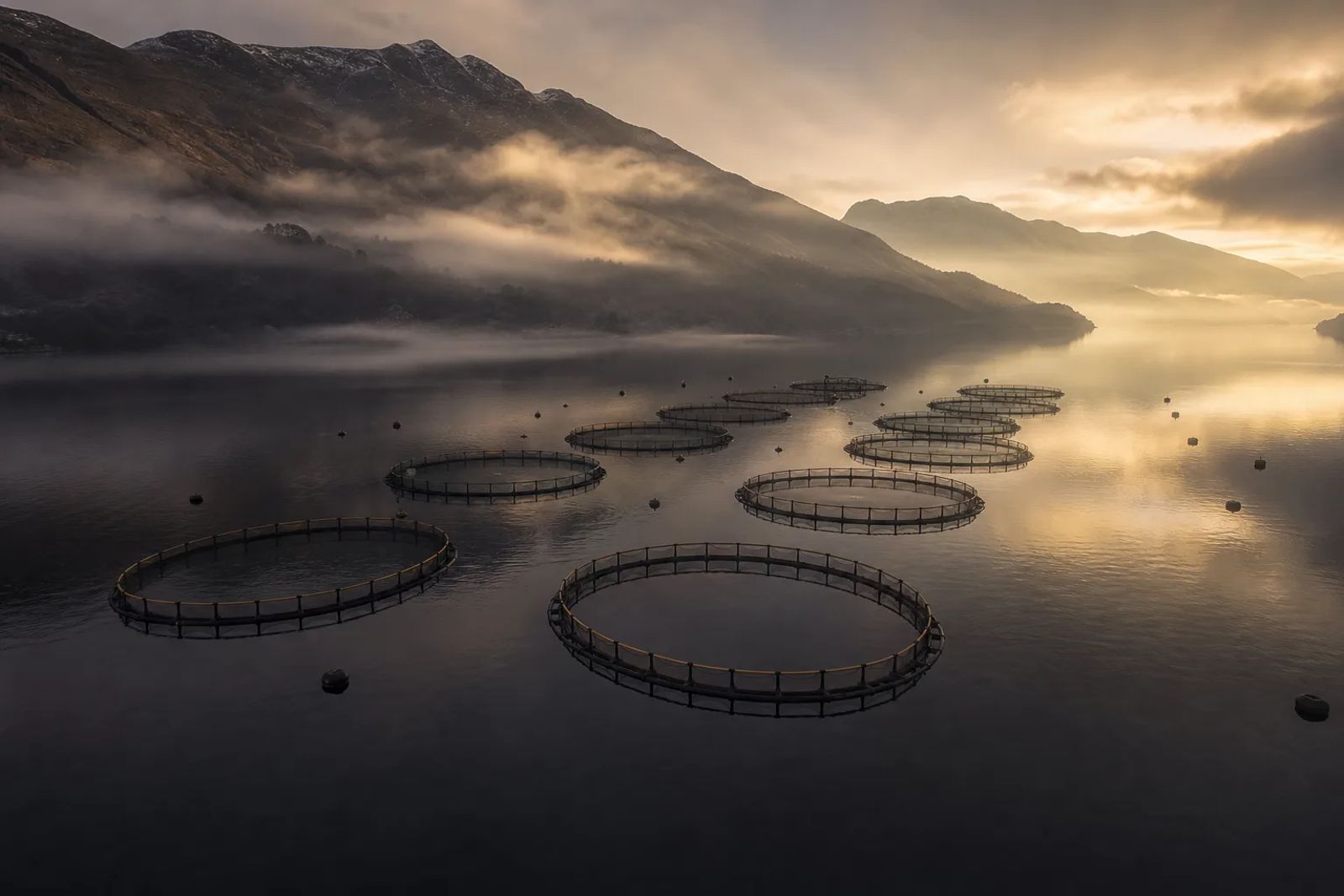
Qiandao Lake is part of the story, not the whole production map. The company's prospectus records bases at Quzhou and Qiandao Lake in Zhejiang; Qingshan Lake in Liaoning; Yingjing in Sichuan; Zhelin Lake in Jiangxi; Baokang in Hubei; Ningxiang in Hunan; and Sishui in Shandong. These are the company's locations, not a list of every Chinese caviar farm.
A lake-associated brand should therefore not be read as a promise that every fish spent its whole life in that lake.
The farming systems are not uniform. Qiandao Lake is documented as net-cage aquaculture, while the Quzhou base combines land-based flow-through farming with recirculating aquaculture, in which water is treated and reused. A lake-associated brand should therefore not be read as a promise that every fish spent its whole life in that lake.
Company-authored documentation lodged in a US wildlife-rulemaking docket describes breeding and hatchery operations and Russian sturgeon propagation. The prospectus also describes the company's sturgeon breeding operations. The wider geographical history belongs in China's caviar story.
Processing and external sourcing
Farming, processing and exporting are separate activities, even within one group. The prospectus identifies operating processing bases at Quzhou and Zhelin Lake, while describing a further Sichuan processing project as under construction. A planned plant is not an operating facility, and a farm address is not automatically a processing registration.
The company also discloses supplementary purchases of live sturgeon from independent suppliers. Consequently, “produces its own caviar” should not be expanded into “breeds and raises every fish itself”. According to the prospectus, the company supplements its farming operations with purchases of live sturgeon from external suppliers.
What Kaluga Queen means on a tin
The brand name is not a species declaration. Kaluga is the species CITES lists as Huso dauricus. The company reports holding Russian sturgeon, Acipenser gueldenstaedtii; Siberian sturgeon, Acipenser baerii; Amur sturgeon, Acipenser schrenckii; beluga, Huso huso; and hybrid stock. Stock records alone do not establish which fish supplied a particular tin.
For the familiar cross of a male Amur sturgeon, Acipenser schrenckii, with a female Kaluga, Huso dauricus, the CITES-style code is SCHxDAU. The male parent's code comes first, as explicitly required by US wildlife regulations. Do not reverse the parentage merely because a farming description writes “Kaluga × Amur”, or assume a brand name supplies missing parent information.
Read the Kaluga hybrid profile for the cross, and the pure Kaluga profile for the species. Those distinctions matter more than a retailer's shorthand, especially when comparing tins sold under similar names.
Scientific names differ between classifications. A 2025 proposal used Sinosturio dauricus; the IUCN Sturgeon Specialist Group and World Sturgeon Conservation Society rejected that proposal and supported a classification using Acipenser dauricus, which WoRMS also lists. This profile retains Huso dauricus for CITES identification.
What it is known for
The prospectus describes an integrated Chinese production network farming several sturgeon species across multiple locations. Its commercial visibility should be separated from sensory judgement: the prospectus's descriptions of flavour and texture are company claims, not independent assessments of individual batches.
The 2026 prospectus reports a 36.1% share of global caviar sales by volume in 2025, using research commissioned from China Insights Consultancy. That is a dated, commissioned estimate, not an independently audited global production census. It concerns the company's sales, not all Chinese caviar, and sales volume should not be silently relabelled as production.
Airline, restaurant and event associations are best treated as dated supplier claims unless the customer confirms them. A historic appearance on a menu cannot identify today's supplier, and a producer's restaurant tally is not a substitute for the species, origin and batch information on the tin being served.
Reading origin and repacking details
Under the CITES caviar labelling system, CN identifies China as the country of origin. The original processor's details and a later repacker's details serve different purposes: moving caviar into a new primary container creates a repacking step, not a new farming origin. A primary container is the tin or jar directly touching the roe.
Under the international labelling system, repacked caviar retains its original country field while identifying the repackaging plant and repackaging year. Thus a European repacker's address can legitimately coexist with Chinese origin. For that distinction, see origin versus repacking. A CITES label provides traceability information, not laboratory proof of the contents.
Do not use a label to infer that every Chinese-origin tin was made by Kaluga Queen. To establish that connection after another business repacks it, request the original processing identity and the batch records linking it to the new lot. A national origin code identifies a country, not a particular supplier.
Registration and importing checks
Business registration, CITES plant registration and food-export approval answer different questions. The CITES register principally concerns processing and repackaging operations, not every brand, retailer or farm.
China's CITES Management Authority and customs records should be checked against the exporting legal entity, not only the brand. According to the prospectus, the group holds export food production registrations. The producer register guide explains how to match a facility rather than a trading name.
For EU commercial imports, wildlife-trade documentation and caviar labelling are separate from food-import eligibility and establishment checks. Regulation (EC) No 865/2006 provides the EU labelling framework; an attractive retail label does not replace consignment documentation. For a UK shipment, ask the importer to identify the applicable route explicitly for Great Britain or Northern Ireland, rather than treating EU clearance as sufficient.
In the US, international trade in sturgeon caviar is subject to the applicable labelling and documentation provisions of 50 CFR 23.71. FDA's nonbinding guidance uses unqualified “caviar” for salted sturgeon roe; other roe needs the fish name in substantially equal type size and prominence, with artificial colour prominently declared. The company's reported beluga stock does not establish permission to import beluga caviar.
Sources
-
Hangzhou Qiandaohu Xunlong Sci-tech Co., Ltd. Global Offering Prospectus, 22 June 2026. Company disclosure. Prospectus.
-
Hangzhou Qiandaohu Xunlong Sci-tech Co., Ltd. Interim Report 2026, published 23 September 2026. Interim report.
-
Hangzhou Qiandaohu Xunlong Sci-tech Co., Ltd. Russian Sturgeon Farming and Breeding in Hangzhou Qiandaohu Xunlong Sci-tech Co. Ltd. (“Kaluga Queen”), undated company submission, retrieved November 2026. Published as an attachment in US Fish and Wildlife Service rulemaking docket FWS-HQ-ES-2021-0073. Its presence in a government docket does not make its assertions government findings. Company submission.
-
European Commission. EU Wildlife Trade Reference Guide, Annex XIV, “Caviar labelling”, undated online edition retrieved November 2026. Explains Regulation (EC) No 865/2006, Article 66, and the CITES processing and repackaging system. Reference guide.
-
United States, Code of Federal Regulations. 50 CFR 23.71: How can I trade internationally in sturgeon caviar?, online text retrieved November 2026, reproduced by Cornell Law School's Legal Information Institute. Regulatory text.
-
US Food and Drug Administration. CPG Sec. 540.150: Caviar, Use of Term, Labeling, October 1989, online guidance retrieved November 2026. Nonbinding naming guidance, separate from wildlife-trade regulation. FDA guidance.
-
World Sturgeon Conservation Society. IUCN SSG summary report, Paolo Bronzi, 13 November 2025. Records the October 2025 discussion of proposed sturgeon classifications. Workshop summary.
-
WoRMS Editorial Board. World Register of Marine Species, Acipenser taxonomic listings, continually updated database, retrieved November 2026. Lists Acipenser dauricus among the names readers may encounter.
Last checked: November 2026