
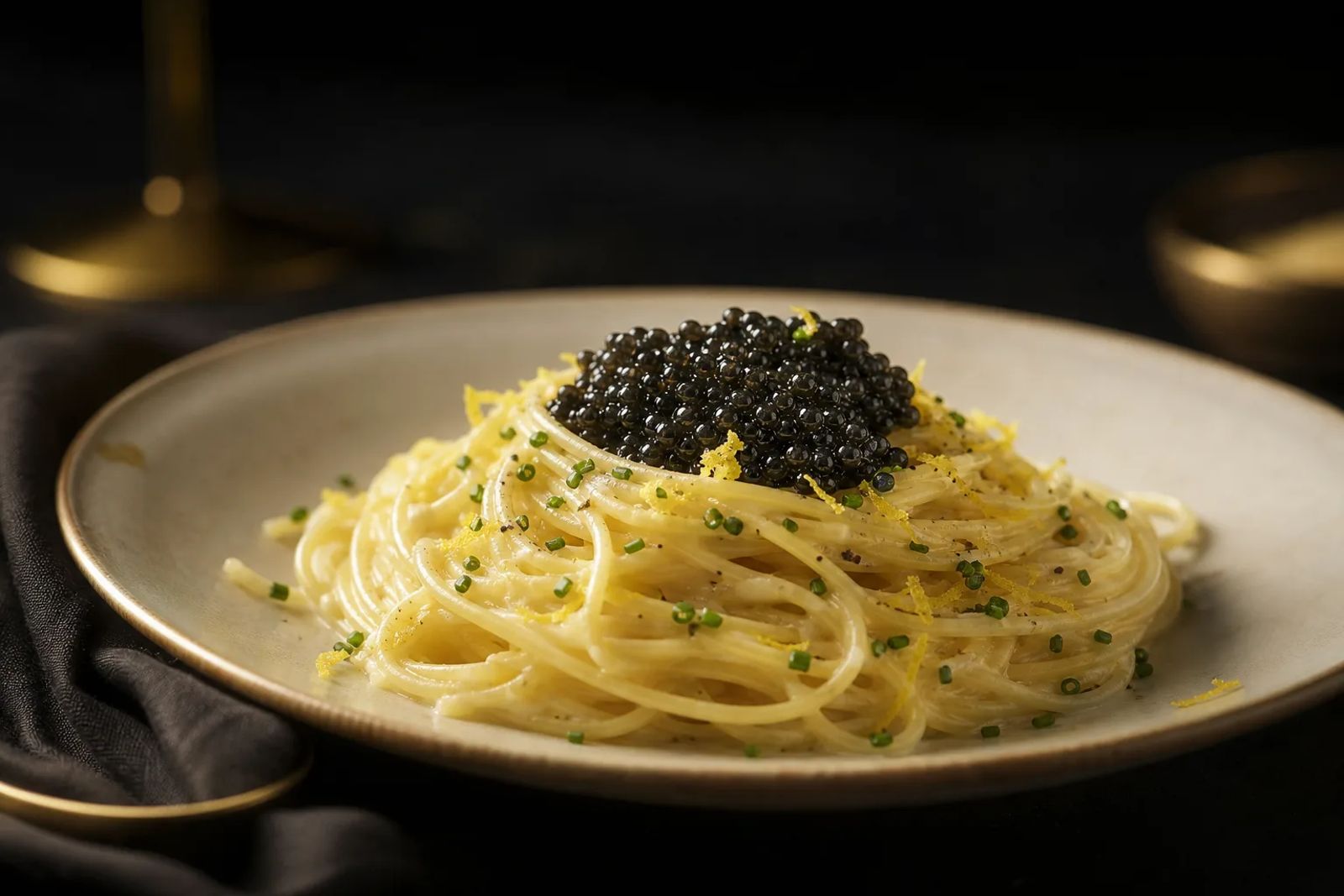
A spoonful of caviar lands on warm pasta, the eggs distinct against the sauce. That final moment is the key to the dish: finish the pasta and sauce first, then add the roe.
Toss off the heat, spoon the caviar onto each plate and serve immediately. Keep it as the topping, rather than simmering it into the sauce.
Which pasta suits caviar pasta?
A plain, fine strand is the practical choice: easy to coat lightly and gather into a forkful with a few eggs. GialloZafferano uses fresh egg tagliolini with a butter sauce loosened with cooking water, finishing with a wild fennel garnish. Its simple dressing lets the caviar take centre stage.
The recipe below follows chef Ludo Lefebvre’s published version and uses dried spaghetti. Fresh egg pasta offers another route, but do not substitute it weight for weight.
Caviar pasta with lemon cream
This adaptation of Ludo Lefebvre’s recipe uses metric measures, replaces heavy cream with double cream and finishes by tossing the pasta off the heat. The quantities retain the original yield of four to six, with the caviar divided between the plates.
Serves: 4 to 6
Time: 20 minutes for Lefebvre’s original recipe
Caviar per person: about 9.5 to 14 g, from 57 g divided between six or four
Equipment: large saucepan, wide frying pan, tongs, measuring jug, serving spoon
Allergens: fish, milk and wheat; egg if present in the pasta. Check the wine label for sulphites.
Ingredients
- 454 g dried spaghetti
- 28 g unsalted butter
- 15 ml lemon juice
- 120 ml dry white wine
- 180 ml double cream
- 57 g (about 2 oz) salted, unpasteurised Russian sturgeon caviar (Acipenser gueldenstaedtii)
- Salt and pepper, to taste
- Up to 240 ml reserved pasta water
Method
- Boil the spaghetti in salted water until al dente, following its packet. Reserve the cooking water before draining.
- Meanwhile, melt the butter gently. Add the lemon juice and wine; simmer for about 1 minute. Add the cream and simmer for about 5 minutes.
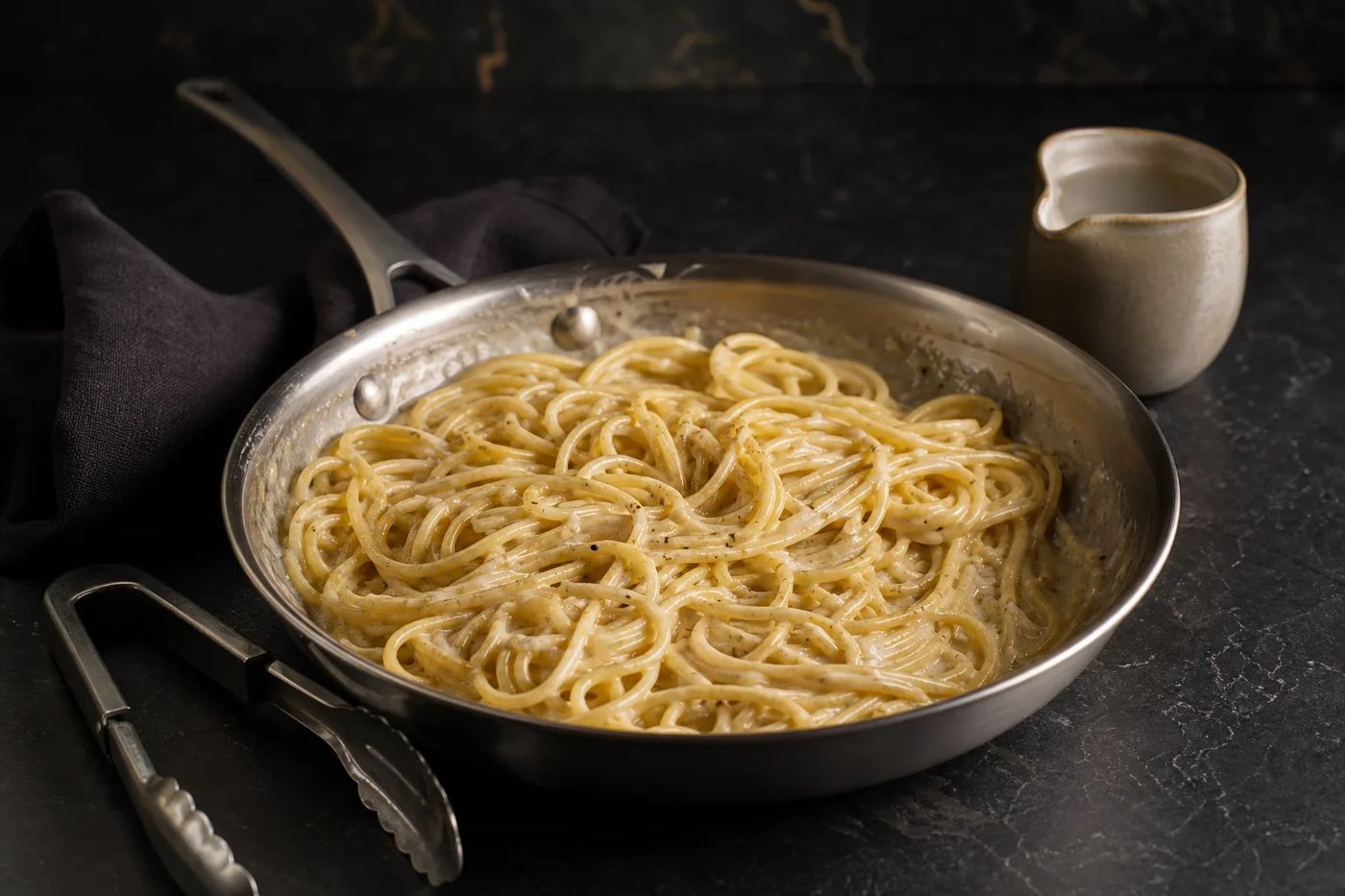
- Take the sauce off the heat. Toss with the drained pasta, adding reserved water until the strands are lightly coated.
- Divide between warm plates, spoon the caviar on top and serve at once.
This version specifies the species and unpasteurised style; Lefebvre’s original does not. The metric quantities are rounded conversions of his US measures, not a claim that this adaptation has been kitchen-tested.
Season for the whole forkful
Fish retailer Bacalalo describes caviar as the salty element in its finished butter pasta. Apply that principle here: salt the cooking water more cautiously than for a sauce without roe, and use the unsalted butter specified rather than salted butter followed by automatic seasoning. Before adding extra salt or pepper, taste a small forkful of dressed pasta with a little of its caviar allocation. Judge that complete bite: pasta tasted alone leaves the topping’s salt out of the reckoning.
Keep the caviar out of the pan
The sauce belongs on the hob. The caviar does not. A 2004 paper by Al-Holy and colleagues notes that conventional pasteurisation harms caviar’s texture, colour and flavour. That is evidence from processing, rather than a measured temperature limit for a plate of pasta.
Finish the sauce before adding the topping, and never return the garnished pasta to the hob. The useful distinction is between warming caviar through contact with the food and deliberately cooking it.
Bacalalo’s method calls specifically for warm, not hot, plates and adds the caviar at the last minute. Follow that approach here. Have everyone ready to eat before draining the pasta, then take the finished plates straight to the table. Do not hold them warm for later.
Butter, crème fraîche and other roe
- Butter only: GialloZafferano melts butter, adds a ladle of pasta water and stirs the fat and water together into an emulsion. Choose this instead of the lemon cream sauce, rather than adding more butter to the same pan.
- Crème fraîche: this cultured cream brings a tangy taste. Babish publishes a creamy, tangy caviar pasta, although the full recipe is not publicly visible. Melina Hammer’s trout roe pasta combines crème fraîche with lemon zest and juice in a mixing bowl.
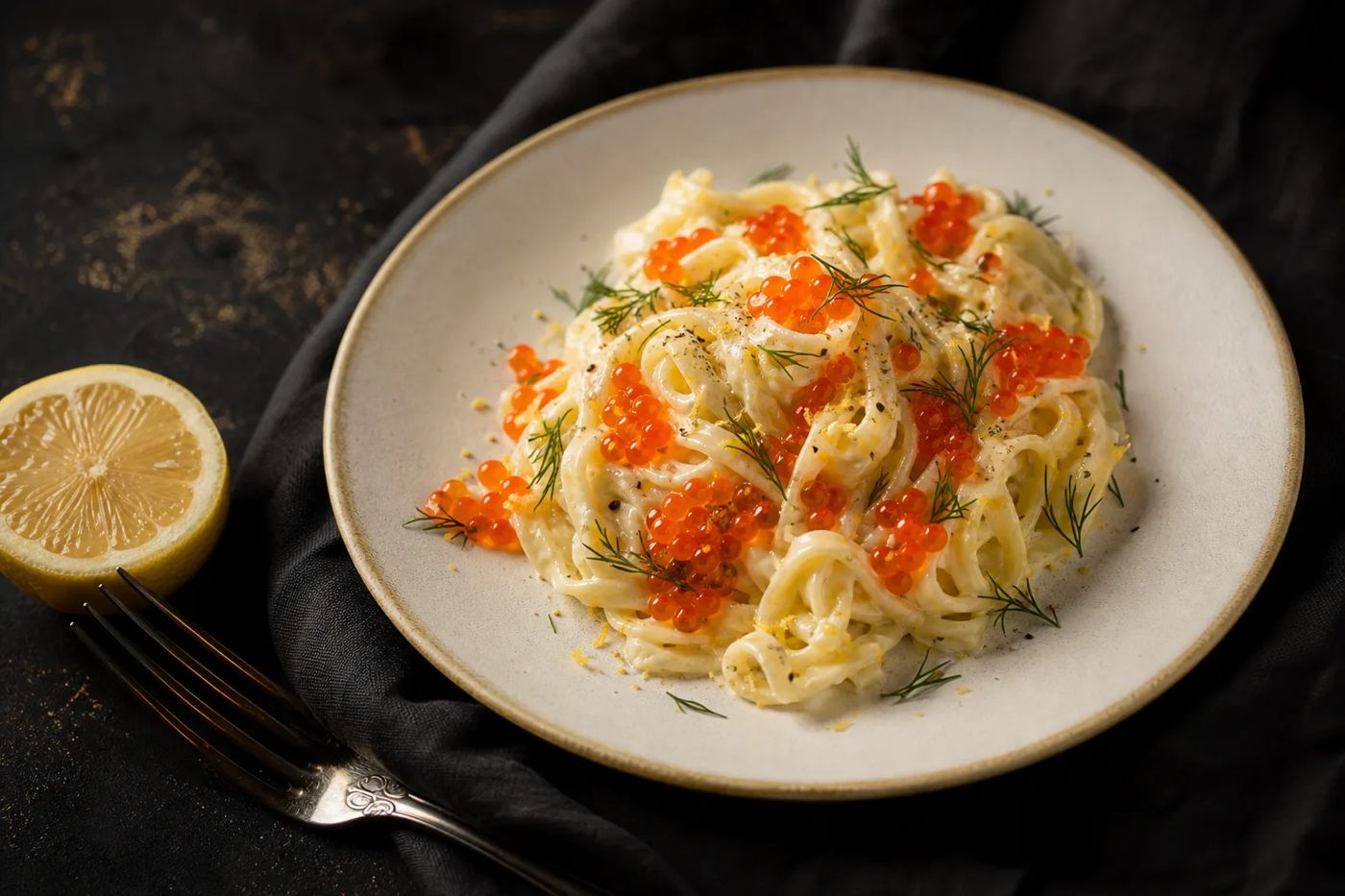
- Salmon or trout roe: either can replace the sturgeon caviar topping. Hammer explicitly suggests salmon roe as an alternative to trout roe. For this adaptation, keep either roe on the plate rather than folding some through the pasta, as Hammer does in her original recipe.
Other roe pastas take a different approach: bottarga pasta uses salted, dried roe, while mentaiko pasta works seasoned pollock roe into the dressing rather than leaving a distinct topping.
Where to go next
- Caviar Recipes: explore more dishes finished with a spoonful of roe.
- Caviar Beurre Blanc: follow the separate method for a butter emulsion with an acidic reduction.
Sources
- Ludo Lefebvre. Caviar Pasta. Original quantities, yield, timing and method. Chef’s recipe.
- GialloZafferano. Tagliolini with caviar. Undated online edition, retrieved November 2026. Fresh egg pasta, butter and cooking-water emulsion, plated caviar and immediate service. Recipe.
- Bacalalo, Maria José Sáez Pastor. Caviar: How to Eat It, Serve It, and 6 Recipes to Enjoy It. 8 March 2026. Retailer's advice, used specifically for warm rather than hot plates, last-minute topping and the seasoning principle. Article.
- Babish Culinary Universe. Leftover Caviar Pasta. Undated online edition, retrieved November 2026. Butter, crème fraîche, lemon and pasta-water sauce. Recipe.
- Melina Hammer. Crème Fraîche Pasta with Trout Roe. Online edition, publication year not displayed, retrieved November 2026. Mixing-bowl sauce and salmon roe alternative. Recipe.
- Al-Holy, M., Ruiter, J., Lin, M., Kang, D. H. and Rasco, B. Inactivation of Listeria innocua in nisin-treated salmon (Oncorhynchus keta) and sturgeon (Acipenser transmontanus) caviar heated by radio frequency. Journal of Food Protection, volume 67, issue 9, pages 1848 to 1854, September 2004. Abstract retrieved through Seoul National University. Research record.
This piece was researched by comparing published culinary methods and checking the heat-sensitivity explanation against peer-reviewed research; the adaptation was not kitchen-tested by the site.
Last checked: November 2026