
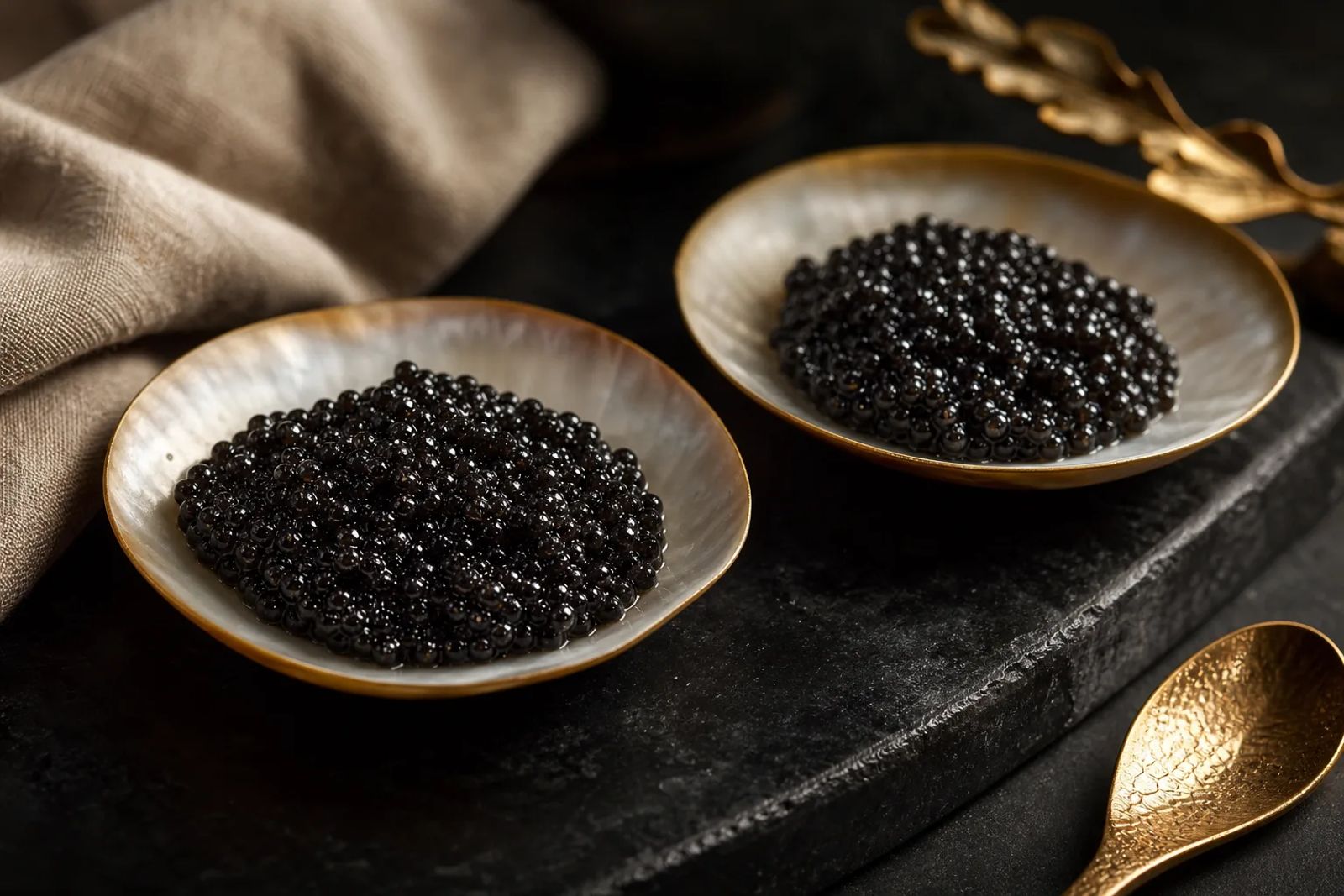
Ossetra usually means Russian sturgeon caviar, from Acipenser gueldenstaedtii, whereas pure Kaluga comes from Huso dauricus. The practical difference is not a guaranteed flavour contrast: both names also appear on hybrid products, so check the scientific name and CITES species code before choosing.
What Ossetra vs Kaluga actually compares
Ossetra, Osetra and Oscietra are spellings used in the caviar trade. FAO describes Osetra as coming mainly from Russian sturgeon and Persian sturgeon, Acipenser persicus, so Ossetra is not an exact scientific name. For the comparison below, Ossetra means pure Russian sturgeon unless another fish is explicitly identified.
Hybrids complicate both sides. Italian producer Pisani Dossi describes its Osetra as Russian sturgeon crossed with Siberian sturgeon, Acipenser baerii, without identifying the male parent or female parent. A Kaluga hybrid with a female Kaluga parent and a male Amur sturgeon parent, Acipenser schrenckii, is a different product from pure Kaluga.
For the fuller species accounts, see Russian sturgeon and pure Kaluga. The separate Kaluga hybrid guide explains the cross rather than treating it as another name for the same fish.
Ossetra and Kaluga side by side
These entries separate biological information from finished caviar descriptions. The egg diameter shown is a maturity assessment reference, not a guaranteed measurement of salted beads in a retail tin.
| Criterion | Ossetra: Russian sturgeon | Pure Kaluga |
|---|---|---|
| Scientific name used by CITES | Acipenser gueldenstaedtii | Huso dauricus |
| CITES species code | GUE | DAU |
| Native range | Black, Azov and Caspian sea basins | Amur River basin, shared by China and Russia |
| IUCN category | Critically Endangered, 2022 Red List update | Critically Endangered, 2022 Red List update |
| Egg diameter | 3.2 to 3.8 mm | Not publicly documented |
| Farmed age at first harvest | Not publicly documented in the records used here | Not publicly documented in the records used here |
| Fish size at first harvest | Not publicly documented in the records used here | Not publicly documented in the records used here |
| Documented farming examples | China and Belgium | China |
The conservation categories describe wild populations, not a grading system for farmed roe. The Chinese farming example is supported by a producer's stock disclosure; it is not a complete list of farming countries.
Bead size, colour and texture
Compare the stated bead measurements for the actual batches, using the same measurement method. Biological egg diameters, measurements taken during breeding and measurements of finished salted caviar are not automatically interchangeable. Ask whether a quoted minimum describes every bead, a selected grade or simply a typical batch.
If you enjoy resistance before the bead breaks, ask for a batch described as firm or elastic.
Colour also needs careful attribution. In its June 2026 prospectus, Kaluga Queen describes its Russian sturgeon roe as brownish-yellow or greyish-yellow, with firm, elastic grains. According to Kaluga Queen's June 2026 prospectus, its pure Kaluga roe is typically brownish grey or yellowish brown; colour alone cannot establish species.
For flavour, the same producer describes a subtle nut-like aroma in its Russian sturgeon caviar. It describes its hybrid caviar separately as having resilient grains, a creamy flavour and a lingering finish. Kaluga Queen describes its pure Kaluga caviar as mellow, with pronounced milky notes and a lingering aftertaste.
If you enjoy resistance before the bead breaks, ask for a batch described as firm or elastic. If you prefer a softer mouthfeel, ask for that explicitly. Neither preference requires choosing a particular trade name, and a clear batch description is more useful than an unsupported flavour score.
Where the fish comes from
Russian sturgeon's native range does not make every Ossetra product Russian in origin. Likewise, the Kaluga's Amur origins do not identify the country where a farmed fish was raised. The producer's headquarters, the place of repacking and the origin of the roe answer different questions.
First harvest also needs more precision than a species headline. Sexual maturity is not the same measurement as age at the first commercial collection of roe, and figures depend on rearing conditions. Ask a farm whether its stated age describes first harvest, an average harvest age or broodstock used for reproduction.
You may also meet different scientific names in newer biological references. Brownstein and Near proposed Sinosturio dauricus in 2025. On 22 October 2025, the IUCN specialist group and WSCS rejected both competing revisions and proposed placing Huso species in Acipenser; readers may also encounter the name Acipenser dauricus. This article retains Huso dauricus, the CITES name.
How to read the label
Look for the non-reusable CITES label on the container, not just the product name on the lid. GUE identifies Russian sturgeon and DAU identifies Kaluga in the CITES species list; PER identifies Persian sturgeon. A hybrid has two parent codes separated by x.
CITES puts the male parent first. SCHxDAU therefore means a male Amur sturgeon, Acipenser schrenckii, crossed with a female Kaluga, Huso dauricus. Reversing the letters would describe the opposite parental direction, not merely another spelling of the same label.
Then compare the country of origin with the repacker's location. Repacked caviar keeps its origin information while adding the repacker's details; a European repacking address does not establish European roe. The label provides traceability, not independent proof of the contents, so ask the supplier to resolve any mismatch with the advertised species.
What the naming rules do and do not say
In the EU, CITES container marking and consumer food information are separate obligations. Regulation (EC) No 865/2006 addresses caviar marking; Article 7 of Regulation (EU) No 1169/2011 requires food information not to mislead. Customs categories are not a substitute for that consumer protection.
Great Britain has its own food information legislation, while Northern Ireland generally follows EU food information law. In the US, nonbinding FDA guidance says unqualified caviar refers to salted sturgeon roe and recommends comparable type size and prominence for other fish names, with prominent disclosure of added artificial colour. A conditional 125 g personal effects exemption may apply. US international caviar trade also has container labelling requirements under 50 CFR 23.71.
Golden, Imperial and the quality of the batch
Golden and Imperial can accompany either trade name without identifying the fish behind it. They are not species names or a common legal grading scale for these two caviars. Ask what the seller means in measurable terms, such as colour selection or a stated bead diameter, rather than assuming that the word promises a particular flavour.
Within either species, assess the product rather than its name alone. Ask about the farm, water management, feed, pre-harvest holding, processing, salt content, maturation and temperature-controlled handling. Ask how these choices are documented, rather than assuming that older fish or longer holding periods automatically produce better caviar.
For a practical choice, request the species, any hybrid parentage, roe origin and a description of the current batch. Then choose the texture and flavour that appeal to you. Our guide to trade names explains the naming language, while other caviar comparisons help when the alternatives involve different species.
Comparing the actual caviar
If you have two samples, first establish whether you are comparing pure Russian sturgeon with pure Kaluga, or with a Kaluga hybrid. Keep the accompaniments the same and follow each product's handling instructions. Taste a little on its own before adding anything that could obscure differences in saltiness, aroma or texture.
Describe what happens rather than trying to identify the species by taste. Does the bead hold its shape on the spoon? Does its membrane resist briefly or give way readily? Does the finish seem mainly salty, marine or more rounded? These observations help you remember your preference without turning a single tasting into a species rule.
Record the exact product description and lot alongside your notes. A later batch carrying the same trade name is a new comparison, not confirmation that your first impression was wrong. For learning your own preferences, consistency in how you compare samples matters more than adopting someone else's vocabulary.
FAQ
Is Kaluga the same as beluga?
Kaluga and beluga are different species, listed by CITES as Huso dauricus and Huso huso respectively. Kaluga is therefore not a synonym for beluga, and a Kaluga hybrid is not pure beluga either. Read Beluga vs Kaluga for that separate comparison, especially when a product description uses both names.
Sources
-
CITES. Conservation of and trade in sturgeons and paddlefish, Resolution Conf. 12.7 (Rev. CoP17), amended 2016. Annex 1 covers container labelling and origin information; Annex 2 gives species codes and the male-first hybrid convention. Resolution text.
-
University of Florida, IFAS Extension. Chapman, F. A. and Van Eenennaam, J. P. Sturgeon Aquaculture: Specialized Techniques: Determining the Stage of Sexual Maturity in Female Sturgeon for Artificial Spawning: The Egg Polarization Index or PI, FA153, 2007; reviewed August 2025. Gives the Russian sturgeon egg diameter reference. Publication.
-
FAO. Chebanov, M. S. and Galich, E. V. Sturgeon Hatchery Manual, Fisheries and Aquaculture Technical Paper 558, reprinted 2013. Section 1.2.2 describes Russian sturgeon distribution and biology. Manual.
-
FAO. Sturgeons (Acipenseriformes), 2004 report by Camillo Catarci. Identifies Russian and Persian sturgeon as the principal sources of Osetra. Report.
-
Hangzhou Qiandaohu Xunlong Sci-tech Co., Ltd. Global Offering Prospectus, 22 June 2026. Prospectus.
-
World Sturgeon Conservation Society. Bronzi, P. IUCN SSG summary report, 13 November 2025, reporting the workshop of 22 October 2025. Records the competing genus proposals and the group's position. Report.
-
North American Sturgeon and Paddlefish Society. Webb, M. IUCN Assessment 2022, 1 August 2022. Reproduces the 2022 conservation categories. Assessment summary.
-
Food Standards Agency, GOV.UK. Packaging and labelling, guidance updated 4 September 2026. Explains accurate food descriptions and the distinction between Great Britain and Northern Ireland. Guidance.
-
US Food and Drug Administration. CPG Sec. 540.150 Caviar, Use of Term: Labeling, October 1989. Nonbinding guidance on unqualified caviar, qualified fish names and their prominence. Guidance.
-
European Commission, EUR-Lex. Commission Regulation (EC) No 865/2006, consolidated version dated 18 February 2025. Caviar marking provisions are in Article 66. Consolidated regulation.
-
Azienda Agricola Pisani Dossi. Company website, undated, retrieved November 2026. Describes its Osetra as a Russian sturgeon and Siberian sturgeon hybrid. Producer statement.
-
US Government Publishing Office. Code of Federal Regulations, Title 50, Section 23.71, 2021 edition. Sets international caviar labelling requirements, including the male-first hybrid convention. Official edition.
Last checked: November 2026