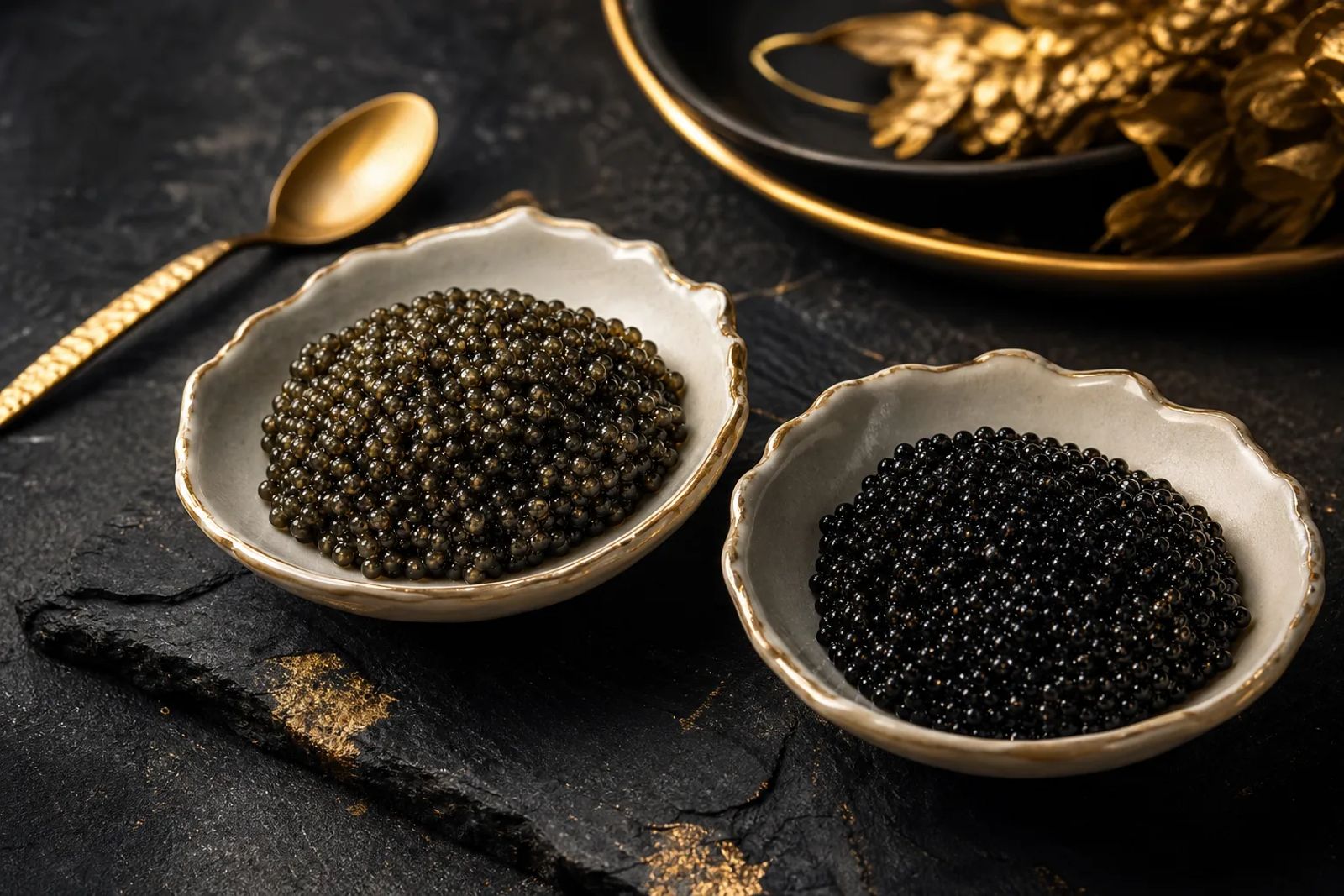
Gold flecks in light amber and brown: that is how Caviar Giaveri describes its Russian-sturgeon Oscietra Classic. Its sevruga offers a contrast in pearl grey. But the most revealing difference lies beyond the spoon: Russian sturgeon has an established farming presence across several countries, while sevruga has a much narrower documented farming base.
These are caviars from two different fish. Here, Ossetra means Russian sturgeon (Acipenser gueldenstaedtii), while sevruga means stellate sturgeon (Acipenser stellatus). Ossetra generally has the larger eggs. To understand either caviar properly, start with the species, then look at the farm and the individual lot.
Ossetra vs sevruga at a glance
The names below follow CITES species designations. Egg diameters come from an aquaculture reference, rather than commercial grades or specifications guaranteed for every finished tin.
| Criterion | Ossetra | Sevruga |
|---|---|---|
| Species | Russian sturgeon, Acipenser gueldenstaedtii | Stellate sturgeon, Acipenser stellatus |
| CITES species code | GUE | STE |
| Typical egg diameter | 3.2 to 3.8 mm | 2.7 to 3.2 mm |
| IUCN category, 2022 update | Critically Endangered | Critically Endangered |
| Documented farming countries | Italy (Giaveri); others not verified | Italy (Caviar Giaveri statement) |
Both ranges meet at 3.2 mm. An individual egg therefore cannot identify the species: check the scientific name and traceability information rather than using bead size as an authenticity test.
The fish behind the names
The stellate sturgeon's very long, flattened snout makes it more immediately distinctive. Star-shaped plates sit between its main rows of scutes. Russian sturgeon has a relatively short, blunt snout and a spindle-shaped body, also armoured with rows of scutes, the protective bony plates characteristic of sturgeons. Both species are native to the Caspian, Black and Azov sea basins and their associated rivers.
The name Ossetra needs closer attention than the fish's silhouette. In this comparison it means Russian sturgeon, not every caviar carrying a similar spelling. Caviar Giaveri's farm page, for example, also associates Oscietra with Persian sturgeon, Acipenser persicus. The species declaration tells you more than the large trade name on the front.
For fuller accounts of their biology, see Russian sturgeon and stellate sturgeon. Keep those identities separate when comparing farms: evidence about another sturgeon or a hybrid does not establish anything about pure sevruga production.
CITES names remain the reference here. A 2025 joint specialist-group meeting rejected proposed taxonomic revisions and recommended a more conservative classification. That debate calls for clarity, not the silent substitution of an unfamiliar scientific name on a comparison or trade document.
Colour, flavour and texture
Expect variety, not a rigid colour chart. Giaveri's Russian-sturgeon Oscietra Classic runs through light amber, brown hues and gold flecks; its sevruga is pearl grey. Italian producer Adamas describes its own Acipenser stellatus roe as black to anthracite.
The flavour descriptions offer another contrast. Giaveri gives its Russian-sturgeon caviar marine and nutty notes, with crisp grains, while its sevruga has bold, rich marine notes. Adamas describes its sevruga as intense, with dairy-like notes and a delicate, soft texture.
These are producer descriptions of particular products, not a blinded head-to-head tasting. They offer useful expectations without establishing which species is always firmer or more intense.
Compare named lots and ask for their actual specifications. The interesting detail is in the caviar being offered, not a stereotype attached to its name.
Why availability has changed
Nearly all caviar on the market now comes from aquaculture, according to EUMOFA's 2023 review. The old association of Ossetra and sevruga with Caspian fisheries tells you little about where a modern tin originated. Farming has transformed supply, but the two species have not acquired equally well-documented production footprints.
Russian sturgeon is farmed in Italy, according to Caviar Giaveri. EUMOFA also identifies it as an important component of production in several European countries. These sources establish a broader farming presence.
For sevruga, the documented example is specific: Caviar Giaveri explicitly lists Acipenser stellatus among the fish it breeds in northern Italy and says its sevruga production chain takes place within the company. This establishes farming, whereas a country's exports or repacking activity alone cannot.
Giaveri describes the species as difficult to breed outside optimal conditions, offering a producer's explanation for the challenge rather than a quantified industry-wide study. Harvest age does not supply a simple comparison, either: sexual maturity, eggs ready for caviar and the first commercial harvest are different milestones.
Ask three practical questions: which farm produced the roe, were the fish pure stellate sturgeon, and can the supplier document a continuing production programme? Those answers are more useful than a general claim that sevruga has returned. A retail listing alone cannot supply them.
Conservation and wild trade
Both species were listed as Critically Endangered in the 2022 IUCN update. That designation concerns wild populations, not the quality of farmed roe. The update year should not be confused with the date on which every underlying assessment was completed.
As checked in November 2026, Russia's fisheries research institute VNIRO reports a moratorium on commercial sturgeon fishing across all five Caspian coastal states: Azerbaijan, Iran, Kazakhstan, Russia and Turkmenistan. For the country-specific legal position, including the distinction between commercial harvest and authorised conservation work, see Caspian fishing restrictions.
Both species fall under CITES Appendix II, which regulates international trade. Any shipment of wild origin needs a specific legal basis and the required documentation.
How to recognise each on a label
Read the species code first, then the origin, then the processing and lot details. GUE identifies Acipenser gueldenstaedtii; STE identifies Acipenser stellatus. These are the codes to look for when distinguishing Ossetra from sevruga.
The label identifies source, country of origin, year, registered processing or repackaging details, and lot information. Separate origin from the repacker's country: an Italian or British brand address does not establish where the roe originated. This is a traceability system, not independent verification of the contents.
Annex 2 of CITES Resolution Conf. 12.7 (Rev. CoP17) supplies the species codes, while Annex 1 sets out the universal labelling guidelines. The CITES resolutions index still lists this revision after CoP20.
For international trade, the US implements caviar labelling through 50 CFR 23.71; EU rules include Regulation (EC) No 865/2006. Great Britain applies Regulation 865/2006, Article 66, as retained; Northern Ireland applies the EU text. For other countries and the conditional 125 g personal allowance, see caviar law.
Retail food naming is a separate matter. EU food information must not mislead, including about identity. Great Britain applies its assimilated version of Regulation 1169/2011, while Northern Ireland generally follows the EU regulation.
In the US, FDA's nonbinding CPG 540.150 says unqualified caviar should mean salted sturgeon roe. For other fish, the guidance calls for the common or usual fish name alongside caviar in the same type size. It also addresses the declaration of added colour. Neither this guidance nor a customs classification makes a trade name such as Royal a species identification or a legal grade.
What drives quality in either caviar
A larger bead or a paler colour cannot tell you how well a fish was reared or its roe handled. Species establishes what you are comparing; documented origin and processing give you more useful grounds for judging the lot.
Ask about water and feed management, egg selection, salting, maturation and the cold chain. Giaveri identifies controlled feeding, water temperature and rapid temperature-controlled preservation among its production practices. Those details make good questions for any supplier. Ask for records rather than assuming that every farm follows the same methods.
Read the ingredient list beside the species information. Request the lot's salt specification and processing history. For a meaningful sensory comparison, choose similar processing styles and ask the supplier to separate its description of that particular caviar from broader claims about the species.
A larger bead or a paler colour cannot tell you how well a fish was reared or its roe handled.
Use Caviar Comparisons for another focused pairing, or the classic three-way comparison if beluga is also part of your question. With Ossetra and sevruga, the revealing comparison is one named lot against another. A producer's account of that caviar tells you more than a traditional name can promise.
Sources
-
FAO. Chebanov, M. S. and Galich, E. V. Sturgeon Hatchery Manual. Fisheries and Aquaculture Technical Paper 558, reprinted 2013. Sections 1.2.2 and 1.2.4 cover Russian and stellate sturgeon.
Read at fao.org -
University of Florida, IFAS Extension. Chapman, F. A. and Van Eenennaam, J. P. Sturgeon Aquaculture: Specialized Techniques: Determining the Stage of Sexual Maturity in Female Sturgeon for Artificial Spawning: The Egg Polarization Index or PI. FA153, 2007, reviewed August 2025.
Read at ask.ifas.ufl.edu -
North American Sturgeon and Paddlefish Society. IUCN Assessment 2022. Published 1 August 2022, reporting the species categories in the 2022 update.
Read at nasps-sturgeon.org -
CITES. Conservation of and trade in sturgeons and paddlefish. Resolution Conf. 12.7 (Rev. CoP17), 2016, Annexes 1 and 2.
Read at cites.org -
CITES. Resolutions of the Conference of the Parties in effect after the 20th meeting. Current index, checked November 2026.
Read at cites.org -
European Commission, EUMOFA. Sturgeon meat and other by-products of caviar: production, trade and consumption in and outside the EU. February 2023.
Read at eumofa.eu -
Caviar Giaveri. Sturgeon farm. Undated company statement, retrieved November 2026.
Read at caviargiaveri.com -
Caviar Giaveri. Oscietra Classic. Undated company description, checked November 2026; retail page not linked.
-
Caviar Giaveri. Sevruga Imperial. Undated company description, checked November 2026; retail page not linked.
-
Adamas Caviar. Premium Sevruga. Undated company description, checked November 2026; retail page not linked.
-
VNIRO. Caspian Sea Day: preservation of a unique reservoir and its inhabitants. 12 August 2026.
Read at vniro.ru -
US Government, Electronic Code of Federal Regulations. 50 CFR 23.71: How can I trade internationally in sturgeon caviar? Current online text, retrieved November 2026.
Read at ecfr.gov -
US Food and Drug Administration. CPG Sec. 540.150: Caviar, Use of Term, Labeling. October 1989 edition, current published guidance retrieved November 2026.
Read at fda.gov -
Food Standards Agency, GOV.UK. Packaging and labelling. Current guidance, retrieved November 2026.
Read at gov.uk -
European Commission. EU Wildlife Trade Reference Guide: What documents are required for (re-)export of specimens of species listed in Annex A, B or C? Current online edition, retrieved November 2026.
Read at environmental-data.ec.europa.eu -
World Sturgeon Conservation Society. Bronzi, P. IUCN SSG summary report. 13 November 2025, reporting the joint meeting of 22 October 2025.
Read at wscs.info
Last checked: November 2026