
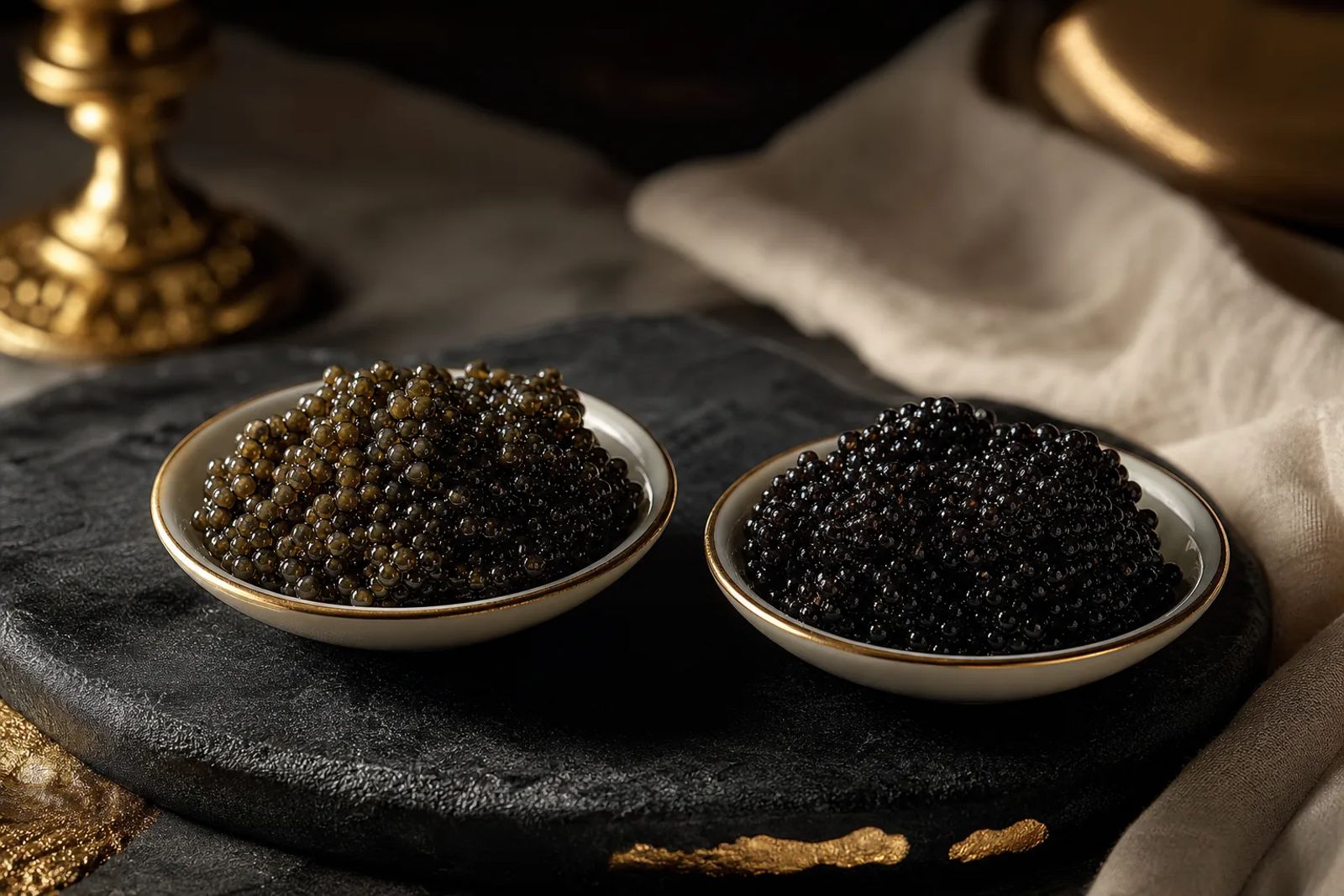
White sturgeon caviar comes from Acipenser transmontanus; the Ossetra compared here comes from Russian sturgeon, Acipenser gueldenstaedtii. Neither name guarantees a better tin: use the species to narrow your choice, then compare the producer’s description, origin and processing, because flavour and texture vary within both.
White sturgeon vs Ossetra at a glance
| Criterion | White sturgeon | Ossetra |
|---|---|---|
| Scientific name | Acipenser transmontanus | Acipenser gueldenstaedtii |
| CITES species code | TRA | GUE |
| IUCN global status | Vulnerable (2022) | Critically Endangered (2022) |
| Reference egg diameter | 3.2 to 4.0 mm | 3.2 to 3.8 mm |
| Documented farming countries | Italy; United States | China; Italy; Poland; Bulgaria; Belgium |
These egg diameters are biological reference ranges, not guaranteed dimensions of salted beads. The colour descriptions are seller-reported examples, while the farming countries are documented examples rather than a complete census.
Two species, not two grades
White sturgeon is a Pacific North American fish. Its principal river systems include the Sacramento and San Joaquin, Columbia and Fraser; commercial farming in California is documented by UC Davis, while Italy also farms the species.
Russian sturgeon is native to the Caspian, Black and Azov sea basins and their rivers. “Russian” names the fish, not necessarily the country that raised it, just as “white sturgeon” does not establish that a tin came from the United States.
Ossetra, also written Osetra or Oscietra, is a trade name rather than a legal quality grade. For this comparison it means Acipenser gueldenstaedtii, so ask for the scientific name whenever a seller uses Ossetra without identifying the fish.
The species profiles, white sturgeon and Russian sturgeon, cover the fish themselves. Here the useful distinction is between the identity of the roe and the choices made while producing the finished caviar.
What the beads can tell you
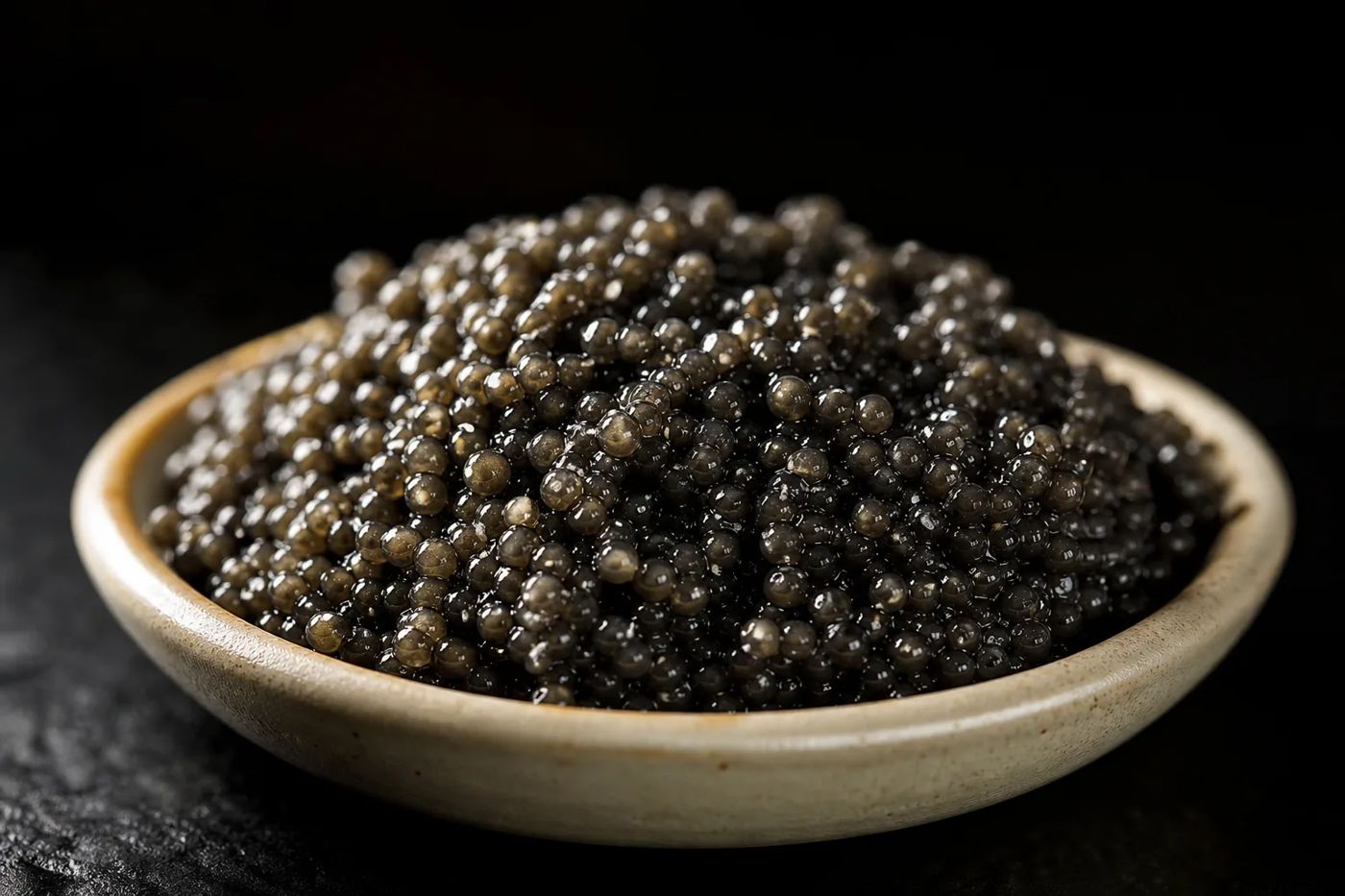
Do not assume Ossetra must have larger beads. The shared reference ranges overlap substantially, and the white sturgeon range extends higher; a particular producer’s sorting and grading determine the sizes offered in a particular selection.
Colour is equally poor as a shortcut to identity. Seattle Caviar describes its Idaho white sturgeon as grey to black and its Belgian Ossetra as dark to golden brown, but those descriptions concern its selections, not every egg produced by either species.
No photograph can establish the species or geographical origin by colour alone. Treat a picture as a view of that batch, then look for the species declaration and traceability information rather than trying to identify the fish from the shade of its roe.
Flavour and texture: compare descriptions, then batches
Producer descriptions suggest useful starting points, not a fixed taste hierarchy.
That comparison comes from one producer’s products, which makes the language helpful but not independent evidence that all Ossetra is firmer or more persistent. Seattle Caviar’s Belgian Ossetra description instead stresses a delicate balance, fruit and nuts, illustrating why the trade name alone cannot predict intensity.
Ask for a batch-specific description rather than a generic species profile. “Firm” should help you anticipate resistance before the egg opens; “persistent” describes how long the flavour remains, while “salty” concerns a different sensation and should not be treated as evidence of greater complexity.
If you prefer a softer impression and restrained salinity, investigate batches described that way, including white sturgeon. If you want distinct nut-like or marine notes and a persistent finish, investigate Ossetra selections with those descriptions, rather than assuming the name promises them.
When tasting both, my recommendation is to try them plain before adding accompaniments. Notice the resistance of the bead, how readily it releases its contents, the immediate salt impression and the flavour remaining afterwards; those observations are more useful than deciding which name sounds more impressive.
Farming origin and the wait for roe
The documented farming countries in the table show why native range and production origin must be separated. White sturgeon caviar can be Italian, and Russian sturgeon caviar can be Belgian or Chinese; neither a Caspian association nor an American species name locates the farm.
Ask the producer about its own harvest age, water conditions and selection criteria before treating maturity as a quality signal.
White sturgeon caviar can be Italian, and Russian sturgeon caviar can be Belgian or Chinese; neither a Caspian association nor an American species name locates the farm.
A brand’s address and a farm’s location answer different questions.

Wild protections are a separate question
The shared overview records white sturgeon as Vulnerable and Russian sturgeon as Critically Endangered in the 2022 IUCN assessment. These describe extinction risk in the wild, not the quality of farmed caviar or an automatic verdict on an individual farm’s environmental performance.
Wild white sturgeon protections are population-specific: California’s authority records a closed commercial fishery and current state listing candidacy, as discussed in White Sturgeon Caviar (Acipenser transmontanus). Caspian wild-sturgeon trade is instead subject to the CITES shared-stock quota framework alongside national fishing restrictions, covered in Ossetra Caviar: Russian Sturgeon (Acipenser gueldenstaedtii).
Read species and origin separately
On a CITES caviar label, TRA identifies white sturgeon and GUE identifies Russian sturgeon. The original container’s code also records source, meaning the documented origin category, country of origin, harvest year, processing plant and lot; a repacked container identifies the repacker and repacking year while retaining the origin country.
That means an Italian repacker can package roe originating elsewhere. Read country of origin versus country of repacking before treating a national flag, business address or brand story as a statement about where the fish was raised; the CITES label is a traceability record, not proof of the contents.
In the United States, FDA’s nonbinding CPG 540.150 says unqualified “caviar” should mean salted sturgeon roe. For other roe, FDA guidance specifies the fish name in comparable size and prominence, permitted colour additives and prominent declaration of added artificial colour. Both species here are sturgeons; wildlife trade requirements under 50 CFR 23.71 are separate from that food naming guidance.
In the EU, Regulation 1169/2011, Article 7, prohibits misleading food information, including about identity and origin. Great Britain applies its assimilated, amended food-information rules; Northern Ireland applies EU food-information law, so customs categories must not be mistaken for consumer naming rules.
The CITES resolution recommends a universal label, but its implementation depends on domestic law. CITES implementation also varies in Switzerland, the UAE, China, Japan, Russia and Australia; any 125 g personal effects exemption depends on national rules.
What should decide your choice?
My advice is to choose the better-documented batch, not automatically the more familiar name. Ask who farmed the fish, where the roe originated, how the selection is described, whether it has been pasteurised and what handling instructions accompany it.
In a two-farm white sturgeon feeding trial, researchers compared high-fat production feed with lower-fat finishing feed for 19 and 33 months before harvest. They measured ovarian fat, caviar yield and egg morphology, with genetic testing to assess relatedness; this supports asking about husbandry, not claiming that a feeding regime guarantees a flavour.
Salting, maturation and heat treatment also belong in the comparison. Ask whether the producer’s description refers to the product you will receive, rather than another grade or an earlier tasting, and whether it can explain the processing behind that description.
For a fair comparison, my preference would be two products with similar processing, rather than a pasteurised selection against one sold without that heat treatment. If the seller cannot describe the batch, its origin or its handling, that missing information is a stronger reason to pause than either species name is a reason to proceed.
Use caviar comparisons to explore other species only after you have identified what you want to change: bead size, texture, flavour intensity or origin. A precise preference gives you a better next question than asking which species wins.
Sources
-
CITES. Resolution Conf. 12.7 (Rev. CoP17): Conservation of and trade in sturgeons and paddlefish, 2016 revision. Annex 1 sets out the labelling system; Annex 2 lists TRA and GUE. The post-CoP20 resolutions index continues to list this revision.
Resolution text · Resolutions index. -
University of Florida, IFAS Extension. Sturgeon Aquaculture, Specialized Techniques: Determining the Stage of Sexual Maturity in Female Sturgeon for Artificial Spawning, FA153, reviewed August 2025. Gives the reference egg-diameter ranges reproduced in the supplied overview.
Publication PDF. -
North American Sturgeon and Paddlefish Society. IUCN Assessment 2022, 1 August 2022. Specialist society account of the IUCN assessments published in July 2022.
Assessment account. -
California Department of Fish and Wildlife. White Sturgeon, live species account, undated. Documents native distribution, commercial-fishery closure and state listing candidacy.
Species account. -
US Fish and Wildlife Service. Russian Sturgeon (Acipenser gueldenstaedtii): Ecological Risk Screening Summary, revised June 2018, web version August 2018. Documents the native sea basins and associated rivers.
Summary PDF. -
UC Davis. Farming Caviar: A UC Davis Innovation, 19 May 2025. Documents white sturgeon farming in Sacramento County.
University account. -
European Commission, EU Aquaculture campaign. The success of caviar from Belgium, undated. Describes Russian sturgeon among the species farmed at the featured Belgian operation.
Campaign account. -
Seattle Caviar Co. Tasting Notes, undated company descriptions. Company descriptions of its white sturgeon and Belgian Ossetra selections.
Company tasting notes. -
Calvisius USA. Caviar Essentials Experience, undated company descriptions. Company descriptions of its white sturgeon and Russian sturgeon selections.
Company descriptions. -
International Aquatic Research. The effect of white sturgeon (Acipenser transmontanus) ovarian fat deposition on caviar yield and nutritional quality: introducing image processing method for sturgeon ovary fat determination, 2015. Introductory husbandry discussion reports processing at 7 to 9 years and intensive-culture temperatures.
Research article. -
Water. Economic Analysis of Sturgeon Farming and Caviar Production: A Case Study of an Italian Fish Farm, volume 16, article 2618, 2024. The resource-stock table reports farm-specific average harvest ages, not first-harvest ranges.
Research article. -
Aquaculture. Finishing diet, genetics, and other culture conditions affect ovarian adiposity and caviar yield in cultured white sturgeon (Acipenser transmontanus), 2017. Reports the two-farm feeding trial and its measurements.
Research article. -
US Food and Drug Administration. CPG Sec. 540.150: Caviar, Use of Term, Labeling, October 1989, current online guidance. Distinguishes unqualified sturgeon caviar from other fish roe and specifies comparable naming prominence.
FDA guidance. -
UK Government. Packaging and labelling, updated 4 September 2026. Explains the distinction between assimilated food-information law in Great Britain and EU law applying in Northern Ireland.
Government guidance. -
European Union. Commission Regulation (EC) No 865/2006, consolidation dated 25 February 2008, Articles 65 and 66. United States. 50 CFR 23.71: How can I trade internationally in sturgeon caviar?, live reproduction by Cornell Legal Information Institute.
EU regulation · US regulatory text.
Last checked: November 2026