
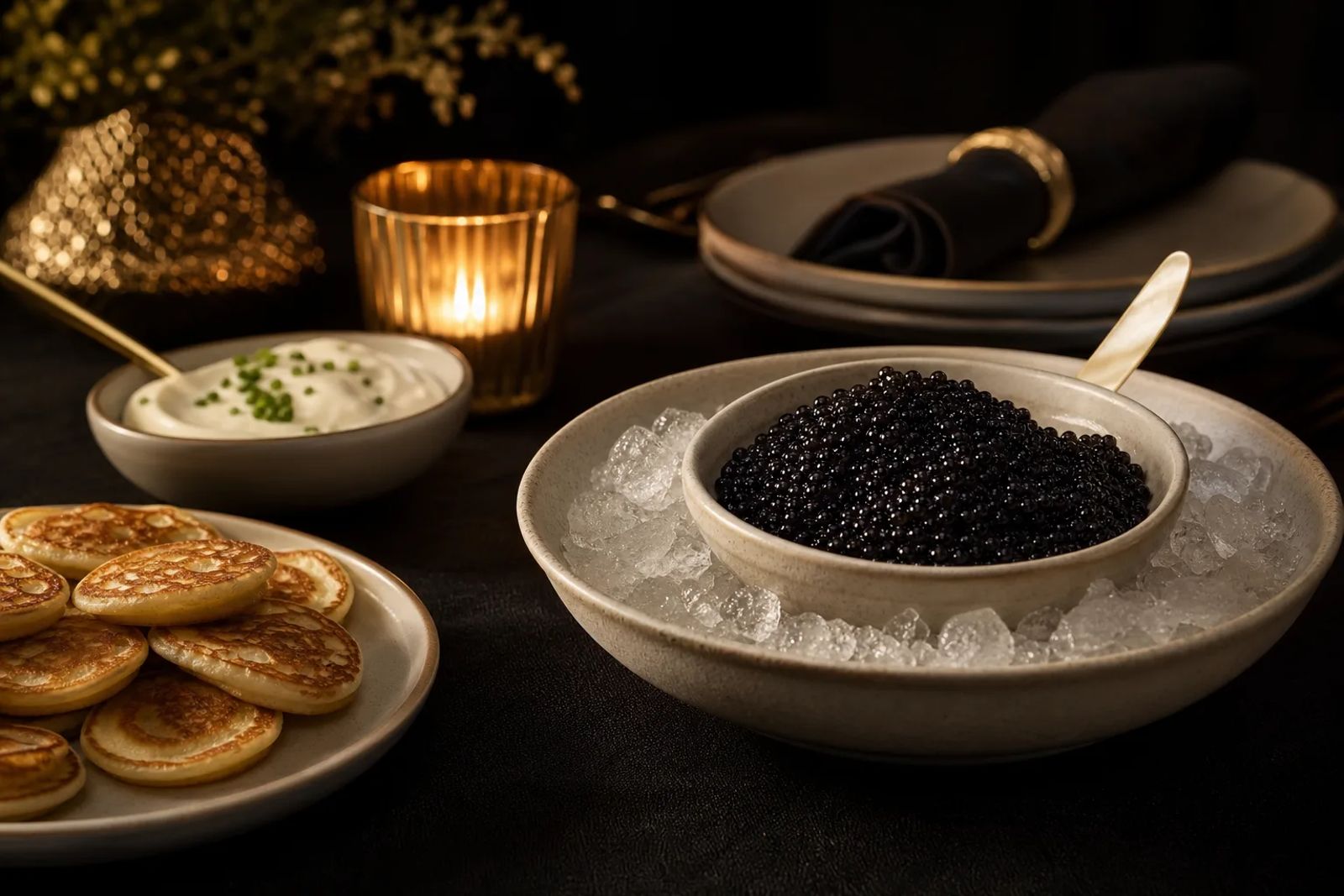
Richard Corrigan's blini recipe calls for just 35 g of caviar for two people. Give it one clear place in the meal, with a serving arrangement you can finish without abandoning your guests. Picture the tin nestled in crushed ice, mother-of-pearl spoons ready, bread and cream alongside.
Keep the caviar refrigerated until you are ready to assemble and serve, then present it over ice rather than leaving it on the table throughout dinner.
Give caviar its moment in the menu
With the aperitif: a shared dish welcomes guests who arrive together and creates a pause before everyone sits down. It works when the main course can wait safely. It works less well if you need to be frying fish while guests help themselves.
As canapés: assembled bites distribute portions neatly and are easy to eat standing up. They also bring last-minute work. Choose a simple base and add the caviar only when the tray is ready to go out.
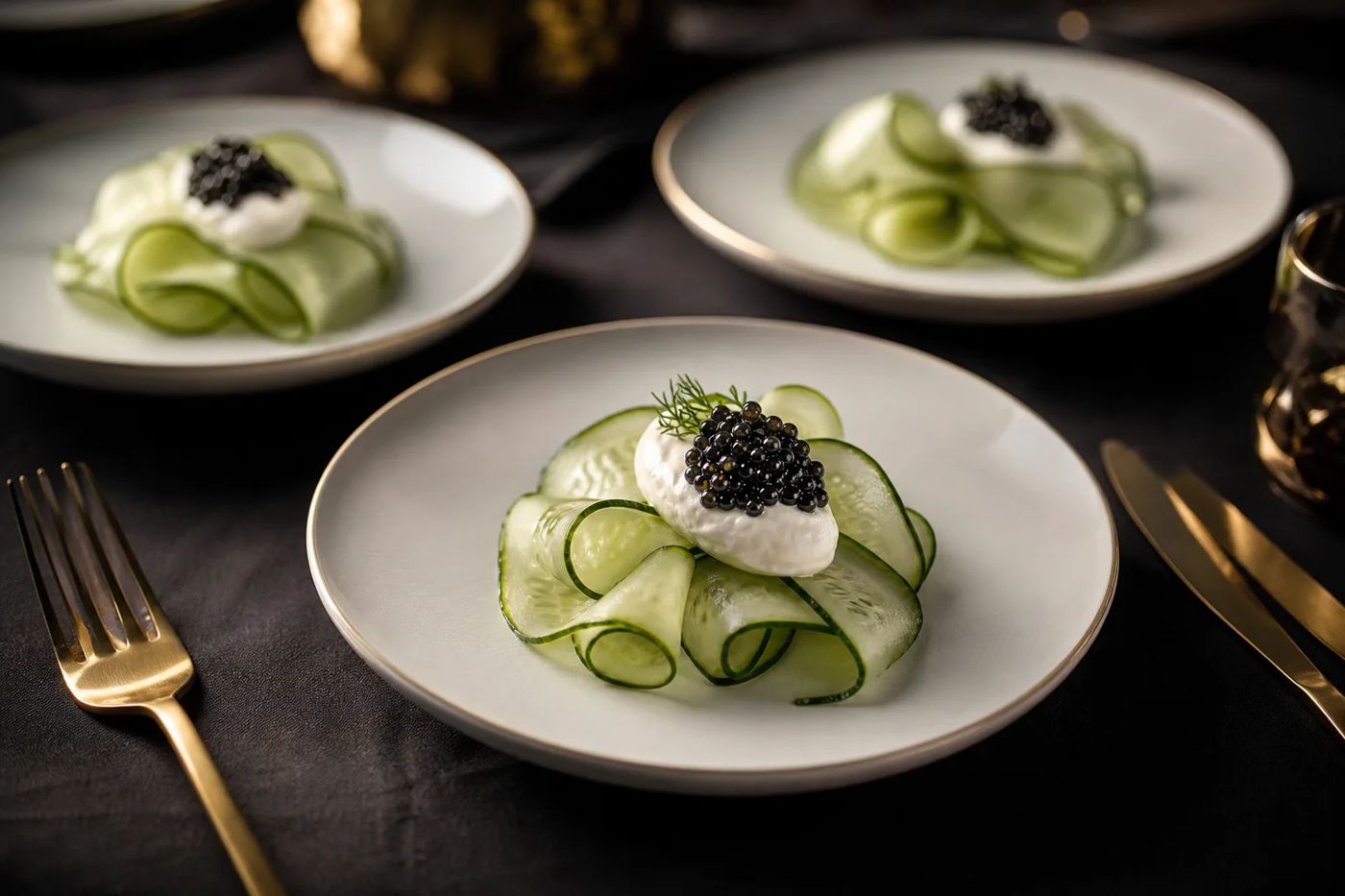
As a first course: a cold plated dish gives each guest a defined portion and dinner a clear beginning. For a host cooking alone, this is often the easiest format: prepare the other components ahead, then finish with the caviar.
As a main-course garnish: use it where it belongs to the dish, rather than simply repeating caviar later in the meal. Add it off the heat at the last moment. Heat can firm the beads and change their texture.
Choose the format that leaves you free to host. For the techniques behind it, see the complete serving guide.
Set the quantity before choosing the presentation
Decide whether caviar is the focus or an accompaniment before planning the display. Paramount's serving suggestions and Richard Corrigan's recipe offer useful starting points, each for a different kind of service.
| Format | Quantity and source | Planning use |
|---|---|---|
| Aperitif or canapés | Paramount: 14 to 28 g (½ to 1 oz) per person with other foods | Choose within the range to suit the menu |
| Caviar-led first course | Paramount: 28 g (1 oz) for a full portion | A supplier's serving suggestion, rather than a formal standard |
| Shared blini service | Richard Corrigan: 35 g for two people | 17.5 g per person, calculated from his published recipe |
These examples describe different ways of serving caviar, so use the one that matches your plans rather than treating them as interchangeable allowances.
Return safely retained caviar to refrigeration instead of leaving it as a permanent centrepiece.
For a main-course garnish, follow a recipe that specifies the caviar quantity instead of borrowing an appetiser portion. For other occasions and group calculations, see portions by occasion.

Ask about guests' needs before fixing the menu
Ask privately about allergies, pregnancy, children's needs and dietary observance when inviting guests. For kosher or halal requirements, establish what is acceptable to that person, including the accompaniments.
Check fish in the caviar; milk, eggs and wheat or other gluten-containing cereals in the accompaniments; and any shellfish served alongside. The UK FSA advises asking guests what they can eat, retaining ingredient information, cleaning equipment and preventing allergen cross-contact. Taking off a topping does not make an affected plate suitable. See fish allergy and caviar.
Check the advice that applies to your guests:
- UK: NHS guidance advises pregnant people to heat cold smoked or cured fish until steaming hot. Check its current advice for other fish preparations; it does not specifically assess caviar.
- US: the FDA tells pregnant people, children, older adults and the immunocompromised to avoid raw or undercooked seafood. Salt is not cooking.
- EU: EFSA identifies pregnant people as vulnerable to Listeria in ready-to-eat foods. France's health portal, sante.fr, advises against raw, smoked or marinated fish in pregnancy.
- Australia and New Zealand: FSANZ advises vulnerable people to avoid higher-risk chilled seafood and notes that Listeria can grow under refrigeration. Its guidance concerns food categories, rather than the suitability of an individual tin.
Prepare an alternative separately so nobody has to make this decision at the table. A doctor or midwife can give personal advice; caviar during pregnancy explains the product-specific questions to ask.
Choose a presentation you can manage
The tin on ice keeps kitchen portioning to a minimum. Nest it securely in crushed ice, with meltwater below the rim. Put bread and cream in separate dishes, each with its own utensil.
Individual spoons make a neat opening bite. Allow space to arrange and distribute them, portion immediately before service and send them straight out. A tray of filled spoons should not be waiting while you finish another course.
A plated course gives you control over every portion, but concentrates the work into the final assembly. Lay out the cold components first, use chilled rather than warm plates for cold service, and add the caviar last.
Gather the equipment before cooking
A steady bowl and a clear serving arrangement matter more than elaborate tableware. Set out the kit before cooking starts:
- A bowl for crushed ice, with a secure inner dish or space for the tin.
- Clean mother-of-pearl spoons for portioning, plus separate utensils for accompaniments.
- Small plates, napkins and a tray that fits in the fridge.
- A fridge thermometer, ice and a clean cover for retained caviar.
Compare practical shapes in caviar servers, bowls and presenters. Test the chosen bowl: it should stay steady when someone takes a spoonful. Make sure you can replenish the ice without moving the whole table setting.
Plan the evening around a short, calm service
-
Before the evening, choose the format and count portions. Put caviar service into the cooking plan as a separate task, including the alternative dish. For canapés, choose a base from caviar canapé recipes rather than taking on several unfamiliar preparations at once.
-
Prepare the supporting components first. Follow the chosen recipe's preparation and refrigeration instructions and keep the caviar sealed. Corrigan's blini batter needs at least 30 minutes resting in the fridge. Build that time into his recipe, rather than applying it to every blini preparation.
-
Make room in the fridge. Follow the caviar's labelled temperature, including any colder requirement. Codex specifies 2 to 4°C for caviar at retail. FSA home guidance for England, Northern Ireland and Wales gives 0 to 5°C (32 to 41°F); the US FDA specifies 4°C (40°F) or below. These are storage limits, not temperatures to which caviar should be warmed for serving.
-
Finish the table before taking out the tin. Arrange the ice bowl, plates, accompaniments and spoons. Choose a pause in the cooking long enough to complete service without interruption, rather than bringing out the caviar simply because guests have arrived.
-
Open, portion and serve. Lift the beads gently with a spoon. Do not press, stir or repeatedly reshape them. For cold plates, finish the other components before adding the caviar, then carry them straight out. For shared service, keep the tin in its ice nest at the temperature specified on the label and check that the arrangement maintains it.
-
Clear the caviar when the course ends. Return safely retained caviar to refrigeration instead of leaving it as a permanent centrepiece. Record when it came out. Once dinner is underway, storage decisions should not depend on anyone remembering the time.
Keep the drinks simple
One dry sparkling wine or a crisp still white, with cold water alongside, is enough. There is no need to turn the pairing into a separate ceremony. Make the non-alcoholic option just as easy to reach, and have everything poured or ready before the caviar comes out.
For the broader pairing context, return to the serving guide.
Decide about leftovers before putting them away
Keep any reserve separate from the serving portion. Never return caviar from guests' plates or used eating spoons to the tin. Cover and refrigerate retained caviar promptly, following the producer's after-opening instructions and use-by date. The remaining life of one opened tin should not be assumed for another.
For a straightforward home-party limit, US USDA guidance says to discard perishable food left at room temperature for more than two hours, or one hour above 32°C (90°F). This is a US household rule, not worldwide law.
Ice helps only while it actually keeps the food cold. A few melting pieces cannot be relied on to protect an entire evening's service. If the temperature history is uncertain, discard the remainder: a pleasant smell or appearance cannot establish safety.
Sources
- Richard Corrigan, Great British Chefs. Ossetra caviar with blinis and sour cream. First published 2015, current web edition. Recipe quantities, refrigerated batter rest and service over ice. Recipe.
- Paramount Caviar. Serving Caviar and Roe. Undated web edition, retrieved 2026. Attributed portion suggestions, serving vessels and gentle handling. Serving guidance.
- Food Standards Agency. Eating in and preparing an allergy-safe meal. Consumer guidance, PDF web edition retrieved 2026. Guidance.
- NHS. Foods to avoid in pregnancy. Current web edition, retrieved 2026. Pregnancy guidance.
- US Food and Drug Administration. Selecting and Serving Fresh and Frozen Seafood Safely. Current consumer web edition, retrieved 2026. Seafood guidance.
- European Food Safety Authority. Listeria. Current topic-page edition, retrieved 2026. Scientific overview.
- French Ministry of Health. Femmes enceintes et jeunes enfants : comment réduire les risques alimentaires ? Archived public-health guidance, web edition retrieved 2026. Guidance.
- Food Standards Australia New Zealand. Listeria in food. Updated 2 October 2025, current web edition retrieved 2026. Consumer guidance.
- Food Standards Agency, GOV.UK. How to chill, freeze and defrost food safely. Published 18 December 2017, current web edition retrieved 2026; stated scope is England, Northern Ireland and Wales. Chilling guidance.
- US Department of Agriculture, Food Safety and Inspection Service. How do I keep foods safe at a buffet? Current consumer knowledge article, retrieved 2026. Buffet guidance.
This piece combines a published chef's recipe, explicitly attributed supplier serving suggestions and national food-safety guidance with editorial recommendations for organising dinner-party service.
Last checked: November 2026