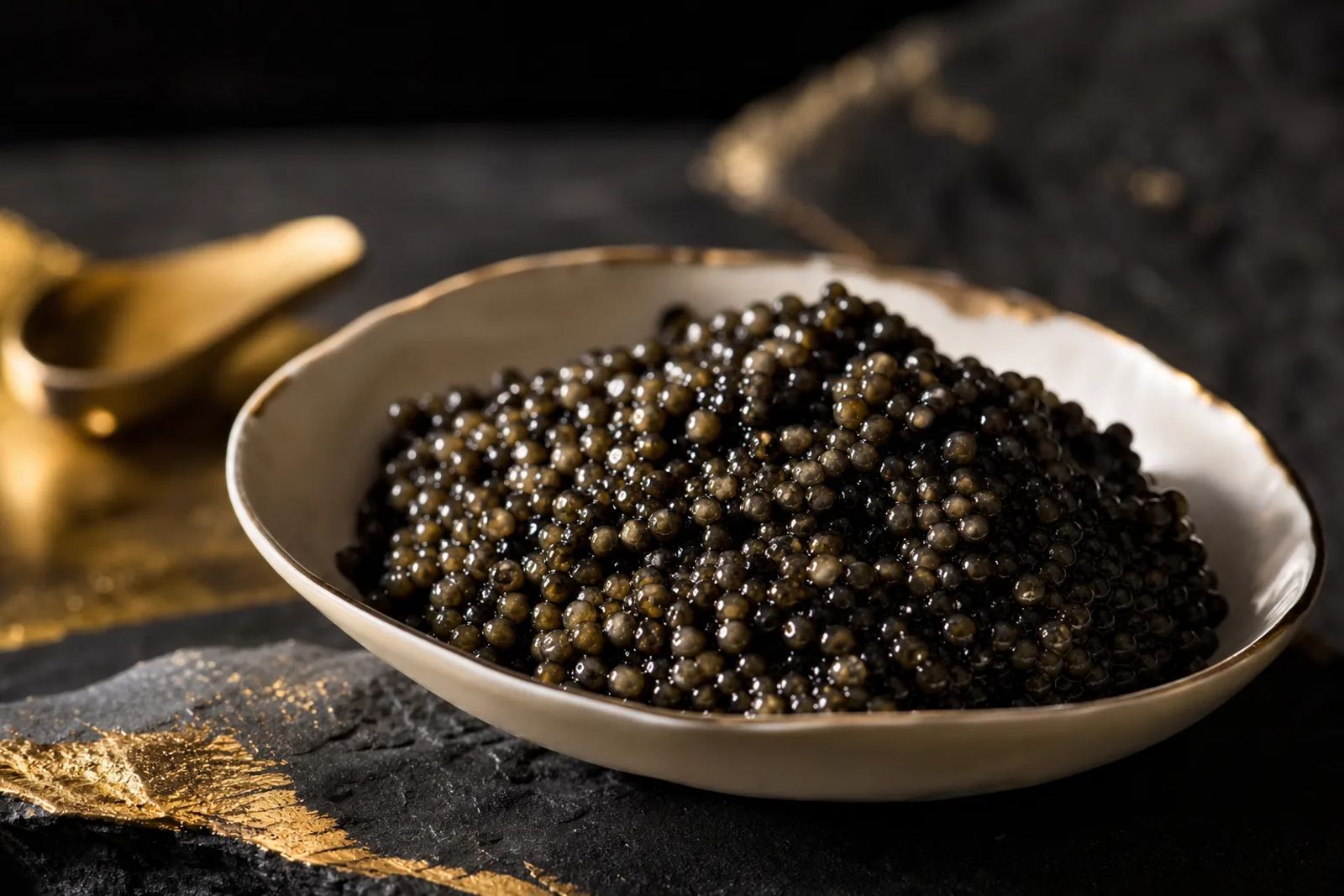
A smooth texture and a nutty, briny flavour: that is Sturgeon AquaFarms’ description of sterlet caviar. This salted roe comes from Acipenser ruthenus, a relatively small freshwater sturgeon whose naturally small eggs give it a fine grain. Albino sterlet also produces pale roe. Its connection with white caviar is real; the story that such caviar belonged exclusively to Russian rulers is more complicated than the fish’s documented place at court.
Sterlet at a glance
| Field | Record |
|---|---|
| Common names | Sterlet; sterlet caviar |
| Scientific name | Acipenser ruthenus, listed by CITES; synonyms include Acipenser pygmaeus. |
| CITES | Appendix II; species code RUT. |
| IUCN Red List | Endangered; global assessment published in 2022. |
| Native range | Danube, Volga and other Black, Azov and Caspian basin rivers; Siberian rivers from the Ob to the Yenisei. |
| First farm harvest | At least four years, according to one Belgian producer. |
| Egg diameter | FAO: 1.9 to 2 mm; UF/IFAS: 2.0 to 2.8 mm. Biological egg measurements. |
| Colour | Grey to dark grey; albino roe can be pale. Colour cannot identify species. |
| Documented farming | Belgium, according to the European Commission. |
| Wild trade | Controlled by CITES Appendix II, not universally prohibited. |
A fine grain, with flavour to discover
Small grain is sterlet’s defining feature. Flavour is less fixed. UF/IFAS explains that sturgeon egg size falls within a species-related range, but also reflects the female’s size and age, food supply and environment. A small sterlet egg does not, on its own, suggest that the fish was harvested too early.
Alongside Sturgeon AquaFarms’ smooth, nutty-briny account, Royal Belgian Caviar describes its albino sterlet caviar as salty and melting on the tongue.
The two diameter ranges above are biological egg measurements, not interchangeable specifications for finished salted caviar. Neither sets a minimum commercial grade. For any batch, ask whether the quoted diameter describes eggs before processing or finished caviar before comparing figures.
Producer descriptions offer a sensory starting point. Alongside Sturgeon AquaFarms’ smooth, nutty-briny account, Royal Belgian Caviar describes its albino sterlet caviar as salty and melting on the tongue. Those descriptions come from the producers; no tasting was conducted for this article. They give a sense of the products without promising that every tin of sterlet will taste the same.

The river fish behind the roe
Sterlet is a river fish, not merely a smaller version of a sea-going sturgeon. Its native waters include the Danube and Volga systems and stretch east into Siberia, through the Ob and Yenisei drainages. Freshwater residence still involves movement: journeys within rivers matter to both feeding and reproduction.
The US Fish and Wildlife Service’s biological summary gives a common length of 40 cm, while also recording larger individuals. Sterlet is relatively small, but that does not make it the smallest of every commercial sturgeon or hybrid. The guide to sturgeon species sets out the wider comparison; the fish discussed here is pure Acipenser ruthenus.
Numerous lateral scutes, the bony plates along the sides, and fringed barbels, the sensory appendages beneath the snout, distinguish the living fish. FAO highlights these features, which tell more than the colour of its caviar. Roe identification requires documentary support and, where authenticity is disputed, appropriate laboratory investigation rather than a visual guess.
How early does sterlet mature?
Sterlet can mature relatively early, but sex and growing conditions matter. FAO’s hatchery manual gives wild maturity in southern rivers as 3 to 6 years for males and 4 to 9 years for females, most often 4 to 5 and 6 to 8 respectively. These figures describe southern river populations, not every population across the range. Male maturity, of course, does not set the date for caviar production.
For farmed roe, Royal Belgian Caviar declares an age of at least four years for its albino sterlet product. That is a specific producer’s harvest statement, rather than a verified range for the species. Temperature management, nutrition and each female’s development affect the timetable. First sexual maturity and first commercial harvest belong in separate records.
The Belgian product documents relatively early roe production at one farm, without establishing a record across all sturgeon species. Sturgeon maturity by species compares ages while keeping sex, rearing conditions and harvest definitions in view. For a particular farm, actual harvest records say more than a claim that sterlet is ready after a certain birthday.
White caviar and the bester connection
Albino sterlet is a documented source of pale caviar. Royal Belgian Caviar explicitly identifies its pale product as Acipenser ruthenus. Albinism affects pigmentation; it neither creates a separate species nor guarantees a particular flavour. White caviar explained distinguishes this documented production from claims surrounding albino beluga and Almas.
Sterlet also supplies one parent of bester. The conventional first-generation cross pairs a male sterlet, Acipenser ruthenus, with a female beluga, Huso huso, using the names retained in the site’s CITES-based records. The resulting hybrid roe is not pure sterlet caviar, however prominently sterlet features in its description. Bester parentage and caviar explains the distinction.

Sterlet at the Russian court
Sterlet had a place at the imperial table. The National Library of Russia’s presentation of coronation menus identifies it among the Russian dishes served in ceremonial court dining. That establishes the fish’s culinary standing. The species and pigmentation of every caviar served there are a separate question.
In The Pantropheon, published in 1853, Alexis Soyer discussed sterlet among the fish furnishing caviar and repeated a report that white caviar was reserved for the court. His qualification, “it is said”, applies only to the quality claim. He states the court reservation plainly, but cites no decree. The passage records a story circulating in the nineteenth century; it does not establish an exclusive legal entitlement.
“White caviar” in a historical text also cannot identify albino beluga as its source or connect it to a modern product bearing the same name. The record preserves a genuine court association while leaving those questions open. Caviar and the Russian Tsars explores the wider imperial history, distinguishing primary evidence from later retellings.
Conservation, research and Danube restocking
Wild sterlet is Endangered, as listed in IUCN’s freshwater fish information brief. The designation describes wild populations, not the condition of a farmed batch of roe. In the Danube, ICPDR identifies river barriers, habitat damage and exploitation among the pressures driving sturgeon decline.
LIFE Sterlet tackles conservation through breeding and fieldwork together. The University of Natural Resources and Life Sciences, Vienna, describes a programme combining a genetic database, tracking of adult fish and the breeding of juveniles for release into suitable Danube habitats. Matching broodstock to the river population and checking results are central to its stated approach. This is conservation breeding, rather than commercial aquaculture followed simply by releasing fish.
Sterlet also has a role in fundamental biology. In 2020, Du and colleagues assembled a chromosome-level sterlet genome to investigate ancient whole-genome duplication, when an ancestral genome was copied in full. That research addresses a different question from whether restocking has restored a self-sustaining population. Danube sturgeon conservation follows the work at river scale.
Protection and international trade
Sterlet’s CITES listing is Appendix II, with the species code RUT. This controls international trade rather than prohibiting all commerce. A CITES label provides traceability information, but the label alone cannot verify the contents. Documentation must distinguish pure sterlet from hybrids and record origin separately from processing or repacking.
EU law covers sterlet within a group of sturgeons in Annex V of the Habitats Directive, rather than under the named sturgeon entries in Annexes II and IV. Annex V allows regulated management of taking and exploitation where necessary for favourable conservation status. It is not a fishing licence. National Danube rules can be stricter: Serbia’s environment ministry imposed a permanent sterlet fishing ban from 1 January 2019. There is no sound basis for a basin-wide claim that wild sterlet can lawfully be caught.
For EU imports, the Netherlands’ CITES authority sets out permit requirements and a conditional personal-baggage exception for no more than 125 g in correctly marked containers. Great Britain follows its own APHA permit procedures; check Northern Ireland separately. In the US, 50 CFR 23.71 governs international caviar trade and container labelling, alongside other applicable import requirements.
A personal allowance does not authorise postal orders or commercial consignments. Wildlife paperwork does not replace food-import requirements either. Consult the authorities in both countries, including Switzerland, the UAE, China, Japan, Russia and Australia where relevant. The requirements depend on route, origin, quantity and purpose.
Sources
-
caviar.uk.
-
FAO, Chebanov, M. S. and Galich, E. V. Sturgeon Hatchery Manual, Fisheries and Aquaculture Technical Paper 558, reprinted 2013. Document.
-
University of Florida, IFAS, Chapman, F. A. and Van Eenennaam, J. P. Sturgeon Aquaculture: Specialized Techniques: Determining the Stage of Sexual Maturity in Female Sturgeon for Artificial Spawning: The Egg Polarization Index or PI, FA153, 2007, reviewed August 2025. Document.
-
US Fish and Wildlife Service. Sterlet (Acipenser ruthenus): Ecological Risk Screening Summary, web version dated 5 September 2017. Document.
-
European Commission, EU Aquaculture. The success of caviar from Belgium, undated online campaign article. Article.
-
Sturgeon AquaFarms. Sterlet (Ac. Ruthenus), undated company species page. Page.
-
Royal Belgian Caviar. White Pearl, undated producer description.
-
IUCN SSC. Freshwater fishes of potential interest for inclusion in CMS: information brief, information brief hosted by IUCN in January 2024. Document.
-
National Library of Russia. Petersburg Cuisine in the 19th to 21st Century, coronation and ceremonial menu exhibition, undated online catalogue. Exhibition.
-
Soyer, Alexis. The Pantropheon; Or, History of Food, Its Preparation, from the Earliest Ages of the World, 1853, Chapter XXI, Project Gutenberg transcription. Text.
-
University of Natural Resources and Life Sciences, Vienna. LIFE Sterlet, project description, undated; project initiated November 2015. Project.
-
Du, K. and colleagues. The sterlet sturgeon genome sequence and the mechanisms of segmental rediploidization, Nature Ecology & Evolution 4, 841 to 852, 2020. Paper.
-
European Commission. Assessment and reporting under Article 17 of the Habitats Directive, July 2011 guidelines for the 2007 to 2012 reporting period. Document.
-
Serbian Environmental Protection Agency. Report on the state of the environment in the Republic of Serbia for 2019, section 9.5, freshwater fisheries. Document.
-
Netherlands Enterprise Agency, RVO. Kaviaar, guidance checked by the issuing authority on 18 July 2024. Guidance.
-
APHA and Defra. Check if you need a CITES permit to import or export endangered species, live GOV.UK guidance, retrieved November 2026. Guidance.
-
United States, Code of Federal Regulations. 50 CFR 23.71: How can I trade internationally in sturgeon caviar?, online text reproduced by Cornell Legal Information Institute, retrieved November 2026. Regulation.
-
ICPDR. The smallest sturgeon species is making big progress, undated online account of LIFE Sterlet. Article.
Last checked: November 2026