
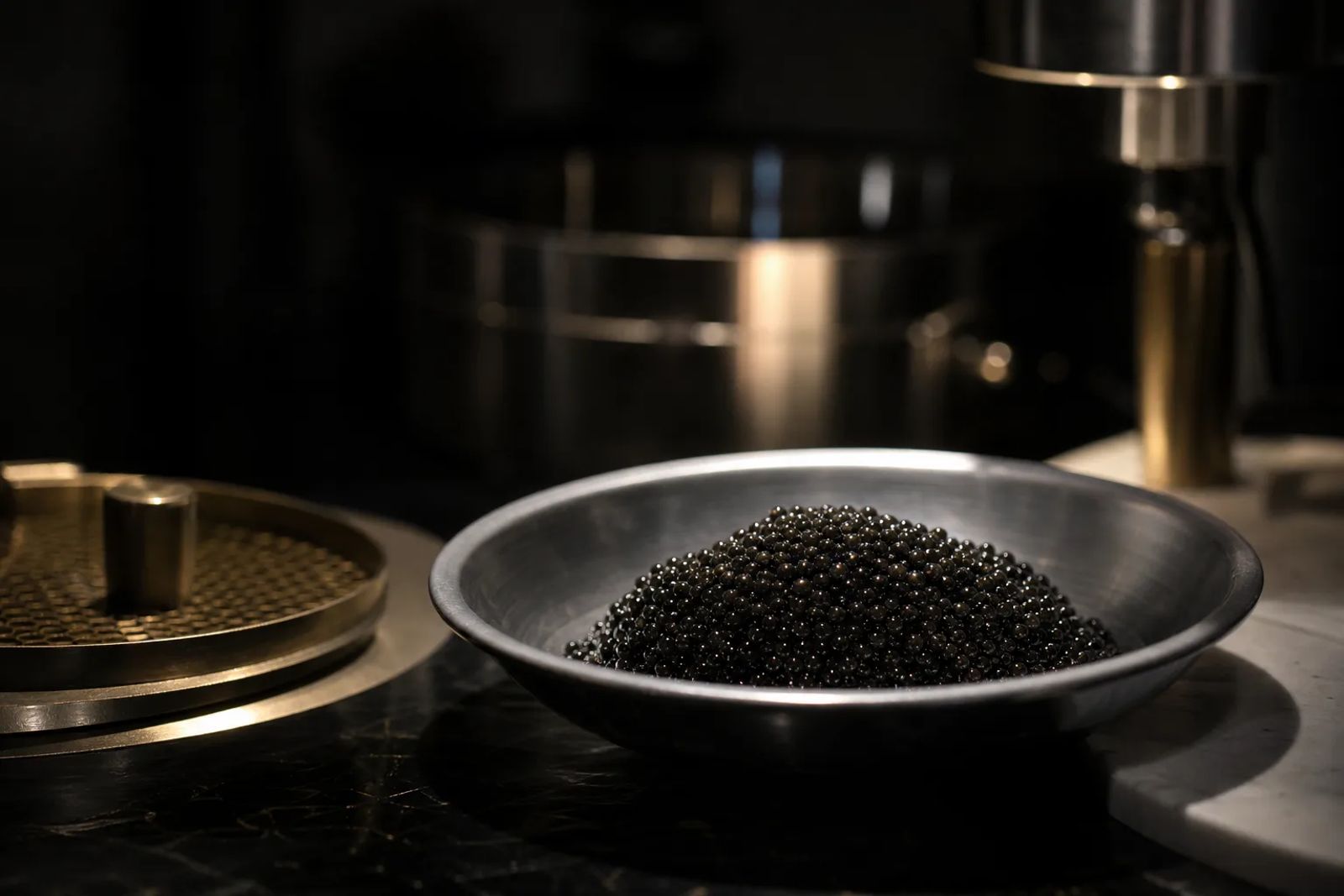
Supermarket and own-label caviar carries the retailer’s brand, but the farm, first processor and final packer may be different businesses. To find out who handled your tin, start with its CITES plant code and any food establishment identification mark, then ask the retailer to connect those facilities to the farm.
- The business address is not necessarily the packing site.
- Repacking can replace the original processor’s code on the retail label without ending the recorded traceability chain.
- Use the batch details from your actual tin, not just an online product photograph.
What own-label caviar means
Own-label, retailer-brand and store-brand describe caviar sold under a retailer’s name rather than the supplier’s consumer brand. They do not tell you whether that retailer farms fish, processes roe, repacks finished caviar or commissions another business to do those jobs.
The useful question is therefore not simply “who made it?” but “which business performed which operation for this batch?” Our caviar houses and producers guide separates the businesses; private-label caviar covers the commercial arrangements.
Three identities to keep separate
The operator responsible for food information is not necessarily the physical producer. A supermarket’s name beside “produced for” identifies the commissioning or responsible business; “packed by” identifies a stated packing business, but does not establish farm ownership.
The CITES plant code identifies the registered processing or repackaging operation named in that system. A processing plant performs the first packing into a container that directly touches the caviar; a repacker transfers previously packed caviar into new primary containers.
The EU identification mark belongs to a separate food hygiene approval system. It contains the establishment’s country and approval number; where packaging is removed or the product is further processed at another establishment, the new mark identifies that establishment, not automatically the fish farm.
What the rules show in different markets
Resolution Conf. 12.7 (Rev. CoP17), Annex 1, sets out the CITES labelling framework. It recommends domestic and international coverage, but binding duties depend on implementation in each jurisdiction.
Britain and Switzerland require caviar labels. Australia, the UAE, China, Japan and Russia have national requirements. Any 125 g personal effects exemption depends on the countries and circumstances.
| Jurisdiction | What to look for | Legal source | Checked |
|---|---|---|---|
| EU | Responsible operator or EU importer’s name and address, not necessarily the manufacturer; establishment identification mark. | Regulations 1169/2011, Articles 8 and 9; 853/2004, Annex II; 865/2006, Articles 64 and 66. | November 2026 |
| Great Britain | UK responsible business or importer address; GB establishment mark where applicable. | Assimilated Regulations 1169/2011 and 853/2004, as amended; FSA guidance. | November 2026 |
| Northern Ireland | NI or EU responsible business or importer address; NI establishments use a distinct NI mark. Retail Movement Scheme arrangements can differ. | EU food information and hygiene rules; FSA guidance. | November 2026 |
| United States | Manufacturer, packer or distributor’s name and address; a non-manufacturer’s role must be qualified. CITES rules here govern international trade. | 21 CFR 101.5; 50 CFR 23.71. | November 2026 |
| Switzerland | A producer, importer, packer or seller’s name and address, generally the distributor; food production origin is a separate declaration. | FSVO food labelling guidance. | November 2026 |
| Australia | Supplier’s name and Australian or New Zealand business address; this need not identify the overseas farm. | Food Standards Code, Standard 1.2.2; FSANZ guidance. | November 2026 |
Under EU food information rules, an operator’s name or address is not itself an origin declaration. Origin must be given where omission could mislead; where a stated food origin differs from its primary ingredient’s origin, additional rules apply.
In the US, USDA’s retail Country of Origin Labelling scheme does not cover roe or caviar. Keep that exemption separate from customs origin marking, FDA business identification and CITES country codes: these are different questions, not one universal origin declaration.
A teaching label, not a real label
Teaching example, not a real label: XXX/?/ZZ/0000/0000/000.
Every value is deliberately unusable: XXX is a placeholder species, ? is not a source code, ZZ is a placeholder country, and 0000 is not a harvest year here. The plant and lot values are placeholders too; never use this string as a compliance model.
| Field | Placeholder | What a real field means |
|---|---|---|
| Species | XXX | Declared species in the standardised CITES system. |
| Source | ? | Documented origin category under CITES, not a quality grade. |
| Country | ZZ | Country of origin, not necessarily the packing country. |
| Year | 0000 | Harvest year on an original processing label. |
| Plant | 0000 | Registered processing plant code. |
| Lot | 000 | Batch identifier linked to the operator’s records. |
On a repacked tin, the year is the repackaging year and the plant field identifies the repacker, incorporating the repacking country code where different. The final field can instead be a relevant CITES document number; see the CITES caviar code for the full decoding.
Trace your tin in five steps
-
Photograph the complete pack. Record the lid, base, side label, outer sleeve, date mark and lot. Keep the image legible without opening the tin or peeling off its seal.
-
Separate the codes. Copy the CITES string exactly, preserving letters, leading zeroes and separators. Record the food establishment approval number separately rather than assuming it matches the CITES plant code.
-
Search the CITES register by country. Use the origin country for an original processor, or the repacking country for a repacker. Match the whole plant identifier against the published entry and note its business name, address and listed activity.
-
Check the food establishment list. For an EU number, start with the European Commission’s approved establishments portal, then select the country and Section VIII, fishery products. For a non-EU establishment supplying the EU, use the Commission’s non-EU lists; for UK marks, use the relevant national approved establishment list.
-
Compare, then ask. Check whether the registered facility matches any “packed by” statement. If you have found only a repacker, give the retailer your lot and ask for the first processor and farm.
Public lists vary in layout, and some combine processing and repackaging rather than separating them. Our CITES register checking guide explains the lookup; if a code cannot be matched, ask the retailer or national CITES authority rather than declaring the business unlawful.
Where the public trail stops
A register match identifies the listed operation, not necessarily the farm where the fish grew. Retailers that only sell sealed tins need not appear as processing or repackaging plants, and the register is not a catalogue of every brand.
Repacking may obscure the original processor on the retail label, but it should not erase the records behind the batch. EU licensed plants must keep quantity records and identify suppliers and business customers under food law; these records are not a public farm directory.
Repacking may obscure the original processor on the retail label, but it should not erase the records behind the batch.
A CITES label shows traceability information, not proof of what is in the tin. Reading a code is not species authentication or an independent check of its contents, and a packing address cannot establish roe origin; country of origin versus repacking explains that distinction.
What to ask the retailer
Ask for information tied to your batch, not a general description of the range. A concise enquiry is easier to answer than “who makes your caviar?”
- Which farm supplied the roe for this lot, and in which country?
- Which registered plant first processed and packed it?
- Was it repacked, and which facility filled this retail container?
- Can you confirm the species, harvest date and packing or repacking date from the batch records?
- Can you explain any difference between the named packer and the establishment codes?
Keep the reply with its date and describe it accurately: “the retailer states that this lot came from…” A retailer’s answer is an attributed statement unless supporting records establish more; a business named on a register alone does not prove a supplier relationship.
Use provenance alongside quality information
Once you know which operations handled the caviar, ask the separate questions that affect your choice: what species is declared, what ingredients and salt information are given, and what dates and storage instructions accompany this batch? The CITES year is not a complete freshness history, particularly when it is a repacking year.
Compare those details on the actual pack rather than treating the retailer’s reputation or the plant’s identity as a tasting verdict. Use our label-reading guide to bring the food information and wildlife-trade information together before deciding.
Sources
-
CITES. Conservation of and trade in sturgeons and paddlefish, Resolution Conf. 12.7 (Rev. CoP17), 2016, particularly paragraph 2 and Annexes 1 and 2. Full resolution: resolution text.
-
CITES Secretariat. Resolutions of the Conference of the Parties in effect after the 20th meeting, live index, 2026. Confirms that Resolution Conf. 12.7 remains Rev. CoP17: resolutions index.
-
CITES Secretariat. United States of America: Register of caviar exporters, live register, retrieved November 2026. country register.
-
European Commission. Commission Regulation (EC) No 865/2006, consolidated text dated 19 January 2022, particularly Articles 64 and 66: consolidated regulation.
-
European Parliament and Council. Regulation (EU) No 1169/2011 on the provision of food information to consumers, consolidated text dated 1 April 2025, particularly Articles 2, 8, 9 and 26: consolidated regulation.
-
European Parliament and Council. Regulation (EC) No 853/2004 laying down specific hygiene rules for food of animal origin, consolidated text dated 9 May 2024, particularly Annex II, Section I: consolidated regulation.
-
European Commission. Approved EU food establishments and Non-EU countries authorised establishments, live guidance and list gateways, retrieved November 2026: EU establishments and non-EU establishments.
-
Defra and Food Standards Agency. Food labelling: giving food information to consumers, updated 20 September 2022, live guidance retrieved November 2026: food information guidance.
-
Food Standards Agency. Guidance on health and identification marks, live guidance retrieved November 2026, including Northern Ireland and Northern Ireland Retail Movement Scheme distinctions: identification marks guidance.
-
Food Standards Agency. Applying for approval of a meat or food establishment, live guidance and national list gateways, retrieved November 2026; and Packaging and labelling: legal requirements for food businesses, updated 4 September 2026: approval guidance and labelling guidance.
-
US Fish and Wildlife Service. 50 CFR 23.71: How can I trade internationally in sturgeon caviar?, current eCFR text retrieved November 2026, particularly paragraphs (a), (b) and (i): federal wildlife rule.
-
US Food and Drug Administration. 21 CFR 101.5: Food; name and place of business of manufacturer, packer, or distributor, current eCFR text retrieved November 2026, particularly paragraphs (a), (c) and (e): federal food labelling rule.
-
USDA Agricultural Marketing Service. Common Questions & Answers, live COOL guidance, retrieved November 2026, question “Are raw fish eggs (roe), or caviar covered commodities under COOL?”: COOL guidance.
-
Swiss Federal Food Safety and Veterinary Office. Information on food labels, live guidance retrieved November 2026, particularly sections 5 and 6: Swiss food labelling guidance.
-
Food Standards Australia New Zealand. Food labels: What do they mean?, published poster, retrieved November 2026, particularly “Food identification”; and NSW Food Authority, Labelling laws, live guidance retrieved November 2026: FSANZ label guide and NSW labelling guidance.
Last checked: November 2026