
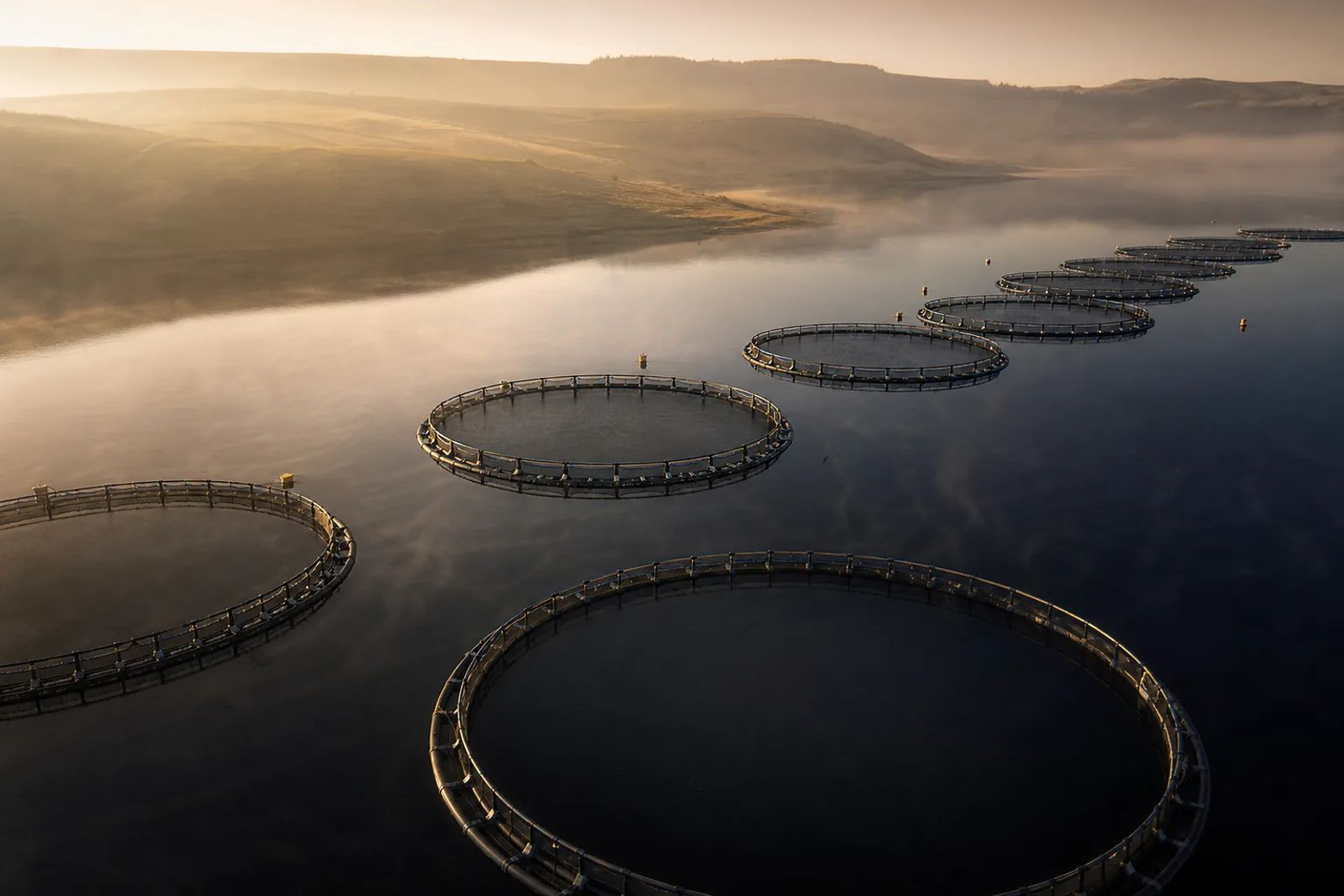
Walnut, hazelnut and a lingering creamy finish: that is how Black River describes its Uruguayan caviar. The producer says its fish are raised in flowing water channelled from the Río Negro. Behind those rich tasting notes lies an inland world of freshwater sturgeon farming, far from Uruguay’s Atlantic coast.
Uruguay has no native sturgeon stocks. Its caviar comes from introduced, farmed sturgeon, with a production history reaching back to the 1990s. Its southern hemisphere harvest can supply caviar at a different point in the year from northern seasonal harvests.
Uruguay at a glance
| Species farmed | Historical records document Siberian sturgeon (Acipenser baerii), Russian sturgeon (Acipenser gueldenstaedtii) and sterlet (Acipenser ruthenus). FAO’s 2017 review identifies Siberian and Russian sturgeon production. 1,5 |
| Main farming areas | Baygorria reservoir and San Gregorio de Polanco, on the Río Negro reservoir system. (DINARA; Uruguay XXI.) |
| Registered caviar operations | As of November 2026, CITES lists two operations, UY-001 and UY-002, both marked as exporters and listed under its combined processing and repackaging heading. |
| Export and import regime | DINARA sanitary controls under MGAP; CITES wildlife-trade documentation; destination food-import requirements. EU reference: Implementing Regulation (EU) 2021/405. (DINARA; EUR-Lex.) |
| PGI or PDO | Not publicly documented. |
| Wild stocks | No native sturgeon stocks; escapes of introduced fish recorded. (DINARA.) |
| Country’s role | Farming origin, processor and roe exporter, not simply a repacking location. (FAO; Uruguay XXI.) |
How sturgeon arrived in Uruguay
Uruguay’s sturgeon story began with aquaculture, the farming of aquatic animals. DINARA’s 2016 fish catalogue dates the introduction of Siberian sturgeon and sterlet by Esturiones del Río Negro to 1995, at Baygorria.
That date marks the fish’s introduction, not necessarily permission, company formation or the first commercial harvest. Accounts of the founding period do not agree on every milestone, so these events should not be folded into one birthday for the industry.
The government resolution of 27 January 1999 provides a firm administrative landmark. It identifies Esturiones del Río Negro S.A. at the Rincón de Baygorria reservoir and supports expansion of its aquaculture facilities and installation of a plant for sturgeon products and caviar.
A retrospective university account describes the early method: import fertilised eggs, rear the fish locally and wait until females yield roe. Domestic reproduction followed. Uruguay XXI describes a complete breeding and growing cycle at Estuario del Plata, establishing a production business rather than an operation confined to finishing imported caviar.
Where Uruguayan caviar is produced
The documented centre of production is inland freshwater, along the Río Negro reservoir system. At Baygorria, university researchers described a hatchery, floating cages, later land-based ponds and a processing plant associated with Esturiones del Río Negro.
Follow the river system upstream to San Gregorio de Polanco, in the Rincón del Bonete reservoir area, and the records place Estuario del Plata there, associated with the Polanco Caviar brand. Esturiones del Río Negro and Estuario del Plata are separate operations sharing a river system, not different names for one farm.
Black River describes its fish as raised in flowing water channelled from the Río Negro. The Black River profile explores the business itself.
For provenance, keep three details distinct: where the fish were farmed, which establishment processed the roe and which brand appears on the tin.
Which sturgeon are documented
The species name tells you more than “Oscietra” alone. FAO identifies Siberian sturgeon, Acipenser baerii, and Russian sturgeon, Acipenser gueldenstaedtii, as sources of Uruguayan caviar at Baygorria. It distinguishes Siberian caviar marketed as an Oscietra type from Russian sturgeon caviar.
“Oscietra” is a trade name, so ask for the scientific species name when comparing tins. Products carrying that word need not share the same biological origin.
Sterlet also appears in historical records, including a university report on farmed sturgeon meat. DINARA records other introductions too, although introduction or authorisation does not establish that a species supplies commercial caviar today.
The southern autumn harvest
Black River provides the clearest dated harvest account. In a report published on 22 May 2023, the producer said harvesting had begun on 5 April. That was later than the previous year because late-summer temperatures had remained high.
Black River linked its 2023 harvest to the cooling water of southern autumn. Hemisphere alone proves neither a more recent harvest, better handling nor a tin closer to its intended eating condition.
Ask when the roe was harvested and packed. Keep harvest, processing and repacking dates separate, and request the producer’s storage instructions and remaining shelf life.
The guide to caviar season explains how seasonal biological cues sit alongside year-round availability.
Export status and national oversight
For an export shipment, check three things: the country’s eligibility, the processing plant’s approval and the consignment documents. Sanitary approval and wildlife-trade compliance are separate checks.
Start with the country. The EU’s 2022 amendment to Annex IX of Implementing Regulation (EU) 2021/405 explicitly listed Uruguay for aquaculture finfish and caviar. As of 4 November 2026, Annex IX lists Uruguay for finfish and caviar.
Then check the plant. A government announcement dated 27 May 2016 records EU approval of Estuario del Plata’s plant. That establishes the historical approval; the plant’s current listing must be checked separately.
Finally, check the consignment documents against the destination’s food and wildlife requirements. Country eligibility alone does not settle the plant or shipment checks.
National sanitary oversight sits with DINARA, the Dirección Nacional de Recursos Acuáticos, within MGAP, Uruguay’s Ministry of Livestock, Agriculture and Fisheries. Its published fishery-product import procedure requires an origin sanitary certificate, labels and relevant analytical results, with registration and inspection through the national single-window system.
Uruguay XXI reports export destinations including Japan, the United States, Switzerland, France, Sweden and Germany.
Destination food and wildlife requirements apply separately in the EU, Great Britain, Northern Ireland, the US, Switzerland, the UAE, China, Japan, Russia and Australia. Personal effects exemptions may cover 125 g of labelled Appendix II caviar per person, subject to national rules.
Reading origin on a label
Look for UY in the CITES origin information: it identifies Uruguay. A brand’s address does not establish where the roe originated.
The label is a traceability tool, rather than verification of the contents. The guide to origin and repacking explains the distinction.
Escapes and biosecurity
In April 1997, storms caused escapes from Baygorria cages. DINARA subsequently recorded Siberian sturgeon across connected rivers, including the Negro, Uruguay, Paraná and Río de la Plata.
These findings make containment an essential part of the farming story. DINARA’s catalogue said reproduction in those natural environments had not been demonstrated at the time.
DINARA subsequently recorded Siberian sturgeon across connected rivers, including the Negro, Uruguay, Paraná and Río de la Plata.
Ask producers about cage and screen integrity, storm contingency plans, quarantine of incoming stock, disease surveillance and escape reporting. Without current farm-level records, neither an environmental guarantee nor a conclusion of established wild populations is justified.
What Uruguayan caviar is known for
Uruguay’s clearest distinction is its production geography: locally farmed sturgeon roe from the Río Negro, exported beyond South America. FAO also describes the traditional malossol approach at the pioneering Baygorria operation. Malossol means lightly salted preparation.
Black River describes walnut and hazelnut flavours and a lingering creamy finish. Those are the producer’s notes on its own caviar, not a national flavour profile or a tasting conducted by this website.
Put two Uruguayan tins side by side and start with the fish: Siberian sturgeon or Russian sturgeon? Then compare the producer, harvest lot and handling history, including harvest and packing dates and storage instructions. Both tins may say Uruguay; those finer details identify the caviar you are actually comparing.
Where to go next
- South America: place Uruguay within the region’s documented production history.
- Caviar Producing Countries: compare farming origins, distinct from branding and repacking centres.
- Other South American Sturgeon Projects (Argentina, Chile and Brazil): explore neighbouring projects separately from Uruguay’s established record.
Sources
-
MGAP, DINARA. Nión, H., Ríos, C. and Meneses, P. Peces del Uruguay: Lista sistemática y nombres comunes. Second corrected and expanded edition, 2016. Sturgeon entries, printed pages 109 to 110.
Read at gub.uy -
MGAP. Peces de agua dulce de Uruguay. 2011 edition. Siberian sturgeon entry, printed page 169.
Read at gub.uy -
República Oriental del Uruguay, IMPO. Resolución N° 60/999: Declaración de interés nacional. Proyecto de inversión. Esturiones del Río Negro S.A. (ex-Marplatense S.A.). Promulgated 27 January 1999; published 3 February 1999.
Read at impo.com.uy -
Universidad de la República, Instituto de Investigaciones Pesqueras. Boletín del Instituto de Investigaciones Pesqueras, no. 26, 2006. ““Desarrollo tecnológico de carne de esturión (Acipenser baerii y Acipenser ruthenus) ahumada”, printed pages 57 to 86.
Read at colibri.udelar.edu.uy -
FAO. Regional review on status and trends in aquaculture development in Latin America and the Caribbean, 2015. Fisheries and Aquaculture Circular No. 1135/3, 2017. Section 2.3.1, “Sturgeon and caviar production in Uruguay”.
Read at fao.org -
Uruguay XXI. Estuario del Plata: Polanco Caviar. Undated export case study.
Read at uruguayxxi.gub.uy -
Presidencia Uruguay. Uruguay promueve vino, caviar y arroz premium en principal feria de alimentos de Asia. 2016 government report.
Read at gub.uy -
Black River Caviar. Mayo, S. It’s Harvest Time. 22 May 2023. Producer statement.
Read at blackrivercaviar.com -
MGAP, DINARA. Solicitud de importación de productos pesqueros. Official procedure, updated 14 October 2026.
Read at gub.uy -
Presidencia Uruguay. Dos plantas pesqueras uruguayas fueron habilitadas para exportar productos a Unión Europea. 27 May 2016.
Read at gub.uy -
European Commission, EUR-Lex. Commission Implementing Regulation (EU) 2022/363. Official Journal L 69, 2022, amending Annex IX to Regulation (EU) 2021/405.
Read at eur-lex.europa.eu -
European Commission, EUR-Lex. Commission Implementing Regulation (EU) 2021/405. Consolidated edition dated 4 November 2026, particularly Article 13 and Annex IX.
Read at eur-lex.europa.eu -
CITES Secretariat. Uruguay: Register of caviar exporters. Public register listing two Uruguayan operations.
Read at cites.org -
Black River Caviar. Our Story Copy. Undated producer webpage, particularly “Our Caviar”.
Read at blackrivercaviar.com -
CITES Secretariat. PC23 Doc. 29.2. Plants Committee document, 2017, Annex country-code table.
Read at cites.org
Last checked: November 2026