

An autumn sturgeon run could end in a spring spawning. In the Volga and Ural system, Russian sturgeon entering rivers in autumn spent the winter there before spawning farther upstream the following spring. Even the old caviar calendar was more intricate than “spring or autumn”.
Today, farmed sturgeon caviar is available throughout the year, though individual farms may harvest seasonally. There is no single best buying season. What matters is the maturity of the eggs, the history of the batch and the day you plan to serve it.
Where the old caviar season came from
The traditional calendar followed fish travelling from the sea into rivers to reproduce. The pattern varied by species and river:
- Russian sturgeon in the northern Caspian: FAO describes spring and autumn migrations in the Volga and Ural system. Spring migrants approached spawning soon after entering freshwater; autumn migrants overwintered before spawning farther upstream the following spring.
- Beluga, Huso huso, in the Volga and Ural: FAO records a predominantly late winter and spring run in the Volga, but a predominantly late summer and autumn run in the Ural. One species, two distinctly different Caspian calendars.
- Stellate sturgeon, Acipenser stellatus, also called sevruga: FAO's hatchery manual distinguishes autumn, spring and summer migratory forms in its account of Caspian and Azov stocks. The familiar two-season shorthand misses part of this fish's life history.
These historical migrations explain references to spring and autumn caviar. They neither describe fishing opportunities today nor establish that one season always produces better roe.
Wild harvests are a separate question
For 2026, Russia's Federal Agency for Fisheries reported that the Caspian states had extended their prohibition on commercial sturgeon fishing and exports of wild sturgeon caviar and meat. See restrictions by country, checked November 2026.
That is a regional prohibition, not a worldwide ban. Elsewhere, restrictions depend on the fishery and jurisdiction.

How farms work beyond the river calendar
A fish can be old enough to produce eggs without its eggs being ready to harvest. Farms select females by the stage of egg development, rather than harvesting every fish on a fixed date. University of Florida researchers describe periodically sampling eggs to identify peak maturation.
In a 2026 qualitative study, Emam and Unerman drew on eight interviews with producers in Sweden, Spain, France and Belgium. Producers described ultrasound monitoring and, at some farms, biopsies: small samples of eggs used to assess readiness. The study records their practices rather than testing a single schedule for all farms. See checking egg ripeness for how these checks work.
Those checks assess readiness; water temperature influences the reproductive development behind it. Controlled or stable water supplies therefore give farms more scheduling flexibility than water exposed to seasonal changes. Antonius attributes its almost continuous production to constant-temperature artesian water; water temperature and maturation explains the biology.
Year-round supply does not require every farm to harvest every month. In a 2015 Eataly interview, Calvisius described extraction generally between November and April, followed by curing. A seasonal harvest can supply a market that stays open through summer.
Harvest, packing and eating are different dates
A CITES year provides traceability, not a food date for planning when to eat the caviar. Nor is it a full harvest date. Under the US international-trade rule, an original processing label records the harvest year; a repackaging label records the repackaging year. A new container does not make the eggs newly harvested.
A producer may also provide a full harvest or packing date. Ask which event the date records, then read it separately from the food date marking and storage instructions. The CITES label does not verify the contents or guarantee safety.
Before buying, ask three questions: when was the roe harvested, has it been repacked, and does its stated date limit suit your serving day? The buying guide sets those questions alongside species, origin and handling.
Why some caviar is held before sale
Holding caviar can serve two purposes: developing flavour and planning supply across the year. Harvest and sale need not happen close together.
A fish can be old enough to produce eggs without its eggs being ready to harvest.
Calvisius said in 2015 that curing took two to three months. California aquaculture producer and consultant Tony Vaught describes caviar being aged and stored for sales throughout the year, including the following Christmas.
The shortest time since harvest is not an automatic mark of quality. Ask what style the producer intended. For the role of maturation, see fresh versus aged caviar.
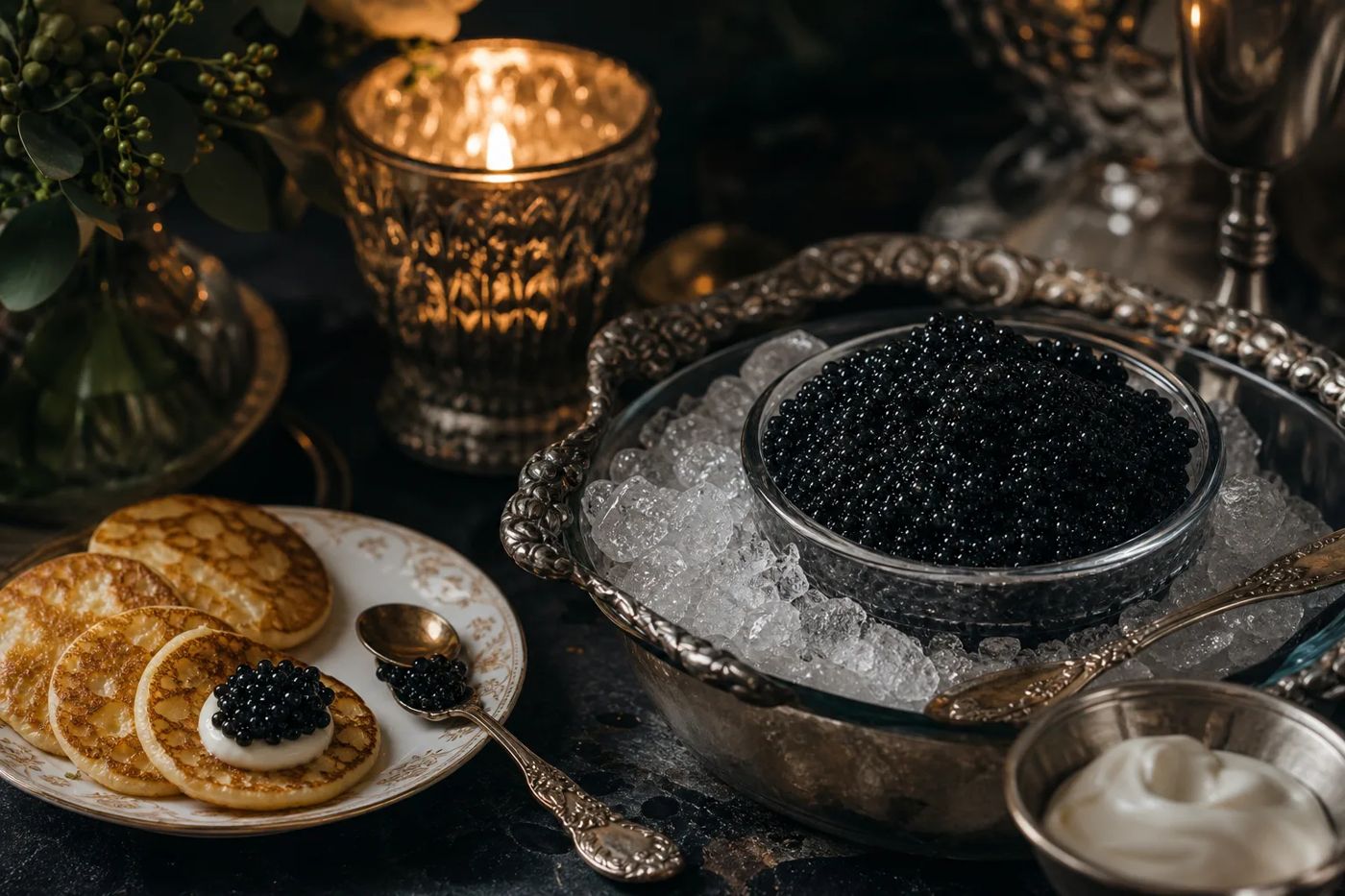
Holiday demand changes planning, not fish biology
At Lemberg, the final eight to ten weeks of the year were the principal sales period, its managing director said in a 2022 interview. Staffing tripled in the high season.
Christmas and New Year can concentrate orders, although caviar has no single global holiday calendar. The accounts of ageing and seasonal staffing show how businesses prepare: holding planned stocks and increasing processing capacity.
Those accounts do not establish that December caviar is inherently fresher. Order ahead and agree a delivery date that suits the product's instructions. Christmas and New Year planning covers the practical detail.
Other fish roes really do have seasons
For other fish eggs, or roe, naming the fishery often brings the seasonal answer into sharper focus. These are harvest windows, rather than assurances that every product on sale has just been harvested:
- Salmon, Alaska: the Alaska Seafood Marketing Institute places the main harvest between May and September, with timing dependent on the fishery.
- Herring, Southeast Alaska: the state's fisheries department describes commercial sac-roe fisheries as spring fisheries immediately before spawning.
- Vendace, Bothnian Bay: producer Junköfiskarna describes a five-week autumn fishery beginning in September. The Kalix Löjrom protected-name specification also documents a five-week fishing period.
When a supplier says “seasonal”, ask what it means: a wild fishery's season, the farm's own harvest window, or simply a period of strong demand. That answer tells you more than a month on the calendar.
Sources
- FAO. Sturgeon hatchery practices and management for release: Guidelines. Fisheries and Aquaculture Technical Paper 570, 2011, section 2. Official PDF.
- FAO. Sturgeon hatchery manual. Fisheries and Aquaculture Technical Paper 558, 2011, reprinted 2013, section 1.2.4.3. Official PDF.
- Federal Agency for Fisheries, Russian Federation. Conservation of valuable fish stocks: Caspian countries agreed to extend the ban on commercial sturgeon fishing [Russian-language title translated], 27 November 2025. Official announcement.
- Illinois Department of Natural Resources. Commercial Fishing and Musseling in Certain Waters of the State, 17 Illinois Administrative Code, Part 830, section 830.13. Official PDF dated 26 February 2020, retrieved November 2026. Official text.
- University of Florida, IFAS Extension. Technically Speaking, What Is Sturgeon Caviar? FA194, undated online edition retrieved in 2026. Extension publication.
- Emam, W. and Unerman, M. Animal welfare in European caviar production: insights from sturgeon producers. Frontiers in Fish Science, volume 4, article 1828234, 5 June 2026. Research article.
- Antonius Caviar USA. Farm. Undated company account, retrieved in 2026. Producer's description.
- Eataly, interviewing Calvisius. Sustainable Caviar: An Interview with Calvisius. Dated 23 October 2015, checked in 2026. Producer interview.
- US Fish and Wildlife Service. 50 CFR 23.71: How can I trade internationally in sturgeon caviar? Electronic Code of Federal Regulations, current online text retrieved November 2026, paragraphs (b)(1) to (3). Official regulation.
- Professional Aquaculture Services, Tony Vaught. From the Fields: By Tony Vaught, Butte County aquaculture producer and consultant. 28 February 2025. Producer's account.
- Lemberg Lebensmittel. Lemberg Lebensmittel celebrates 20th anniversary. Interview with managing director Ruslan Volny, 30 March 2022. Company interview.
- Alaska Seafood Marketing Institute. Seasonality & Harvesting. Undated online edition, retrieved in 2026. Seasonal overview.
- Alaska Department of Fish and Game. Overview of Southeast Alaska Herring Fisheries. Board of Fisheries presentation, 2024 to 2025 meeting cycle, slide 5. Official presentation.
- Junköfiskarna. About Kalix Löjrom. Undated producer account, retrieved in 2026. Producer's description.
- European Commission. Kalix Löjrom: Single document, amendment PDO-SE-0650-AM01, Official Journal C 164, 4 May 2021, section 3.2. Swedish-language official document hosted by the Swedish Food Agency. Official specification.
This piece was researched from FAO manuals, official fisheries and trade texts, extension guidance, peer-reviewed research and explicitly attributed producer accounts.
Last checked: November 2026