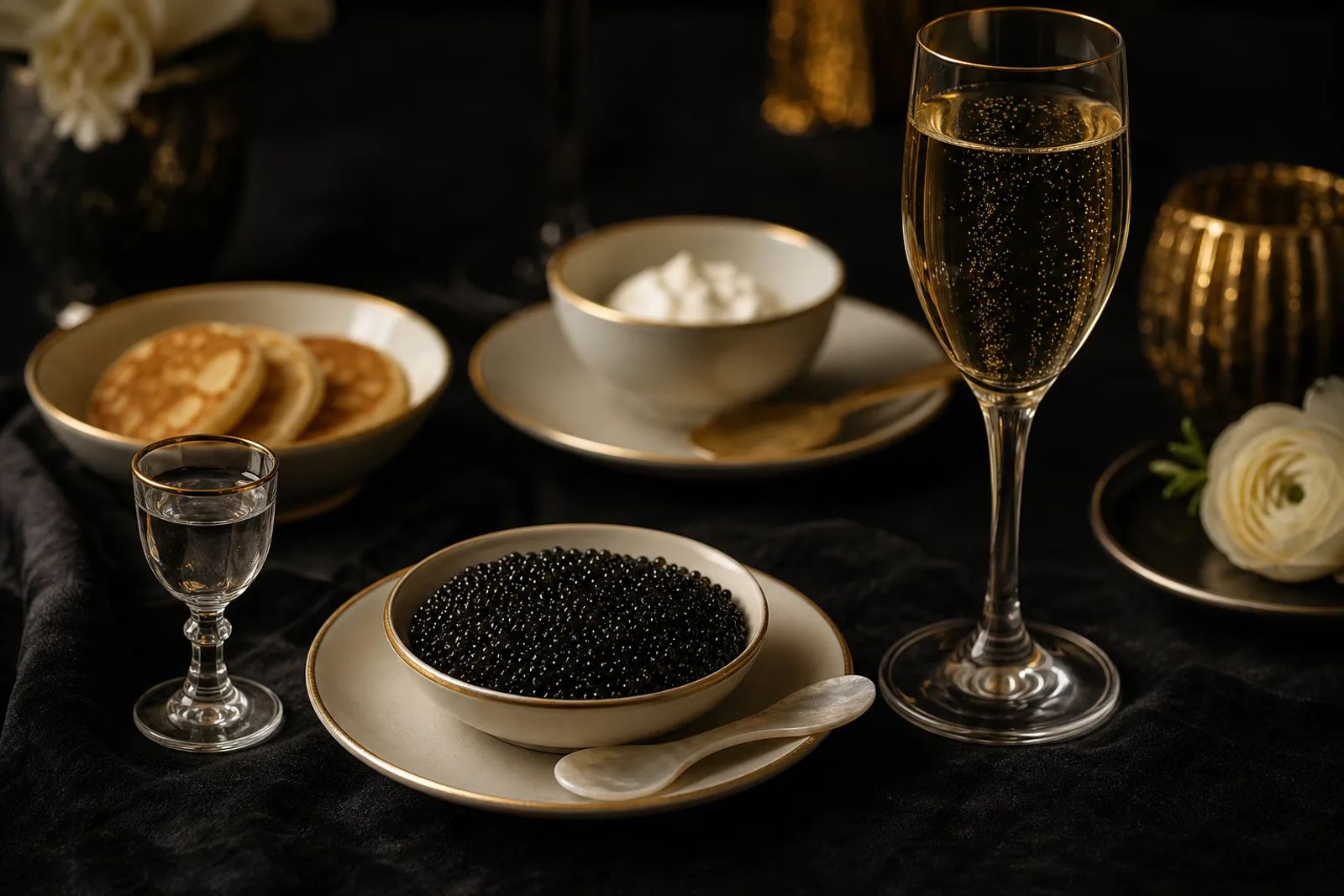
Champagne's rising bubble trails are part of the pleasure, and the glass helps shape it. For a caviar table, start with a tulip-shaped Champagne glass and a small vodka glass. A comfortable white wine glass is a useful alternative. There is no need for a matching service: focus on bowl shape, a comfortable rim and glassware documented as suitable for drinks.
Champagne glassware: four shapes, different pleasures
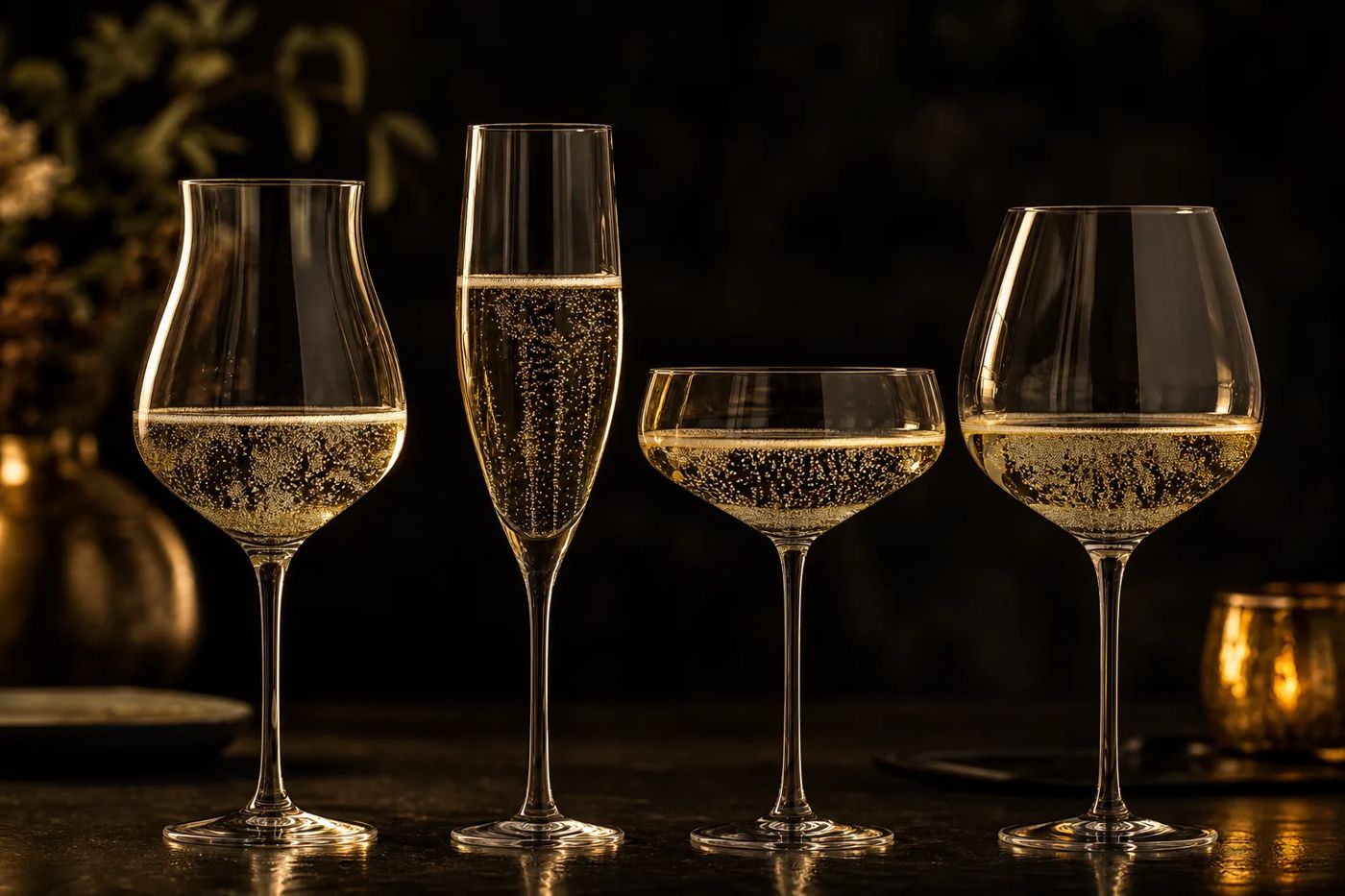
A tulip widens through the bowl before narrowing towards the rim. This is the shape Comité Champagne recommends to let the wine express its aromas and its bubbles develop. The industry body's advice makes it a useful starting point, rather than a guarantee that every tulip will outperform every other glass.
A flute is tall and narrow, framing the rising trails of bubbles. A coupe is broad and shallow, spreading the wine across a wider surface. Choose a coupe because you enjoy its shape; the research below favoured the flute for retaining dissolved gas under the study's conditions.
A white wine glass with a rounded bowl and a narrowing opening is a sensible alternative. Use one that already feels comfortable in your hand rather than acquiring a separate set simply because the packaging says Champagne. Leave space above the pour. The wine need not reach the rim.
What research reveals about gas and aroma
The clearest evidence here concerns carbonation. In their 2009 peer-reviewed study, Gérard Liger-Belair and colleagues measured carbon dioxide escaping from Champagne in a flute and a coupe during the first ten minutes after pouring. Dissolved carbon dioxide declined significantly faster in the coupe under the study's conditions.
Their 2012 study looked above the wine. Using micro-gas chromatography, the researchers measured carbon dioxide and ethanol above 100 ml pours over fifteen minutes. Carbon dioxide concentrations were higher above the flute than above the coupe. This measures the headspace, the air above the wine, rather than how attractive its aroma smells.
Glass shape can influence odour ratings, too. In a separate 2003 study, T. Hummel and colleagues asked 181 volunteers to assess red or white wine in differently shaped glasses and found that shape affected their ratings. It was not a Champagne trial, so it cannot rank these four shapes for sparkling wine. For drink selection and serving temperatures, see the Champagne pairing guide.
Vodka glasses: small, comfortable and chilled
Serve neat vodka, meaning vodka without mixers or ice, in a small glass. Difford's Guide describes small glasses in Eastern European and Nordic service, including slender stemmed Russian glasses it calls “stopkis”. A stem gives the fingers somewhere to rest without wrapping the hand around the bowl.
Russian glassware has more than one silhouette. The Sholokhov Museum describes lafitniki as faceted, stemmed glasses with conical or tulip-shaped bowls, tracing their origins to wine glasses. These names carry cultural history; they do not prescribe a universal capacity for a vodka glass.
Chill clean, empty glasses in the refrigerator before serving. The Alabama Alcoholic Beverage Control Board recommends at least an hour as a general glass-chilling method, rather than as a vodka-specific experimental finding. Refrigerator chilling is the straightforward choice here, without a coating of frost. Use the freezer only if the maker's instructions allow it.
Choose the bottle's temperature and the pairing separately from the glass. The vodka pairing guide covers those decisions.
Glass, crystal and lead: know the material
“Crystal” does not mean lead-free. Ordinary glass, lead-free crystal and lead crystal are distinct descriptions, and Health Canada warns that appearance alone may not distinguish them. When buying new glasses, ask for the material specification and confirmation that they are intended for beverage use.
Health Canada recommends lead-free tableware. Its guidance says lead crystal should be used only occasionally for serving and never for storing food or drinks. Lead transfer depends on the drink and the contact time; acidic drinks such as wine draw out more lead. Lead-free tableware is especially critical for infants, children and pregnant people.
Food-contact requirements include Regulation (EC) No 1935/2004 in the EU and Northern Ireland, its assimilated version as amended in Great Britain, and US federal requirements administered by the FDA for food-contact substances. Each is a jurisdiction-specific framework, not a single international approval for a glass. Legal framework checked November 2026.
Clean glasses, lively bubbles
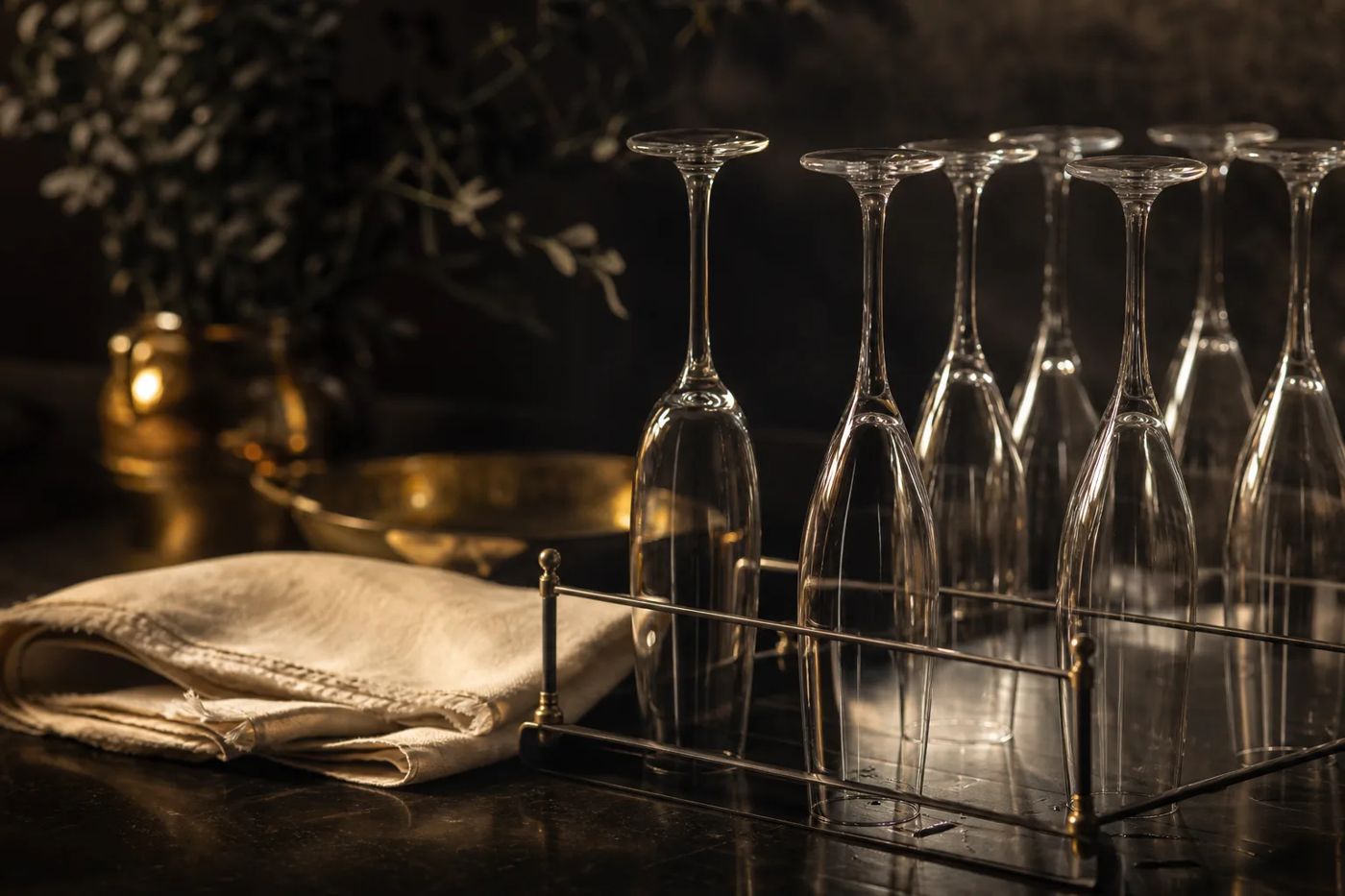
Detergent residue can interfere with bubble formation, according to Comité Champagne. Its advice is to use hot water without detergent, then air dry or dry with a cloth. In professional service, follow the required cleaning and sanitising procedures rather than substituting this consumer guidance.
Where the glassware's care instructions call for detergent, use it and rinse thoroughly. Leave no film behind. Health Canada specifically recommends mild detergent for handwashing lead crystal, so the right method depends on the material. For the caviar table, choose easily cleaned lead-free glasses and inspect them for residue before pouring.
The practical choice for a caviar table
Choose a lead-free tulip for Champagne and a small, stable glass for vodka. Our personal selection criteria would be roughly 250 to 350 ml capacity for the tulip and about 50 ml for the vodka glass, rather than prescribed standards. These are vessel capacities, not recommended measures of alcohol.
A comfortable rim matters more than a matching set. So does a base that sits securely, and a shape that fits the way you wash and store your glasses. If the white wine glasses already in the cupboard meet those needs, use them before adding another set. For the wider equipment choices, see the complete accessories guide.
For drinks without alcohol, choose glassware that suits the drink and explore non-alcoholic pairings for the pairing choices.
Sources
-
Comité Champagne, Serving Champagne, undated educational factsheet, file hosted May 2024, “Glassware” section. Service factsheet.
-
Liger-Belair, G., Villaume, S., Cilindre, C., Polidori, G. and Jeandet, P., CO2 volume fluxes outgassing from champagne glasses in tasting conditions: flute versus coupe, Journal of Agricultural and Food Chemistry, volume 57, issue 11, 2009, pages 4939 to 4947. DOI: 10.1021/jf900804j. PubMed record and abstract.
-
Liger-Belair, G., Bourget, M., Pron, H., Polidori, G. and Cilindre, C., Monitoring Gaseous CO2 and Ethanol above Champagne Glasses: Flute versus Coupe, and the Role of Temperature, PLOS ONE, volume 7, issue 2, 2012, e30628. Open-access article.
-
Hummel, T., Delwiche, J. F., Schmidt, C. and Hüttenbrink, K.-B., Effects of the form of glasses on the perception of wine flavors: a study in untrained subjects, Appetite, volume 41, issue 2, 2003, pages 197 to 202. DOI: 10.1016/S0195-6663(03)00082-5. Publisher abstract.
-
Difford's Guide, How to Serve Vodka Neat and Ice Cold, undated online edition. Vodka service guidance.
-
State M. A. Sholokhov Museum-Reserve, Лафитник [Lafitnik], undated collection article. Museum collection record.
-
Alabama Alcoholic Beverage Control Board, Alabama Select Spirits, May 2021, “Chill out with icy-cold cocktails”. Magazine issue.
-
Health Canada, Lead crystalware, online guidance, modified 21 August 2024. Lead crystalware guidance.
-
European Parliament and Council, Regulation (EC) No 1935/2004 on materials and articles intended to come into contact with food, 2004, Article 3. EUR-Lex legal text.
-
Northern Ireland legislation, The Materials and Articles in Contact with Food Regulations (Northern Ireland) 2012, SR 2012 No 384, 2012. Official legislation.
-
Food Standards Agency, Guidance on using the Register of Substances in Plastic Food Contact Material Authorisations, current online edition, describing the authorisation system effective from April 2025. Register guidance.
-
Food Standards Scotland, Food contact materials, current online guidance, undated edition. Food-contact framework guidance.
-
US Food and Drug Administration, Food Packaging & Other Substances that Come in Contact with Food: Information for Consumers, current online edition, undated. FDA consumer guidance.
This piece was researched using peer-reviewed experimental findings, attributed drinks-service guidance, a museum collection account and official food-contact and lead-exposure guidance; no glassware testing was undertaken.
Last checked: November 2026