
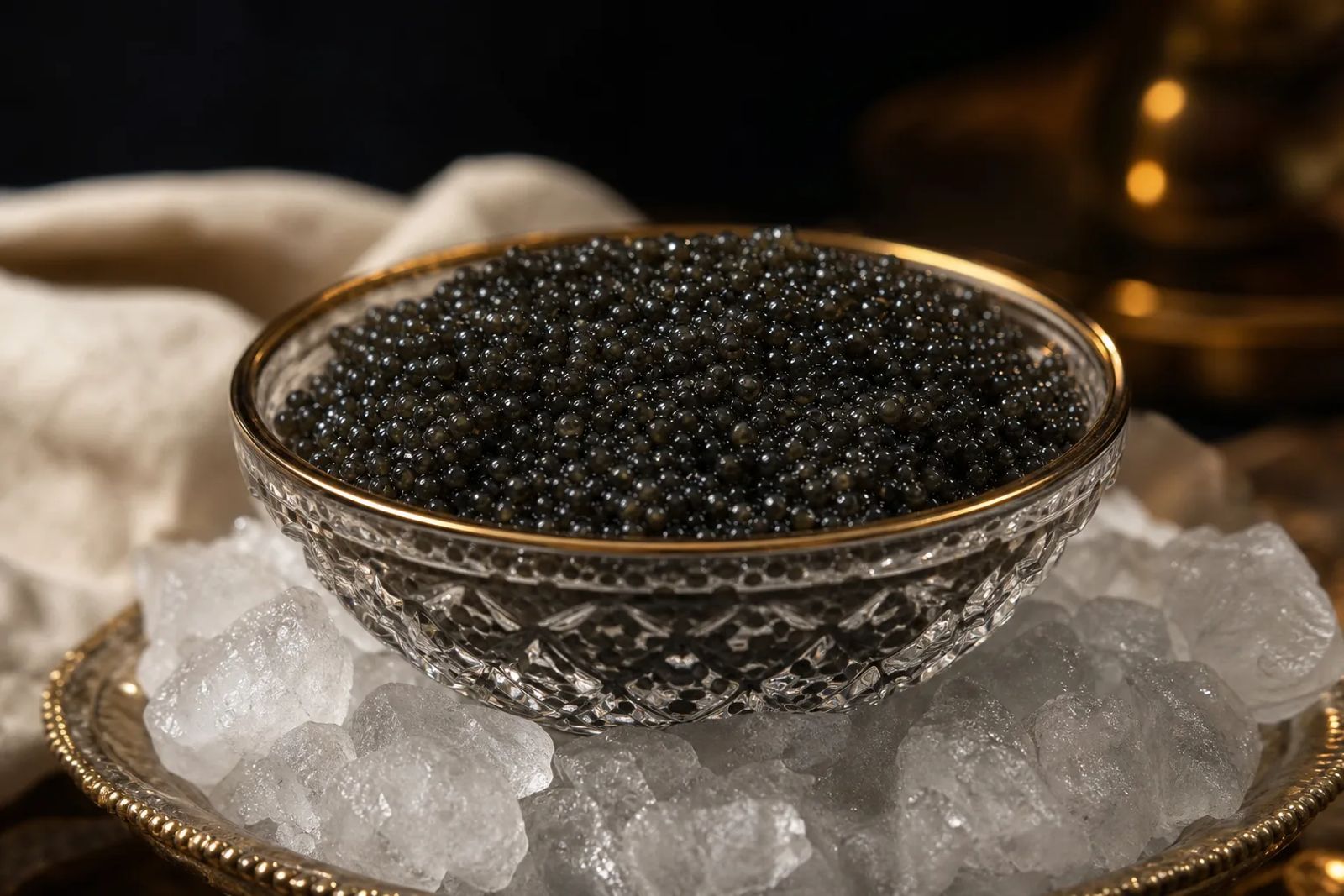
A white sturgeon can live beyond 100 years. On Sacramento-area farms with warm water throughout the year, its roe may be harvested after 8 to 10 years. Those eggs become white sturgeon caviar through salting: the produce of Acipenser transmontanus, a large Pacific coast fish farmed in the United States and Italy.
The farm and the river tell very different stories. Wild populations have their own conservation and fishing rules, and permission to catch a fish is never the same as permission to harvest or sell its eggs.
White sturgeon at a glance
| Field | Record |
|---|---|
| Common and trade names | White sturgeon; Pacific white sturgeon. |
| Scientific name | Acipenser transmontanus Richardson, 1836; proposed alternative combination, Sinosturio transmontanus. |
| CITES listing and code | Appendix II; TRA. |
| IUCN Red List status | Vulnerable; assessed in 2020, published in 2022. |
| Native range | Pacific coast of North America; principal river systems include Sacramento and San Joaquin, Columbia and Fraser. |
| Documented farm harvest age | 8 to 10 years on Sacramento-area farms with warm water throughout the year; timing varies by farm. |
| Egg diameter | 3.2 to 4.0 mm in an aquaculture reference; finished-caviar selections use producer grading. |
| Documented roe colours | Dark grey to black; amber tones in some producer selections. |
| Main documented farming countries | Italy; United States. These records do not constitute a worldwide census. |
| Wild harvest and trade | Population-specific restrictions; see the jurisdiction table. Checked November 2026. |
What white sturgeon caviar is known for
Compact, smooth and silky: that is how Calvisius describes its white sturgeon Tradition Prestige selection, with fruit, soft nuts and gentle marine salinity. Its Elite description adds seaweed and deeper umami, or savouriness. These are descriptions of particular producer selections, rather than findings from a comparative tasting or a flavour profile shared by every tin.
The eggs have a relatively generous reference diameter. University of Florida aquaculture guidance gives 3.2 to 4.0 mm, but that measurement concerns reproductive management. Producers grade finished caviar into their own selections, so the aquaculture range and the finished-caviar grades serve different purposes.
“White” names the fish, not a pale grade of roe. Dark grey and black predominate in the producer descriptions cited here, with amber tones in some selections. Colour does not reveal whether a tin was produced in North America or Europe.
Compact, smooth and silky: that is how Calvisius describes its white sturgeon Tradition Prestige selection, with fruit, soft nuts and gentle marine salinity.
For a closer species comparison, read white sturgeon versus Ossetra. Neither bead size nor a tasting adjective establishes species identity.
The fish behind the roe
White sturgeon belongs to Acipenseridae, the family of true sturgeons. Its principal North American strongholds are the Sacramento and San Joaquin system in California, the Columbia system including the Snake River, and the Fraser system in British Columbia. The Nechako and Kootenay systems are also central to its Canadian conservation story.
Its coastal range reaches beyond those spawning rivers. Some fish move between fresh and salt water; others inhabit inland river reaches separated by barriers. These different lives help explain why white sturgeon cannot be managed as one interchangeable stock.
Longevity is one of the species' striking qualities. UC Davis notes that white sturgeon can live beyond 100 years, while California's wildlife authority reports that fish exceeding 2 m are now rarely encountered in Californian waters. Even a population containing very large adults can be in difficulty if few young fish survive.
The CITES name is Acipenser transmontanus. A proposed alternative, Sinosturio transmontanus, appeared in 2025. The Catalog of Fishes records that proposal but currently retains Acipenser transmontanus as valid, the name used throughout this article.
Where it is farmed, and when females yield roe
California and Italy both have documented white sturgeon production. UC Davis records farming in Sacramento County, including the Wilton farm discussed in its May 2025 account. Visit Brescia, the local tourism authority, documents production at Calvisano in Italy.
The farm matters more than the nationality suggested by a brand. A Californian name does not establish Californian roe, and a business offering several species may source them from different farms.
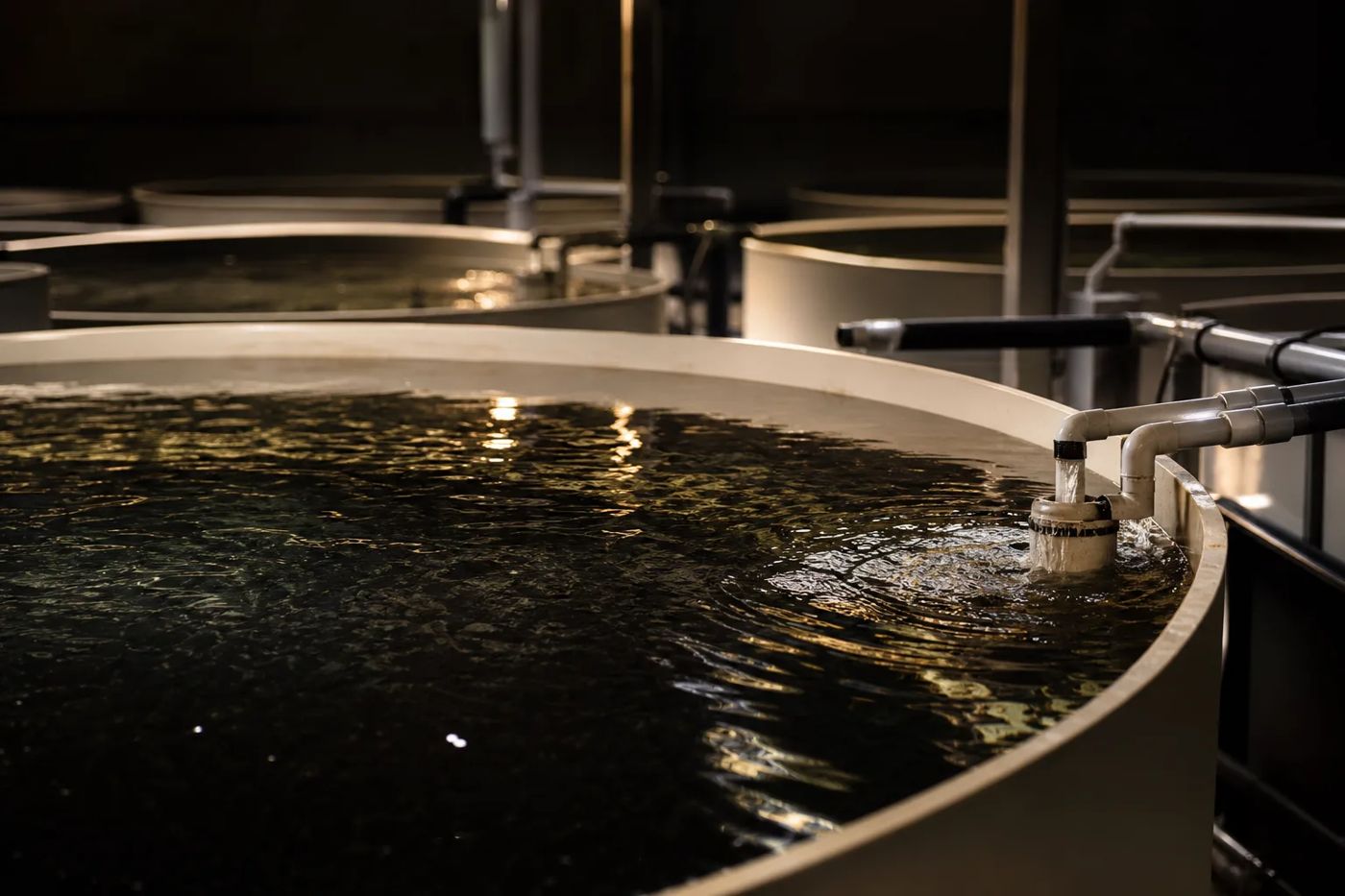
Time to harvest depends on how and where the fish are raised. A 2015 farm information sheet hosted by California's aquaculture programme gives 8 to 10 years for Sacramento-area farms, where water stays warm throughout the year. UC Davis's 2025 account describes female maturation at seven to eight years.
Maturity and harvest are different milestones. Temperature, husbandry and ovarian development all shape the production cycle, and producers can hold females beyond first maturity to meet their roe specifications. A farm-specific harvest age is therefore a useful guide to production under those conditions, rather than a fixed timetable for the species.
Why wild populations receive different protection
The future of a river population depends on young fish surviving, not simply on adults remaining. Recruitment is the addition of young fish to a population. Fisheries authorities describe persistent failures of young sturgeon to survive in several regulated rivers: recruitment failures. Protecting adults, restoring suitable flows and habitats, and conservation hatchery work tackle different parts of this problem.
The IUCN assessment published in 2022 classifies white sturgeon globally as Vulnerable. That describes extinction risk; fishing permissions and the legal status of individual river populations are separate matters.
According to the federal listing rule, Endangered Species Act protection for the Kootenai River population took effect on 6 October 1994. That listing applies to this population, rather than every white sturgeon in California, Oregon or Washington. It is also distinct from the federal protection of green sturgeon.
Canada's 2024 action plan identifies four populations listed as Endangered under the Species at Risk Act in 2006: Upper Fraser River, Nechako River, Upper Columbia River and Kootenay River. A footnote explains that the last was renamed Upper Kootenay River population in 2019. Lower and Middle Fraser populations are not among those four listings.
Wild harvest and roe sale: the rules are local
An open fishery does not automatically mean a lawful source of caviar. Recreational retention, commercial fishing and roe sale each have their own rules. The summary below concerns ordinary recreational and commercial supply, rather than determining Indigenous or treaty fishing rights. All entries were checked in November 2026.
| Jurisdiction | Wild harvest position | Roe sale position and source |
|---|---|---|
| California | CESA candidate since July 2024; seasonal catch and release only, with area closures. | No commercial supply from California's wild stocks; CDFW distinguishes lawful cultured caviar. |
| Oregon | Lower Columbia and lower Willamette fisheries default to catch and release unless retention is specifically opened. | |
| Washington | Lower Columbia retention is closed; limited reservoir retention occurred on specified dates in 2026. | WAC 220-353-110 prohibits trading sturgeon eggs from the Columbia below Bonneville Dam. |
| Idaho | Kootenai River sturgeon fishing is prohibited; incidental catches must be released immediately. | Idaho's rules require recreational sturgeon catches to be released. |
| British Columbia | Recreational white sturgeon fishing is non-retention; some waters prohibit targeting altogether. | Section 14 of the Angling and Scientific Collection Regulation prohibits sale of fish caught by non-tidal angling. |
A claim of “wild white sturgeon caviar” therefore needs a precise account of its origin and permissions: the river, the lawful fishery, authority to retain the fish and authority to sell the eggs. A sporting catch photograph or an old fishing regulation supplies none of those permissions.
CITES, origin and international movements
Start with the label, then check the rules for the journey. White sturgeon is an Appendix II species, identified by the CITES species code TRA. Resolution Conf. 12.7 (Rev. CoP17) sets out the universal caviar labelling system in Annex 1 and the species codes in Annex 2. National fishing permissions and food-import requirements remain separate.
On repacked caviar, the country where the roe originated and the country where it was repacked are different pieces of information. The label provides traceability, rather than laboratory confirmation of the contents. TRA is the species code; by itself, it establishes neither the farm nor the taste, and cannot validate an unsupported claim of lawful wild origin.
EU Regulation (EC) No 865/2006 provides for non-reusable labels on individual primary caviar containers. Consult the law hub for the EU, UK, US, Switzerland, UAE, China, Japan, Russia and Australia, then confirm the applicable wildlife and food import requirements with the destination authorities.
For travellers, the important figure is up to 125 g per person. CITES recommends an exemption at that level for Appendix II caviar in individually marked containers carrying CITES labels. It applies only where national law allows it: Appendix II status does not create an automatic personal allowance or override import bans and biosecurity rules. Check the requirements for the entire route with the relevant authorities before travelling.
Where to go next
- Sturgeon Species: compare the main caviar-producing fish and distinguish trade names from biological identities.
Sources
-
CITES. Conservation of and trade in sturgeons and paddlefish, Resolution Conf. 12.7 (Rev. CoP17), 2016 revision, published resolution text. Document.
-
University of Florida, IFAS Extension. Sturgeon Aquaculture: Specialized Techniques, FA153, reviewed August 2025. Document.
-
University of California, Davis. Jocelyn Anderson, Farming Caviar: A UC Davis Innovation, 19 May 2025. Article.
-
California aquaculture programme. Sturgeon Farming & the Long View, farm-tour information sheet, May 2015. Document.
-
Calvisius USA. Round Collection, undated producer descriptions.
-
California Academy of Sciences. Eschmeyer's Catalog of Fishes, Acipenser transmontanus species record, online record retrieved November 2026. Record.
-
US Geological Survey. White Sturgeon (Acipenser transmontanus): Species Profile, Nonindigenous Aquatic Species Database, online record, 2026. Record.
-
California Department of Fish and Wildlife. White Sturgeon, undated species account, retrieved November 2026. Species account.
-
US Fish and Wildlife Service. Determination of Endangered Status for the Kootenai River Population of the White Sturgeon, final listing notice, 59 FR 45989, 6 September 1994. Official publication record.
-
Fisheries and Oceans Canada. Action Plan for the White Sturgeon (Acipenser transmontanus) in Canada, Species at Risk Act Action Plan Series, final edition, 2024. Document.
-
Fisheries and Oceans Canada. White Sturgeon (Acipenser transmontanus): COSEWIC Assessment and Status Report 2012, 2012 edition. Report.
-
Visit Brescia. Calvisano Caviar, undated local production account, retrieved November 2026. Account.
-
California Department of Fish and Wildlife. 2026 Freshwater Sport Fishing Regulations, 2026 edition, section 5.80; and White Sturgeon, Marine Species Portal, online account. Regulations and portal.
-
Oregon and Washington fisheries authorities and tribal partners. 2026 Sturgeon Joint Staff Report, 2026 edition. Report.
-
Washington Department of Fish and Wildlife. White Sturgeon, fisheries status page, retention table updated 5 March 2026. Washington State Legislature. WAC 220-353-110, online codified text retrieved November 2026. Fisheries status and rule.
-
Idaho Department of Fish and Game. Idaho Fishing Planner: North Fork Coeur d'Alene River, 2025 to 2027 Panhandle regional rules displayed in the online planner. Rules.
-
Province of British Columbia. Freshwater Fishing Regulations Synopsis, 2025 to 2027 edition. BC Laws. Angling and Scientific Collection Regulation, BC Reg. 125/90, online text retrieved November 2026, section 14. Synopsis and regulation.
-
European Union. Commission Regulation (EC) No 865/2006, consolidated text dated 19 January 2022, including Articles 57 and 66. Consolidated text.
-
Monterey Bay Aquarium, Seafood Watch. White Sturgeon: United States, farmed-sturgeon assessment circulated for expert review, July 2025. Assessment.
Last checked: November 2026