
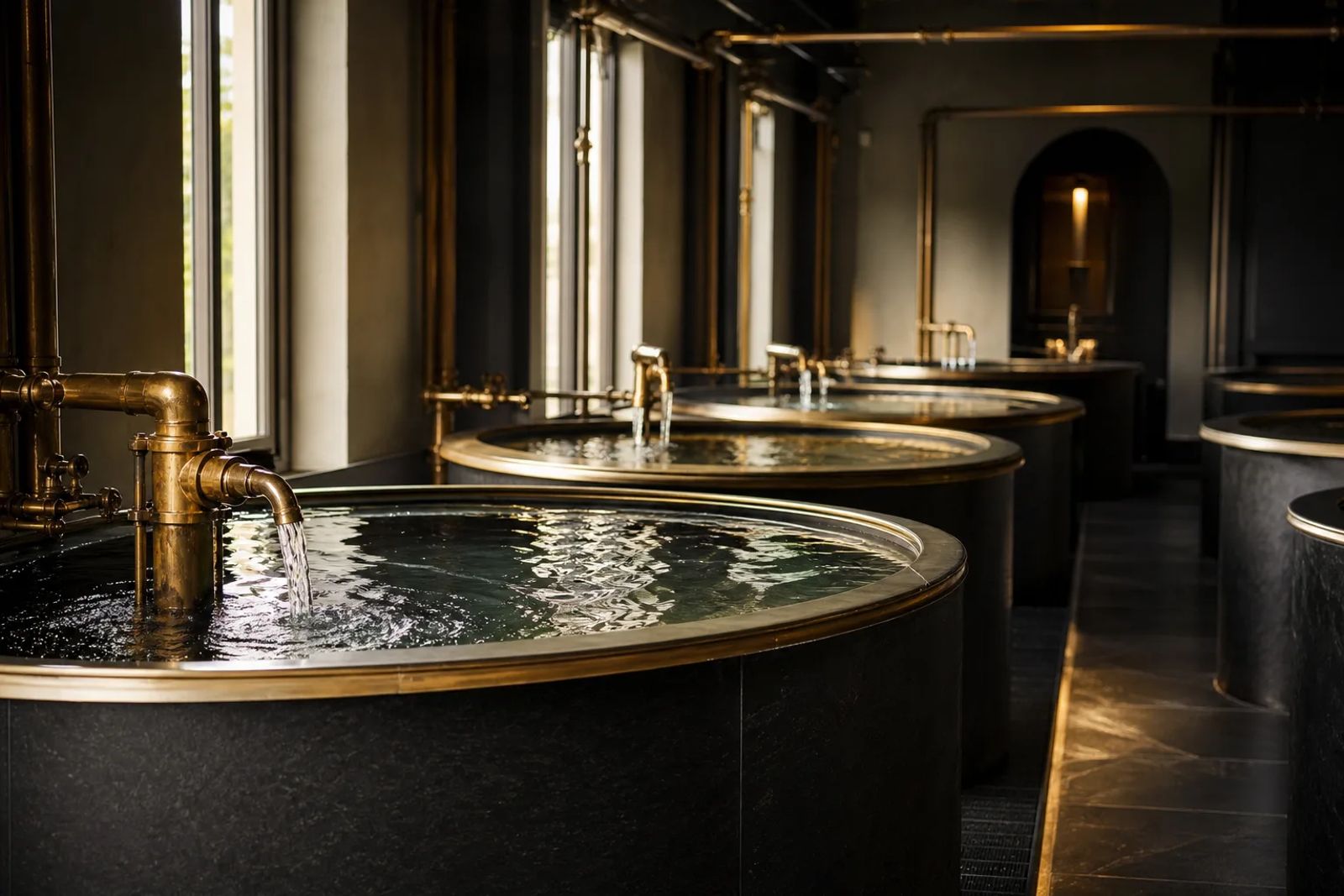
Acadian Sturgeon and Caviar is a New Brunswick producer that reports farming shortnose sturgeon and harvesting wild Atlantic sturgeon for processing. Shortnose sturgeon is in CITES Appendix I, while Atlantic sturgeon is in Appendix II, so their international trade cannot be treated as interchangeable.
House facts
| Operating entity | Acadian Sturgeon and Caviar Inc., as listed by the Canadian Food Inspection Agency (CFIA). 1 |
| Ownership | A 2016 company announcement identifies Cornel and Dorina Ceapa as founders and owners. |
| Established | 2005; the CITES breeding register gives 1 January 2005 as the operation's establishment date. |
| Province of incorporation | Operations are documented in New Brunswick. |
| Headquarters | The company's published mailing address is 248 Douglas Avenue, Saint John, New Brunswick. |
| Verified production and processing | Hatchery and processing at 30 Carters Wharf Road, Carters Point, New Brunswick; CFIA establishment 4417. |
| Role and roe origin | Hatchery operator, farmer and processor; the company reports farmed shortnose sturgeon and wild Atlantic sturgeon from Canada. 6,9 |
| CITES registrations | Appendix-I breeding operation A-CA-515 for Acipenser brevirostrum; caviar processing/repackaging and exporter register code 4417. |
These records establish an operating producer, not merely a Canadian brand attached to imported roe. They also show why a company registration, a food-processing establishment number and a wildlife-trade registration must be checked separately: each answers a different question about the business, its premises or its permitted activities.
Who runs Acadian Sturgeon and Caviar?
The company's own account describes a family business involving Cornel Ceapa, his wife Dorina and their son Michael. A 2016 company announcement describes Cornel and Dorina as Acadian's founders and owners.
The strongest public identity checks are operational. CFIA lists Acadian Sturgeon and Caviar Inc. at Carters Point, and CITES registers Acadian Sturgeon and Caviar Incorporated at the same locality. Neither entry is a certificate of incorporation, so New Brunswick should be described confidently as its operating province, not assumed to be its incorporation jurisdiction.
A separate company needs particular care in historical accounts. An October 2016 announcement said Cornel and Dorina Ceapa had acquired shortnose sturgeon and equipment from Breviro Caviar in Charlo through newly incorporated Canadian Sturgeon & Caviar Inc. The announcement concerned Canadian Sturgeon & Caviar Inc.
What it is known for
Acadian's distinguishing feature is the combination of a hatchery, land-based farming and a river fishery, rather than a portfolio assembled only by repacking other producers' caviar. Its company material documents fertilised eggs, larvae and juveniles of both local species, alongside caviar and meat production.
The company's 2017 product manual maps Acadian Wild to Atlantic sturgeon, Acipenser oxyrinchus, and Acadian Gold and Acadian Green to farmed shortnose sturgeon, Acipenser brevirostrum. These are trade names, not three species or statutory quality grades; the historical manual should not be treated as a current product specification.
The manual distinguishes the products by species and production origin, not simply by colour. The wider Canadian production picture belongs in Canadian caviar, while caviar houses and producers places this mixed farming-and-fishing model alongside other kinds of producer.
The Canadian fishery and farming framework
Acadian describes its Atlantic sturgeon roe as wild-caught from the Saint John River and its shortnose roe as farmed in land-based systems. Fisheries and Oceans Canada (DFO) independently documents a commercial Atlantic sturgeon fishery there, managed through limited entry, allowable harvest, gear and minimum-length controls, and a June closure.
DFO's September 2024 assessment establishes the regulated fishery's existence, not the validity of an individual company's licence in November 2026. DFO's 2024 assessment describes the fishery's management controls. Acadian's account describes its collaboration with commercial fishers.
The conservation categories require equal care. COSEWIC, Canada's scientific assessment committee, assessed the Atlantic sturgeon's Maritimes population as Threatened in May 2011. DFO's 2025 publication records no Species at Risk Act (SARA) status for the Maritimes population; assessment and legal listing are different decisions.
Shortnose sturgeon is listed as Special Concern under SARA, with that status confirmed by COSEWIC in May 2015. DFO's management plan explains that SARA's general prohibitions do not apply to Special Concern species, while recording that historic wild broodstock collection for aquaculture required written permissions or licences under fisheries legislation.
That is not permission for unrestricted capture of this protected fish. The species account, shortnose sturgeon (Acipenser brevirostrum), explains its biology and conservation separately from the company's activities; Atlantic sturgeon (Acipenser oxyrinchus) does the same for the fish supporting the river harvest.
Shortnose sturgeon and Appendix I trade
The CITES captive-breeding register provides a particularly significant verification: operation A-CA-515 names Acadian Sturgeon and Caviar Incorporated and Acipenser brevirostrum, with registration dated 16 December 2012. It records Canadian wild specimens as the original stock and describes marking arrangements for broodstock and derived products.
Appendix I generally restricts international trade for primarily commercial purposes. Qualifying specimens bred in captivity for commercial purposes may be treated under Appendix II provisions, subject to the applicable CITES conditions. Registration does not remove the species from Appendix I or override a destination country's stricter laws.
The public registration is therefore evidence of an authorised breeding operation, not proof that every consignment qualifies or that any particular export occurred. The CITES registration specifies marking arrangements for broodstock and derived products; neither a farm description nor the word wild should be substituted for shipment documentation.
What changes at the border
Environment and Climate Change Canada is Canada's national CITES authority; the importing country's wildlife rules also matter. Canadian processing approval is not an export permit, and a CITES permit does not replace food-import requirements; Switzerland, the UAE, China, Japan, Russia and Australia also apply destination rules.
In the United States, shortnose sturgeon remains ESA Endangered throughout its range, including the Canadian population. CITES registration does not by itself establish that a shipment may enter the United States. The applicable ESA import provisions and any exceptions require direct verification before an import is described as permitted. NOAA Fisheries administers the species' ESA protection, while USFWS handles CITES wildlife-trade controls.
Atlantic sturgeon needs a different explanation: NOAA distinguishes the ESA-listed US population segments from Canadian-origin fish, which are not ESA-listed. Documented Canadian origin is therefore material, but it does not dispense with Appendix-II CITES controls. The US listing cannot be summarised accurately as either all Atlantic sturgeon prohibited or all Atlantic sturgeon unrestricted.
In the EU, Regulations (EC) No 338/97 and No 865/2006 govern wildlife-trade permits and caviar marking. Great Britain generally requires permits, with a conditional 125 g personal-effects exemption. Northern Ireland applies EU wildlife trade rules, with permits issued by UK authorities. Neither system should be read as automatically admitting a shipment merely because Acadian appears in a Canadian register.
Reading origin and source on a label
The CITES caviar register lists Acadian under code 4417 as an exporter and processing/repackaging operation. Its listed Saint John address differs from CFIA's Carters Point establishment address and the company's present contact address; those records should be identified by purpose rather than combined into an invented single headquarters.
Canadian origin and a repacker's location are different statements, and a traceability label is not independent proof of the contents.
For provenance, read the declared species, country of origin and source independently of the front-facing brand. Canadian origin and a repacker's location are different statements, and a traceability label is not independent proof of the contents. Use CITES source codes explained: W, R, F and C for the code distinctions and how to check a caviar producer on the CITES register for the register checks.
Sustainability claims and conservation evidence
Acadian describes its wild fishery as sustainable and says its wild and farmed products are Ocean Wise certified. Ocean Wise's May 2018 account names Acadian among its recommended farms.
There is firmer evidence of participation in research: DFO's 2024 assessment cites earlier Saint John River studies co-authored by Cornel Ceapa. That documents a contribution to the evidence base, not a finding that commercial activity is harmless; the assessment itself concerns harvest management and was based on a March 2021 scientific meeting.
The useful questions are consequently specific: which population supplied the fish, which licence covered the capture, which facility handled the roe, and which documents support the shipment? Keeping those questions separate respects both the producer's documented work and the conservation status of the fish.
Sources
-
Canadian Food Inspection Agency. Canadian fish and seafood establishments approved for export. Live register, undated, checked November 2026. Entry: Acadian Sturgeon and Caviar Inc., establishment 4417.
Read at inspection.canada.ca -
CITES Secretariat. Register of captive-breeding operations: A-CA-515. Live register, registration dated 16 December 2012, checked November 2026.
Read at cites.org -
CITES Secretariat. Canada: Register of caviar exporters. Live register, undated, checked November 2026. Entry: Acadian Sturgeon and Caviar Inc., code 4417.
Read at cites.org -
Acadian Sturgeon and Caviar Inc. Our Story. Company account, undated, checked November 2026.
Read at acadian-sturgeon.com -
Service New Brunswick. Corporate Registry. Registry gateway.
Read at www2.snb.ca -
Acadian Sturgeon and Caviar Inc. What We Do. Company account, undated, checked November 2026.
Read at acadian-sturgeon.com -
Canadian Sturgeon & Caviar Inc. Canadian Sturgeon & Caviar Aquires the Sturgeon and Equipment in Charlo NB and Launches a Kickstarter Campaign to Help Finance the Turnaround. Company announcement, 12 October 2016, archived by the Wallace McCain Institute.
Read at wallacemccaininstitute.com -
Acadian Sturgeon and Caviar Inc. The Trio of Acadian Caviar. Company manual, 2017, hosted by Cooks Camp.
Read at cookscamp.ca -
Acadian Sturgeon and Caviar Inc. Products. Company description of species and production origins, undated, checked November 2026.
Read at acadian-sturgeon.com -
Fisheries and Oceans Canada. Assessment of the Status of the Spawning Population of Saint John River Atlantic Sturgeon (Acipenser oxyrinchus). Canadian Science Advisory Secretariat, Science Advisory Report 2024/047, September 2024.
Read at publications.gc.ca -
Fisheries and Oceans Canada. Tidal and freshwater (Diadromous). DFO publication, 2025, recording Atlantic sturgeon assessment and SARA status.
Read at dfo-mpo.gc.ca -
Fisheries and Oceans Canada. Management Plan for the Shortnose Sturgeon (Acipenser brevirostrum) in Canada. Species at Risk Act Management Plan Series, 2016; online text checked November 2026.
Read at canada.ca -
NOAA Fisheries. Shortnose Sturgeon. Species and management account, updated 1 October 2026, checked November 2026.
Read at fisheries.noaa.gov -
NOAA Fisheries. Atlantic Sturgeon. Species and management account, live edition checked November 2026.
Read at fisheries.noaa.gov -
CITES Secretariat. How CITES works. Live explanatory guidance, undated, checked November 2026.
Read at cites.org -
European Commission. EU Wildlife Trade Reference Guide: What are the rules regarding marking of specimens? Live online edition, undated, checked November 2026. References Regulations (EC) No 338/97 and No 865/2006 and Resolution Conf. 12.7 (Rev. CoP17).
Read at environmental-data.ec.europa.eu -
Department for Environment, Food & Rural Affairs. CITES: import restrictions. Great Britain guidance, updated 5 October 2026, checked November 2026.
Read at gov.uk -
US Fish and Wildlife Service. Caviar & Passengers. Office of Law Enforcement fact sheet, 11 January 2011.
Read at fws.gov
Last checked: November 2026