
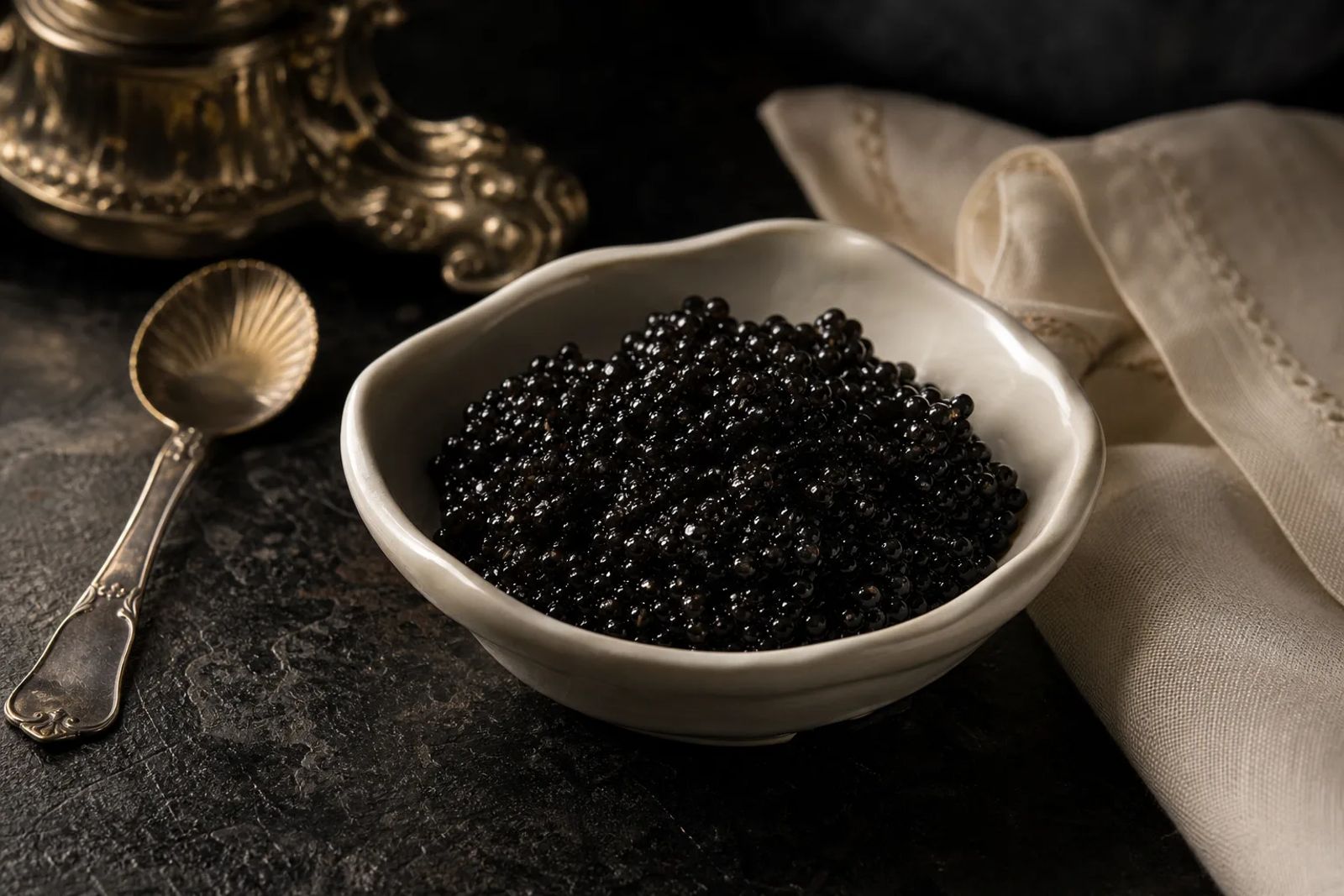
Near Sechelt, on British Columbia’s Sunshine Coast, Northern Divine Aquafarms raises white sturgeon. Historical government records also document land-based sturgeon culture in British Columbia. In New Brunswick’s Saint John River fishery, Atlantic sturgeon are harvested from the wild. Canadian caviar has come from both worlds: the farm and the regulated river fishery.
That contrast makes Canada’s story distinctive. It also makes the details worth knowing. Wild sturgeon protection depends on the species, the population and the federal and provincial rules that apply.
Canada at a glance
| Documented farmed species | White sturgeon (Acipenser transmontanus), Atlantic sturgeon (Acipenser oxyrinchus) and shortnose sturgeon (Acipenser brevirostrum). |
| Main farming regions | British Columbia’s Sunshine Coast; southern New Brunswick. |
| Three exporters listed | Conflicting record; see Canadian requirements below. |
| Export and import regime | WAPPRIITA and the Wild Animal and Plant Trade Regulations; Safe Food for Canadians Act and Regulations; Food and Drugs Act and Regulations. |
| PGI or PDO | Not publicly documented. |
| Wild stocks | Status varies by species and population; federal legal listings appear in SARA Schedule 1. |
| Country’s role | Farmed and wild roe origin, processor, exporter and domestic market. |
Canadian caviar farms and their beginnings
Canada’s documented sturgeon farming story takes in British Columbia and New Brunswick. Historical government records describe land-based culture in both provinces. DFO’s 2016 plan also documents shortnose sturgeon aquaculture, a notable detail for a species listed in CITES Appendix I.
Near Sechelt, a Sunshine Coast Regional District groundwater report identifies Northern Divine Aquafarms as a white sturgeon farm. Its beginnings carry two dates in the published record: the producer’s brochure says it has raised sturgeon since 1999; a trade report dated 3 May 2012 gives 2000 as the start of rearing.
In New Brunswick, Fisheries and Oceans Canada’s shortnose sturgeon management plan documents two land-based aquaculture operators. The consultation record names Breviro Caviar and Acadian Sturgeon & Caviar. A federal research grant record credits Acadian with developing husbandry for Atlantic and shortnose sturgeon since 2005.
Acadian dates its founding to March 2005. It describes supplying live Atlantic and shortnose sturgeon as well as processing wild Atlantic sturgeon. Farming fish, selling juveniles and harvesting farmed caviar are separate activities; none establishes that the others take place. The producer profile explores the company in detail.
Conservation hatcheries belong in a separate category. Raising fish for release is not evidence of roe production for food.
What Canadian caviar is known for
Provenance is Canada’s strongest signature, rather than a single national flavour. British Columbia’s documented production centres on white sturgeon. New Brunswick combines native Atlantic and shortnose sturgeon aquaculture with a continuing wild Atlantic fishery.
The producers reflect that geography. Acadian describes its work through local species and the Saint John River fishery; Northern Divine’s brochure foregrounds farmed white sturgeon.
Use provenance to trace the roe, rather than predict its flavour. Species, processing and the particular batch tell you more about texture, colour and taste than nationality alone. The producer descriptions do not establish a flavour shared by all Canadian caviar.
Wild sturgeon: two different kinds of status
A conservation assessment and a legal listing answer different questions. COSEWIC, the Committee on the Status of Endangered Wildlife in Canada, assesses extinction risk. Schedule 1 of the Species at Risk Act, usually shortened to SARA, records federal legal listings.
A threatened COSEWIC assessment does not itself create a SARA listing or an automatic fishing ban. The two systems can also draw population boundaries differently, so check their records separately:
| Population | COSEWIC assessment | SARA Schedule 1 |
|---|---|---|
| White sturgeon, Lower Fraser | Threatened, November 2012 | Not listed |
| White sturgeon, Upper Fraser | Endangered, November 2012 | Upper Fraser and Nechako: Endangered; Middle Fraser: not listed |
| White sturgeon, Upper Columbia | Endangered, November 2012 | Endangered |
| White sturgeon, Upper Kootenay | Endangered, November 2012 | Endangered |
| Lake sturgeon, Western Hudson Bay | Endangered, April 2017 | Not listed |
| Lake sturgeon, Saskatchewan-Nelson River | Endangered, April 2017 | Not listed |
| Lake sturgeon, Southern Hudson Bay and James Bay | Special Concern, April 2017 | Special Concern |
| Lake sturgeon, Great Lakes and Upper St. Lawrence | Threatened, April 2017 | Not listed |
| Atlantic sturgeon, St. Lawrence | Threatened, May 2011 | Not listed |
| Atlantic sturgeon, Maritimes | Threatened, May 2011 | Not listed |
| Shortnose sturgeon, Canadian population | Special Concern, May 2015 | Special Concern |
| Green sturgeon, Canadian occurrence | Special Concern, November 2013 | Special Concern |
Special Concern does not trigger SARA’s general prohibitions on killing or possessing listed endangered or threatened aquatic species. Fisheries legislation and provincial rules still apply. Geography matters, too: according to DFO, green sturgeon occur in Canadian Pacific waters, but all known spawning locations are in the United States.
Where wild commercial fishing continues
The Saint John River fishery is for Atlantic sturgeon specifically. It does not give general permission to harvest either sturgeon species found in the river.
DFO’s Maritimes licensing policy describes a closed-entry fishery in tidal waters in Kings County, New Brunswick. The terms are precise: no new or replacement licences, gill nets as authorised gear, and a June closure. This is the continuing licensing framework; the opening conditions for a particular fishing day must be checked separately.
For travellers, CITES provides a conditional personal effects exemption of 125 g of caviar per person, subject to national rules.
Québec also documents commercial lake sturgeon fishing in the St. Lawrence and commercial Atlantic sturgeon fishing farther downstream. British Columbia, by contrast, has prohibited commercial and sport harvest of wild white sturgeon. Indigenous fisheries and rights require separate consideration.
For the fish behind these fisheries, Atlantic sturgeon and lake sturgeon explain their biology and population histories.
Indigenous relationships and rights
In 1994, First Nations initiated a voluntary harvest moratorium for white sturgeon, recorded in British Columbia’s Fraser River plan. The same plan documents longstanding First Nations relationships with these fish.
Sturgeon belong to living Indigenous food traditions, knowledge and responsibilities, not simply to the history of commercial fishing. Aboriginal and treaty fishing rights require their own legal treatment, distinct from commercial licences. The account of Indigenous sturgeon traditions explores that wider context.
Trade, food regulation and Canadian origin
Start with the origin label when checking provenance. Applicable wildlife trade rules and food requirements are separate matters; neither a Canadian brand address nor wildlife clearance answers every question.
Canadian requirements
According to ECCC, WAPPRIITA implements CITES. Environment and Climate Change Canada administers this wildlife trade regime; food compliance is a separate responsibility involving the Canadian Food Inspection Agency.
For fish processed or packaged for export or interprovincial trade, CFIA’s Safe Food for Canadians Regulations guidance requires licensing, preventive controls, a preventive control plan and traceability. Canadian fish import requirements depend on the activity and applicable rules. A business trading only within one province has a different federal licensing position, alongside applicable provincial requirements.
The exporter count remains unresolved in the record: it states that, as of November 2026, CITES lists three Canadian exporters, each marked for processing or repackaging, but also describes three exporters being listed as “not publicly documented”.
Destination-market requirements
Switzerland, the UAE, China, Japan, Russia and Australia apply destination rules. Australia separates DAFF biosecurity checks from EPBC wildlife controls.
For entry into the United States, USFWS rules in 50 CFR 23.71 govern international caviar trade and labelling. According to NOAA, Canadian Atlantic sturgeon populations are not ESA listed. Shortnose sturgeon are ESA Endangered throughout their range and listed in CITES Appendix I. Wildlife clearance does not replace FDA food requirements.
EU Annex IX, consolidated 4 November 2026, lists Canadian wild and farmed finfish products. EU and UK entry also requires establishment approval and the applicable health and CITES documents.
Labelling and origin
On a CITES caviar label, CA declares Canadian origin; the repacker’s country is a separate detail. The code is a traceability declaration rather than verification of the tin’s contents. A Canadian brand address alone does not establish where the roe originated.
Where to go next
- North America: place Canadian production alongside neighbouring fisheries and farms.
- American Caviar: California and the Pacific Northwest: explore the Pacific coast’s other documented production story.
Sources
-
CITES. Canada: Register of caviar exporters. Undated register, checked November 2026. The display identifies three operations and combines processing with repackaging.
Read at cites.org. -
Sunshine Coast Regional District / Kalwij Water Dynamics. Groundwater Investigation Phase 2, Part 2 and Phase 3, Gray Creek. Final report dated 25 March 2021. Identifies Northern Divine Aquafarms as farming white sturgeon.
Read at scrd.ca. -
Northern Divine / Seacore Seafood. Northern Divine brochure. Undated producer material. Includes the producer’s statement that it has raised sturgeon since 1999.
Read at seacoreseafood.com. -
SeafoodSource, Lauren Kramer. B.C. fish farmer bets on white sturgeon. 3 May 2012. Reports rearing beginning in 2000.
Read at seafoodsource.com. -
Fisheries and Oceans Canada. Management Plan for the Shortnose Sturgeon (Acipenser brevirostrum) in Canada. Species at Risk Act Management Plan Series, 2016. Documents two land-based aquaculture operators, established broodstock and the species’ management position.
Read at canada.ca. -
National Research Council Canada, Open Government. Grants and Contributions: Acadian Sturgeon and Caviar. Record 172-2020-2021-Q1-948795, 2020 to 2021 reporting period. Describes husbandry development since 2005 for shortnose and Atlantic sturgeon.
Read at search.open.canada.ca. -
Acadian Sturgeon and Caviar Inc. About. Undated company statement, retrieved November 2026. Gives March 2005 as its founding date and distinguishes live-fish production from its wild-fishery activities.
Read at acadian-sturgeon.com. -
Department of Justice Canada. Species at Risk Act, Schedule 1. Consolidation current to 19 October 2026, last amended 25 September 2026. Supplies the legal listings, separately from COSEWIC assessments.
Read at laws-lois.justice.gc.ca. -
COSEWIC. COSEWIC assessment and status report on the White Sturgeon Acipenser transmontanus in Canada. 2012 edition. Assessment summaries distinguish four assessment populations.
Read at canada.ca. -
COSEWIC. Lake Sturgeon (Acipenser fulvescens), four populations: COSEWIC assessment and status report 2017, Chapter 1. 2017 edition. Provides the four population assessments.
Read at canada.ca. -
Government of Canada. Atlantic sturgeon, St. Lawrence and maritime populations: consultation. 2017 consultation document, reporting the 2011 Threatened assessments.
Read at canada.ca. -
COSEWIC. COSEWIC assessment and status report on the Shortnose Sturgeon Acipenser brevirostrum in Canada. 2015 edition. Documents the May 2015 assessment and distinguishes Canadian status from CITES and US protection.
Read at canada.ca. -
British Columbia Conservation Data Centre. Species Summary: Acipenser medirostris, Green Sturgeon. Live record, retrieved November 2026. Gives the November 2013 COSEWIC assessment and federal Special Concern listing.
Read at a100.gov.bc.ca. -
Fisheries and Oceans Canada. Maritimes Region Commercial Fisheries Licensing Policy, section 44, “Sturgeon (Atlantic)”. Live policy retrieved November 2026. Specifies closed entry, fishing area, gear and June closure.
Read at dfo-mpo.gc.ca. -
Gouvernement du Québec. Esturgeon jaune; Pleins feux sur… la recherche et l’esturgeon noir. Undated official species and research pages, retrieved November 2026. Document commercial St. Lawrence fisheries for lake and Atlantic sturgeon respectively.
Read at quebec.ca
Read at mffp.gouv.qc.ca. -
Government of British Columbia. B.C. Fraser River White Sturgeon Plan. Live provincial guidance, retrieved November 2026. Documents First Nations relationships and the voluntary 1994 harvest moratorium.
Read at www2.gov.bc.ca. -
Environment and Climate Change Canada. Wild species trade and protection regulations: frequently asked questions. Live official guidance, retrieved November 2026. Explains WAPPRIITA and its regulations.
Read at canada.ca. -
Canadian Food Inspection Agency. Overview of key SFCR requirements by food commodity, fish tables; Importing fish and seafood products. Live guidance retrieved November 2026. Separates processing, exporting, importing and intraprovincial activities.
Read at inspection.canada.ca
Read at inspection.canada.ca. -
US Government / US Fish and Wildlife Service. 50 CFR 23.71: How can I trade internationally in sturgeon caviar? Current eCFR page retrieved November 2026; CITES Labeling Requirements for Sturgeon Caviar. Official explanatory bulletin, undated.
Read at ecfr.gov
Read at fws.gov. -
NOAA Fisheries. Atlantic Sturgeon. Live species account retrieved November 2026. Distinguishes Canadian populations from US ESA-listed populations.
Read at fisheries.noaa.gov. -
European Commission. Commission Implementing Regulation (EU) 2022/363, amending Annex IX to Implementing Regulation (EU) 2021/405. Official Journal L 69, 2022. Recitals explain Canada’s aquaculture caviar authorisation.
Read at eur-lex.europa.eu. -
UK Government. Importing or moving fish to the UK. Live guidance retrieved November 2026. Identifies fish import documentation and the separate need to check CITES requirements.
Read at gov.uk.
Last checked: November 2026