
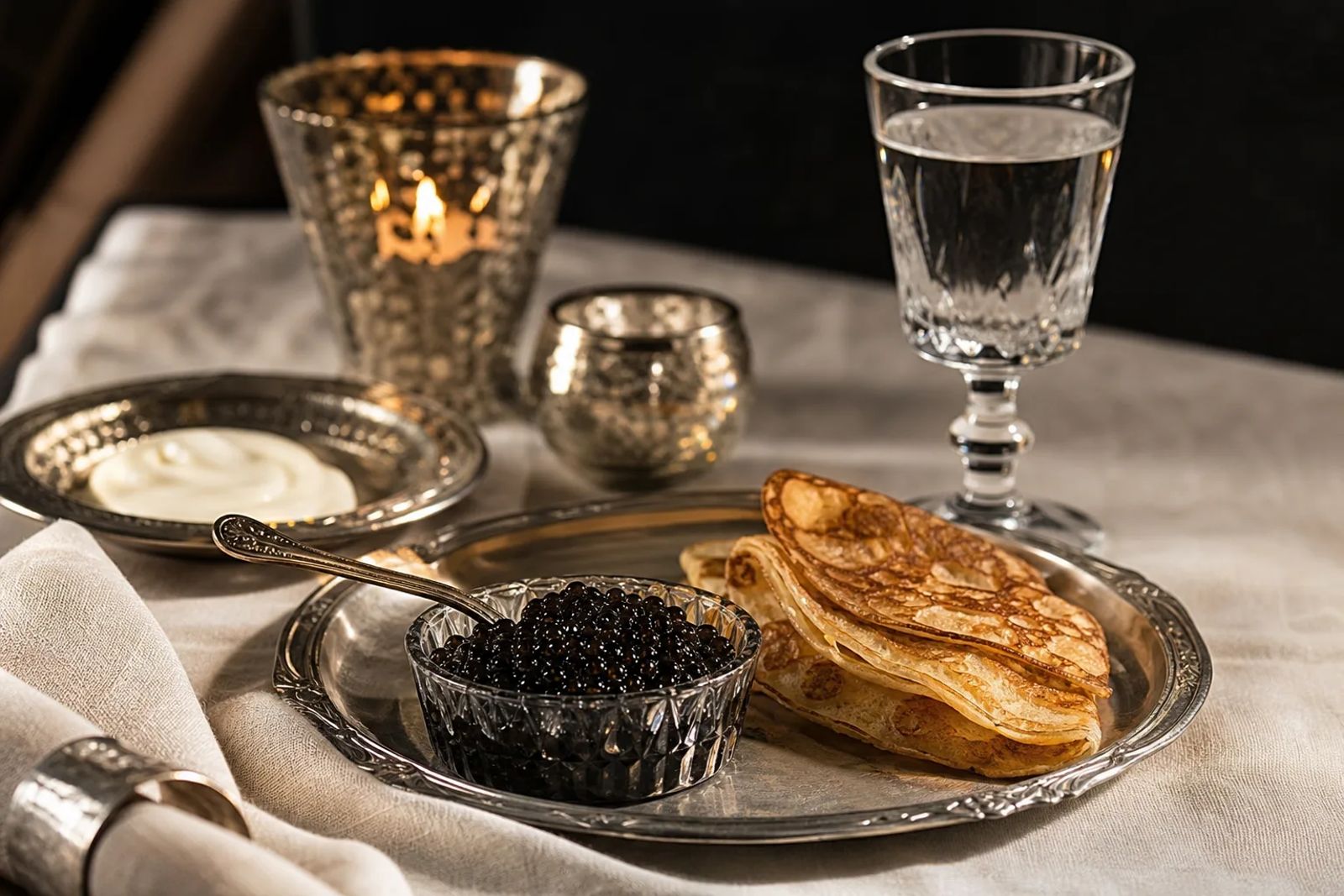
Caviar in Moscow and St Petersburg appears in food halls, specialist counters and restaurant service, including blini and dishes built around chilled roe. For readers outside Russia, that cultural picture must be separated from official advice against travel and from sanctions that can prevent a legally purchased tin from entering the destination country.
Scope and inclusion, checked 4 November 2026. This is a documentary account, not a destination recommendation. Places are included only where a published venue source documents a caviar connection; current service and legal status are reported separately, because status in Russia is harder to verify from abroad.
Official travel advice comes first
On 4 November 2026, the following government positions were current in the published advice. These are the authorities’ statements, not travel advice supplied by this site.
- United Kingdom: the FCDO page, updated 18 September 2026, “advises against all travel to Russia”.
- United States: the State Department advisory issued 29 December 2025 says, “Do not travel to Russia for any reason”.
- France: advice updated 16 October 2026 says, in translation, “Travel throughout the territory of Russia is strongly discouraged”.
Belgium also publishes its own security advice for Russia; check its current wording before relying on it. EU member states issue their own national travel advice; France’s wording should not be presented as a single EU travel advisory.
How caviar is served in Moscow and St Petersburg
The familiar restaurant setting is zakuski, the Russian assortment of appetisers served before or alongside the meal. Caviar may appear as a separate serving with blini, thin pancakes, or as one element in a composed dish; these are different ways of eating it, not different guarantees of origin.
The Grand Hotel Europe’s published material provides a concrete example: its Caviar Bar has described caviar with blini and vodka, while its heritage menu lists dishes using sturgeon caviar.
Restaurants and shops also distinguish dark sturgeon caviar from red roe. GUM’s own account describes both at its caviar counter, so a reference to “ikra”, the Russian word for roe or caviar, does not by itself establish which fish supplied it.
See Russian caviar traditions for the place of zakuski and blini at the table, and Russian caviar for the production background rather than restaurant custom.
Food halls, shops and documented venues
The useful distinction is between a retail counter, a specialist seller and a restaurant. A food hall sells provisions to take away; a restaurant serves a portion or a dish, while a market stall is simply a sales setting and says nothing, by itself, about the legality of its stock.
Historic names need particular care. GUM describes its present Gastronome No 1 as a successor opened in 2008 to the Soviet food shop that operated from 1953 to 1990; that is continuity of a retail tradition, not an unchanged shop surviving intact.
St Petersburg’s Eliseev merchants’ store dates its reopening to 8 March 2012 in its own history. Its current website lists a fish and caviar department at Nevsky Prospekt 56; neither statement should be transferred to another shop sharing the Eliseev name.
| Place and city | Documented connection | Verification limit |
|---|---|---|
| Gastronome No 1, GUM, Moscow | Official GUM page describes a caviar counter. | |
| Eliseev merchants’ store, St Petersburg | Official site lists fish and caviar. | |
| Caviar Bar, Grand Hotel Europe, St Petersburg | Hotel material documents caviar service; according to Allcafe, its menu was updated on 21 October 2026. |
The table describes published venue accounts, not destination recommendations.
Legal trade and the black market
Legal retailing and illegal supply coexist, but a market’s scale cannot be inferred from a restaurant menu or an attractive display. Russia’s Interior Ministry has documented the attempted export of illicit sturgeon caviar in ordinary plastic containers, illustrating why an informal sale is not evidence of lawful provenance.
CITES, the wildlife trade convention, provides a universal caviar labelling system for sturgeon and paddlefish. Its resolution calls for non-reusable labels on primary containers, including domestic trade; the resolution is an international framework, however, and its enforcement depends on national implementation.
Russia’s Interior Ministry has documented the attempted export of illicit sturgeon caviar in ordinary plastic containers, illustrating why an informal sale is not evidence of lawful provenance.
A CITES label is a traceability device, not proof of the contents of a particular tin. Russia’s customs requirements for factory packaging and supporting documents are separate from any destination’s import permission; the wider problems of poaching and misdescription belong in the black market in caviar, not in a list of supposedly secret suppliers.
Taking caviar out of Russia
Eurasian Economic Commission Decision No 107, Annex 6, excludes quantities of sturgeon caviar above 250 g from the category of goods for personal use. The complete current Russian export documentation and wildlife permit requirements are not covered on this page; check them before any export.
That is not the same rule as the familiar 125 g CITES personal-effects exemption. The Russian customs quantity does not establish that 250 g can cross another border without wildlife permits, and neither quantity overrides sanctions.
For the distinction between an export threshold, a wildlife permit exemption and permission to import, read when the 125 g CITES exemption applies. A purchase receipt records a transaction; it does not resolve those separate legal questions.
Sanctions and personal luggage
These restrictions concern entry into the destination, not merely commercial shipments. The regimes differ, particularly over personal effects, so a single statement that every country either permits or prohibits every small tin would be misleading.
| Jurisdiction | Rule relevant to caviar | Legal source | Checked |
|---|---|---|---|
| EU | Article 3i prohibits covered goods, including caviar in Annex XXI, originating in or exported from Russia. Article 3i(3aa) lets competent authorities allow qualifying personal effects; this is discretionary, not an automatic luggage exemption. | Regulation (EU) No 833/2014, Article 3i and Annex XXI. | November 2026 |
| United Kingdom | According to UK guidance, importing caviar originating in or consigned from Russia is prohibited, without a general personal luggage exemption; EU goods sanctions also apply in Northern Ireland. | The Russia (Sanctions) (EU Exit) Regulations 2019, regulation 46XB and Schedule 3DA. | November 2026 |
| United States | Russian-origin fish, seafood and preparations are prohibited, including caviar. According to Executive Order 14068, the prohibition is not limited to commercial shipments. | Executive Order 14068, section 1(a)(i); OFAC FAQ 1022. | November 2026 |
France’s traveller guidance is more explicit about the practical outcome at its border: caviar bought in Russia cannot be brought back to France, whatever the quantity. The EU provision permitting competent authorities to allow certain personal effects should therefore not be read as advance permission for a food souvenir.
UK rules exempt UK nationals in Russia acquiring goods there for their own or immediate family members’ personal use in Russia. This article’s venue descriptions must not be read as permission for UK persons to purchase caviar in Russia.
Transit is not a change of origin
Carrying an unchanged Russian-origin tin through the UAE or Switzerland does not make it Emirati or Swiss. For the US prohibition on Russian-origin seafood, OFAC distinguishes simple onward movement from substantial transformation abroad; its additional restrictions on transformed products expressly name salmon, cod, pollock and crab, rather than all seafood indiscriminately.
Repacking, changing the seller or buying in a transit airport should not be confused with establishing a new origin. The relevant questions remain the fish product’s origin, whether the destination also restricts goods exported or consigned from Russia, and whether a specific authorisation or exception applies.
Switzerland’s food and CITES guidance describes a 125 g personal allowance, with conditions, but that is not a determination of Russian sanctions admissibility. Switzerland announced a ban on imports of Russian caviar in April 2022; check any personal luggage exceptions, and the UAE’s transit and onward rules, before travelling.
These unresolved points are not permissions. The fuller distinction between origin, processing and dispatch belongs in caviar, sanctions and country-of-origin rules, rather than in assumptions based on a connecting flight.
Where to go next
- Caviar Bars and Restaurants: a wider reference to restaurant formats and service.
- Caviar and the Russian Tsars: historical context, kept separate from present-day travel and trade.
Sources
- Foreign, Commonwealth & Development Office. Russia travel advice: Warnings and insurance. Updated 18 September 2026; current when checked, 4 November 2026. Official advice.
- US Department of State. Russia Travel Advisory. Issued 29 December 2025; current when checked, November 2026. Official advisory.
- French Ministry for Europe and Foreign Affairs. Russie: Sécurité. Updated 16 October 2026. Official advice.
- Belgian Federal Public Service Foreign Affairs. Sécurité générale en Russie. Live edition checked November 2026. Official advice.
- GUM. Gastronome No 1. Undated company account of the shop’s history and departments.
- Grand Hotel Europe. Caviar Bar & Restaurant, hotel brochure. Undated company publication, preserved by the World Customs Organization’s Regional Office for Capacity Building, Europe. Brochure.
- Grand Hotel Europe. Heritage Menu: Grand Hotel Europe 150 years. Anniversary menu documenting dishes containing sturgeon caviar.
- Magazin Kuptsov Eliseevykh. Магазин and История. Undated company history documenting the reopening on 8 March 2012.
- Allcafe. Caviar Bar & Restaurant, Санкт-Петербург. According to Allcafe, the restaurant supplied menu was updated on 21 October 2026. Venue record.
- Russian Ministry of Internal Affairs, MVD Media. В Хабаровске в суд передано дело о попытке вывоза за рубеж на самолёте более 1 кг нелегальной чёрной икры. Official enforcement report, 2023. Report.
- Eurasian Economic Commission. Council Decision No 107 of 20 December 2017, Annex 6. Eurasian Economic Commission Decision No 107, Annex 6. Annex.
- CITES. Conservation of and trade in sturgeons and paddlefish, Resolution Conf. 12.7 (Rev. CoP17), including the Annex 1 labelling guidelines, checked after CoP20, November 2026. Official rulemaking attachment.
- Council of the European Union. Council Regulation (EU) No 833/2014. EUR-Lex consolidation dated 24 April 2026; supplemented by the 16 January 2026 consolidated text reproduced by the Russian Chamber of Commerce and Industry. EUR-Lex edition and reproduced consolidation.
- UK Government. The Russia (Sanctions) (EU Exit) (Amendment) Regulations 2023, SI 2023/440. Enacted edition, 2023. Legislation.
- UK Government. Russia sanctions: statutory guidance. Updated 20 May 2026; and Look up exceptions to the Russia trade and transport sanctions, live edition checked November 2026. Statutory guidance and exceptions guidance.
- US Department of the Treasury, OFAC. FAQs 1022, 1154 and 1155, concerning Executive Order 14068 and Russian seafood restrictions. Live editions checked November 2026. FAQ 1022, FAQ 1154 and FAQ 1155.
- US Customs and Border Protection. Importing Seafood, Article 000001110. Published 6 April 2026. Traveller guidance.
- French Ministry for Europe and Foreign Affairs. Russie: Entrée / séjour. Live edition checked November 2026. Caviar import warning.
- Swiss Federal Food Safety and Veterinary Office. Foods brought into the country by travellers and Souvenirs (CITES). Live editions checked November 2026. Food guidance and CITES guidance.
Last checked: November 2026