
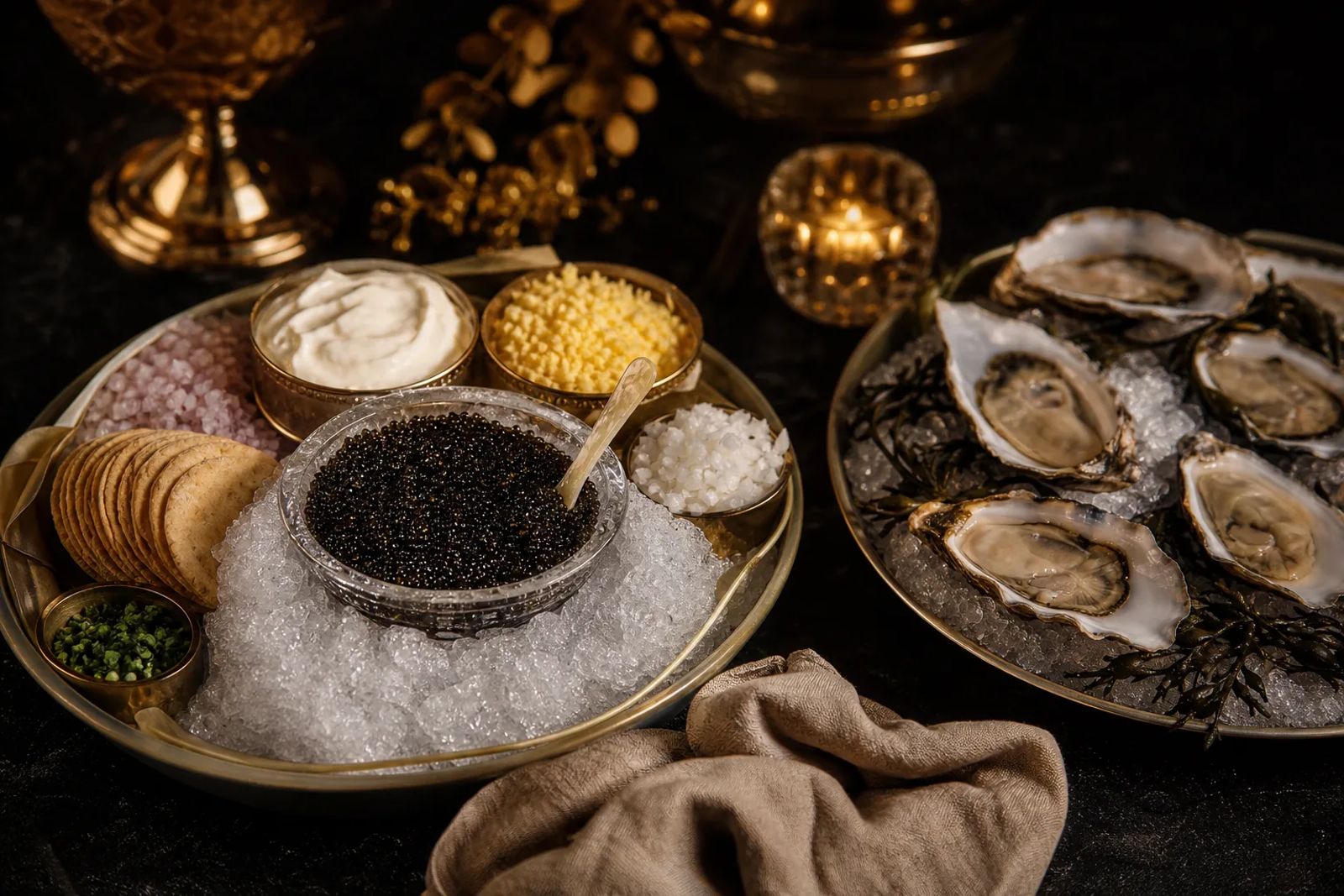
Caviar, plain crackers, crème fraîche: let guests taste the roe alone, then build their own bites. Serve it in a small chilled bowl, not spread across the board.
Replenish as needed from a refrigerated reserve. Keep the roe separate from raw shellfish, and give every food its own serving utensil. The board can be generous; the bowl need not be.
- Plan for the people who will eat roe, not the whole guest list.
- Firm beads do not earn extra time out of refrigeration.
- Replace bowls and spoons together. Never add fresh roe to a partly used bowl.
How much caviar belongs on a grazing board?
Allow 10 g (about 0.35 oz) per roe-eating guest on a mixed board, where other foods do most of the feeding. For ten people who want caviar, that means 100 g (about 3.5 oz), brought out in small servings rather than displayed all at once. This is a hosting allowance, not a safety standard.
Ask who actually wants caviar before planning the quantity, especially when the board is part of a larger meal. If everyone wants a proper tasting rather than a garnish, give it a course of its own. Follow the portion planning in how to serve caviar rather than stretching a shared bowl.
Choose roe for its texture
Salmon roe makes sense when guests will be spooning it onto crackers themselves. The Alaska Seafood Marketing Institute describes good-quality salmon eggs as firm but pliable under pressure, and notes their thick membranes when discussing freezing resistance. That supports a practical preference for intact, resilient beads, not a claim that salmon roe survives an unattended buffet better.
No reliable comparative evidence shows that salmon or trout roe resists drying longer than sturgeon caviar during service. Choose by the documented texture of the particular product, then give every roe the same chilled-food controls. For more about the eggs themselves, see the salmon roe guide.
Build the cold station before opening the roe
Have the serving area ready before opening the roe, with clean spare bowls and utensils waiting in the kitchen. This home-board arrangement draws on national buffet and seafood hygiene advice; it is not a validated catering procedure.
-
Chill the reserve. Follow the producer's storage instructions, use-by date and directions after opening. Codex specifies 2 to 4°C for caviar at retail; FDA consumer guidance gives 4°C (40°F) or below as the US buffet benchmark for cold food. Check the food with a clean food thermometer, not by judging the ice. Follow a colder product instruction where one is given.
-
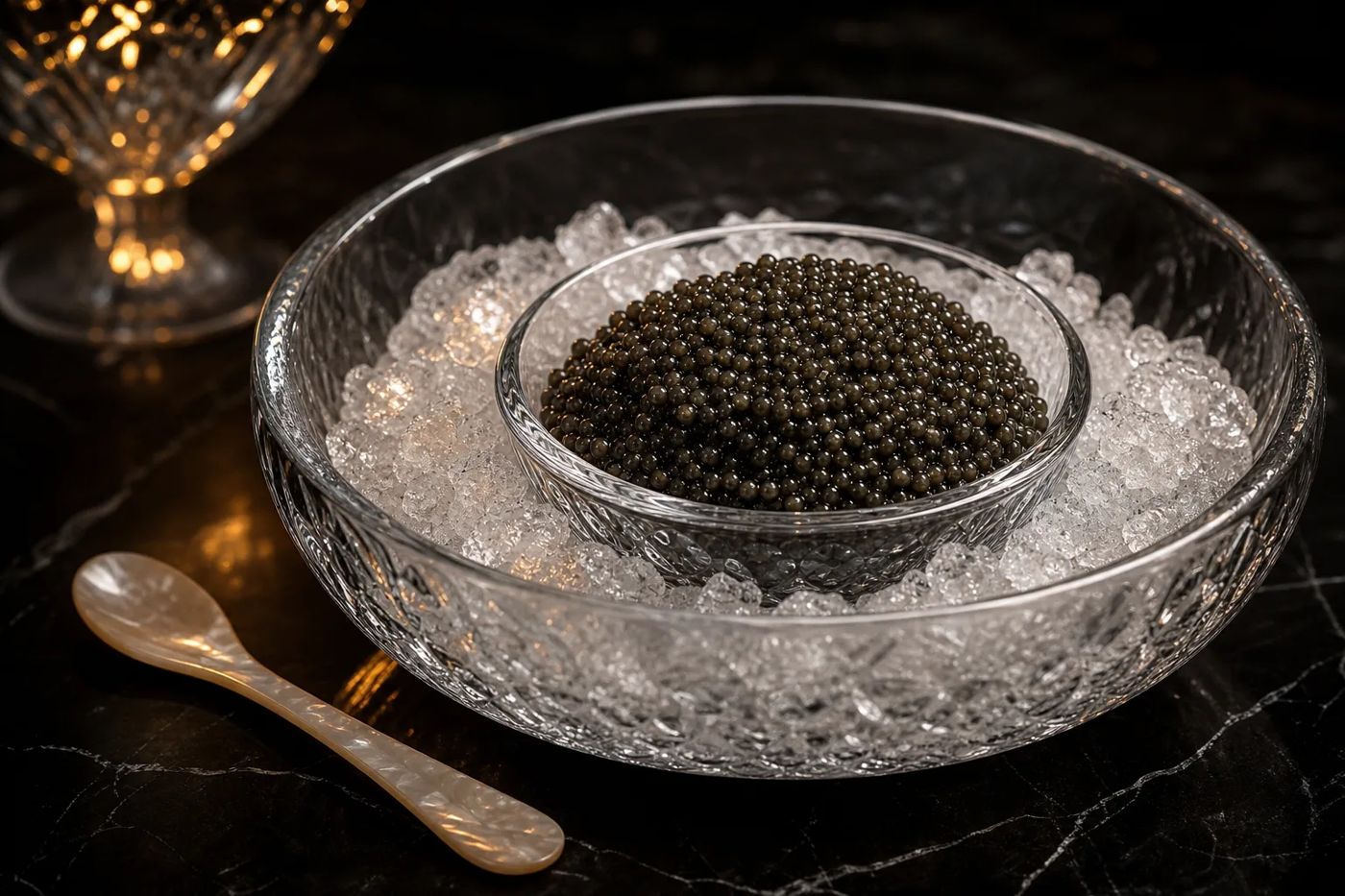
Nest the bowl in ice. Set a small, clean glass bowl of roe inside a larger bowl of crushed ice, with ice around its sides. Keep it stable and its rim clear of meltwater. Do not place roe directly on ice, cucumber slices or the communal board for extended display.
-
Give raw shellfish its own zone. Put opened oysters and other raw shellfish on a separate, contained, chilled tray, away from roe, cooked prawns, smoked fish and vegetables. Keep their ice bed and drainage path separate from ready-to-eat foods. Arrange the dishes so nobody has to carry dripping shellfish across them.
-
Give every dish its own utensil. Each roe needs a separate spoon. Crème fraîche, cooked seafood, cucumber and crackers need their own tools too. Set out side plates for assembling bites, and ask guests not to return a used cracker or personal spoon to a communal bowl.
-
Keep a service record. Note when each perishable dish leaves refrigeration. Separately, track any earlier preparation time without temperature control. Put one person in charge of watching the station and checking cold holding. Replace dropped, swapped or visibly soiled utensils immediately with clean ones.
-
Replace rather than top up. Drain meltwater and renew the ice as needed to maintain the required temperature, taking care not to splash the food. Replenish with a fresh chilled bowl and clean spoon. Never top up the old bowl or return its remaining roe to the untouched reserve.
Give guests simple, satisfying accompaniments
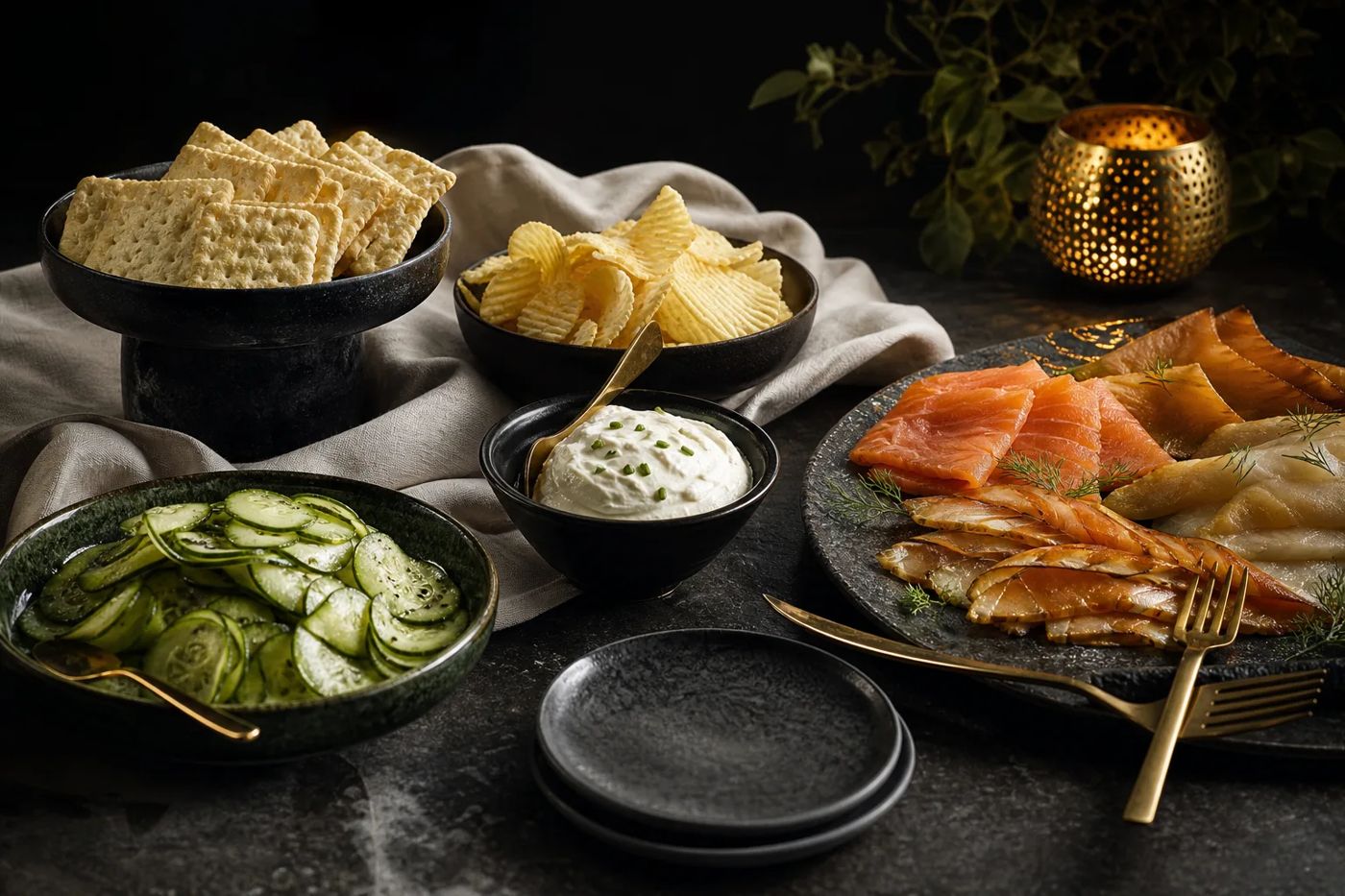
Set out plain crackers, potato crisps, crème fraîche, cucumber and a separate platter of smoked fish. Choose mild, crunchy carriers: Great British Chefs recommends crackers and crispbreads, while caviar seller Original Tin pairs lightly salted potato crisps with crème fraîche, giving each component its own spoon.
Offer smoked salmon, cucumber, crème fraîche and caviar separately, so guests can taste the roe alone before building a bite. Chef Matthew Tomkinson combines them in a published recipe, a flavour reference rather than a board layout. Keep the chilled accompaniments under temperature control too.
Leave lemon and oyster dressings beside the shellfish, not between the roe bowls.
Know which time limit applies
A little ice beneath a warming bowl is not effective cold holding. The limits below apply to food without effective temperature control, and each belongs to a different set of national guidance. They are not interchangeable allowances.
- United States: FDA consumer buffet advice says to discard perishables left at room temperature for more than two hours, reduced to more than one hour above 32°C (90°F), unless kept properly hot or cold.
- Northern Ireland: FSA catering guidance describes a single display period of up to four hours for food held above 8°C (46°F), subject to its conditions. This is not a recommended caviar serving duration.
- Australia: FSANZ's business guidance counts cumulative time between 5°C and 60°C (41°F and 140°F). Under two hours permits refrigeration again; two to four hours means use immediately without returning to refrigeration; beyond four hours means discard.
Fresh ice does not reset the clock. Earlier time without temperature control still counts. Read serving caviar safely for the full rules and what to do when the history is uncertain. For the physical set-up, see keeping caviar cold.
Make a separate safety decision about raw shellfish
Ice keeps oysters cold. It does not make them free of pathogens. The UK's NHS warns that raw shellfish can carry harmful bacteria and viruses, including norovirus. It advises older people, pregnant people, young children and people with weakened immune systems to avoid raw or lightly cooked shellfish.
US FDA and Health Canada guidance also tells these higher-risk groups to avoid raw or undercooked shellfish. In Ireland, the Sea-Fisheries Protection Authority explains why their waters matter: filter-feeding shellfish can accumulate microorganisms or biotoxins from them.
If everyone wants a proper tasting rather than a garnish, give it a course of its own.
Removing the oysters does not automatically make the rest of the board suitable for every guest. FDA advice for at-risk groups also excludes refrigerated smoked seafood unless it is in a cooked dish. Discuss personal questions with a doctor or midwife, and consult the caviar food safety guide when planning for vulnerable guests.
Keep allergens separate too
Roe, prawns and oysters fall into three distinct allergen categories in FSA guidance. Roe and smoked fish are fish; prawns are crustaceans; oysters are molluscs. Fish allergy and shellfish allergy are not interchangeable. On a mixed seafood station, hands, spoons, plates and spills all create opportunities for cross-contact.
Ask about allergies before preparing the board. Keep ingredient information for crackers, dressings and flavoured roe: crème fraîche contains milk, wheat crackers introduce wheat, and prepared foods may contain further allergens. Separate spoons help with ordinary service, but they do not establish that an open shared board is safe for someone with a diagnosed allergy.
Where an allergy requires avoidance, agree a separate preparation and serving plan with the guest. Use clean equipment, a separate preparation area and protected individual portions where appropriate. If cross-contact cannot be prevented, say so plainly rather than describing a corner of the board as allergen-free.
Sources
- US Food and Drug Administration. Serving Up Safe Buffets. Online consumer guidance, undated edition retrieved November 2026. Small-batch service, replenishment and room-temperature time limits.
- US Food and Drug Administration. Entertaining All Year (Food Safety for Moms-to-Be). Online edition, undated, retrieved November 2026. Cold holding, thermometers and refrigerated reserves.
- Food Standards Agency. Safe Catering: Your Guide to Making Food Safely. Issue 7, April 2019, Northern Ireland guidance. Section 3, displaying chilled food and avoiding contamination.
- Food Standards Australia New Zealand. 2-hour / 4-hour rule. Online business guidance, undated edition retrieved November 2026. Cumulative time and permitted actions.
- NHS. Fish and shellfish. Online edition, retrieved November 2026. Raw shellfish risks, vulnerable groups and separation during preparation.
- US Food and Drug Administration. Selecting and Serving Fresh and Frozen Seafood Safely. Online consumer guidance, undated edition retrieved November 2026. Cross-contamination and foods higher-risk groups should avoid.
- Health Canada. Shellfish food safety. Online edition, retrieved November 2026. Vulnerable groups, containing raw juices and separate equipment.
- Sea-Fisheries Protection Authority, Ireland. Shellfish Safety. Online edition, undated, retrieved November 2026. Accumulation of microorganisms and biotoxins in filter-feeding shellfish.
- Food Standards Agency. Allergen guidance for food businesses. Online edition retrieved November 2026. Allergen categories and measures against allergen cross-contamination.
- NSW Food Authority. Fish. Online allergen guidance, undated edition retrieved November 2026. Distinct seafood allergies, shared buffets and separate preparation equipment.
- Alaska Seafood Marketing Institute. Alaska Salmon Roe. Copyright 2010 edition. Salmon caviar quality characteristics and membrane strength. Industry guidance, not a comparative buffet-service study.
- Great British Chefs. What to Serve with Caviar. Online edition, undated, retrieved November 2026. Crackers and crispbreads as accompaniments.
- Original Tin. Chips + Caviar. Undated recipe retrieved November 2026. Seller's serving suggestions, separate spoons and protection from meltwater.
- Matthew Tomkinson, Great British Chefs. Home-smoked salmon with pickled cucumber, crème fraîche and English wasabi gazpacho. First published 2015. Documented combination of smoked salmon, cucumber, crème fraîche and caviar.
This piece was researched from national food-safety guidance, an industry roe reference and attributed culinary sources; the board arrangement and portion suggestion are editorial applications, not results of a service trial.
Last checked: November 2026