

A bowl of ice is only doing its job if the caviar itself stays cold enough. Ice around the dish is not the test; the temperature of the food is.
Keep caviar refrigerated until serving, bring out small portions with clean utensils, and track any time without effective chilling. The time allowed varies by country, so follow local guidance and the product's instructions rather than choosing the most generous limit.
Why caviar needs careful handling
Caviar is a ready-to-eat food, normally eaten without further cooking. With no final cooking step at the table to reduce contamination, refrigeration and clean handling are essential for a product labelled for chilled storage. The wider risks are covered in the caviar food safety guide.
Start with the producer's validated storage and after-opening instructions for that particular product, including its use-by date. Codex CXS 291-2010 specifies 2 to 4°C (36 to 39°F) for packaging, storage and retail. This is an international reference, not a universal household law. A national fridge maximum does not override a colder temperature on the label.
Pasteurisation reduces microorganisms through heat treatment; it does not make every product suitable for room-temperature storage. Chilled caviar still needs the handling stated on its label, as explained in fresh and pasteurised caviar. Pasteurisation gives an opened container no separate allowance for lingering on the table.
How long can caviar stay out of the fridge?
Use the guidance for your location, together with any stricter product instructions. The table distinguishes consumer advice from food-business guidance. These are general chilled-food rules rather than caviar-specific shelf-life studies, so the longest allowance is not automatically yours to use.
| Where and status | Guidance without effective chilling | Authority | Checked |
|---|---|---|---|
| UK, public advice | NHS: eat chilled ready-to-eat foods within 4 hours. FSA events: maximum 4 hours, or 2 hours in extreme heat. | NHS; FSA | November 2026 |
| US, consumer advice | Discard perishables after more than 2 hours at room temperature, or 1 hour above 32°C (90°F). | FDA; USDA FSIS | November 2026 |
| EU, public and Irish business guidance | EFSA: refrigerate perishables promptly below 5°C (41°F); cooked food must not stand out beyond 2 hours. Ireland: no food on counters beyond 2 hours. | EFSA; FSAI | November 2026 |
| Australia, business guidance | Total time between 5°C and 60°C (41°F and 140°F): under 2 hours, use or refrigerate; 2 to 4 hours, use immediately; discard at 4 hours. | FSANZ | November 2026 |
| New Zealand, business plan | MPI's template food control plan uses a cumulative 2-hour/4-hour approach: early refrigeration is possible, but not during the later, serve-only period. | MPI | November 2026 |
| Canada, consumer advice | Refrigerate or freeze leftovers within 2 hours; keep cold food at 4°C (40°F) or below. | Health Canada | November 2026 |
UK: NHS four-hour advice directly covers ready-to-eat foods. FSA event guidance adds that food reaching 8°C (46°F) or above should be discarded after four hours unless refrigerated within that period. Once returned to the fridge, it should not stand at room temperature again.
Under FSANZ guidance, warm periods add up: refrigeration does not reset the clock.
EU and Ireland: EFSA's two-hour wording concerns cooked food, not a binding EU-wide caviar limit. Ireland's Food Safety Authority gives the broader countertop advice above. Elsewhere in the EU, check the relevant national authority.
Australia and New Zealand: FSANZ publishes Australian food-business guidance, not identical business law for both countries in its name. New Zealand's Ministry for Primary Industries supplies its own food control plan. A conservative practice under either approach is to refrigerate before two hours, or finish serving and discard before four.
Ice helps, but temperature decides
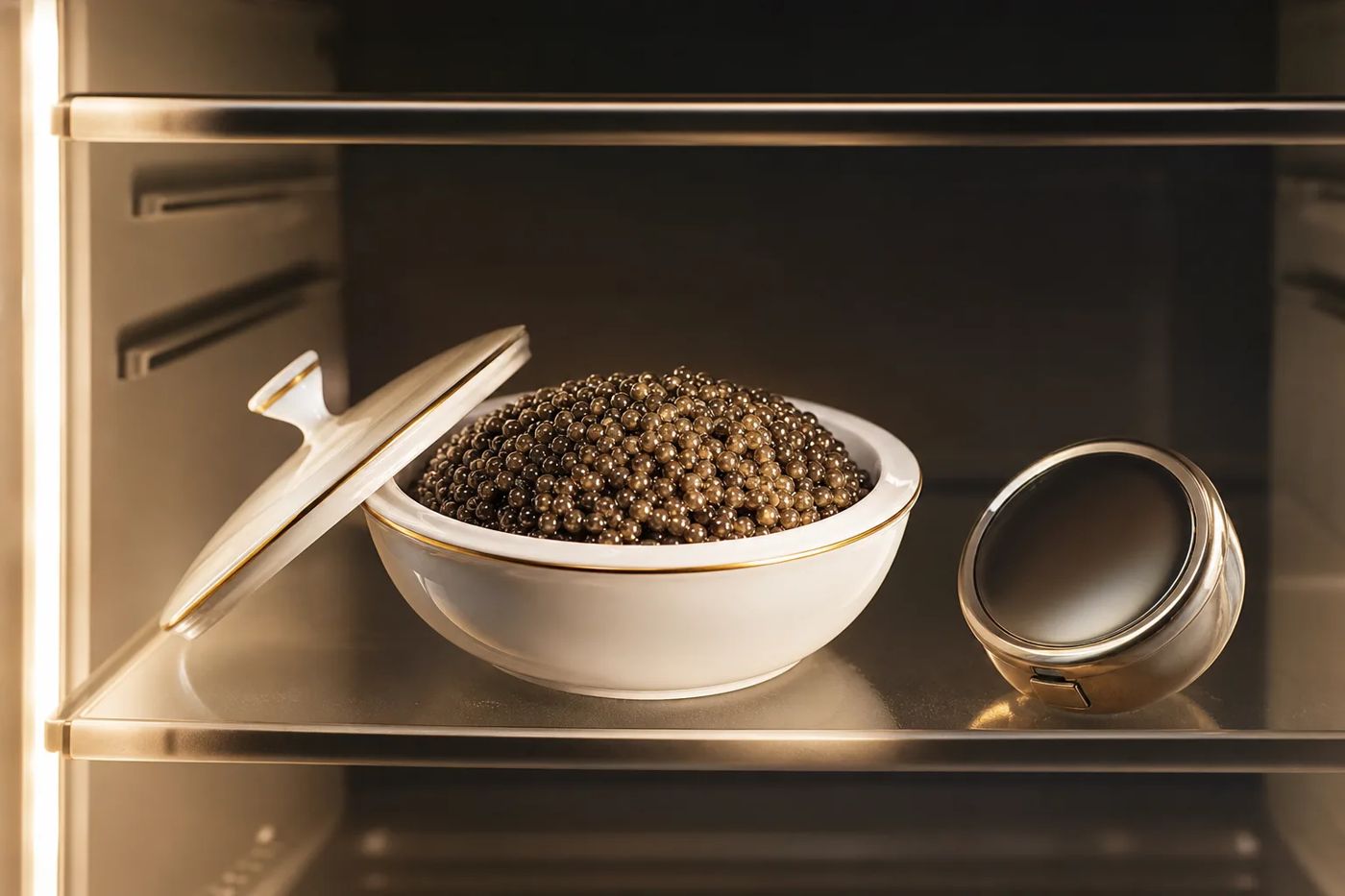
Ice can maintain genuine cold holding, not merely slow the warming. FDA home-buffet guidance calls for cold food at 4°C (40°F) or below; Australian guidance uses 5°C (41°F) or below. Measure the caviar's temperature rather than judging the ice left in the outer bowl.
Choose the approach that matches what you can verify:
- Verified cold holding: if the caviar stays at the required temperature, time physically outside a fridge is not the same as room-temperature display time. Keep within any colder storage instruction on the label, the use-by date and the producer's after-opening limit.
- Unverified chilling: if you cannot confirm effective cold holding, start the applicable time limit when the portion leaves refrigeration, even if the dish sits on ice. The use-by date and after-opening limit still apply.
For professionals, the FDA Food Code 2026 specifies cold holding at 5°C (41°F) or below in section 3-501.16, with separate time-control procedures in section 3-501.19. The Code is a model for adoption by jurisdictions, not an automatic federal allowance for a home buffet.
Serve small, clean and cold
-
Prepare the space. Wash your hands with soap and water. Clean the worktop, dishes and utensils, and keep the caviar and serving equipment away from raw fish, meat and their juices. Chilling cannot replace preventing contamination during preparation.
-
Check the fridge and label. Read a fridge thermometer rather than trusting the dial, and meet the product's stated storage temperature. UK FSA household guidance recommends 0 to 5°C (32 to 41°F). If the label requires colder storage, arrange it before opening.
-
Bring out one small portion. Transfer, for example, 15 g (about half an ounce) into a clean serving dish instead of exposing the whole tin. Cover the reserve and return it promptly to the fridge. Note when the container was opened.
-
Separate serving from eating. Use a dedicated clean spoon to transfer caviar to individual plates or spoons. A spoon that has touched someone's mouth must not return to the shared dish. Replace contaminated utensils; wiping one on a napkin is not enough.
-
Keep cold or start timing. Nest the serving dish in ice, with meltwater kept outside the food container. Verify cold holding with a clean food thermometer. Otherwise, record the removal time and set a reminder before your local limit, counting any earlier preparation time too.
-
Replace rather than top up. When more caviar is needed, bring out a clean dish and clean spoon. FDA buffet advice recommends replacing dishes instead of adding fresh food to old food. This also keeps each portion's time record clear.
These steps protect hygiene; they are not a suggested tasting temperature or an invitation to let caviar warm deliberately. For portions, dishes and accompaniments, turn to the serving guide, while keeping those choices separate from the cold-holding limits above.
Between servings and after the party
Keep the refrigerated reserve separate from the portion on the table. Each time you open the reserve, use a fresh clean utensil, replace the cover and return it promptly to the fridge. Never scrape table leftovers back into it.
Check each displayed portion's time, temperature and handling history before deciding what to keep. Discard any portion with an uncertain history or contamination during service. For the rest, follow your jurisdiction's row: refrigerate only where allowed and within the stated window, or discard when required. Do not wait until the guests leave if that window closes earlier. Under FSANZ guidance, warm periods add up: refrigeration does not reset the clock.
A pleasant smell, normal appearance or intact seal cannot establish that refrigeration and handling have been adequate.
The time allowed during service is separate from the number of days an opened product keeps. See opened and unopened shelf life for that question. Use spoilage warning signs to recognise reasons to discard food, not to certify it safe.
Guests who should take extra care
For some guests, the first decision is whether to serve the product at all. US food-safety advice identifies pregnant people, adults aged 65 and over, children under five and people with weakened immunity as groups at increased risk of foodborne illness. FDA seafood guidance advises susceptible groups to avoid raw or undercooked seafood. Meticulous table hygiene does not resolve that food-choice issue.
In the UK, NHS advice tells pregnant people and those with weakened immunity to avoid ready-to-eat cold-smoked or cured fish unless cooked until steaming hot. Its listeriosis page also identifies older people as more vulnerable, without using the same age threshold as US guidance.
That NHS page gives neither caviar-specific permission nor a caviar-specific ban. For pregnancy, consult the pregnancy guide for product distinctions and discuss personal questions with a midwife or doctor. Salted roe should not simply be assumed suitable.
Health Canada uses different age groupings in its safer food information: people aged 60 and over and children aged five and under, alongside pregnancy and weakened immunity. Check local advice for the product, and ask a doctor or pharmacist if unsure. When suitability remains unclear, offer an alternative.
Sources
- Codex Alimentarius, FAO/WHO. Standard for Sturgeon Caviar, CXS 291-2010, last modified 2026 per the Codex register. Retrieved PDF, particularly sections 2.2 and 2.3.
- Food Standards Agency. Providing food at community and charity events, live guidance retrieved November 2026, particularly “Chilled food”.
- Food Standards Agency. How to chill, freeze and defrost food safely, published 2017, live guidance retrieved November 2026.
- NHS. Listeriosis, reviewed 10 November 2023, live page retrieved November 2026.
- US Food and Drug Administration. Selecting and Serving Fresh and Frozen Seafood Safely, live consumer guidance retrieved November 2026.
- US Food and Drug Administration. Serving Up Safe Buffets, live consumer guidance retrieved November 2026.
- USDA Food Safety and Inspection Service. How do I keep foods safe at a buffet?, live consumer guidance retrieved November 2026.
- US Food and Drug Administration. Food Code 2026, 2026 edition, particularly sections 3-301.12, 3-501.16 and 3-501.19; accompanying publication page explains its model status.
- European Food Safety Authority. Proper food handling, Safe2Eat public guidance, live version retrieved November 2026.
- Food Safety Authority of Ireland. Safe Food to Go, retrieved PDF, publication year not reliably established from the extracted document.
- Food Standards Australia New Zealand. 2-hour / 4-hour rule, live business guidance and accompanying factsheet, retrieved November 2026.
- Food Standards Australia New Zealand. Food temperature and thermometers, live business guidance retrieved November 2026.
- New Zealand Ministry for Primary Industries. Template Food Control Plan, retrieved version, “Sourcing, receiving and storing food” and “Keeping food cold”, pages 40 to 43.
- Health Canada. Food safety and you, live consumer guidance retrieved November 2026.
- Health Canada. Food safety tips for leftovers, live consumer guidance retrieved November 2026.
- Health Canada. Safer food choices for people at greater risk of food poisoning: Information sheet, live version retrieved November 2026.
- FoodSafety.gov. People at Risk of Food Poisoning, reviewed 14 August 2025, retrieved November 2026.
This piece was researched using official food-safety guidance, the FDA's current model Food Code and the retrieved Codex standard, adapting their handling principles to small portions of caviar.
Last checked: November 2026