
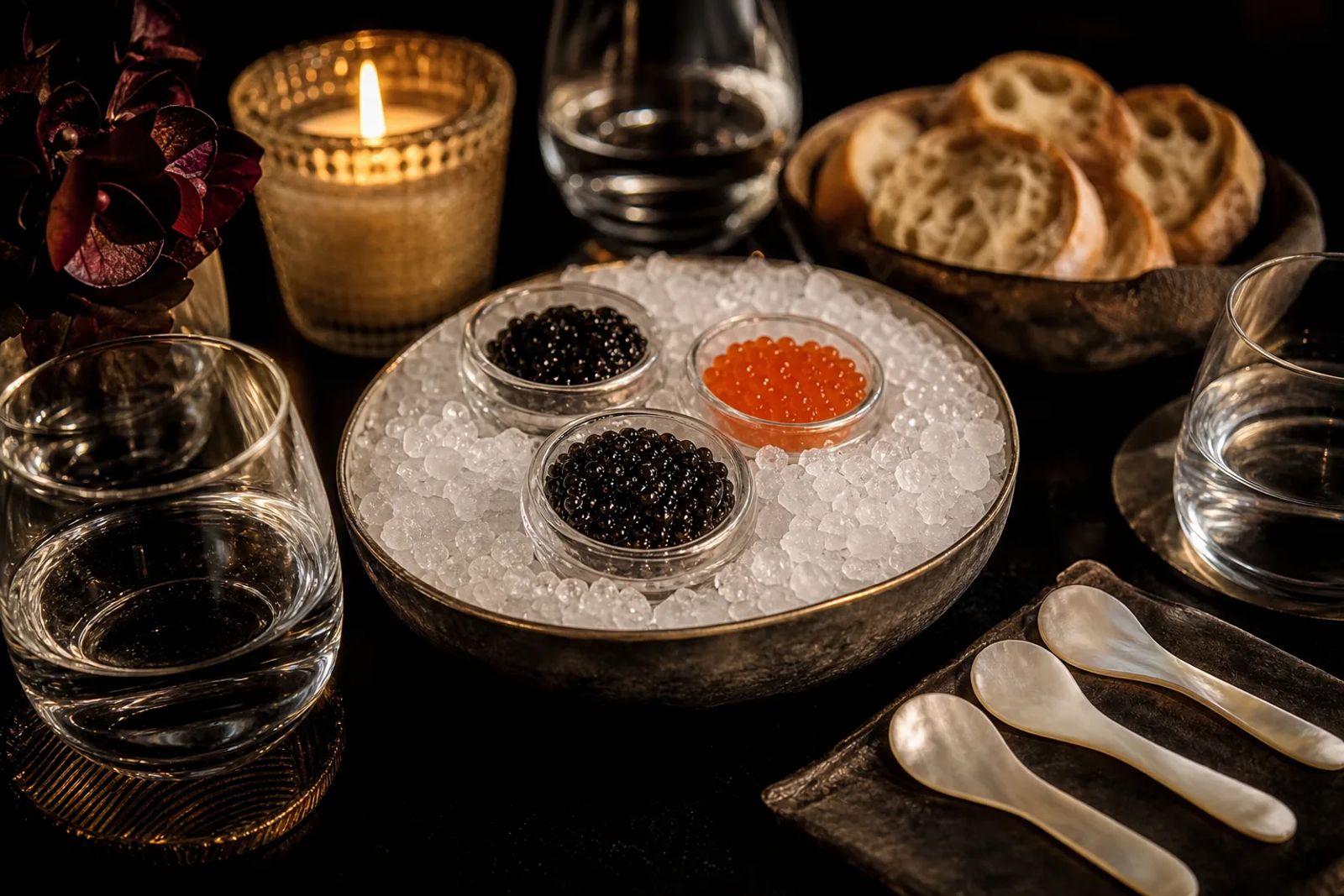
The pleasure is in the differences: what arrives first, how the beads feel and what stays on the palate. Put contrasting samples side by side and the evening has its subject. Bookmark this plan for choosing the line-up, weighing portions and keeping each round cold.
Great British Chefs describes Oscietra as nutty and slightly fruity, with a lingering flavour, and Siberian caviar as bringing a more immediate burst of flavour. Start with two to four samples, served cold and tasted plain. Move from mild to strong, keep reserves refrigerated and invite guests to describe what they notice. There is no correct answer to hunt for.
- For the worked plan, allow 5 g of each sample per guest.
- Give each dish its own serving spoon and keep meltwater out.
- Ask about pregnancy and fish allergies privately before choosing the menu.
Choose a line-up worth comparing
Choose by fish and processing style, rather than brand or presentation. A useful starting pair is Siberian sturgeon, Acipenser baerii, and Russian sturgeon, Acipenser gueldenstaedtii. The latter is sold under the Ossetra or Oscietra trade name; ask for the species, because the trade name alone is not enough.
For a third sample, introduce a different style, such as a more matured caviar, and get its handling instructions. Or set sturgeon caviar alongside salmon roe, meaning salmon eggs. Label that clearly: the tasting now compares different fish roes, rather than three equivalent sturgeon caviars.
Share the Great British Chefs descriptions only after guests have made their own notes. They are that writer's descriptions, not promises about what will be in your dishes.
Two samples are enough for a first evening. Choose four only if everyone wants a longer comparison. For a grounding in the essentials, read caviar for beginners before planning the line-up.
Work out portions before opening anything
For the worked plan below, allow 5 g of each sample per guest: 15 g in total for three samples. Think of it as a small comparison tasting, not a caviar course. The calculation applies a published supplier guideline of 5 to 10 g for a first taste to each sample.
For six guests, set aside 30 g (about 1 oz) of each sample, or 90 g altogether. Divide each guest's allocation between a plain taste and a second taste with bread. Weigh the portions: a spoon is not a fixed measure of weight.
Take a small spoonful, let them move across the tongue and gently press them against the palate.
For other occasions, consult the portions guide. Do not multiply a full serving by the number of samples. A tasting can open the evening beautifully without becoming the whole meal; supper can follow.
Set the table, then bring out the roe
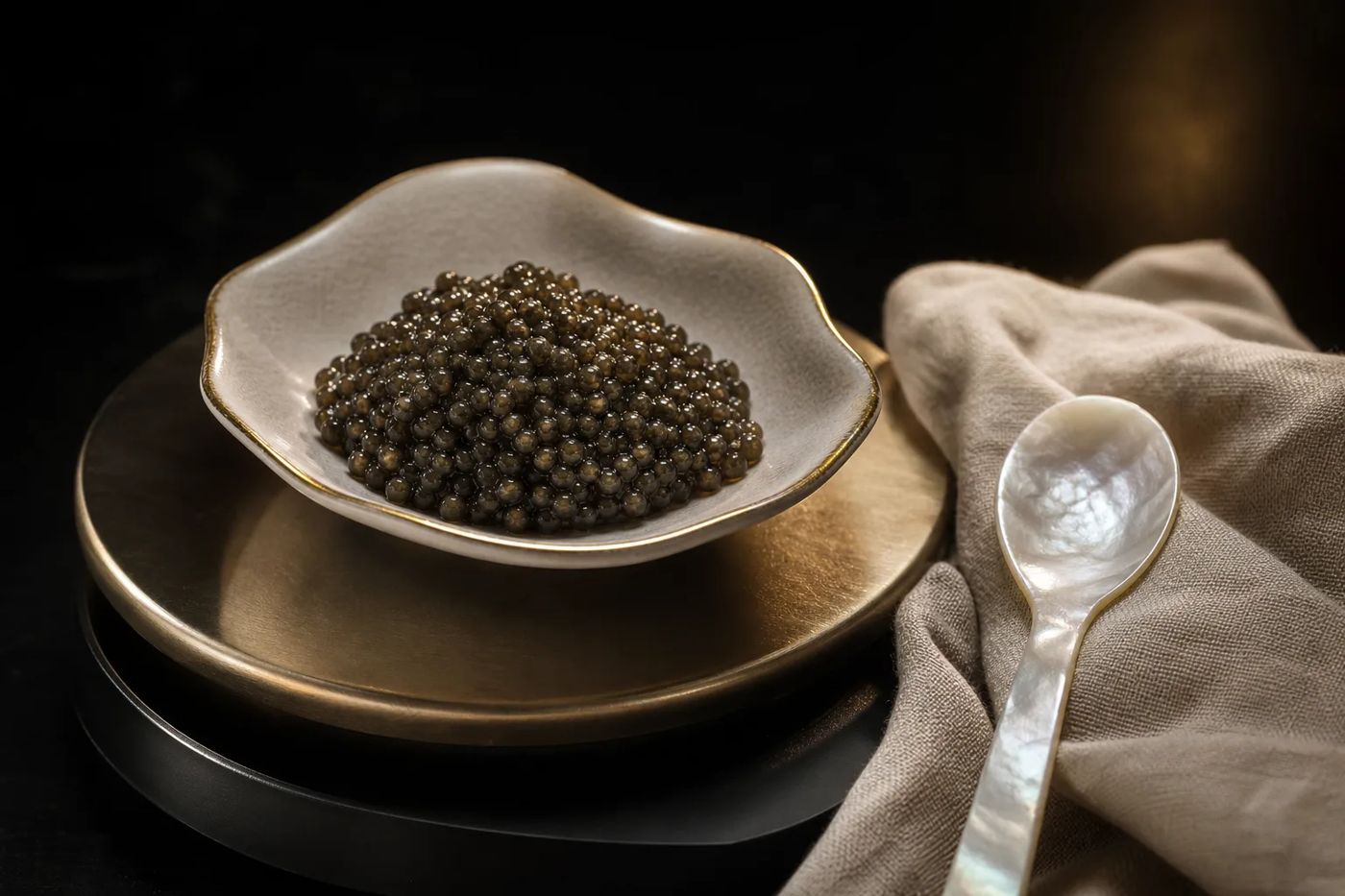
Give each sample a small glass or ceramic dish and a clean serving spoon. Have a tray of crushed ice ready, with separate tasting spoons for guests. Mother-of-pearl, glass or food-safe plastic spoons are straightforward choices. Keep a kitchen scale, fridge thermometer, clean towel and spare spoons close at hand.
Put still water and plain, unsalted bread or crackers within reach for clearing the palate. Keep butter, crème fraîche, blinis and garnishes separate until the plain comparison is over. Guests should be able to return to the same unadorned samples without an accompaniment changing the next mouthful.
A numbered plan for hosting a caviar tasting
Keep the rounds short and the reserves cold. This suggested running order is a hosting plan, rather than a tested recipe; its timings do not create a food-safety allowance. Follow the temperature and maximum exposure limits in the guidance below.
-
Before guests arrive: check the product's storage instructions and use-by date, then keep it refrigerated until needed. Codex gives 2 to 4°C (36 to 39°F) for packaging, storage and retail. That is an international reference standard, not a universal law for home storage.
-
Before tasting: fill the ice tray, chill the dishes and set out water and notes. Leave the caviar in the fridge while guests settle. It need not spend that time on the table as a centrepiece.
-
At the first round: open only what you need. Portion 5 g per guest from the first sample and leave reserves refrigerated. Nest the serving dish securely in ice, keep meltwater out and use a clean serving spoon.
-
Taste each sample: taste it plain and write a few words. Take water and a little bread before moving on. Use the supplier's tasting notes to start with the mildest, then progress towards stronger or more persistent flavours, so the first sample gets its moment.
-
Keep bulk portions cold throughout: US FDA buffet guidance recommends cold food at 4.4°C (40°F) or below. Chef Thomas Wenger gives about 8°C (46°F) as a culinary serving temperature. Use that only as a brief tasting temperature for a small portion, never as the holding target for a shared dish.
-
After the plain round: offer a second taste with one mild accompaniment, then clear the roe away. Let the conversation continue over the rest of the meal, without opened dishes lingering on the table.
Storage, serving and exposure are different things
Fridge settings: FSA household refrigeration guidance for England, Wales and Northern Ireland specifies 0 to 5°C (32 to 41°F); the US FDA says 4.4°C (40°F) or below. Follow colder storage instructions on a particular caviar label.
Exposure limits: the US FDA advises discarding perishable food left at room temperature for more than two hours, or one hour when the temperature is above 32°C (90°F). As a precaution, count preparation and serving time for portions not kept at or below 4.4°C (40°F) towards that limit. Putting them back in the fridge does not restart the clock.
Ice earns its place only while it keeps the food cold. Keep rounds short, replenish melting ice and use serving temperature and cold handling for the fuller method.
Help guests notice, not perform
A preference and one reason are enough. Give everyone the printable tasting sheet, with a moment to make private notes before each discussion. Scores are optional; the useful record is what each person noticed and enjoyed.
Begin with the beads: compare their shape, relative size and colour under the same light. Take a small spoonful, let them move across the tongue and gently press them against the palate. Notice the change from appearance to texture: do they resist, release cleanly or feel soft?
As the flavour unfolds, ask what arrives first and how pronounced the salt seems. Then notice what remains after swallowing: the finish. Words such as briny, savoury, mineral or seaweed-like can help someone name a sensation; no sample needs to tick every box.
If the verdict is simply ‘salty’, ask whether the salt fades quickly or stays, then ask which sample feels firmer. Keep labels visible for a relaxed evening, or use simple letters and reveal the identities afterwards. Neither approach needs the formality of professional tasting and scoring.
Let drinks and accompaniments wait
Still water gives the first comparison a clear starting point. Afterwards, offer drinks to suit your guests. Great British Chefs identifies Champagne and chilled vodka as traditional partners, but a good tasting needs neither. Keep water on the table whatever else is poured.
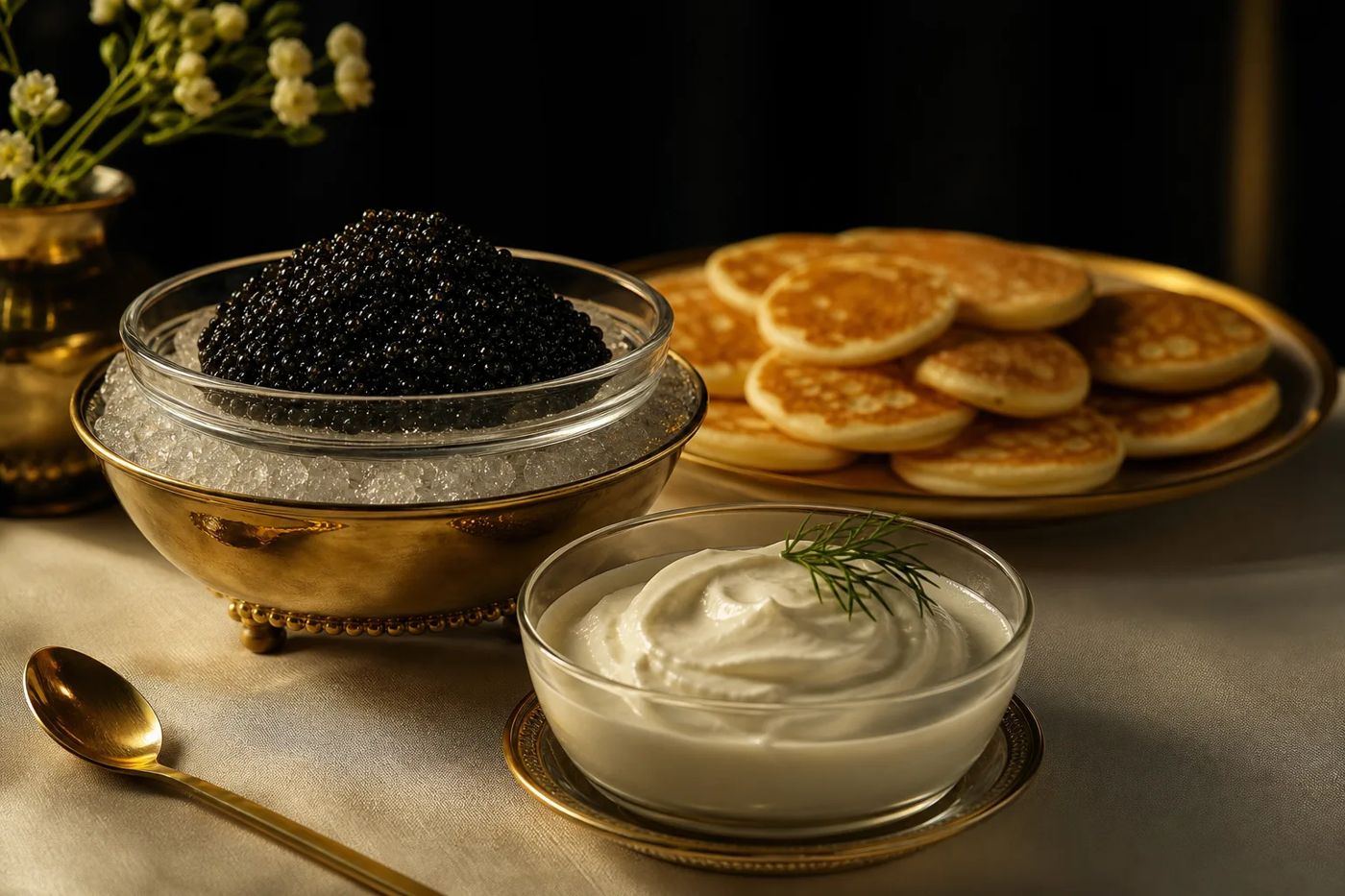
For the second taste, choose plain toast, a blini or a little crème fraîche. One mild accompaniment is more useful than a table crowded with garnishes. If the tasting is becoming a seated meal, turn to dinner-party presentation for that different kind of service.
Ask about guests' needs before choosing the menu
Ask privately about pregnancy and allergies when inviting people, then arrange an alternative before the evening. Nobody should have to explain a medical concern across the table or feel obliged to take a taste.
In England, NHS pregnancy guidance advises cooking cold smoked or cured fish until steaming hot because of Listeria risk. It does not specifically settle every caviar product. Offer a pregnant guest a fully cooked alternative and suggest checking the exact product with their midwife or doctor.
US FDA guidance likewise advises pregnant people to avoid raw or undercooked seafood. Do not assume salting makes an uncooked roe suitable, or that a pasteurisation claim alone answers an individual pregnancy question.
For fish allergy, the US Institute of Child Nutrition explicitly includes caviar and roe among fish foods to avoid. Prepare a separate fish-free dish with separate utensils and prevent cross-contact. Check bread, blinis and dairy accompaniments for the guest's other allergens, too.
Put leftovers away promptly
Untouched reserves belong back in the fridge promptly, covered and labelled with the opening date. Follow the producer's opened-product instructions and use-by date. Keep served portions out of the original container, and never top up a dish guests have already used with new caviar.
Discard anything beyond the exposure limits above, or whose handling history is uncertain. A pleasant smell or appearance cannot establish safety. If opened-storage instructions are missing, ask the supplier: another caviar's shelf life is not a reliable substitute.
Sources
-
Great British Chefs. Making the grade: a guide to caviar. Originally published 2015; page also displays an updated date of 14 February 2025. Used for attributed sensory descriptions and traditional drinks, not its legal, grading or blanket metal-utensil claims. Read the guide.
-
Great British Chefs. What to serve with caviar. Web edition retrieved November 2026; revision date not reliably established. Used for tasting plain first, chilled presentation and mild accompaniments. Read the serving guide.
-
Thomas Wenger, Chef's Pencil. How to Serve Caviar. 4 May 2011, web edition retrieved November 2026. Used selectively for the attributed culinary serving temperature and gentle tasting technique, not its storage advice. Read Wenger's guide.
-
OM Caviar. How to Serve Caviar: Temperature, Portions & Setup. Published 2022; updated 24 August 2026. Commercial supplier guidance, used for its first-taste quantity and practical equipment arrangements, not as independent food-safety authority. Read the service guidance.
-
FAO and WHO, Codex Alimentarius Commission. Standard for Sturgeon Caviar, CXS 291-2010. Retrieved PDF states amendments in 2013, 2018 and 2024; section 2.3 supplies the packaging, storage and retail temperature range.
-
Food Standards Agency. How to chill, freeze and defrost food safely. Published 18 December 2017; GOV.UK web edition retrieved November 2026. Applies to England, Northern Ireland and Wales. Read the chilling guidance.
-
US Food and Drug Administration. Serving Up Safe Buffets. Undated web edition retrieved November 2026. Used for cold holding, small replacement dishes and exposure limits. Read the buffet guidance.
-
US Food and Drug Administration. Selecting and Serving Fresh and Frozen Seafood Safely. Undated web edition retrieved November 2026. Used for refrigeration, seafood handling and advice for pregnant people. Read the seafood guidance.
-
NHS. Foods to avoid in pregnancy. Web edition retrieved November 2026; revision date not reliably established. Used for England's advice on raw and cured fish and Listeria. Read the pregnancy guidance.
-
Researched from the dated sources listed above.
This piece combines retrieved culinary guidance with national food-safety advice, distinguishing suggested hosting arrangements from sourced safety limits.
Last checked: November 2026