
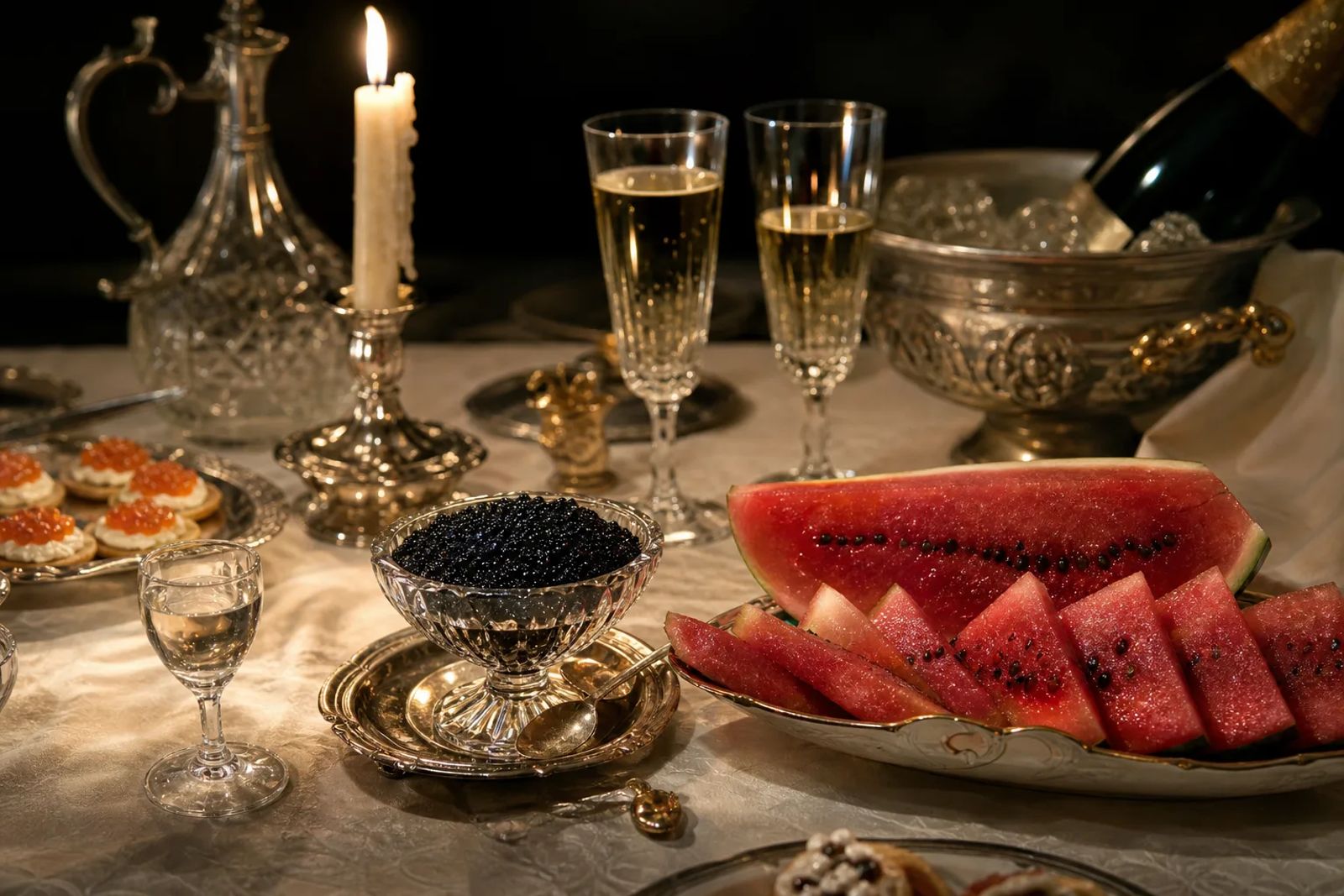
Caviar and vodka to begin; watermelon and champagne to finish. Stalin's state dinner, as Harry Truman described it, offered plenty between those bookends. It is a revealing place to begin: famous company at a caviar table does not always mean famous appetites. The richest stories come from what people actually said, ate and remembered.
What makes a documented caviar lover?
A letter, diary, menu, memoir or interview on the record gives a story something solid to stand on. A traceable connection in a primary source is the starting point for the main accounts here. Familiar claims without that foundation receive a separate examination below.
The labels describe the claim, not the person. Documented means the cited record supports the statement. Attributed anecdote means an identifiable person recalled the episode, without independent confirmation. Legend means the version examined has no established primary foundation in the material checked; it does not mean the story has been proved false.
For living people, only their own public statements qualify. Photographs, staff gossip and restaurant customer lists are excluded, and a documented preference is not an endorsement. For the wider cultural setting, see caviar and the arts.
The stories at a glance
| Person | The story | Evidence | Source | Verdict |
|---|---|---|---|---|
| Marilyn Monroe | Compared fame with caviar | Recorded interview | National Portrait Gallery interview extract | Documented comparison |
| Marilyn Monroe | Repeated takes to eat more caviar | Cook's later recollection | Christie's lot essay | Attributed anecdote |
| Harry Hopkins | Ate caviar with Maxim Litvinov | Contemporary memorandum | US diplomatic papers | Documented meal |
| Harry Truman and Joseph Stalin | Caviar opened Stalin's dinner | Letter reproduced in memoir | Truman, Year of Decisions | Documented hospitality |
| Winston Churchill | Caviar among his favourites | Later biographical account | International Churchill Society | Attributed anecdote |
| Charlie Chaplin | Received a fixed caviar payment | Later retellings | Discussion below | Legend in this quantified form |
| Jacqueline Kennedy Onassis | Caviar and potato diet | Later feature | Guardian | Legend |
Marilyn Monroe: fame, caviar and another take
Marilyn Monroe compared fame with caviar, and the record lets readers get closer than a quotation website. The National Portrait Gallery's exhibition material reproduces her comparison and directs visitors to an audio excerpt from her final interview. These are her own words, rather than a line bestowed on her by a later admirer.
Marianne Geltner, who worked as Monroe's cook in 1956, recalled Monroe saying she had deliberately made mistakes during a caviar scene so that she could keep eating it.
The subject was excess: fame becoming too much. It was not a declaration that she ate caviar every day, nor a detailed account of her eating habits. The comparison stands on its own.
The more mischievous story comes from The Prince and the Showgirl, filmed in 1956. Marianne Geltner, who worked as Monroe's cook in 1956, recalled Monroe saying she had deliberately made mistakes during a caviar scene so that she could keep eating it. Christie's recounts the episode in a lot essay.
Geltner recalled what Monroe told her, rather than reporting that she witnessed the retakes herself. It is a vivid attributed anecdote, not a production record establishing why particular takes were repeated.
Harry Hopkins: a diner who noticed the difference
Harry Hopkins did more than record caviar on the table. He gave it a verdict.
In a memorandum dated 6 January 1942, preserved in the Roosevelt Papers and published in the US diplomatic record, Hopkins described lunch with Soviet ambassador Maxim Litvinov. They were served caviar and vodka. He judged that day's caviar less good than usual, wording that also presents it as a recurring feature of these lunches. This is a documented meal with a personal reaction, although it does not establish caviar as his favourite food.
The observation comes before his account of a political conversation, neither an advertisement nor a retrospective food profile. Its interest lies in that incidental setting: a contemporary diner passing judgement while writing about something else.
Harry Truman and Joseph Stalin: the table and the appetite
Truman recorded a lavish sequence of dishes, but also observed that he had eaten very little and drunk less.
His letter, dated 23 July 1945 and reproduced in Year of Decisions, described the state dinner Stalin had given two nights earlier. The numerous dishes between its opening and closing courses make it a record of abundant hospitality.
The letter places caviar at a dinner hosted by Stalin and attended by Truman. It gives no quantity of caviar eaten by either man, and no declaration that either considered it a favourite. The host's table and the guest's appetite are different subjects.
Read banquet accounts with that distinction in mind: menus record hospitality and what was offered, rather than individual enthusiasm. The broader story appears in caviar and diplomacy: state gifts and Soviet banquets. For the imperial table, turn to caviar and the Russian tsars.
Three familiar stories, examined closely
Winston Churchill's favourite foods
Caviar appears among the seafood Winston Churchill enjoyed in Barry Singer's account of his tastes, published by the International Churchill Society in December 2019. Singer is a Churchill biographer, giving the claim an identifiable author rather than the anonymity of a circulating list.
The article's quoted letter about a departing cook does not mention caviar, and it supplies no underlying caviar letter, diary entry or first-hand recollection. Churchill's preference therefore remains an attributed anecdote, rather than a claim supported here by primary documentation.
Charlie Chaplin's payment in caviar
The memorable detail is the quantity: 4 kilograms of caviar. A 2013 Spanish-language article repeats that payment story without identifying a contract or contemporary account.
That leaves two questions, not one. Was there a caviar payment at all, and was this the agreed amount? Repetition settles neither the fixed quantity nor whether a transaction was completed. The figure deserves scrutiny precisely because it makes the tale so easy to remember and repeat.
The quantified version remains a legend here. Any broader payment story needs its original documentation before receiving a stronger verdict. Chaplin's screen persona belongs to a separate discussion in caviar in film and television.
Jacqueline Kennedy Onassis and the potato
A plate of caviar and potato is one claim. An exclusive daily diet is quite another.
A Guardian feature repeats the story that Jacqueline Kennedy Onassis followed an exclusive caviar and potato diet, without identifying a first-hand source. The recipe accompanying the story cannot establish her complete daily intake.
The unsupported part is the claim to describe everything she ate. That verdict leaves open whether she ate the combination; it simply keeps a familiar food story from becoming a verified account of her entire diet.
Petrossian: breakfast habits and company memories
Pressed caviar on toast was Christian Petrossian's breakfast habit, according to a 1984 newspaper profile. The same article tells a much larger story about the house.
It recounts the house's account of introducing reluctant Parisian customers to caviar, including the installation of spittoons at a food fair. That vivid detail belongs to a company origin story. The profile does not independently establish that Paris first discovered caviar through one business.
A reported breakfast preference and a company's claim to historical importance call for different corroboration.
How repetition makes a caviar story look like fact
A story can become familiar while its evidence disappears. One retelling drops the witness's name. Another adds an exact quantity. A later list cites an earlier list, and repetition begins to look like confirmation.
The original record sets the limits. A menu records an offering; a letter can record an appetite; a memoir preserves a recollection; an interview establishes what someone publicly said. None automatically establishes the species, quantity or frequency of the caviar consumed.
Chefs: authorship is a different story
Chef Bailly's Caviar Surprise layers caviar and crab, as described in a 2010 eyewitness dining report. It belongs with iconic restaurant caviar dishes, where culinary authorship is the point.
A signature dish tells readers what a chef created, not necessarily what that chef preferred to eat. Restaurant dishes deserve attention on their own terms, rather than being pressed into service as evidence of private eating habits.
Sources
-
National Portrait Gallery, Marilyn Monroe: large-print exhibition guide, undated online edition. Reproduces Monroe's caviar comparison and identifies an audio excerpt from her final interview. Exhibition guide.
-
Christie's, Marilyn Monroe, lot 3839376, undated online auction catalogue entry. The lot essay records Marianne Geltner's recollection concerning The Prince and the Showgirl. Catalogue entry.
-
US Department of State, Office of the Historian, Foreign Relations of the United States, The Conferences at Washington, 1941 to 1942, and Casablanca, 1943, online edition, document 98, “Memorandum by Mr. Hopkins”, 6 January 1942. Diplomatic document.
-
Harry S. Truman, Memoirs, Volume One: Year of Decisions, Doubleday, 1955, letter dated 23 July 1945 to his mother and sister; page number not confirmed in the transcription checked. Transcription.
-
International Churchill Society, Barry Singer, Churchill Style, Churchill Bulletin, issue 138, 1 December 2019. Article.
-
España Rusa, Historia de la comida de los tsares, online article, 18 June 2013. Article.
-
The Guardian, Rebecca Seal, Breakfast of champions: Jackie Kennedy's baked potato, 14 November 2015, updated 9 July 2019. Article.
-
The Armenian Weekly, Roger Ricklefs, newspaper profile of Christian Petrossian, 19 May 1984, page 6, digitised newspaper edition. Issue scan.
-
Gastronomy Blog, Cathy Chaplin, Petrossian: Los Angeles (West Hollywood), 24 March 2010, eyewitness dining report. Article.
Primary records were compared with museum material, named recollections and later retellings, with each verdict restricted to what the retrieved evidence supports.
Last checked: November 2026