
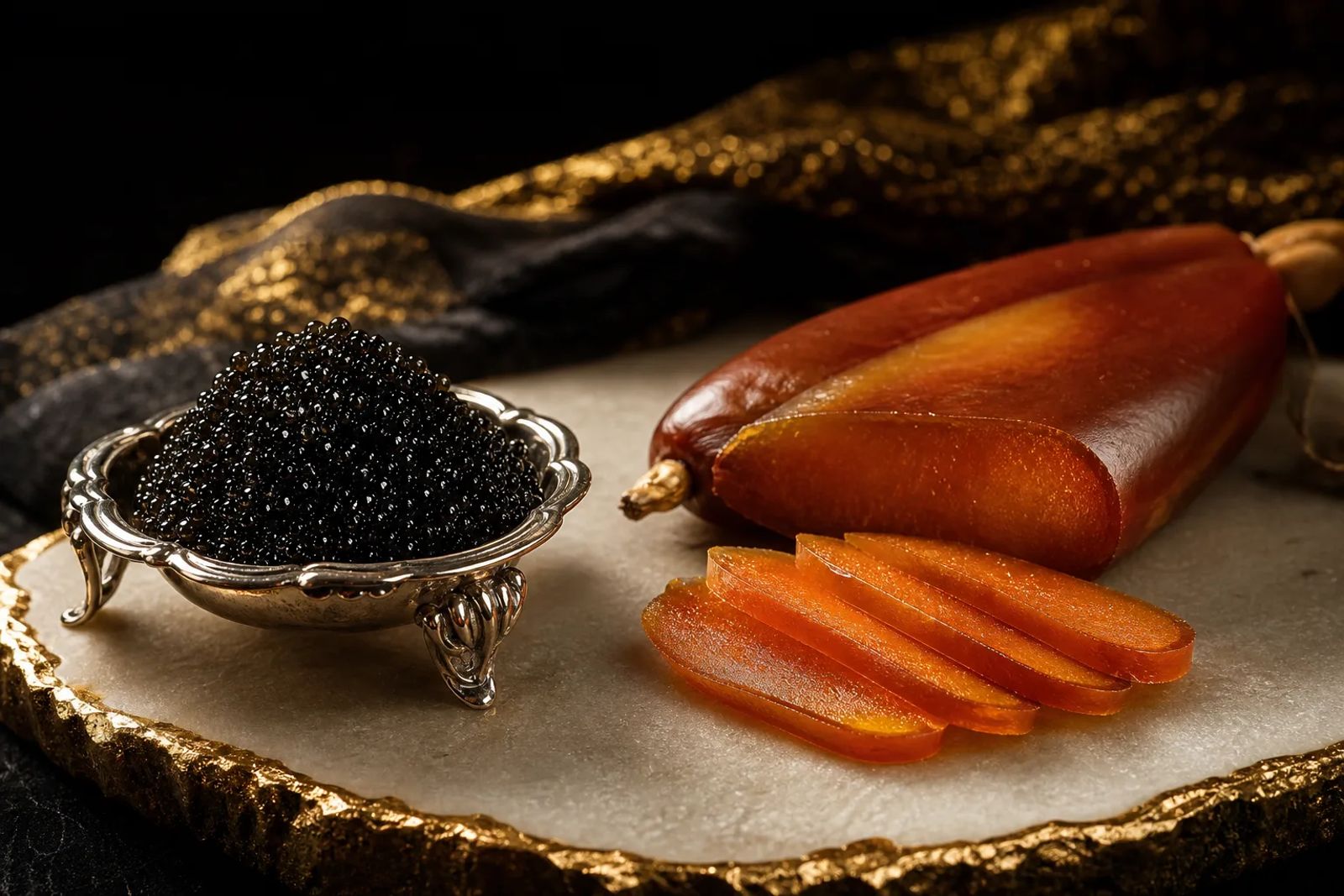
Until 1975, European sturgeon supported a small caviar industry on the Evros, according to Economidis, Koutrakis and Bobori. Today, “Greek caviar” can mean two very different foods: sturgeon caviar produced in Greece, or avgotaraho, cured grey mullet roe. Paschos and colleagues date Greek sturgeon farming efforts to 1992. Avgotaracho Messolongiou PDO belongs to a separate tradition of lagoon fishing and curing.
Greece at a glance
| Species farmed | Thesauri reports Russian sturgeon (Acipenser gueldenstaedtii), Siberian sturgeon (Acipenser baerii) and beluga (Huso huso). 2 |
| Farming regions | Arta area, Epirus, documented in a published farm visit. 4 |
| CITES operations | Three entries marked Processing/Repackaging in the CITES register, as of November 2026. The activities share one column and cannot be counted separately. 1 |
| Import and export regime | EU Wildlife Trade Regulations, principally Regulations (EC) No 338/97 and No 865/2006; EU food hygiene rules, including Regulation (EC) No 853/2004. 11,12,13 |
| Protected roe name | Avgotaracho Messolongiou PDO, grey mullet roe; original EU registration, 2 July 1996. 8,9,17 |
| Wild stock status | European sturgeon (Acipenser sturio): possibly extirpated nationally; stellate sturgeon (Acipenser stellatus): native breeding populations probably extinct, according to HCMR’s 2015 synthesis. HCMR recommended treating Adriatic sturgeon (Acipenser naccarii) and beluga as extinct in Greece in 2015. 6,7 |
| Country’s role | Documented origin of farmed sturgeon caviar and cured mullet roe, with registered caviar processing, repackaging and export activity. 1,2,4,10 |
What “Greek caviar” means
Look first at the eggs: separate beads, or whole roe sacs? That distinction tells you more than the phrase “Greek caviar” on a menu. Roe means fish eggs; avgotaraho uses the whole sacs rather than eggs separated into beads.
Thesauri describes caviar harvested from three sturgeon species. The protected Messolongi product, by contrast, comes from grey mullet, Mugil cephalus. Its ovaries are salted, dried and covered in wax. These are distinct foods, even when an English description gives them the same shorthand. Other fish roe products can also appear as Greek caviar, so check both the species and the preparation.
The naming question has several layers. Food standards, wildlife rules and consumer descriptions serve different purposes, as explained in caviar and roe. A customs classification alone does not settle what a retailer may call a food.
Greek sturgeon farming, from 1992
Paschos and colleagues date initial farming efforts at the Municipal Hatchery at Lake Ioannina to 1992. Their peer-reviewed review, published in 2008, documents the development of Greek sturgeon aquaculture.
The review records imports of broodstock or fertilised eggs between 1992 and 2004, including Russian, Siberian, white and sterlet sturgeons. These introductions trace the development of aquaculture; they do not establish an uninterrupted commercial caviar harvest from every imported species.
Commercial production has its own documentation. A published Greek Gastronomy Guide visit describes the Thesauri sturgeon facility near Arta. Thesauri identifies Russian sturgeon, Siberian sturgeon and beluga as the sources of its caviar.
The company says it brought its first sturgeon eggs from Astrakhan in 1992. That is a separate company history from Paschos and colleagues’ account of initial farming efforts at the Municipal Hatchery at Lake Ioannina in 1992. Together, these accounts give substance to Greece’s farming story. Thesauri’s species selection, however, cannot define a flavour profile for the whole country.
Reading the CITES register
Greece’s public CITES page lists four exporter entries, three of them also authorised for processing/repackaging. OXIRIGXOS OF GREECE P.C., Varvakis Caviar and LAKY S.A. carry that combined designation; G. MPERMPERIDIS OXIRIGXOS OF GREECE G.P. is listed as exporter only.
The distinction matters when reading the register. Its single Processing/Repackaging column combines two activities, so separate totals cannot be drawn from it. Equally, four entries do not mean four independent farms. Registration identifies an authorised trade or handling role, which need not be a separate site where sturgeon are raised.
The registered addresses are in Drama, Preveza and Arta. They locate the registered entities, but cannot alone map farming capacity or establish the relationship between every legal entity and a particular brand.
Retailers can still belong to the lawful supply chain without appearing in the register as processing or repackaging plants.
Sturgeon in Greek rivers
The Evros has the strongest historical record. Economidis, Koutrakis and Bobori’s 2000 review describes European sturgeon sustaining a small caviar industry there until 1975. Long after that industry ended, an isolated European sturgeon capture in 2005 did not establish that a breeding population remained. The review also examines the difficulties of identifying fish in older records.
HCMR’s Freshwater Fishes and Lampreys of Greece, published in 2015, brings together historical records and national conservation assessments. Its account is river by river, a more revealing picture than treating northern Greece as one undifferentiated sturgeon habitat.
- Evros: Historical records include European and stellate sturgeon.
- Nestos: European sturgeon appears in historical records; HCMR considered it extirpated from this basin.
- Strymon: Both European and stellate sturgeons have historical records.
HCMR’s 2015 synthesis also questioned the historical evidence for Adriatic sturgeon and beluga in Greece, recommending that both be treated as extinct nationally.
Those assessments describe the evidence available then, rather than the rivers’ condition in 2026. A present-day capture could be an escapee or a released farmed fish. HCMR specifically raises that explanation for Russian sturgeon reported in the Evros.
Long after that industry ended, an isolated European sturgeon capture in 2005 did not establish that a breeding population remained.
For the older cultural history, see sturgeon in the ancient world. Historical fisheries and modern farms are separate chapters; neither establishes a surviving wild supply.
Avgotaracho Messolongiou PDO
Salted, dried and wax-covered mullet roe belongs to a different Greek story. Its protected name is Avgotaracho Messolongiou, also written Αυγοτάραχο Μεσολογγίου. Defra’s register records the original EU registration as 2 July 1996. Greece’s Ministry of Rural Development and Food lists it as a PDO, a protected designation of origin.
The Greek specification places this roe in a tightly defined landscape: the Messolongi lagoon system, including Messolongi-Etoliko, Kleisova and Bouka, between the Acheloos and Evinos river mouths. The roe comes from grey mullet in that defined area. This is a much more precise geographical claim than “made in Greece”.
PDO protection belongs to the named product and its specification. It neither certifies sturgeon caviar nor authenticates every mullet roe product described as Greek. Those broader descriptions need evidence of their own.
For the curing methods and the relationship with bottarga and karasumi, see cured mullet roe. The protected name identifies a specified product and answers a provenance question; it does not rank two different kinds of roe for quality.
The EU regime in brief
Greece applies EU wildlife trade law through Regulation (EC) No 338/97 and its implementing Regulation (EC) No 865/2006. Commercial external trade requires wildlife documentation. Under Article 57, eligible Annex B caviar carried as personal effects may enter without wildlife permits up to 125 g per person in individually marked containers.
Article 66 of Regulation 865/2006 requires licensed caviar processing and repackaging plants and individual non-reusable labels on the relevant primary containers. Food hygiene remains a separate obligation under EU legislation, including Regulation (EC) No 853/2004. Wildlife registration is not a food safety certificate.
Consumer information in Greece is separately subject to Regulation (EU) No 1169/2011, including Article 7’s prohibition on misleading descriptions.
Outside the EU, Greek registration does not replace destination import requirements. Destination wildlife and food import rules also apply in Great Britain, the United States, Switzerland, the UAE, China, Japan, Russia and Australia. Northern Ireland has separate arrangements from Great Britain for some food rules.
Sturgeon caviar or avgotaraho: read the label
Start with the named fish and preparation. Thesauri’s species descriptions identify its sturgeon sources; the Messolongi PDO specification identifies the protected mullet roe product.
For sturgeon caviar originating in Greece, look for GR in the country-of-origin field of the CITES label. On repacked caviar, the Greek repacker’s details are separate from the original country of origin. The label supplies traceability information; it cannot independently verify the contents of the tin.
Read the product name and ingredients before relying on “Greek caviar” on the front label. If another fish is named, assess that roe as its own product. Neither a Greek address nor a reference to Messolongi replaces a clear identification of what is actually in the pack.
Where to go next
- Caviar Producing Countries: place Greece within the wider production map.
- Europe: explore the regional context and distinguish brand nationality from roe origin.
Sources
-
CITES Secretariat. Greece: Register of caviar exporters. Undated public register. Register.
-
Thesauri Caviar. Meet our sturgeons. Undated company statement. Producer account.
-
Thesauri Caviar. Thesauri Caviar, homepage, “Our Story”. Undated company statement.
-
Greek Gastronomy Guide. Caviar from Thesauri: Papagiannis, Arta. Undated published farm visit account. Visit account.
-
Paschos, I., Perdikaris, C., Gouva, E. and Nathanailides, C. Sturgeons in Greece: a review. Journal of Applied Ichthyology, volume 24, pages 131 to 137, 2008. Paper.
-
Hellenic Centre for Marine Research, Barbieri and colleagues. Freshwater Fishes and Lampreys of Greece: An Annotated Checklist. Monographs on Marine Sciences No. 8, 2015, species accounts on pages 35 to 37. Monograph.
-
Economidis, P. S., Koutrakis, E. Th. and Bobori, D. C. Distribution and conservation of Acipenser sturio L., 1758 and related species in Greek waters. Boletín del Instituto Español de Oceanografía, volume 16, pages 81 to 88, 2000, Paper.
-
Department for Environment, Food & Rural Affairs. Αυγοτάραχο Μεσολογγίου / Avgotaracho Messolongiou. Protected food name register entry, published 4 January 2021. Register entry.
-
Greek Ministry of Rural Development and Food. Ψάρια νωπά-Μαλάκια & Μαλακόστρακα. Registered Greek protected name list, dated 11 March 2013. Ministry list.
-
Greek Ministry of Agriculture. Ministerial Decision No. 269858, recognition of the protected designation for Messolongi botargo. Government Gazette No. 3, 7 January 1994. Official gazette.
-
European Union. Council Regulation (EC) No 338/97 on the protection of species of wild fauna and flora by regulating trade therein. Consolidated text dated 29 June 2026, especially Articles 4 and 5. Regulation.
-
European Commission. Commission Regulation (EC) No 865/2006. Consolidated text dated 18 February 2025, especially Article 66(6) and (7). Regulation.
-
European Union. Regulation (EC) No 853/2004 laying down specific hygiene rules for food of animal origin. Current consolidation identified as 7 May 2026; Annex I and Annex III, Section VIII. Regulation record.
-
European Union. Regulation (EU) No 1169/2011 on the provision of food information to consumers. 2011, Article 7. Regulation.
-
European Commission. Commission Implementing Regulation (EU) 2025/1926 amending Annex I to Council Regulation (EEC) No 2658/87. 2025, Combined Nomenclature applicable in 2026, heading 1604. Regulation and annex.
-
European Commission. EU Wildlife Trade Reference Guide, Annex XIV: Caviar labelling. Undated online guidance. Labelling guidance.
-
European Commission. Commercial designations: Mugil cephalus. Undated species entry, protected name information from eAmbrosia. Species and protected-name entry.
Last checked: November 2026