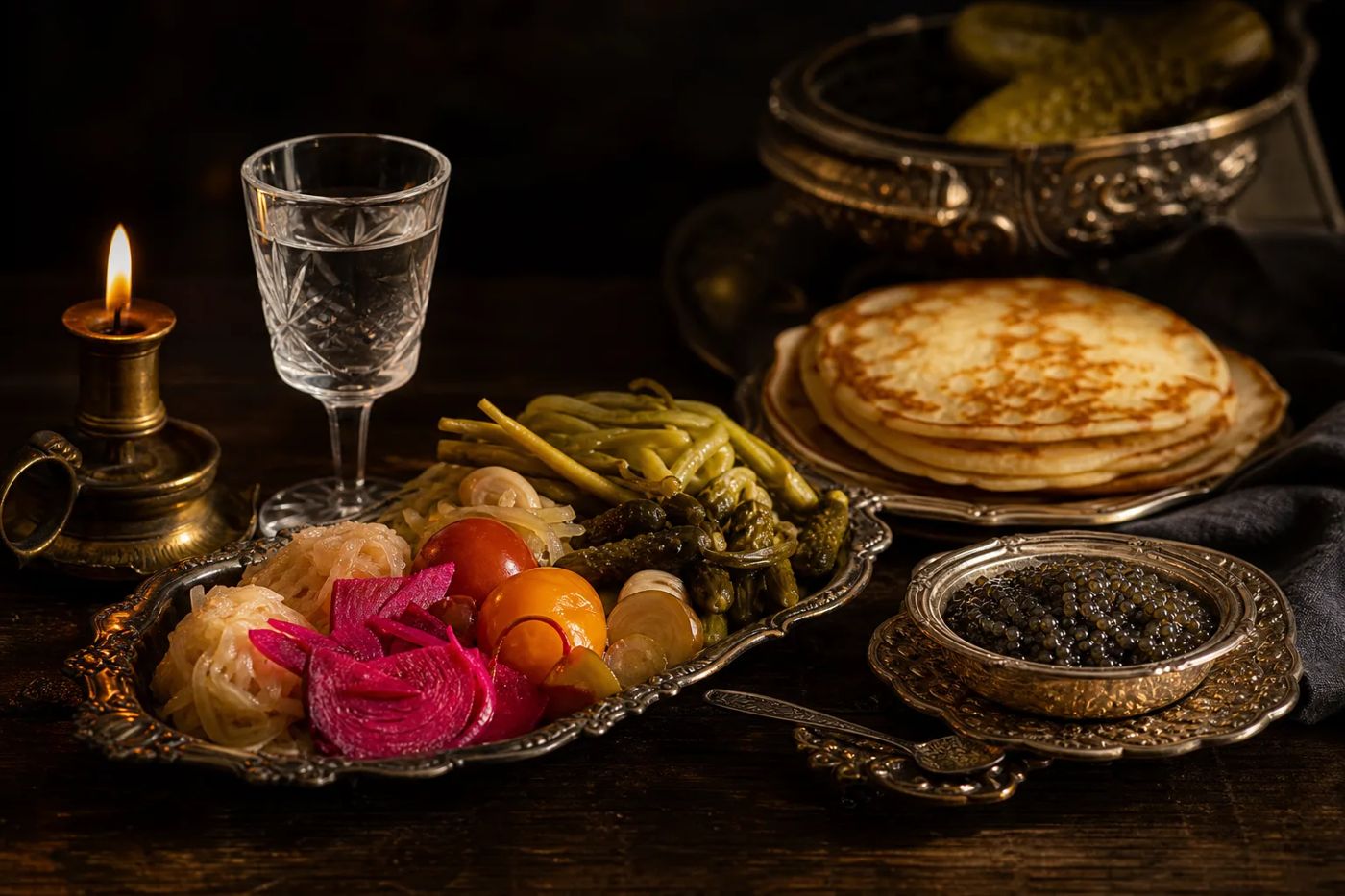
Before dinner, in a separate room, guests in well-off Russian households ate zakuski, often standing up. Historian Catriona Kelly describes this nineteenth-century custom in her study of St Petersburg and Leningrad food culture, drawing on chef Petit's 1860 account. Caviar appears among the small dishes served in this setting.
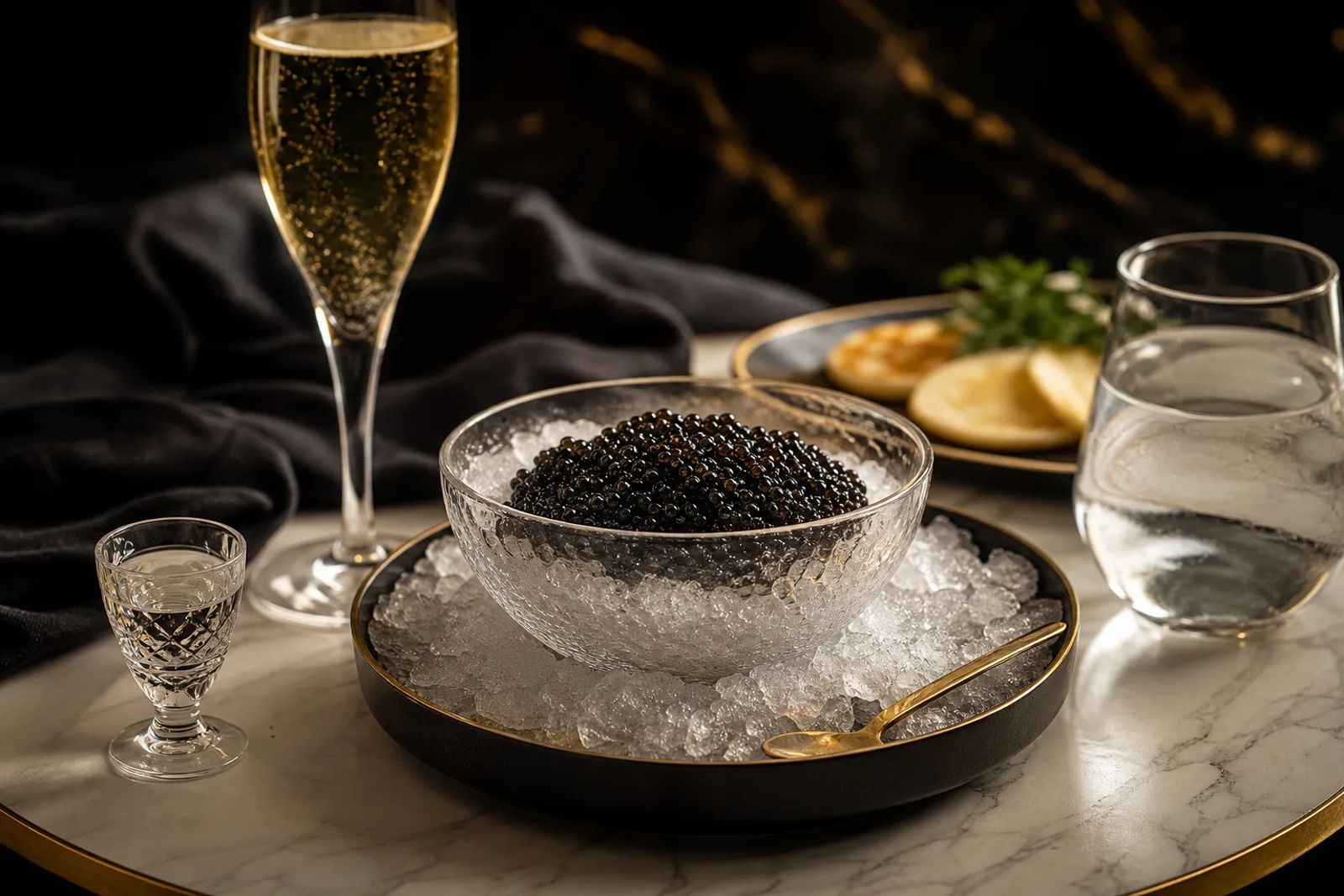
Does that mean caviar must be served with vodka? No. Vodka is a Russian tradition; champagne has a well-established place in French caviar service. White wine, sake and drinks without alcohol belong at the table too. The useful question is which accompaniment you enjoy.
Where the vodka tradition comes from
Caviar and vodka make sense as part of a spread. In Russian food culture, zakuski are appetisers or snacks eaten with drinks, commonly vodka. Caviar takes its place alongside pickled vegetables, fish and other small dishes, rather than demanding a drink of its own.
The Oxford Companion to Spirits & Cocktails likewise places caviar within the zakuski custom. The tradition is about the table as a whole, not one permissible drink for one food. Explore that setting in Russian caviar traditions.
Why cold vodka appeals to some tasters
Cold and relative neutrality are the commonly cited appeal. Chef Shaun Hergatt, interviewed by Tasting Table, recommends keeping both the vodka and its glasses in the freezer when serving caviar. The aim is to leave the roe prominent, without adding wine's fruit, acidity or bubbles.
“Cleansing the palate” is the familiar description, but it describes a tasting impression rather than an established resetting of the mouth. In a 2015 sensory study, Seo and colleagues asked nine trained panellists to rate the burning sensation left by several alcoholic drinks, then compared ways of reducing it. The study did not test caviar with vodka; its relevance is that alcohol can itself leave a sensation to clear.
Try the pairing for its contrast. If the spirit's warmth becomes the main thing you notice, choose another drink. The detailed caviar and vodka guide takes a closer look at the pairing.
Champagne has its own history
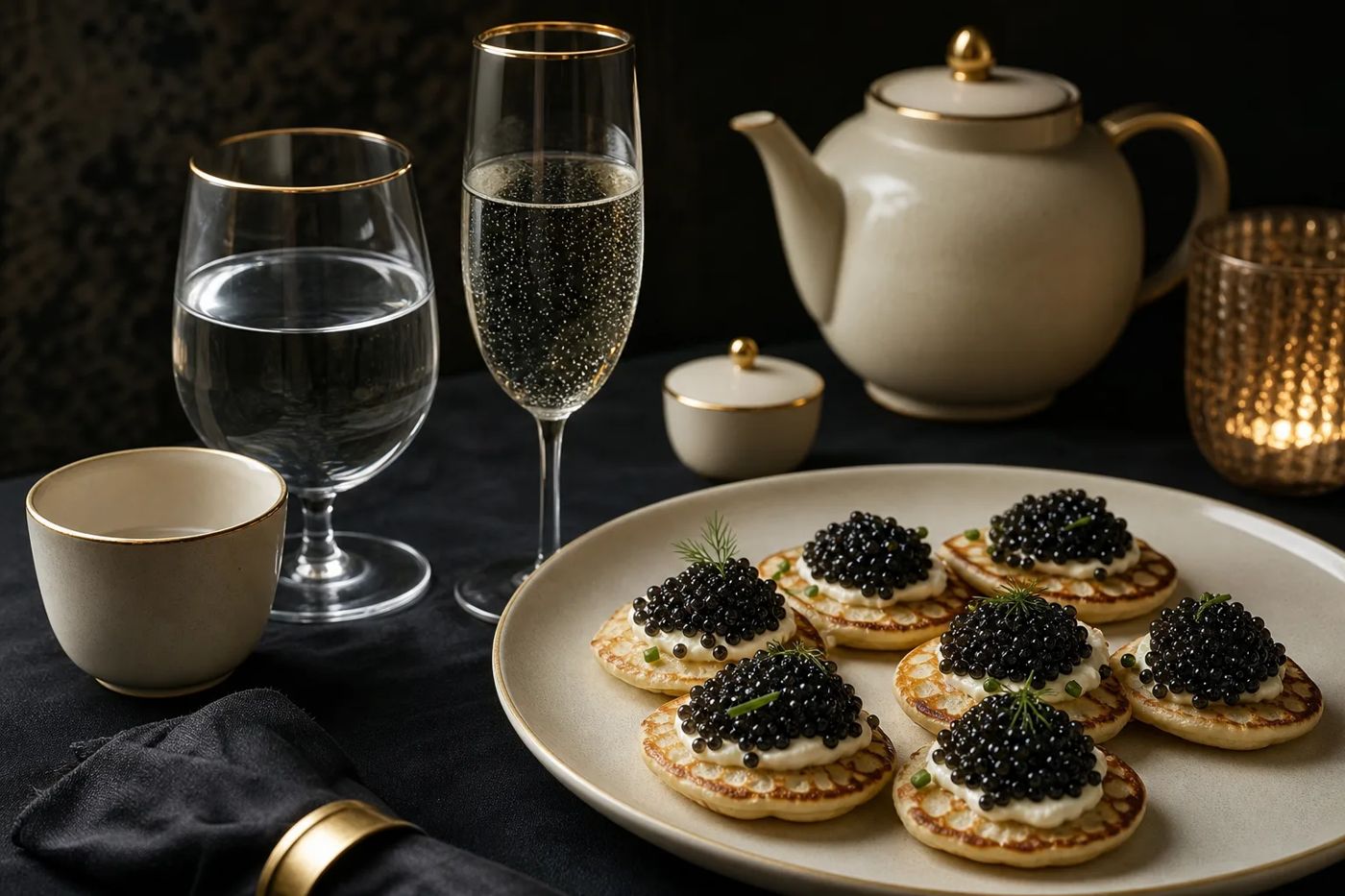
Champagne with caviar has a documented history of its own. A Paris restaurant lunch menu dated 19 March 1928, preserved by the Culinary Institute of America, lists fresh caviar and a drink called champagne cup. They appear on the same menu, though it does not record what diners drank with the roe.
The pairing is explicit in the Comité Champagne's guide, which recommends dry vintage champagne made from white grapes with plain caviar. Beyond France, a reception menu for a dinner at the California Institute of Technology on 28 October 2016 pairs oysters and caviar with dry champagnes. These examples document the association without establishing its first appearance.
The pleasure is different from vodka's. Champagne brings acidity and effervescence into the mouthful, rather than aiming for neutrality. The caviar and champagne guide explores the styles to choose, with French dining tradition as an invitation rather than an obligation.
What sensory research reveals
The order of a sip and a bite can change what you taste. A 2026 study by Wendin and colleagues examined two Swedish white wines, one still and one sparkling, with two caviars. A trained analytical panel assessed sixteen combinations using quantitative descriptive analysis, a method that measures the intensity of sensory attributes.
When caviar came first, assessors recorded stronger fruitiness, sourness, tingliness and mouth dryness. Starting with wine accentuated earthy and salty attributes. The same elements could produce different perceptions simply through the sequence of eating and drinking.
When caviar came first, assessors recorded stronger fruitiness, sourness, tingliness and mouth dryness.
This was an analytical assessment, not a consumer vote for the most enjoyable drink, and vodka was not tested. The practical lesson is straightforward: a pairing is an interaction. Try changing the sequence and notice what comes forward.
Other drinks deserve a place
Dry white wine is an established caviar companion. Boulud recommends it with caviar during a meal, and Williams Sonoma names Chablis as an example. There is no etiquette failure in preferring a glass of white to a measure of vodka.
Sake offers another approach. Sommelier Aldo Sohm has argued for its clean flavour, lower acidity and range of textures: qualities worth considering on their own terms, rather than confining caviar to European drinks.
Without alcohol, start simply. Offer plain still water, or sparkling water for those who enjoy bubbles, and let guests choose. For tea and other possibilities, explore non-alcoholic pairings. A satisfying accompaniment need not imitate vodka's strength or champagne's flavour for the occasion to feel complete.
How to serve vodka with caviar
Serve vodka well chilled in a small plain glass. Pour a small measure, sip it and leave room to notice the caviar. Offer water alongside. There is no need to empty a glass between bites.
Good hosting makes the choice easy: keep alcohol optional, avoid automatic refills and never pressure anyone to drink.
For the social side of serving, see caviar etiquette. For other customs that can sound more binding than they are, caviar myths and facts separates inherited habits from genuine requirements.
Sources
-
Kunstkamera, Forum for Anthropology and Culture. Catriona Kelly, Leningrad Cuisine / La cuisine leningradaise: A Contradiction in Terms?, English edition, no. 9, 2013, particularly p. 254. Research paper.
-
Oxford University Press. The Oxford Companion to Spirits & Cocktails, edited by David Wondrich and Noah Rothbaum, 2021, entry “Russia and Eastern Europe”, online reproduction. Reference entry.
-
Tasting Table. How To Serve Caviar Like You Know What You're Doing, online edition, 2025, interview with chef Shaun Hergatt. Article.
-
Institute of Brewing & Distilling. Seo and colleagues, Effectiveness of palate cleansers on various alcoholic beverages, Journal of the Institute of Brewing, first published 7 September 2015. Research paper.
-
Culinary Institute of America, CIA Menu Collection. Ciro, dejeuner menu, original lunch menu, Paris, 19 March 1928, page 2 and catalogue record. Digitised menu.
-
Comité Champagne. Champagne from cellar to table, undated English digital edition, food-pairing table. Guide.
-
The Athenaeum, California Institute of Technology. Escoffier Dinner 2016, original reception and dinner menu, 28 October 2016. Menu.
-
Kristianstad University research repository. Wendin and colleagues, White wine, sparkling white wine and black caviar: The sensory experience of pairing of flavours, International Journal of Gastronomy and Food Science, volume 45, article 101636, 2026. Research record and abstract.
-
Williams Sonoma. What to Drink with Caviar, undated online edition, including Daniel Boulud's white-wine recommendation. Serving guidance.
-
Wine Enthusiast. Beyond Bubbles: What to Drink with Caviar, 12 December 2019, including Aldo Sohm's sake recommendation. Article.
Last checked: November 2026