

A small serving of caviar can contain less carbohydrate than the bread beneath it. The generic TabNut entry for black and red granular caviar puts a 15 g portion at about 40 kcal, 3.7 g protein, 0.6 g carbohydrate and 2.7 g fat. The roe is only part of the picture: bread, blinis and potatoes can change the nutritional balance of the plate.
Caviar calories and macronutrients
Start with the portion you will eat. The 100 g figures make comparisons easy, but the smaller serving column brings the numbers back to the plate.
The table draws on USDA Standard Reference Release 25 (2012), reproduced by Brazil's TabNut database from the Federal University of São Paulo, entry 15012. That entry combines black and red granular caviar and may include roe from fish other than sturgeon, so these are generic reference figures rather than a specification for every tin.
Here, 15 g, about half an ounce, is caviar.uk's standard comparison serving. It is neither a regulatory serving size nor a recommended intake.
| Nutrient | Per 100 g | Per 15 g |
|---|---|---|
| Energy, kcal | 264 | 39.6 |
| Energy, kJ | 1,105 | 166 |
| Protein | 24.6 g | 3.69 g |
| Fat | 17.9 g | 2.69 g |
| Carbohydrate, by difference | 4.00 g | 0.60 g |
Source: USDA Standard Reference Release 25 (2012), black and red granular caviar, via TabNut, Brazil. Serving values multiply the source figures by 0.15. Energy in kJ is converted from kcal using 4.184 kJ per kcal, then rounded.
For a particular caviar, use the tin's own nutrition declaration. Multiply its per 100 g figure by the weight you eat, then divide by 100. The same calculation works for energy, protein, fat, carbohydrate and salt. Weigh the portion: spoonfuls are not a reliable measure of equal amounts.
For the wider nutrient profile, see caviar nutrition and caviar nutrition facts. When comparing either guide with a label, keep portion figures and per 100 g figures separate.

What the blini brings to the plate
The base can contribute more carbohydrate than the caviar. Roe is fish eggs, made up mostly of water, protein and fat rather than the starch found in bread or potatoes. Blinis, toast and potatoes all add carbohydrate, however savoury the topping.
USDA's United States carbohydrate tables document carbohydrate in bread, pancakes and potatoes. In practice, these accompaniments can supply more carbohydrate than a small caviar topping, and more energy too, depending on their quantities and preparation. “Caviar on toast” has no single calorie count: the amount of toast and what goes on it matter.
Count the base, the caviar and any spread separately, then add them together. Butter and cream contribute energy as well. Counting a canapé's carbohydrate alone therefore misses part of its macronutrient content. For serving choices, see the guides to blinis and potatoes with caviar.
What a serving means on the label
A serving size on a label is a reference for reading the numbers, not an instruction about how much to eat.
In the EU, Regulation (EU) No 1169/2011, Articles 32 and 33, makes per 100 g the basis of the standard nutrition declaration for solid foods. A manufacturer may add information per portion, provided the portion is quantified and the number of portions is stated. The regulation does not prescribe a universal 15 g caviar portion.
Great Britain follows the corresponding requirements in its assimilated version of that regulation. Use per 100 g information to compare products, and check the stated size of any additional portion declaration. Northern Ireland follows the applicable EU nutrition labelling framework, as explained in the Food Standards Agency's Northern Ireland guidance.
In the United States, FDA rules use reference amounts customarily consumed, or RACCs, to determine label serving sizes. The caviar entry in 21 CFR 101.12, Table 2, specifies 15 g. This matches the site's comparison serving, but serves a different purpose: the American figure is a labelling reference; the site's is an editorial convention.
Check both the declared gram weight and the number of servings in the container. This is especially useful when comparing American labels with European or British declarations based on 100 g.
Caviar on keto and low-carb diets
Caviar can fit a low-carbohydrate eating pattern when the portion and accompaniments suit the person's plan. Its composition supports that conclusion; it does not establish that caviar causes ketosis or that a whole meal is suitable for a ketogenic diet.
Caviar on toast” has no single calorie count: the amount of toast and what goes on it matter.
Ketogenic diets are very low in carbohydrate and high in fat, with protein also planned. The UK's NHS Specialist Pharmacy Service describes medical ketogenic diets as individual prescriptions from a specialist team, including a dietitian. Requirements vary, so a carbohydrate figure alone cannot determine whether a food fits a prescription.
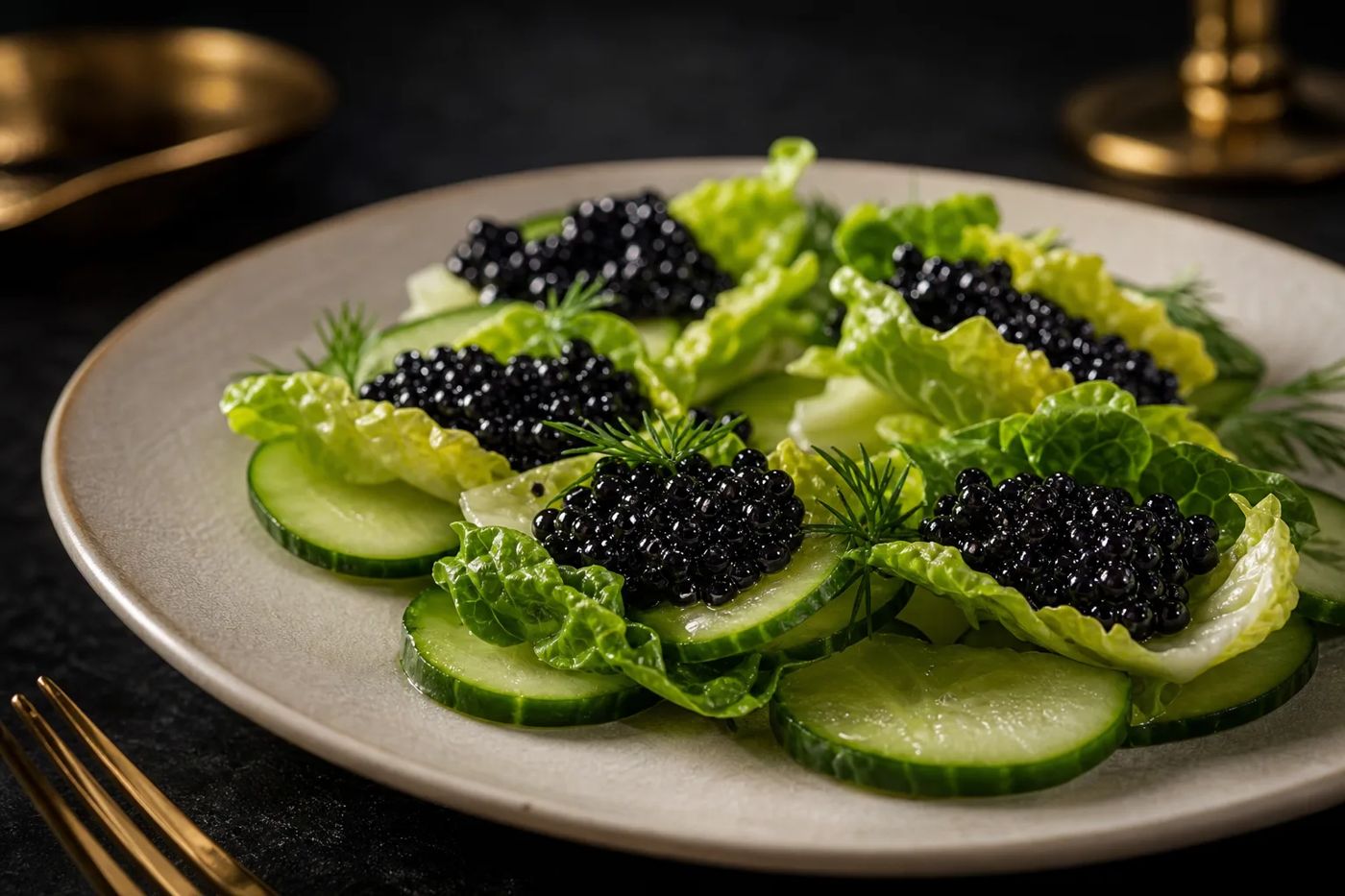
For a lower-carbohydrate serving, replace bread or potato with cucumber slices or lettuce leaves. Australia's government-funded Healthdirect lists cucumber and lettuce among low-carbohydrate vegetables in its keto guidance. Serving caviar without garnish keeps accompaniments out of the calculation altogether.
Low carbohydrate does not mean low salt. The same TabNut entry contains 1,500 mg sodium per 100 g, or 225 mg per 15 g. Using the standard sodium-to-salt factor of 2.5, that serving contains the equivalent of about 0.56 g salt. Check the product label for its own figures; salt in caviar explains the distinction between sodium and salt.
If the diet is for a medical reason, discuss it with your doctor or dietitian rather than choosing from this table alone. Healthdirect advises professional guidance before starting keto. For a prescribed plan, follow the clinical team's instructions for carbohydrate, protein, fat and salt across the whole day.
Sources
-
Federal University of São Paulo, Escola Paulista de Medicina, Brazil. Tabela de Composição Química dos Alimentos: Peixe, caviar, negro e vermelho, granular, entry 15012. Undated online database record, retrieved November 2026. Composition table.
-
United States Department of Agriculture, National Agricultural Library. USDA National Nutrient Database for Standard Reference Legacy: Carbohydrate, by difference. 2018 edition, abridged household-measure table. Carbohydrate table.
-
UK Department of Health. Technical guidance on nutrition labelling. March 2017 edition, including expression per 100 g and per portion, and calculation of salt from sodium. Technical guidance.
-
European Parliament and Council. Regulation (EU) No 1169/2011 on the provision of food information to consumers. 2011 text, Articles 32 and 33; relevant requirements cross-checked against official Northern Ireland guidance published in 2026. EUR-Lex text.
-
Food Standards Agency, United Kingdom. Nutrition labelling. Northern Ireland guidance, published 25 June 2026. Guidance.
-
United States Food and Drug Administration. 21 CFR 101.12: Reference amounts customarily consumed per eating occasion. Electronic text displayed as current to 2 November 2026, paragraph (a) and Table 2. Regulatory text.
-
NHS, United Kingdom. Food labels. Online guidance retrieved November 2026. Guidance.
-
NHS Specialist Pharmacy Service, United Kingdom. Assessing suitability of medicines in a ketogenic diet. Published 14 August 2024, updated 18 November 2025. Guidance.
-
Healthdirect Australia. Ketogenic diet. Online guidance, last reviewed August 2025, accessed November 2026. Guidance.
This piece was researched using an institutional food composition database, USDA composition tables, official nutrition labelling rules and public health guidance; serving values and unit conversions were calculated from the stated source data.
Last checked: November 2026