Caviar pasteurisation is a validated treatment intended to control specified microbial hazards and extend refrigerated shelf life, commonly by heating the sealed final container. It is not commercial sterilisation, and the word “pasteurised” does not establish that a jar can be stored at room temperature.
What caviar pasteurisation means
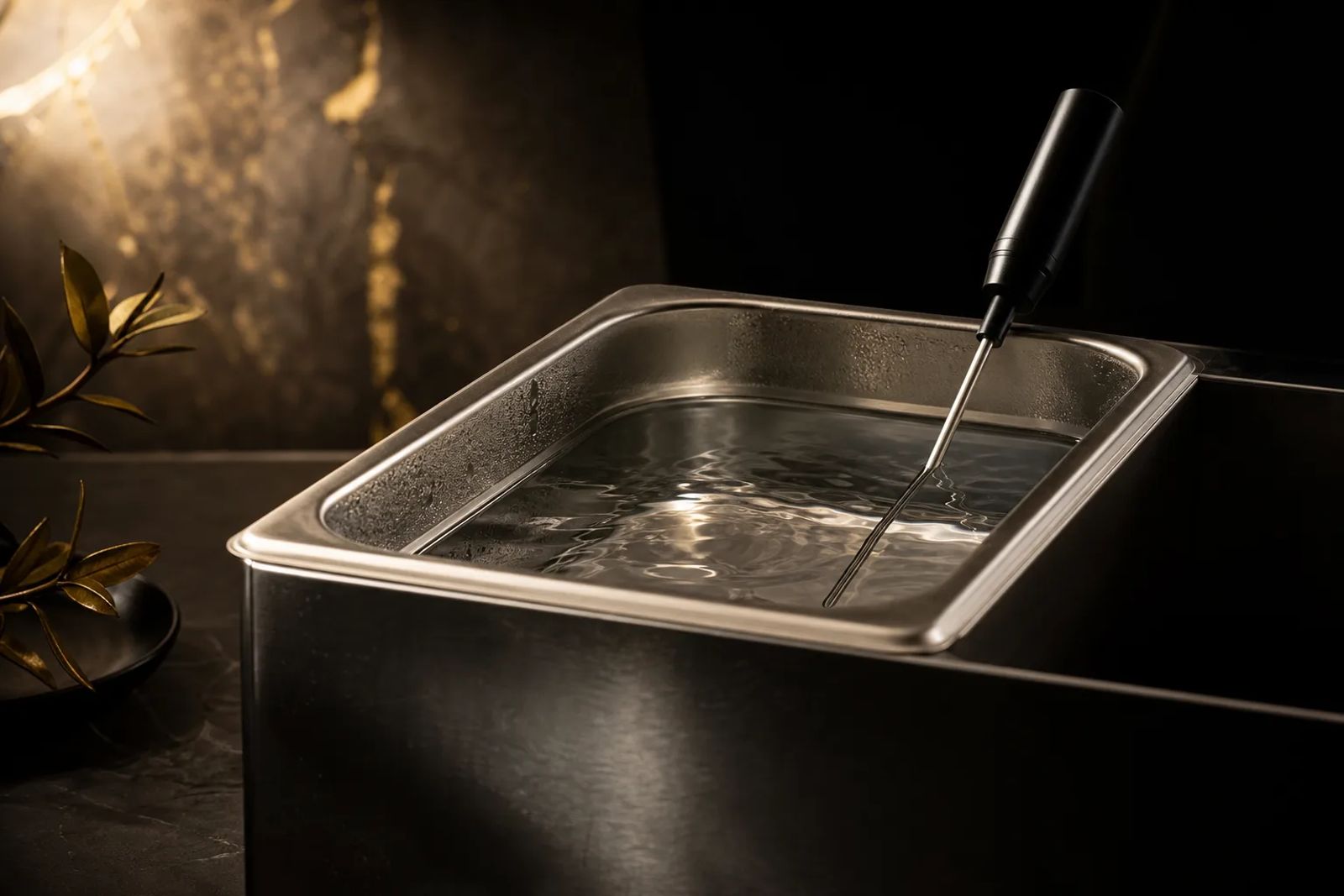
Pasteurisation must be defined by its target organism, required reduction and validated operating conditions, not simply by a bath temperature. FDA describes seafood pasteurisation as usually occurring in the hermetically sealed finished container, meaning a container designed to prevent microorganisms entering. “Usually” matters: the packaging sequence is not a universal definition.
Codex CXS 291-2010 covers salted sturgeon roe and specifies 3 to 5 g salt per 100 g of finished product. It does not prescribe a universal pasteurisation schedule. Its process definition requires conditions preventing pathogenic microorganisms from growing; Codex is an international reference standard, not automatically binding national law.
For the surrounding production sequence, see caviar processing. The consumer distinction belongs in fresh, unpasteurised and pasteurised caviar.
Validate the product, not the water bath
A processor needs evidence that the slowest-heating part of the product receives the required treatment. Container dimensions and material, fill weight, formulation, initial temperature and equipment loading can change heat penetration. Codex's 2016 fish committee processing text explicitly connects caviar pasteurisation conditions to these variables rather than offering one recipe.
Seal integrity and cooling water hygiene also matter because contamination after heating can defeat the treatment.
The same text describes treatment in cans or jars, followed by immediate cooling to 0 to 4 °C (32 to 39.2 °F). According to Codex, pasteurisation conditions depend on the container, fill weight and equipment. Seal integrity and cooling water hygiene also matter because contamination after heating can defeat the treatment.
Al-Holy and colleagues tested radio-frequency heating at 60, 63 and 65 °C (140, 145.4 and 149 °F) in sturgeon and salmon roe inoculated with three strains of Listeria innocua, a research surrogate for Listeria monocytogenes. Faster heating than a water bath and successful microbial reductions were experimental findings, not a transferable commercial schedule.
Botulism controls are separate from a Listeria kill step
Reduced-oxygen packaging can permit Clostridium botulinum growth and toxin formation unless effective barriers are maintained. A treatment validated against vegetative bacteria, such as Listeria, need not destroy bacterial spores. Extending shelf life also lengthens the period during which surviving organisms could grow.
FSA guidance for vacuum or modified atmosphere packed chilled foods identifies additional controlling factors for shelf lives exceeding 10 days at 3 to 8 °C (37.4 to 46.4 °F). These include a treatment equivalent to 90 °C (194 °F) for 10 minutes, pH no higher than 5.0 throughout the food, water activity no higher than 0.97 throughout the food, at least 3.5% salt in the aqueous phase throughout the food, or a validated combination of factors.
Those are alternative control approaches within that guidance, not instructions to apply all of them or a mild caviar heating schedule. Its scope covers England, Wales and Northern Ireland; Scottish operators should confirm the approach with Food Standards Scotland.
Water phase salt measures salt relative to the product's water and salt together: 100 × salt percentage ÷ (salt percentage + moisture percentage). It is not the nutrition label's total salt percentage. FDA's 2022 lumpfish-caviar warning letter illustrates the distinction: the agency required controls beyond a Listeria-directed pasteurisation step, including verified formulation and refrigeration controls.
What changes in texture, colour and flavour
Heat treatment changes more than microbial counts. Rocchetti and colleagues examined eight commercial caviars from six sturgeon species using sensory assessment, texture measurements and untargeted metabolomics, an analysis of many small molecules. Their study found that pasteurisation affected chemical and sensory profiles in white sturgeon caviar.
A separate Swedish study compared two live-harvested sturgeon caviars: one stabilised using warm water, the other using pH-adjusted cold water. Cold processed samples required greater force in groups of 25 grains; warm processed samples scored slimier, with no significant instrumental colour difference. Because the processing systems differed, these results do not isolate heat alone.
The professional implication is to assess the finished process, not promise a universal sensory penalty. Compare bead rupture, free liquid, colour and flavour against an appropriate untreated control, then repeat the assessment through the proposed shelf life.
Treatment and storage are different specifications
A glass jar does not identify the treatment or establish shelf stability. FDA's 2022 warning letter documents refrigerated pasteurised lumpfish caviar in glass jars.
| Treatment | What changes | Storage specification | Source |
|---|---|---|---|
| Validated thermal pasteurisation | Targeted microbial reduction; possible sensory changes | Follow the producer's validated chilled or frozen conditions | FDA, chapter 16 |
| Commercial sterilisation | Commercial sterility, not merely pasteurisation | Ambient only where the process and package establish shelf stability | FDA; 21 CFR 113 |
| High pressure processing | Experimental reduction of a Listeria surrogate | Storage conditions require separate validation | Ovissipour and colleagues |
Codex specifies 2 to 4 °C (35.6 to 39.2 °F) during packaging, storage and retail, and -4 to 0 °C (24.8 to 32 °F) for wholesale storage and transport. These are storage conditions, not serving temperatures; pasteurisation does not authorise a warmer service allowance. Product-specific shelf life and instructions after opening remain separate specifications.
Which processing rules apply
In the EU, Regulation (EC) No 852/2004 establishes hygiene and HACCP duties, including controls for heat treatment in hermetically sealed containers. Regulation (EC) No 853/2004 adds requirements for foods of animal origin, including fishery products. Neither replaces the operator's responsibility to validate the actual product and process.
Regulation (EC) No 2073/2005 governs microbiological criteria. Since 1 July 2026, its amendment by Regulation (EU) 2024/2895 extends the requirement for Listeria monocytogenes not to be detected in 25 g throughout shelf life for relevant growth-supporting ready-to-eat foods unless competent authorities accept evidence that Listeria remains within 100 colony-forming units per gram throughout shelf life.
Northern Ireland follows the applicable EU requirements; Great Britain has its own assimilated and amended legislation. The FSA identifies the July 2026 Listeria change as applying in the EU and Northern Ireland, so it should not be presented as an automatic Great Britain amendment.
In the US, 21 CFR Part 123 requires seafood hazard analysis and, where necessary, a HACCP plan. Refrigerated pasteurised caviar does not become a low-acid canned food merely because it occupies a sealed jar. Part 113 concerns thermally processed low-acid foods in hermetically sealed containers. FDA distinguishes refrigerated or frozen pasteurised seafood from shelf stable retorted products governed by Part 113.
An ambient-stable acidified formulation may instead engage Part 114: classification depends on formulation, equilibrium pH, water activity and storage conditions. Part 114 also excludes foods stored, distributed and retailed under refrigeration. A processing authority should resolve the classification before an ambient product is launched.
Labelling and additional markets
In the EU, Regulation (EU) No 1169/2011 requires treatment information alongside the food's name where omission could mislead, as well as relevant storage instructions. This is a conditional information duty, not grounds to claim a universal caviar-specific “pasteurised” wording rule. Great Britain and Northern Ireland need separate legal checks.
For US specifications, distinguish a substantiated pasteurisation claim from refrigeration labelling used as a HACCP control.
Canada's CFIA expressly distinguishes ready-to-eat pasteurised caviar from commercially sterile canned fish in its product categories. Japan classifies salted or heat-treated fishery foods as processed foods for labelling.
High pressure is documented, but remains process-specific
Ovissipour and colleagues reported a laboratory study of white sturgeon caviar inoculated with Listeria innocua. Treatment at 400 MPa in three five-minute cycles at room temperature produced a reported six-log reduction, equivalent to a millionfold reduction. This conference abstract establishes experimental work on caviar, not commercial validation, spore control or a proven shelf life.
What to request before release
Request the validated process and target organism, heat-penetration evidence, formulation limits, cooling specification, closure checks, calibrated monitoring records and shelf-life substantiation. The finished label and distribution temperature must match that evidence. A batch record showing only water-bath temperature is not a complete product safety case.
Where to go next
- Caviar Microbiology: for the organisms and their behaviour.
- Caviar Food Safety: Listeria, Botulism and Who Should Take Care: for risks to consumers.
- How Long Does Caviar Last? Unopened vs Opened: for interpreting storage life after opening.
Sources
-
FAO and WHO, Codex Alimentarius Commission. Standard for Sturgeon Caviar, CXS 291-2010, The Codex register lists its last modification as 2026. Standard PDF.
-
FAO and WHO, Codex Committee on Fish and Fishery Products. Code of Practice for Fish and Fishery Products, CXC 52-2003, revised 2019, including guidance on sturgeon caviar processing.
-
US Food and Drug Administration. Fish and Fishery Products Hazards and Controls Guidance, fourth edition, June 2022 compilation, particularly chapters 13, 16 and 18. Guidance PDF.
-
Food Standards Agency. The safety and shelf-life of vacuum and modified atmosphere packed chilled foods regarding non-proteolytic Clostridium botulinum, December 2020 edition. Guidance collection.
-
Al-Holy, M., Ruiter, J., Lin, M., Kang, D. H. and Rasco, B. “Inactivation of Listeria innocua in nisin-treated salmon (Oncorhynchus keta) and sturgeon (Acipenser transmontanus) caviar heated by radio frequency.” Journal of Food Protection, 67(9), 1848 to 1854, 2004. PubMed record and abstract.
-
Rocchetti, G. and colleagues. “The contribution of sturgeon species and processing conditions on caviar texture, metabolomic profile and sensory traits.” Food Chemistry, 463, article 141516, 2025. Publisher record.
-
International Journal of Food Properties. “Quality characteristics of Swedish black caviar from live sturgeons (Acipenser baerii): a comparison of hot-water and pH-adjusted cold-water post-harvest processing”, 2025. Research article.
-
US Food and Drug Administration. Myllan-ORA ehf, Warning Letter 637443, 30 August 2022. Warning letter.
-
European Commission. Commission Regulation (EU) 2024/2895 amending Regulation (EC) No 2073/2005 as regards Listeria monocytogenes, 20 November 2024, applicable from 1 July 2026. Official legal record.
-
US Electronic Code of Federal Regulations. Title 21, Part 113, thermally processed low-acid foods, Part 114, acidified foods, and Part 123, fish and fishery products, editions current in November 2026.
-
Food Standards Agency. Managing food safety, updated 21 August 2026, including changes to Listeria criteria. Official guidance.
-
Canadian Food Inspection Agency. Food Safety Supplemental Information: Glossary of terms, updated 30 March 2026, including categories for heat-processed and canned fish. Official glossary.
-
Tokyo Metropolitan Government. General fresh foods: fishery products, official labelling guidance distinguishing fresh and processed fishery foods. Official guidance, Japanese.
-
Ovissipour, R., Nguyen, C. H. and Nitin, N., University of California, Davis. High pressure pasteurization of white sturgeon Acipenser transmontanus caviar, World Aquaculture Society meeting abstract. Original abstract.
Last checked: November 2026