
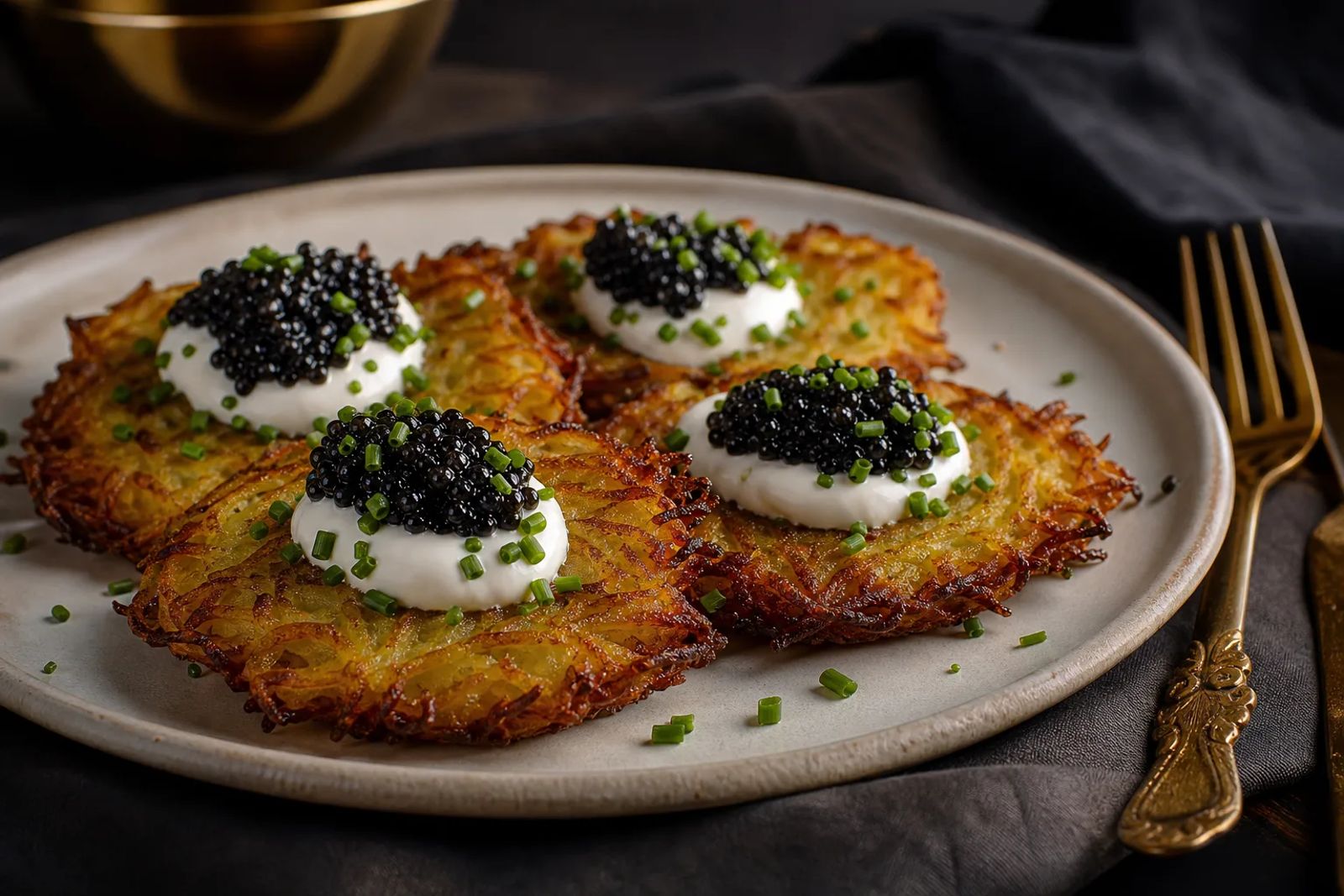
In Epicure’s potato and haddock mousseline, 40 g of purée carries 30 g of caviar. The potato is more than a pedestal: cooked with fish and enriched with butter, it becomes part of the pleasure of each spoonful. A golden latke offers a different contrast, its crisp crust beneath sour cream and cold roe. Beetroot brings colour to a third, small dish.
All three preparations follow one essential sequence: cook the potato completely, let it settle, then add chilled caviar off the heat.
Choose your texture: crisp, smooth or spoonable
Potato gives roe a quiet base; sour cream, butter or cream brings the textures together. What distinguishes these dishes is what happens beneath the caviar: onion and a crisp crust in the latkes, haddock cooked with the potato in the mousseline, and beetroot folded through the small purée starter.
Choose latkes for individual crisp portions, allowing time to fry in batches. Choose mousseline for a smooth potato course cooked with haddock, which is removed before serving. Choose beetroot purée when the menu calls for a small, coloured opening dish.
For simpler accompaniments, see potatoes as carriers. This page belongs to caviar recipes; potato batter pancakes have their own discussion in blinis. The cards retain the source recipes’ stated yields and cooking directions, with metric conversions and changes identified. These are home adaptations, untested by this site.
Potato gives roe a quiet base; sour cream, butter or cream brings the textures together.
Where a source says only caviar, the cards use salted, unpasteurised Siberian sturgeon caviar, Acipenser baerii. That is an ingredient choice for these adaptations, rather than the original author’s identification or a promise of a particular flavour. Use the caviar selected for your meal: neither a trade grade nor a large bead is required.
Crisp latkes with sour cream and caviar
A golden crust, onion threaded through grated potato, then sour cream and caviar: the essentials of food writer Stephanie Ganz’s recipe in Richmond magazine. This is its metric adaptation, using russet potatoes bound with egg and flour.
Serves: 4. Time: 4 to 5 minutes’ frying on each side; total preparation time is not stated.
Caviar per person: 14.2 g, calculated from 56.7 g (2 oz) divided by four.
Equipment: grater, clean tea towel, bowl, frying pan, fish slice.
Ingredients
- 907 g russet potatoes
- Half a small yellow onion
- 1 egg
- 22.5 g plain flour
- Vegetable oil for frying
- 114 g sour cream
- 56.7 g salted, unpasteurised Siberian sturgeon caviar
- Chopped chives, quantity not specified
Method
- Peel and grate the potatoes and onion. Squeeze the potato thoroughly in the towel, then gently combine with onion, egg and flour.
- Use 25 mm of oil, no more than one third of a deep pan. Turn off the heat if it smokes.
- Shape and fry the latkes until golden, turning once. Drain in one layer.
- Let the latkes settle, then add sour cream, caviar and chives off the heat.
Allergens: fish, egg, milk and wheat.
For the potato, seek a dry, fluffy cooked texture rather than a particular skin colour. The US recipe calls for russets, a potato type encompassing several cultivars. In Britain, floury Maris Piper or King Edward can stand in if russets are unavailable, though they are different cultivars.
The decisive preparation is squeezing out liquid. A perfectly regular shape matters less. The Jewish Food Society’s recipe shared by Adam Zolot likewise emphasises squeezing grated potato thoroughly in a clean cloth. Let the mixture’s texture guide you rather than automatically adding more flour. These are potato pancakes, not a flour batter.
Latkes also carry a tradition beyond the plate. A Reform Judaism recipe, demonstrated on video by Tina, describes them as a Hanukkah food whose frying oil recalls the festival’s oil tradition. Tina uses California long whites or Yukon Gold potatoes. Different potatoes, different household formulas: no single version defines every latke.
For a kosher table, the topping needs particular attention. Rabbi Chaim Goldberg explains for the Orthodox Union that sturgeon is not kosher. Use appropriately kosher-certified salmon or trout roe instead, and check the dairy ingredients and preparation with your guests.
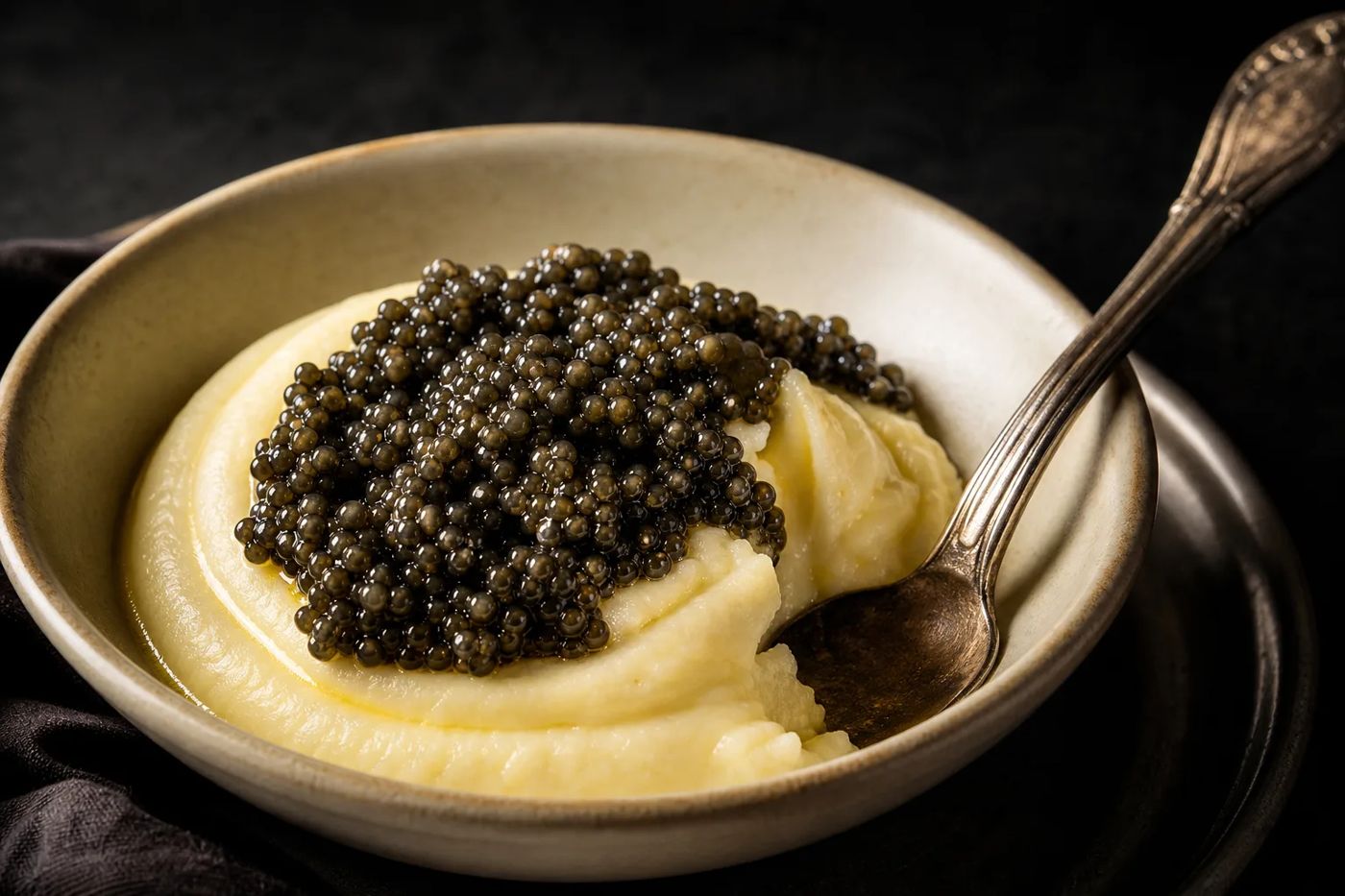
Potato and haddock mousseline with caviar
The haddock cooks with the potato, then is removed. Epicure’s recipe in Tripadvisor’s 2015 restaurant collection cooks it with potato before turning the potato into a mousseline, a very smooth purée enriched with butter. This adaptation leaves out the original buckwheat straws and cream garnish, while keeping its caviar allocation.
Serves: 8. Time: not stated in the source.
Caviar per person: 30 g (about 1 oz), stated in the original.
Equipment: saucepan, food mill or fine sieve, bowls.
Ingredients
- 600 g peeled Ratte potatoes
- 600 g haddock
- 300 g butter
- Water, just enough to cover
- 240 g salted, unpasteurised Siberian sturgeon caviar
Method
- Cover potatoes and haddock with water and cook until the potatoes are soft.
- Remove the haddock. Sieve the potatoes, then add butter and enough reduced cooking liquid to make a smooth purée.
- Serve 40 g of purée per person. Cool and refrigerate leftovers within two hours. Let the plated portions cool until no longer hot, then top each with 30 g of caviar off the heat.
The source plates just 40 g of purée per person and gives no total purée yield.
Allergens: fish and milk.
Ratte is a named potato variety, not shorthand for any small potato. It also appears in Joël Robuchon’s purée recipe, published by La Ratte de Paris, which puts the potatoes through a ricer or food processor. For a British alternative suited to this smooth preparation, the potato education programme Cook Your Own Potatoes lists Desirée among its mashing varieties.
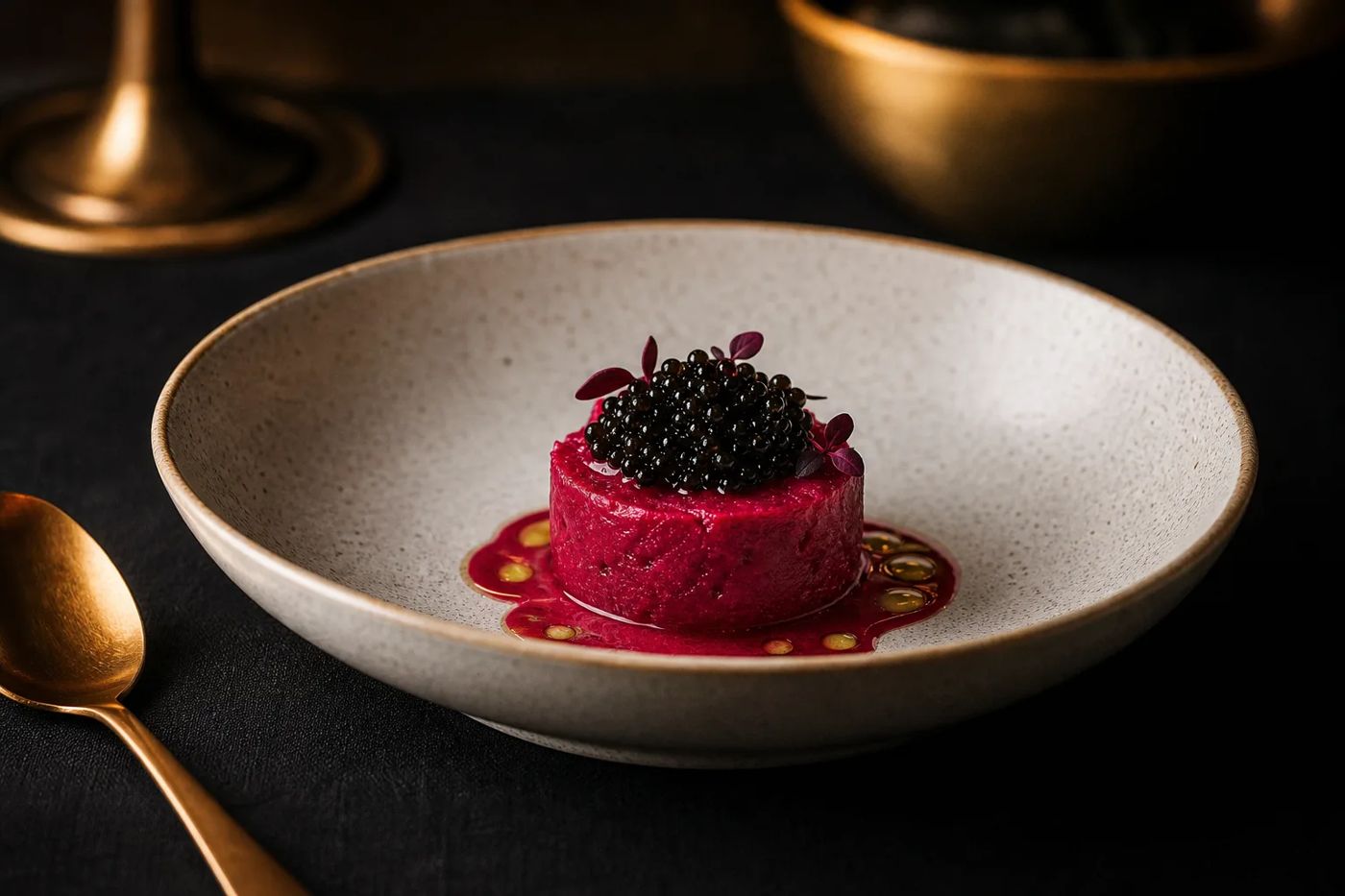
Potato and beetroot purée with caviar
Beetroot changes the purée’s colour and balance. Calvisius publishes this small spoon-served preparation with potato, beetroot, cream and butter. Keep the original proportions: this is a distinct dish, rather than a plain French purée with an incidental garnish.
Serves: 4, as a small starter. Time: the potatoes boil for about 10 minutes.
Caviar per person: 12.5 g, calculated from 50 g divided by four.
Equipment: saucepan, potato masher, serving spoons or small dishes.
Ingredients
- 200 g potatoes
- 100 g raw beetroot
- 100 ml fresh cream
- 10 g butter
- White pepper and salt, to taste
- 50 g salted, unpasteurised Siberian sturgeon caviar, replacing the source’s named product
Method
- Peel, wash and dice the potato and beetroot. Cover with water and boil for about 10 minutes, until cooked.
- Drain and mash. Incorporate warmed cream, butter and white pepper; season lightly.
- Divide between serving spoons or small dishes. Allow to settle, then distribute the caviar off the heat.
Allergens: fish and milk.
Choose potatoes that will become a blended mash, not hold their shape in intact pieces. The producer names no variety. Desirée is a reasonable British substitution from the same mashing guidance used above; elsewhere, look for potatoes labelled for mashing. A salad potato is not the right choice simply because it is small.
Finish with cold roe, not more cooking
Caviar goes on last, once the plated potato is no longer hot. Keep it refrigerated according to its producer’s instructions until assembly, add it off the heat and do not reheat the finished dish. A 2025 Swedish study found mildly heated caviar softer and slimier. None of these recipes supplies a specific cooling time or temperature.
Before the final salt adjustment, taste a little potato with its dairy accompaniment and a few eggs of roe. Season for that complete mouthful, not for the potato alone. Keep extra garnishes restrained so the potato preparation and roe remain the focus, rather than competing finishing touches. For dairy choices, see crème fraîche, smetana and butter.
Salted salmon or trout roe can replace sturgeon caviar as an editorial variation, rather than a claim that the result tastes the same. The caviar weights above come from the original recipes; they are not a general serving allowance. When offering different roes, plate them separately and let guests choose their topping.
Sources
-
Richmond magazine, Stephanie Ganz. “Edible Elegance: Latkes With Creme Fraiche and Caviar”, 22 November 2023, online recipe edition.
Read at richmondmagazine.com -
Tripadvisor, Epicure. Recipes from 2015 Travellers’ Choice Restaurants, “Sologne Caviar, Potato Mousseline & Crispy Buckwheat Straws”, 2015 collection.
Read at cdn.tripadvisor.com -
Calvisius. “Potato Puree and Beet with Caviar”. Undated producer recipe.
-
King Arthur Baking. Ingredient Weight Chart, undated web edition, retrieved November 2026. Entries for all-purpose flour and sour cream.
Read at kingarthurbaking.com -
Jewish Food Society, recipe shared by Adam Zolot. “Latkes”, 7 December 2017; page updated 24 February 2026.
Read at jewishfoodsociety.org -
Reform Judaism, Tina Wasserman. “Classic Latkes (Potato Pancakes)”, undated web edition, retrieved November 2026.
Read at reformjudaism.org -
Orthodox Union, Rabbi Chaim Goldberg. “Kosher Fish Production: Getting Into the Stream of Things”, 24 January 2022.
Read at oukosher.org -
La Ratte de Paris, recipe attributed to Joël Robuchon. La Ratte de Paris Potato Purée Recipe, undated PDF edition, retrieved November 2026.
Read at parispotato.com -
Kristianstad University Research Portal. Quality characteristics of Swedish black caviar from live sturgeons (Acipenser baerii): a comparison of hot-water and pH-adjusted cold-water post-harvest processing, published in International Journal of Food Properties, volume 28, issue 1, 2025, article 2589574.
Read at researchportal.hkr.se
The piece was researched from attributed recipes, potato education material, Jewish culinary and religious sources, and primary research, with conversions and editorial adaptations noted in each recipe card.
Last checked: November 2026