Caviar can work in desserts when its saltiness is part of the flavour rather than a decorative afterthought. Chefs have paired sturgeon caviar with white chocolate and ice cream, and used bowfin roe in panna cotta. The claim that shared aroma molecules explain their success is less settled than the dishes themselves.
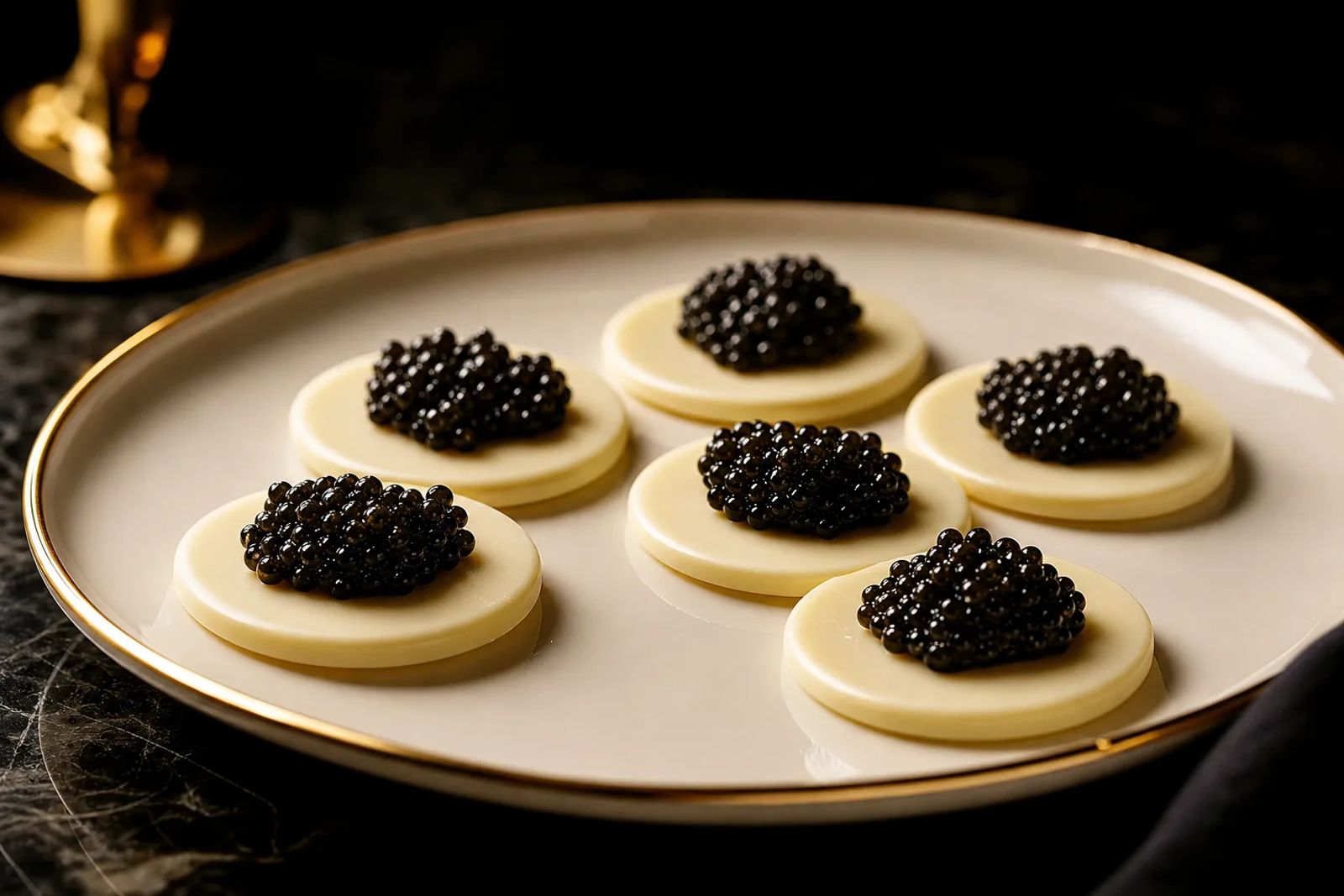
- Blumenthal's white chocolate discs use two ingredients, with no custard or ice cream to make.
- Bowfin roe also appears in a chef's dessert recipe; it is not sturgeon caviar.
- Keep the sweet component and caviar separate until serving, as the cited recipes direct.
How chefs use caviar in desserts
Heston Blumenthal's white chocolate and caviar at The Fat Duck is a documented starting point. In his May 2002 account, he credited François Benzi at Firmenich with an explanation involving amines; the combination helped popularise the broader idea that foods sharing flavour compounds might work together.
Blumenthal describes a culinary experiment followed by Benzi's suggested explanation. Amines are a chemical family, not the name of a single shared aroma, and the account does not establish which molecules, at what concentrations, made the pairing appealing.
A different approach appears in Pedro Sanchez's dessert for BraeBurn Country Club in Houston, published on 9 January 2023. His white chocolate panna cotta combines mascarpone, condensed milk and ganache with apple granita and bowfin roe. In the accompanying interview, he describes tasting different roes before choosing bowfin, rather than selecting it from a molecule chart.
Ice cream offers another format. The American Culinary Federation's September/October 2024 magazine documented Evan Hennessey's white chocolate and fennel ice cream with loganberry sweet and sour sauce and Siberian caviar at The Living Room in Dover, New Hampshire. It also recorded a seasonal caviar ice cream course at his Stages at One Washington, introduced in 2019, including a brown butter miso version with candied celery leaves.
These are dated examples, not a statement that the dishes remain on current menus. For their place in a wider restaurant repertoire, see restaurant caviar dishes.
What food pairing research actually shows
The food pairing hypothesis proposes that ingredients sharing important flavour compounds will tend to taste good together. Its attraction is obvious: chemistry could suggest combinations that habit would overlook. The difficulty is that a list of molecules does not describe their concentrations, their sensory importance or the texture and proportions of the finished dish.
Ahn and colleagues tested patterns, not diners, in their 2011 Scientific Reports study. They analysed 56,498 recipes from three online repositories, linking 381 ingredients to 1,021 recorded flavour compounds and comparing compound sharing with randomised recipe sets. North American and Western European recipes favoured shared compounds; East Asian recipes showed the opposite tendency.
That finding supports food pairing as one pattern within particular cuisines, not a universal rule of deliciousness. The researchers did not feed white chocolate and caviar to a tasting panel, and recipe frequency cannot tell us whether a particular dessert is liked because of shared aroma, familiarity or another feature.
A sensory experiment reported by Kort and colleagues in the 2010 proceedings Expression of Multidisciplinary Flavour Science reached a more sceptical result. Fifty students, blindfolded and uninformed about the ingredients, rated seven foods and their paired purées. The foods included pear, tomato, chocolate and cauliflower; a separate eight-person panel established mixing ratios so both ingredients remained recognisable.
Greater aroma overlap did not reliably produce a better combination. This was a small study of purées, not composed desserts, but it directly challenges the idea that counting shared compounds predicts liking. The useful distinction is between a tool for generating ideas and evidence that a particular recipe will succeed.
For the underlying chemistry, read caviar aroma compounds; the science of caviar flavour explains why smell alone cannot describe the whole mouthful.
Why salt, sweetness and fat can work
Salt can change the balance of a sweet food, but saying it always increases sweetness goes too far. The US Institute of Medicine's 2010 review describes experiments in which sodium acetate reduced bitterness in sugar and urea mixtures, allowing sweetness to become more apparent. Without the bitter component, sweetness did not increase.
That mechanism is not proof of what happens in white chocolate and caviar. It does explain why the familiar cooking instruction to add salt needs context: the result depends on the food and the amount. Caviar brings its own flavour and texture as well as salt, so it is not simply a substitute for a pinch of seasoning.
For the fat-rich component, Sanchez offers a cook's explanation rather than a laboratory result. He attributes his dessert's effect to sweet, sour and salty elements carried by the silky white chocolate. Cream, ganache and ice cream also give chefs a soft background against which individual beads remain a distinct part of the bite.
Which caviar, and how much?
Follow the named recipe before choosing a species by reputation. Blumenthal specifies sevruga, the roe of Acipenser stellatus, for his chocolate discs; Hennessey's documented ice cream uses Siberian caviar, from Acipenser baerii. These are individual chefs' recipe choices, not universal recommendations for sweet dishes.
Sanchez's choice is instructive because it followed tasting with the actual dessert. Bowfin is a different fish, so his recipe should be described as a roe dessert, not evidence about sturgeon caviar's chemistry. His published plating instruction calls for half a teaspoon of bowfin roe, a volume that should not be converted into an invented gram weight.
The quantities here are recipe-specific, not a general dessert allowance. Keep the roe separate while making the sweet base, then add it at service: that is the sequence in both Blumenthal's discs and Sanchez's panna cotta.
Recipe: white chocolate discs with sevruga caviar
This is Blumenthal's two-ingredient recipe, paraphrased from the version reproduced by Reporter Gourmet in May 2024. Blumenthal gives four servings. Allow the chocolate to set fully.
- Serves: 4.
- Caviar per person: 7.5 g, calculated from 30 g divided between four.
- Time: Allow the chocolate to set fully.
- Equipment: microwave-safe bowl or bowl and saucepan for a water bath, spatula, baking parchment, flat tray, knife or cutter, serving spoon.
- Allergens: fish and milk; check the chocolate for any additional declared allergens.
Ingredients
- 125 g white chocolate.
- 30 g salted sevruga caviar (Acipenser stellatus).
Method
- Melt the chocolate gently in short microwave bursts, stirring between them, or in a bowl over simmering water.
- Spread it thinly over baking parchment on a flat tray. Refrigerate until firm.
- Cut into small shapes with a knife or cutter dipped in hot water. The reproduced recipe suggests pieces about 3 cm across.
- Just before serving, top each piece with caviar. Let the chocolate melt in the mouth rather than chewing everything immediately.
The source allows the topping quantity to be adjusted to taste, so do not force a uniform number of discs from the batch. This version has not been tested by caviar.uk.
Keep the contrast clear
The documented dishes here are cold or chilled preparations, not baked puddings with roe cooked into them. Make and cool the base first, then garnish when you are ready to eat: heat can firm the eggs and change their flavour. Keep the caviar refrigerated according to its producer's instructions until needed; the dessert's serving temperature is not a new storage instruction for the roe.
It becomes novelty, in my view, when the caviar's presence matters more than what it tastes like in the mouthful.
My editorial view is that the idea works best when the roe has a clear job: seasoning the sweetness, interrupting a smooth texture or contributing a recognisable savoury finish. A thin chocolate disc is a useful first encounter because there are only two ingredients to consider. You can decide whether you enjoy their interaction without a complicated dessert concealing it.
It becomes novelty, in my view, when the caviar's presence matters more than what it tastes like in the mouthful. A garnish that could be removed without changing the dessert meaningfully has little culinary purpose. Equally, disliking the combination does not mean failing to understand the science: the research does not promise that everyone will enjoy it.
Treat these recipes as invitations to taste, not instructions to admire an unexpected ingredient. For savoury experiments that use a different starting point, see unexpected caviar pairings, or return to caviar recipes for other ways to cook and serve.
Sources
- Heston Blumenthal, The Guardian. Weird but wonderful, May 2002. Original chef column.
- Reporter Gourmet, Alessandra Meldolesi. How Heston Blumenthal Combines Caviar and Chocolate: Among the “Most Astonishing Dishes” in the World, 19 May 2024. Includes the reproduced recipe.
- Club + Resort Chef, Isabelle Gustafson. Pairing Panna Cotta With Caviar, 9 January 2023. Interview with Pedro Sanchez.
- Club + Resort Chef, recipe supplied by Pedro Sanchez. White Chocolate Panna Cotta, 9 January 2023. Published ingredients and plating instructions.
- American Culinary Federation. The National Culinary Review, September/October 2024 edition. “Premium Proteins” coverage documents Evan Hennessey's desserts.
- Ahn, Y-Y., Ahnert, S. E., Bagrow, J. P. and Barabási, A-L. Flavor network and the principles of food pairing, Scientific Reports 1, article 196, 2011. Author-hosted published paper.
- Kort, M., Nijssen, B., van Ingen-Visscher, K. and Donders, J., TNO Quality of Life. Food pairing from the perspective of the ‘Volatile Compounds in Food’ database, in Expression of Multidisciplinary Flavour Science, proceedings edition, 2010, pp. 589 to 592.
- Institute of Medicine, National Academies Press. Strategies to Reduce Sodium Intake in the United States, chapter 3: “Taste and Flavor Roles of Sodium in Foods”, 2010 edition.
- Spence and colleagues, Flavour. Pairing flavours and the temporal order of tasting, volume 6, article 4, 2017. Research review distinguishing molecular overlap from demonstrated sensory compatibility.
Last checked: November 2026