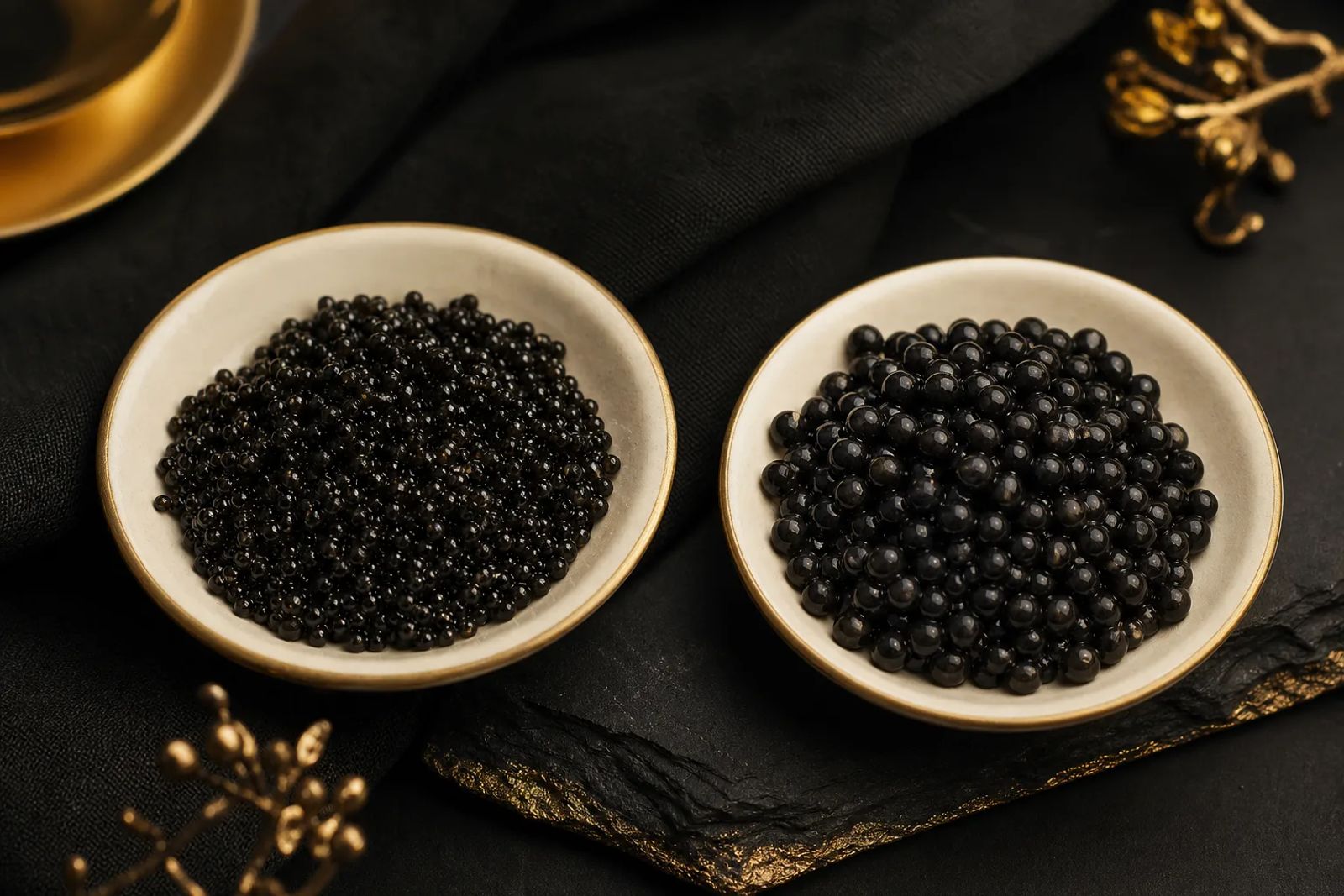
Beluga's large grains have a documented association with prestige: an FAO account of the Caspian caviar trade records large eggs in the first grade and smaller ones in the second. Size mattered to that selection system. But does a bigger egg make a better spoonful?
No. Larger beads can be beautiful and pleasing in the mouth, but quality also rests on freshness, firmness, flavour, careful handling and balanced salting. Size tells you something about the experience. It does not tell you everything worth knowing.
Why bigger eggs are not a quality grade
Uniformity within a product is different from largeness. The Codex Standard for Sturgeon Caviar describes eggs that are approximately uniform in size within the product. It does not require every species to produce large eggs. Codex is an international food reference standard, not automatically binding national law.
A naturally small egg and a naturally large one are different starting points. Comparing them is not the same exercise as comparing two batches from the same species, prepared and stored under similar conditions. The useful comparison begins with what the eggs have in common.
University of Florida guidance identifies culture conditions, egg ripeness, processing and storage as influences on quality. No impressive diameter can rescue caviar treated badly along the way. For a broader look at appearance and quality, turn to caviar myths and facts.
What determines bead size
Species gives an egg its biological starting point; the individual fish matters too. University of Florida aquaculture guidance identifies heredity, female age and size, food supply and quality, and other environmental factors as influences on egg size. Genetics and husbandry belong in the picture alongside the species name.
Yet age is no reliable ruler. A peer-reviewed study of 420 wild Persian sturgeon, sampled in Iran from 2001 to 2004, measured eggs and female characteristics, then tested their relationships using correlations. In that population, egg diameter had no statistically significant relationship with female age, length or weight.
A University of California, Davis thesis examined the farming side. Its experiment involved 92 female white sturgeon at two farms, comparing diets and husbandry conditions, measuring egg diameter and assessing texture at harvest. Farm and diet treatments did not significantly affect caviar yield, egg texture or stage of development.
Rearing conditions still matter. What these findings challenge is the tidy promise that older fish or richer feed always produces bigger eggs. Size alone cannot identify a species, either. The guide to bead size, colour and firmness puts those features together.
Does a larger bead mean a stronger pop?
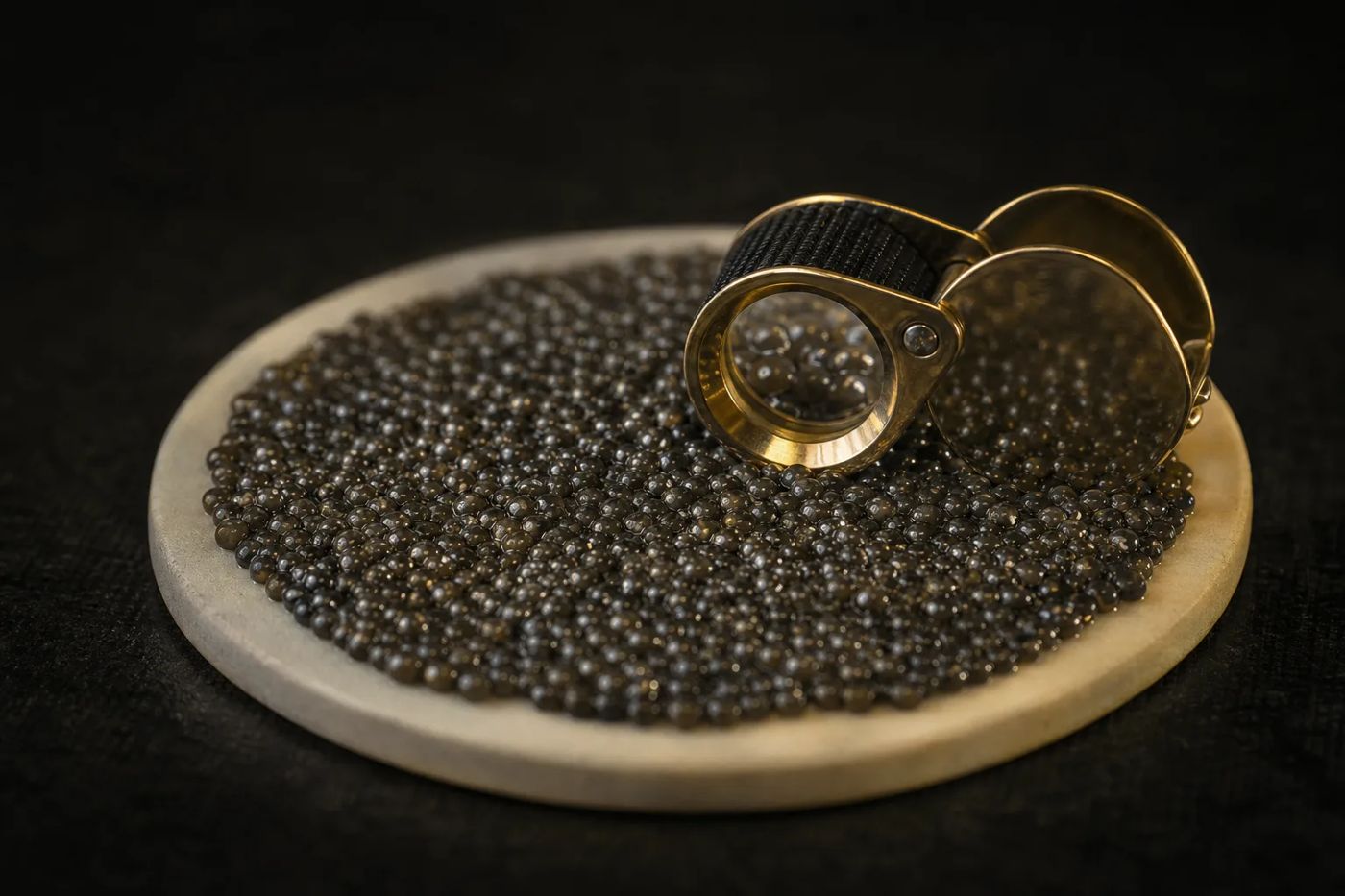
A large bead can be creamy rather than explosive. Petrossian describes its large grained beluga as sumptuously creamy; its Sevruga description emphasises a fine membrane and an immediate, silky melt. Diameter and firmness are different properties.
Choose the texture you enjoy: size alone will not tell you whether an egg will pop or melt.
Those house descriptions offer a useful sensory guide, but they do not establish that every batch behaves identically. Larger grains may feel more separate in the mouth, while smaller ones may create a finer impression. Neither sensation is inherently better. Choose the texture you enjoy: size alone will not tell you whether an egg will pop or melt.
How beluga helped build the association
Beluga's trade history shows that size had a place in an established selection system long before modern caviar photography. That gives the association between largeness and prestige a documented foundation, but it does not turn one species' grading practice into a quality rule for every caviar.
That association remains visible in Petrossian's present description, which brings together beluga's large grains and prestigious reputation. Beluga's history gives those grains a particular context, rather than a standard against which every other species should be judged. Explore the species itself in beluga caviar.
How graders use size
Size can separate selections within a species. It is one measure among several: Petrossian's tasting guide names grain size, colour, firmness, shine, texture and taste. The guide also describes each species' characteristic grains and flavours, placing diameter alongside what the caviar actually tastes and feels like.
This is a house's selection practice, not a ladder that leaves naturally small beaded species at the bottom. Ask what a grade measures before treating it as a verdict, and compare like with like.
The complete guide to caviar grading explains the terminology. The question of black versus golden caviar calls for the same distinction: a visible characteristic is not the whole measure of quality.

Small beads have their own appeal
Small eggs can deliver an intense mouthful. Sevruga, from the stellate sturgeon, makes the point neatly. Petrossian describes its small grains through intense marine notes, a fine membrane and a long finish. In Petrossian's account, the attraction is flavour and a melting texture, not an imitation of a larger egg.
Sterlet (Acipenser ruthenus) offers another route to delicacy. KC Caviar describes small, delicate eggs with creamy, buttery and gently marine or nutty flavours. Beyond sturgeon caviar, Petrossian describes trout roe as smaller, firmer beads that pop, with tangy and briny flavours. A small bead need not make a quiet impression.
When choosing, ask about texture, flavour and salting before asking for the largest grain. If you like a soft melt, say so. If firmer beads are your pleasure, start there. The best question is not which caviar looks biggest, but which eating experience you want.
Sources
-
University of Florida, IFAS Extension. Technically Speaking, What Is Sturgeon Caviar? Publication FA194, originally published June 2016, reviewed February 2025. Guidance on biological variation and the influences of culture, processing and storage on quality. Source.
-
University of Florida, IFAS Extension. Chapman, F. A. and Van Eenennaam, J. P. Sturgeon Aquaculture: Specialized Techniques: Determining the Stage of Sexual Maturity in Female Sturgeon for Artificial Spawning: The Egg Polarization Index or PI. Publication FA153, originally published 2007, reviewed August 2025. Source.
-
Imanpoor, M. R., Alavi, S. H. and Cosson, J. Relationship between biological characteristics of eggs and female brood stocks of Persian sturgeon Acipenser persicus: a comparison with other fish species. Fish Physiology and Biochemistry, volume 35, pages 701 to 707, 2009. Source.
-
University of California, Davis. Zhang, Y. Husbandry and Dietary Effects on Sturgeon (Acipenser transmontanus) Farmed for Caviar. Thesis, 2011, institutional repository edition. Source.
-
FAO and WHO, Codex Alimentarius Commission. Standard for Sturgeon Caviar, CXS 291-2010, section 2.2. According to the Codex register, last modified in 2026. Source.
-
FAO. Sturgeons (Acipenseriformes), report chapter, undated web edition, approximately 2004. Box 1 and the beluga subsection document historical trade grading. Source.
-
Petrossian. Beluga Caviar, undated current web edition. Commercial source. Source.
-
Petrossian. Sevruga Caviar, undated current web edition. Commercial source. Source.
-
Petrossian. Our expertise, undated current web edition, section on caviar classification. Source.
-
KC Caviar. Sterlet Caviar, undated current web edition. Commercial source, sensory description retrieved through the indexed page extract. Source.
-
Petrossian. Trout Roe Blini Sampler, undated current web edition. Commercial source. Source.
Last checked: November 2026