
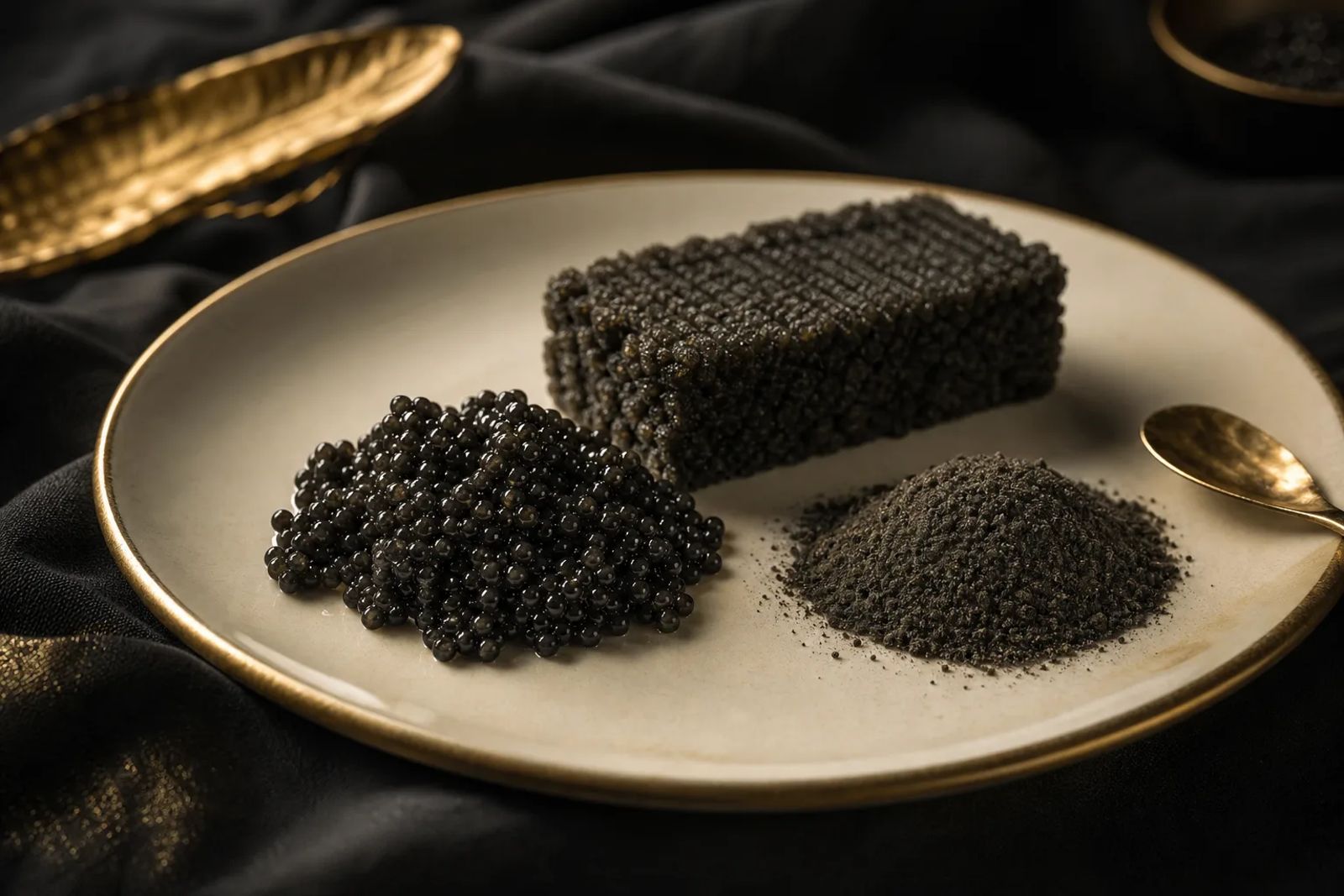
Dried caviar is salted sturgeon roe with water removed; it may remain as separate beads, become a firm piece for grating, or be ground into powder. These forms are used chiefly as seasonings and garnishes, rather than as substitutes for the moist beads served by the spoon. Their drying methods and storage requirements are not interchangeable.
What dried, grated and powdered caviar mean
The three terms describe different things. “Dried” describes processing, “grated” describes how a solid piece is broken into shavings, and “powdered” describes its final particle form. A dried product need not be powdered, and the word “powder” alone does not establish its ingredients or manufacturing method.
This is not simply another name for pressed caviar. Pressing produces a compact preparation; drying is an additional treatment, although a producer may combine the two. The distinction matters when reading descriptions of bars and nuggets: their shape does not tell you how much water remains.
Nor is it the same as mullet bottarga: both may be grated, but bottarga is typically salted and dried mullet roe prepared in its sac. For those separate traditions, see cured mullet roe; the comparison here concerns products made from sturgeon roe.
The main forms at a glance
| Form | How it is made | Typical use | Source |
|---|---|---|---|
| Dried beads | Water removed while retaining individual eggs | Sprinkled garnish | Petrossian product description. |
| Grating block | Caviar dried into a firm piece | Shavings over purées | Calvisius product description. |
| Powder | Dried caviar reduced to fine particles | Seasoning eggs or cocktail rims | American Culinary Federation. |
| Freeze-dried roe | Salted roe frozen and vacuum-dried | Ingredient or garnish | Chinese patent CN112772877A. |
These are documented examples, not four official grades. A product can occupy more than one row, so the ingredient list and the producer’s description matter more than the category name.
How drying is documented
In freeze-drying, water is frozen before ice is removed under reduced pressure. Chinese patent application CN112772877A, published in 2021, describes salting sturgeon roe, pressing and draining it, then freeze-drying and packing it; this documents a proposed process, not proof that every commercial caviar powder uses it.
A 2012 account in Der Standard described Petrossian’s dried beads as air-dried using a confidential method; the producer’s current product page does not disclose airflow, temperature or processing time.
Other manufacturers disclose the result rather than the machinery. Calvisius describes a special drying technique for its grating block without publishing the detailed process, so it should not be relabelled as freeze-dried, oven-dried or spray-dried on that evidence.
Drying is a further processing step, not a different species of caviar. The broader caviar processing guide explains where it fits; from fish to tin covers the preparation that precedes these specialist forms.
What happens to flavour, aroma and texture
The clearest documented change is texture: Petrossian describes its dried beads as crunchy, while Calvisius says its block can be grated finely or sliced into thin sheets. Neither is promising the same mouthfeel as a moist egg whose membrane gives way under pressure.
Petrossian describes an intense iodine-like character, and Calvisius calls its dried product bold; these are producer descriptions. Drying should not be taken to mean that every aroma is simply preserved unchanged.
Removing water can concentrate salt and other solids per gram, but it does not provide a universal conversion from fresh to dried caviar. Petrossian’s current dried product lists salt at 6.2 g per 100 g; use the actual label rather than assuming a powder is lightly salted.
How chefs use it
The American Culinary Federation’s National Culinary Review recorded chef Giselle Wellman using dried caviar powder as a seasoning in 2015. Her examples included sprinkling it into eggs, making a caviar-dusted martini rim and incorporating it into taco shells, shortbread and macaroons.
Calvisius suggests its grating block over potato or pumpkin purées. That illustrates the useful distinction between forms: a shaving gives a visible finish, whereas a fine powder can distribute seasoning through a mixture. Choose according to the effect you want, rather than treating every dried product as interchangeable.
Her examples included sprinkling it into eggs, making a caviar-dusted martini rim and incorporating it into taco shells, shortbread and macaroons.
For home cooking, my advice is to season the base dish cautiously, add the dried roe, then taste before adding more salt. Use it as a finishing ingredient unless following a documented recipe; the wider possibilities belong in caviar as a finishing seasoning and chef techniques with caviar.
Shelf life and storage are product-specific
Petrossian publishes a shelf life of six months at room temperature for its current dried beads and explicitly says not to refrigerate them. Calvisius states a shelf life of 120 days for its grating block. Follow the pack’s storage and opening instructions.
These storage instructions come from the producers. Follow the directions on the actual pack, including any separate instructions after opening, and request clarification if a retailer’s description conflicts with them. Do not transfer a room-temperature claim from one dried product to another.
A home-dried batch has no demonstrated shelf life merely because it feels dry or smells pleasant. This article therefore gives no domestic dehydration schedule: a manufacturer’s commercial process and packaging cannot be replaced by an improvised oven temperature and a clean jar.
Codex identity is not CITES identity
Codex CXS 291-2010 applies to granular sturgeon caviar from the family Acipenseridae and defines caviar through the salting of its eggs. Its stated scope is granular caviar, not a separate category of dried blocks or powders. That is a scope distinction, not a worldwide ban on the food name.
A whole dried bead should not be declared Codex-compliant merely because it still looks like an egg: the product must satisfy the standard’s applicable requirements. Codex is an international reference standard, not automatically binding national law, and compliance cannot be established from a product photograph.
CITES Resolution Conf. 12.7 (Rev. CoP17), Annex 1, instead defines caviar as processed unfertilised eggs of Acipenseriformes, the order including sturgeons and paddlefish. Its definition does not specify a moisture level, and its primary container can be a tin, jar or another receptacle in direct contact with the product.
Dried roe may remain subject to CITES controls, but the labelling requirements for a particular dried or powdered product require confirmation from the relevant national authority. A mixed seasoning or extensively transformed extract also needs a product specific determination.
The resolution recommends a universal non-reusable label, including for domestic trade, but national implementation supplies the enforceable rules. EU Regulation (EC) No 865/2006, Article 66(6), and US 50 CFR 23.71 provide binding caviar-labelling provisions; the US definition expressly includes receptacles other than tins.
In Great Britain, GOV.UK warns that CITES requirements can apply even to beauty products containing caviar extract. Drying is therefore not a sound reason to dispense with wildlife-trade checks; Northern Ireland’s applicable arrangements must be checked separately. A traceability label records declared origin, not a laboratory finding about the contents.
Customs codes and retail names answer different questions
Heading 1604 covers prepared or preserved fish, caviar and caviar substitutes. The UK’s published commodity tree identifies caviar as 1604 31 00; Japan’s October 2026 tariff also separates caviar from caviar substitutes. These are customs categories, not consumer naming permissions, and a composite seasoning cannot be classified confidently from the word “caviar” alone.
For a dried product, request classification against its ingredients and processing history, not just its serving form. For certainty in Great Britain, an Advance Tariff Ruling provides a legally binding classification for the specified goods.
In the US, FDA’s nonbinding CPG Sec. 540.150 says unqualified “caviar” should apply only to salted sturgeon roe. For roe from other fish, the fish name should appear in the same type size as the word caviar; added artificial colour requires prominent declaration, and ingredients should be listed.
For clarity, a description such as “dried sturgeon caviar” or “powdered sturgeon caviar” tells readers more than “caviar powder” alone. The lawful retail name depends on the formulation and the rules of the market where it is sold.
Japan’s Consumer Affairs Agency describes name, ingredients, date and storage information as part of packaged processed-food labelling. The Chinese patent describes a freeze drying process, not a retail labelling standard.
Sources
-
Petrossian. Dried caviar, Fleur de Caviar®. Undated producer specification, consulted November 2026.
-
Calvisius. Calvisius Lingotto Caviar. Undated producer specification, consulted November 2026.
-
Sarda Affumicati. Mullet Roe. Undated manufacturer description, consulted November 2026.
-
China National Intellectual Property Administration. Preparation method of freeze-dried sturgeon caviar, patent application CN112772877A, 2021. English machine translation and original patent record reproduced by Google Patents. Patent record.
-
Der Standard. Trocken-Ei, 3 March 2012. Original contemporary report describing an air-dried caviar product. Article.
-
American Culinary Federation. The National Culinary Review, May 2015. Magazine issue.
-
Codex Alimentarius Commission. Standard for Sturgeon Caviar, CXS 291-2010. The official Codex register lists the standard as last modified in 2026. Accessible standard.
-
CITES. Conservation of and trade in sturgeons and paddlefish, Resolution Conf. 12.7 (Rev. CoP17), 2016 revision, Annex 1. Resolution.
-
European Commission. Commission Regulation (EC) No 865/2006, 2006, particularly Article 66. Original instrument and amendment history retrieved through EUR-Lex. Legal record.
-
United States, Fish and Wildlife Service. 50 CFR 23.71: How can I trade internationally in sturgeon caviar? Online regulatory text reproduced by Cornell Legal Information Institute, retrieved November 2026. Regulatory text.
-
UK Government. Bringing food into Great Britain: Check if you need a CITES permit. Undated live guidance, retrieved November 2026. Government guidance.
-
HM Revenue & Customs, UK Trade Info. Caviar, commodity 160431 and its commodity hierarchy. Live classification page, retrieved November 2026. Commodity record.
-
US Food and Drug Administration. CPG Sec. 540.150: Caviar, Use of Term, Labeling, October 1989. Nonbinding compliance guidance. FDA guidance.
-
Japan Consumer Affairs Agency. Japan’s Food Labelling System, April 2024 publication. Agency publication.
-
Japan Customs. Japan’s Tariff Schedule, Chapter 16, edition dated 31 October 2026. Tariff chapter.
Last checked: November 2026