
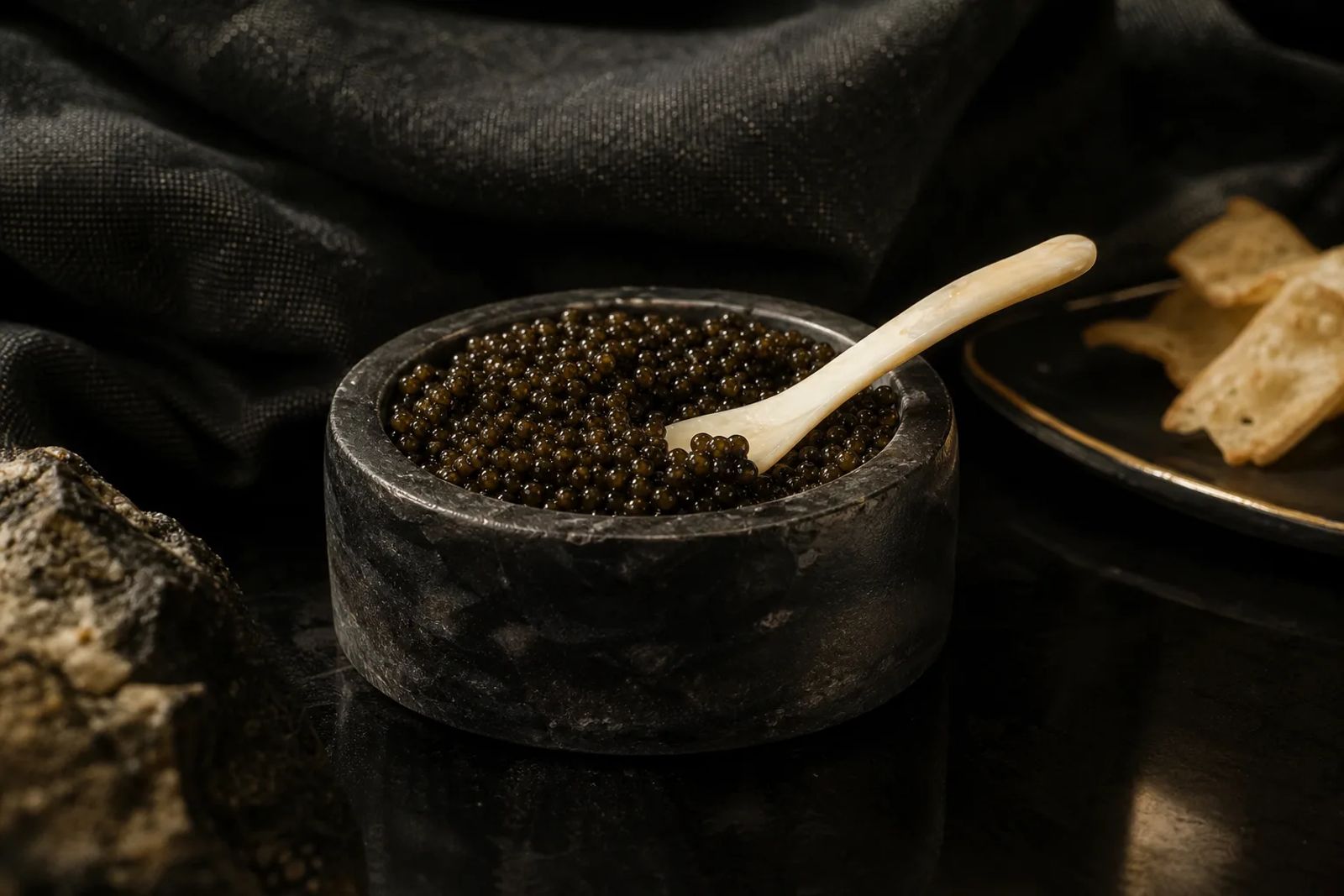
Caviar Giaveri is an Italian sturgeon farmer and caviar processor based at San Bartolomeo di Breda, in Veneto’s Treviso province. Its documented business identity is GIAVERI RODOLFO, while its own account describes a family operation that breeds fish, processes their roe and packs caviar on its Italian premises.
House facts
| Founded | 1979, according to a company history; the original business was fish farming. |
| Legal operator | GIAVERI RODOLFO, VAT 00807580261, checked November 2026. |
| Ownership | Family owned, according to SeafoodSource’s May 2025 interview. |
| Headquarters | Via Villanova 10, 31030 San Bartolomeo di Breda, Treviso, Italy. |
| Production and processing | Farming at San Bartolomeo di Breda; Ministry of Health processing listing at Via Villanova 10. |
| Role | Farmer, processor, packer and brand; the company also describes supplying other caviar businesses. |
| Roe sourcing | The company reports its own production and says it does not buy caviar from international producers for resale. According to Giaveri, its caviar comes from its own farms. |
| Species and origins | Seven named species, an albino sterlet form and two hybrid combinations in the company’s farming list; Italian production claimed. |
| CITES registration | GIAVERI RODOLFO, code E786A; the public register gives Via Villanova 7, checked November 2026. |
The useful distinction is between a producer’s brand, its legal operator and its registered processing establishment. Giaveri belongs in the farm producer category within caviar houses and producers, rather than being described simply as an Italian name on a tin; the records nevertheless need to be read separately, because they answer different questions.
The family and the business
An undated company history places the creation of the fish farm in 1979. It describes Rodolfo Giaveri developing an eel farming operation, introducing sturgeon in the early 1980s, and opening a new caviar processing plant in 2009. These dates come from the company’s own history.
Family management is more recently documented in reporting. A May 2025 SeafoodSource interview identifies Giada Giaveri as running the business with her sisters Jenny and Joys, continuing the enterprise started by their father.
Official records provide a firmer link between name and premises: the Italian Ministry of Health lists GIAVERI RODOLFO with VAT number 00807580261 and establishment identifier E786A at Via Villanova 10. The same VAT number appears on Giaveri’s website, connecting the public business identity with the consumer brand.
Where Caviar Giaveri farms and processes
San Bartolomeo di Breda is the locality to look for, not Venice itself. The company gives its headquarters as Via Villanova 10, and published accounts locate its farming activity in the same locality. This places Giaveri in the Veneto part of the wider Italian caviar story, rather than among Lombardy’s producers.
The CITES register uses a different street number, Via Villanova 7, for Giaveri Rodolfo. The CITES register lists E786A, with Yes under Exporter and the combined Processing/Repackaging heading. CITES lists number 7; Giaveri’s contact page lists number 10.
Nor should the register’s combined processing/repackaging column be read as a detailed description of each activity on site. A wildlife-trade listing, a food establishment approval and evidence of farm ownership are different records, even when the same operator might appear in more than one.
Species, hybrids and trade names
Giaveri’s farming list includes seven named species, an albino sterlet form and two hybrid combinations. It names Russian, Siberian, starry, white, Persian and sterlet sturgeon, plus beluga, an albino sterlet form and two hybrid combinations. Those last categories matter: the company’s description of “ten species” should not be repeated as ten distinct biological species.
| Company name | Scientific identity | What is documented |
|---|---|---|
| Oscietra Classic | Acipenser gueldenstaedtii | Current product specification. |
| Siberian Classic | Acipenser baerii | Company catalogue and farming list. |
| Persian Oscietra | Acipenser persicus | Named farmed species and current catalogue selection. |
| Sterlet | Acipenser ruthenus | Named farmed species and current catalogue selection. |
| Beluga | Huso huso | Named farmed species; a separate Beluga 000 selection is listed. The IUCN Sturgeon Specialist Group and World Sturgeon Conservation Society proposed the name Acipenser huso in 2025. |
| Sevruga | Acipenser stellatus | Documented in the farming description. |
| White sturgeon | Acipenser transmontanus | Documented in the farming list. |
The marketed Beluga Siberian is explicitly identified as a cross between Huso huso and Acipenser baerii. Giaveri also lists a beluga and Adriatic sturgeon cross involving Huso huso and Acipenser naccarii. The company names the parent species of both crosses without identifying which parent is female or male.
The Adriatic cross is also not evidence that Giaveri currently offers pure Adriatic sturgeon caviar; a parent species and a marketed pure-species product are different things.
Likewise, Osietra and Oscietra are trade spellings, not a substitute for the scientific name. Giaveri’s general farming page associates Oscietra with Persian sturgeon, whereas the specific Oscietra Classic page names Russian sturgeon. For that selection, the product-level declaration is the more precise reference.
How the fish and roe are handled
The company describes large outdoor tanks, water supplied from a river and geothermal wells, and computer-assisted monitoring of feeding, water temperature and fish condition. These are its descriptions of the farm system, not independently measured performance results.
Giaveri says it selects eggs by hand, salts them using the malossol method and packages the caviar itself. Malossol means lightly salted; here it describes the producer’s processing style, not a species, an independent quality grade or evidence that a tin needs no refrigeration.
Its account of the production chain is unusually explicit: it says every stage, from reproduction to caviar packaging, takes place within the business. The company also states that it does not buy caviar from other international producers for resale under its brand. That is an attributable sourcing policy, rather than an audit of every batch.
The company describes large outdoor tanks, water supplied from a river and geothermal wells, and computer-assisted monitoring of feeding, water temperature and fish condition.
The older company history also describes supplying repackers and wholesalers whose own names appear on the finished product. Producing roe for another business is not the same activity as buying finished caviar to relabel, so the two statements are not inherently contradictory.
What it is known for
The verifiable distinguishing feature is breadth: Giaveri documents farming several named sturgeon species alongside hybrids, rather than presenting one trade name without a biological identity. Its family management, Veneto location and stated control of processing are more useful reference points than unverified claims to be the largest or most varied producer.
For a sensory reference, Giaveri describes Oscietra Classic as crisp, with marine and nut-like notes, and Beluga Siberian as delicate and notably mellow. These are the producer’s descriptions, not a tasting conducted for this profile. They are best treated as an introduction to the selections, not a guarantee about every tin.
Reading origin and processing on a Giaveri tin
Giaveri’s label guide directs attention to the CITES information on the package. Depending on whether caviar has been repacked, the label identifies the year of harvest or the year of repackaging, alongside other traceability details. Read that information alongside the food label, rather than treating the prominent selection name as the complete product description.
For this house, E786A is a useful establishment reference because it appears in both the CITES entry and the Italian food establishment record. It identifies an operation, not the species or the country in which every possible product was farmed. A traceability label records declarations; it is not, by itself, analytical proof of what the container holds.
The practical check is to keep origin and handling separate. An Italian producer or repacker address tells you who performed an operation; the country-of-origin element tells you where the roe originated. If a distributor has repacked the caviar, its details should not be substituted for the original country declaration.
Producer registration must be checked separately from food labelling and import requirements. Import requirements differ across the EU, UK, US, Switzerland, UAE, China, Japan, Russia and Australia; the CITES 125 g personal effects exemption is conditional. Start with checking a producer on the CITES register.
Published reporting describes tastings at the business. For planning, see caviar farm visits in France, Italy and Spain, rather than assuming an unrestricted farm tour.
Sources
-
Italian Ministry of Health. Lista stabilimenti, dynamic establishment database, Section VIII, GIAVERI RODOLFO entry. The entry identifies VAT 00807580261, E786A and Via Villanova 10, Breda di Piave.
-
CITES Secretariat. Italy: Register of caviar exporters. Public CITES register. Public register.
-
Caviar Giaveri. Contatti. Undated live company page, retrieved November 2026. Company contact record.
-
Caviar Giaveri. Company history and information. Undated company document, distributor copy. Company history PDF.
-
SeafoodSource, Erin Spampinato. Caviar Giaveri focused on the long term, not concerned about tariffs. 14 May 2025. Reported interview.
-
Caviar Giaveri. Eco-sustainability of farmed caviar. Undated live company page, retrieved November 2026. Farming list and company claims.
-
Caviar Giaveri. Italian caviar, sturgeon-farm page. Undated live company page, retrieved November 2026. Farm and processing account.
-
Caviar Giaveri. A pleasure that comes from passion: Caviar Giaveri’s signature caviar. Undated live company page, retrieved November 2026. Production-chain account.
-
Caviar Giaveri. Oscietra Classic and Beluga Siberian. Undated company product specifications.
-
Caviar Giaveri. Caviale Osietra Heritage, company catalogue including Siberian Classic. Undated company catalogue, distributor copy.
-
Caviar Giaveri. Caviar. Undated company catalogue index.
-
Caviar Giaveri. Learning the qualities of caviar from label. Undated live company page, retrieved November 2026. Company label guide.
-
Italia a Tavola. Il caviale italiano si fa largo grazie a e-commerce e degustazioni in azienda. 29 June 2021. Reporting on producer tastings.
Last checked: November 2026