
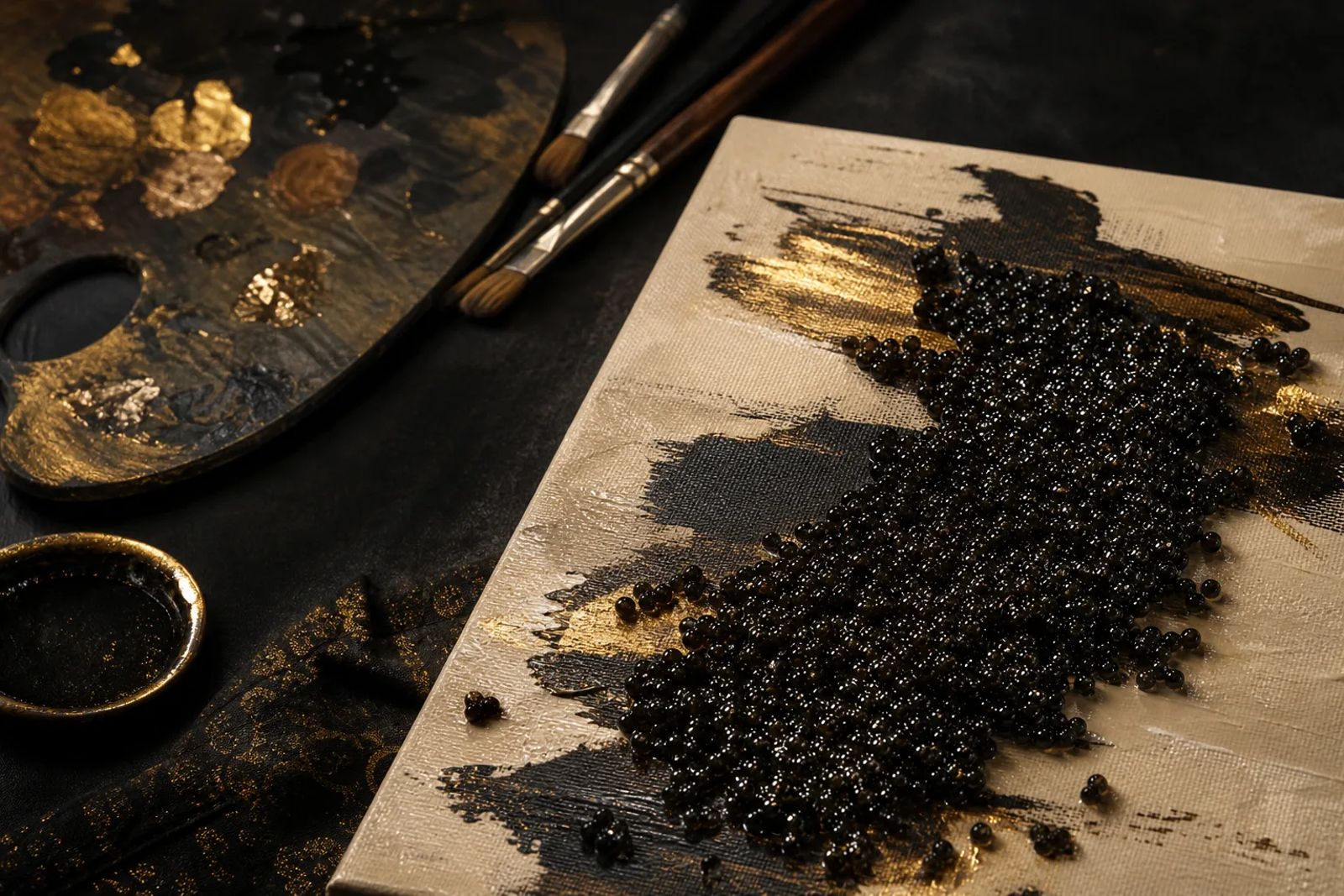
Caviar appears in visual culture as food, a marker of status and, sometimes, an artist’s material. Its tins combine practical closures with memorable colours, fish motifs and lettering, but those designs are best read as claims about identity and tradition, not evidence of the contents or their origin.
Caviar in art: from subject to material
In Georg Herold’s Schal ohne Arafat (Scarf without Arafat), 1990, caviar is not painted in a bowl: it is attached to the canvas. The Städel Museum in Frankfurt records the medium as caviar and varnish on canvas, inventory number 2182. Individual beads are numbered, turning something normally eaten into a surface that asks to be inspected rather than admired unthinkingly.
The museum interprets the brownish material and apparently illogical numbering as part of the work’s ambiguity. One useful way to read it is as a refusal of the polished advertising image: the familiar food remains, but its usual presentation disappears. That is an interpretation, not a statement about the artist’s intentions or the quality of the caviar originally used here.
One useful way to read it is as a refusal of the polished advertising image: the familiar food remains, but its usual presentation disappears.
Ed Ruscha took another route in News, Mews, Pews, Brews, Stews, & Dues, a 1970 portfolio held by Princeton University Library’s Graphic Arts Collection. Its screenprints use unconventional materials, including caviar and axle grease. Princeton’s account also identifies red salmon roe in another print, a useful reminder that an archive’s material descriptions deserve the same attention as an artwork’s title.
Sturgeon paintings need more than a familiar fish
A sturgeon in a painting should not automatically be described as evidence of caviar consumption. The Museum of Moscow’s exhibition material identifies Vladimir Kashkin’s Sturgeons and Sevrugas, dated 1930, as belonging to the Radishchev Art Museum in Saratov.
Royal Museums Greenwich provides another instructive distinction: its record for William Lionel Wyllie’s Rough sketches of a shoal of fish, an octopus, a sturgeon and an eel identifies preparatory work for Davy Jones’s Locker, completed in 1890. A study and a finished painting are different objects; neither should inherit the other’s date, medium or collection details without checking both records.
Posters, advertising and the archive
Alexandra Terentieva’s article The Silver Age of the Russian Poster describes advertising posters from 1897 to the early 1920s. Its core came from Fedor Fedorov’s collection, acquired in 1933. According to the article, the exhibition also included posters from the Parisian legacy of Mikhail Larionov and Natalya Goncharova, received in 1989.
That distinction matters especially for Soviet food advertising, where a product image can be read alongside the institutions distributing it. An advertisement presents an intended message, not a census of what people actually ate. For the institutional history behind those messages, see the Soviet state trade, keeping the poster’s visual argument separate from evidence about production, distribution and everyday consumption.
Menus are designed objects
The New York Public Library’s Buttolph collection includes a menu titled The Caviar, dated 1940, held by its Rare Book Division. The record gives its dimensions as 21 by 10 centimetres folded and 21 by 19 centimetres open. That small physical object places caviar within the history of designed reading matter, not merely within a list of foods and dishes.
A menu transcription can preserve dish names while losing typeface, spacing and paper colour. The original object or a scan is needed to discuss those design features.
Why caviar tins look familiar
A useful surviving reference is the Caviar Tin dated 1970 in GRAD’s Work and Play exhibition resource, credited to the Moscow Design Museum. The illustrated circular blue lid carries Cyrillic lettering. It provides a dated example of Soviet packaging, not a starting date for caviar tins themselves or proof that every earlier export container had the same appearance and construction.
Imperial Heritage describes filling traditional tins, pressing down the lid and securing it with a thick rubber band. This is the producer’s account of its own method.
Visually, a band makes the join between lid and body part of the package’s identity. Its presence should not be confused with an ornamental border printed around the lid, or taken as evidence of age. For the separate questions of container formats and material use, follow caviar packaging and waste rather than reading an old container as a technical specification.
Colour, lettering and national identity
GRAD’s resource describes a historical Soviet packaging convention: blue for beluga, the species CITES lists as Huso huso, yellow for osetra and red for sevruga. Osetra and sevruga are trade names, and the fish behind a particular product must be established separately. This is the exhibition’s account, not a universal key; colour alone cannot identify the roe.
Taha Fakouri’s published Tochki Caviar project, dated September 2020, uses a dot motif that the designer relates to the product’s rounded form. Fakouri’s submission to Packaging of the World identifies this as a produced project.
What design can and cannot prove
When reading a tin, separate three layers: illustration, brand language and traceability information. A sturgeon motif makes a visual association; it does not establish species. Cyrillic lettering can suggest a cultural reference without proving Russian origin, just as a deliberately traditional design cannot establish the container’s manufacturing date or the provenance of the roe packed inside that particular sealed container.
A CITES label shows traceability, not proof of what is in the tin. That distinction is separate from design history: the label’s information must be assessed as information, rather than inferred from lid colour or lettering. Use the caviar label guide for that task, and caviar tin sizes when comparing dimensions rather than judging a package from its proportions.
A short visual timeline
| Date | Object | Significance |
|---|---|---|
| 1940 | The Caviar, NYPL | A dated menu in the Buttolph collection. |
| 1970 | GRAD’s Caviar Tin; Ruscha’s portfolio | Packaging and experimental printmaking offer different uses of caviar’s identity. |
| 1990 | Herold’s Schal ohne Arafat | Caviar appears as a painting material. |
| 2020 | Fakouri’s Tochki Caviar project | A published explanation of an abstract packaging motif. |
Using museum and archive images
An online collection image is not automatically available for republication. The Städel record credits the Herold picture to VG Bild-Kunst, Bonn, while the NYPL menu record states its public domain assessment under United States law. NYPL expressly leaves the position in other countries undetermined.
Reuse depends on copyright status and applicable exceptions. For new documentary images, photographing caviar concerns technique; image reuse depends separately on applicable copyright law, any exceptions and the rights attached to the particular image.
Where to go next
- Caviar and the Arts: the parent guide to caviar’s cultural connections.
- Soviet Caviar and the State Monopoly: the institutional history behind Soviet production and export imagery.
Sources
- Städel Museum. Georg Herold: Schal ohne Arafat, 1990. Digital collection record, inventory 2182; updated 17 July 2026. Collection record.
- Princeton University Library, Graphic Arts Collection. Julie Mellby, Printed with Axle Grease over Caviar. 27 August 2016; discusses Ruscha’s 1970 portfolio. Collection article.
- Museum of Moscow. Special menu for the exhibition “Volga. Moscow. Neva”. Undated exhibition webpage identifying Kashkin’s painting, its date and holding museum. Exhibition material.
- Royal Museums Greenwich. Rough sketches of a shoal of fish, an octopus, a sturgeon and an eel. Undated online collection record, object 104643. Collection record.
- The Tretyakov Gallery Magazine. Alexandra Terentieva, The Silver Age of the Russian Poster. No. 2, 2011, pp. 36 to 47. Exhibition article.
- The New York Public Library, Rare Book Division. The Caviar. 1940; Buttolph collection of menus, shelf locator 1940-0024. Digital record includes dimensions and rights statement. Collection record.
- GRAD. Work and Play: Exhibition resource. Undated PDF, packaging section; illustrated tin dated 1970 and credited to Moscow Design Museum. Exhibition resource.
- FOUR Magazine. The World’s Finest Caviar. Online article reproducing Imperial Heritage’s account of its processing and banded tins; published 21 December 2020. Producer account.
- Taha Fakouri. Tochki Caviar. Designer’s project statement, Behance, 14 September 2020. Project record.
Last checked: November 2026