
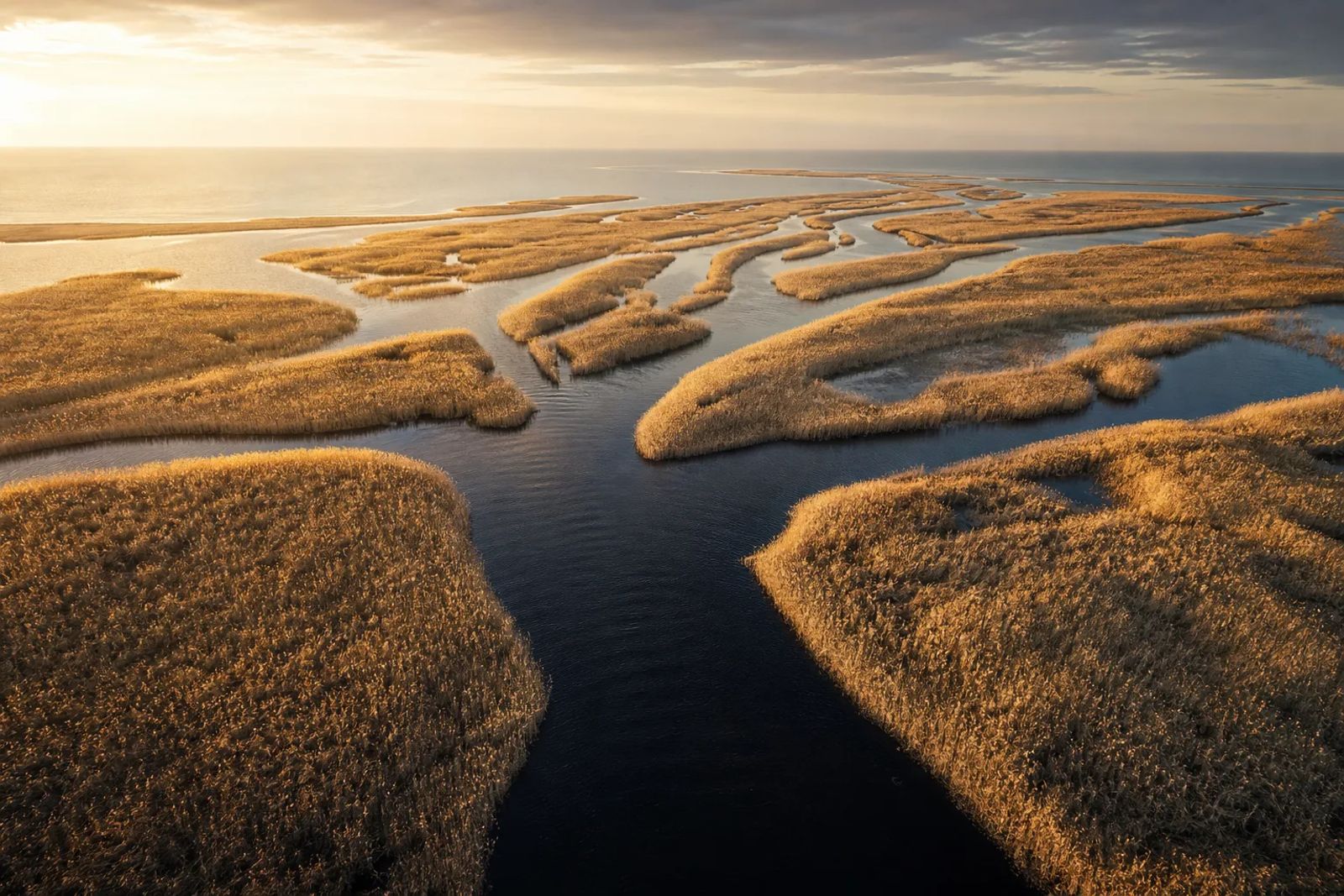
In 1972, Iron Gates I opened across the Danube, obstructing the upstream journey of sturgeon. Far below the dam, where the river opens into the Black Sea, the delta remains part of that obstructed migration route. Its channels, fishing villages and museums offer something more revealing than a tasting: a way to understand the fish behind the caviar. In Romania and Bulgaria, wild sturgeon fishing and the sale of locally wild-caught sturgeon products are prohibited.
The delta, the sea and the river beyond
The Danube Delta belongs to both Romania and Ukraine. Its three principal branches, Chilia, also called Kiliya, Sulina and Sfântu Gheorghe, divide a landscape of channels, lakes, reed beds and islands. For migrating sturgeon, these waters connect marine feeding grounds with freshwater breeding habitat. To understand the delta, look upstream as well as out to sea.
Bulgaria borders the lower Danube upstream of the delta; farther upriver, Serbia and Romania share the Iron Gates reach. After Iron Gates I opened in 1972, Iron Gates II’s main units entered service during 1984 to 1986, according to Hidroelectrica, obstructing upstream migration. The dams are not delta attractions, but their significance reaches the river mouth: protecting the delta alone cannot restore its fish. Explore habitat loss and migration barriers across the whole basin.
The delta’s protected status has several layers. UNESCO’s World Heritage property, inscribed in 1991, lies in Romania, rather than covering the entire international delta. The wider Romanian reserve became a Ramsar wetland in 1991. The Romanian and Ukrainian reserves together form a transboundary UNESCO biosphere reserve, recognised in 1998. Each designation recognises something different; none grants unrestricted visitor access.
Which sturgeon still live here?
Four of the Danube basin’s six native sturgeons are still recorded. Using CITES names, they are beluga (Huso huso), Russian sturgeon (Acipenser gueldenstaedtii), stellate sturgeon (Acipenser stellatus) and sterlet (Acipenser ruthenus). Ship sturgeon is considered functionally extinct. In the 2022 IUCN Red List update, beluga, Russian and stellate sturgeon were Critically Endangered; sterlet was Endangered. These global categories describe extinction risk, not delta fish counts, and 2022 is the update year rather than necessarily the date of each underlying assessment.
Birds overhead and apparently healthy water reveal little about how many sturgeons survive below.
Beluga, Russian and stellate sturgeon move between sea and river. Sterlet spends its entire life in freshwater. The lower Danube is therefore both a migration corridor and a home, far more than a place where fish arrive to produce roe. Danube sturgeon conservation explains the recovery work, while the beluga species guide introduces the fish behind the familiar caviar name. Birds overhead and apparently healthy water reveal little about how many sturgeons survive below.
Where to meet the delta’s story
For a close look at sturgeon, start with the aquarium rather than a boat. Tulcea’s Danube Delta Eco-Tourism Museum Centre, run by the Gavrilă Simion Eco-Museum Research Institute, has a public aquarium that includes sturgeons. Its permanent displays introduce the delta’s habitats. Check opening arrangements before travelling, and book at least four days ahead if you want a guided visit, as the institute requests.
Once on the water, make time for inhabited places as well as wildlife. In villages such as Crișan and Sfântu Gheorghe, the channels shape fishing, transport and household life. Conversations about routes used within a lifetime, changing fishing gear and life after sturgeon fishing stopped can bring those connections into focus without becoming arguments about blame. Let residents choose what to share, and seek permission before photographing people, working boats or private yards.
Fishing heritage is living knowledge, not permission to revive a prohibited catch. For the longer story of fisheries and caviar, the regional trade history supplies context. A village visit is a chance to understand that history, not to seek an illicit souvenir.
Why wild Danube caviar is off the menu
Romania introduced its first sturgeon fishing moratorium in 2006. Joint Order 85/662/2021, published on 16 April 2021, prohibits commercial, recreational and family fishing for sturgeon in Romanian natural waters for an indefinite period. Article 3 also prohibits commercialisation of products and by-products from sturgeons caught in those waters, including meat and caviar. That provision has no scheduled expiry.
Bulgaria’s first one-year ban followed in 2011. The current joint orders, RD-09-1044 of 20 November 2025 and RD-882 of 5 December 2025, took effect on 1 January 2026 without a fixed end date. They prohibit catching the four surviving species in Bulgarian Danube and Black Sea waters, as well as carrying, storing, transporting or selling those fish and their products. Farm-reared fish and products are expressly excluded from the latter prohibition.
The practical rule is simple: never buy wild caviar. Laws differ across the Danube countries. Ukraine’s fisheries authority excludes Red Book species from lawful recreational catches; Serbia’s MonStur conservation project reports permanent protection from fishing, including for sterlet. Legitimate farmed caviar belongs to a separate category, with its own traceability requirements.
Permits and better boating
Arrange the Romanian reserve’s tourist access permit through the Danube Delta Biosphere Reserve Authority, ARBDD. Its official portal lists separate permits for tourist access, boat access, vehicle access and recreational fishing. One does not automatically replace another. On an organised boat trip, establish which permits the operator holds and which you must arrange yourself. A fishing permit never overrides species protection.
Agree the route before setting out. Ask the authority or operator to confirm current access restrictions and authorised landing places; a permit does not open every reed bed and side channel. Choose an operator prepared to keep back from nesting birds, reduce speed and wake, and abandon an approach when wildlife reacts. Binoculars are a better choice than asking the skipper to edge closer for a photograph.
Watch wildlife without baiting or handling it, and never ask anyone to catch a sturgeon for display. If you witness a suspected offence, note the location from a safe distance and report it to the reserve authority. Do not confront those involved.
Conservation beyond the release photograph
Saving Danube sturgeon means working across borders and along the river. WWF-CEE describes LIFE-Boat 4 Sturgeon as a conservation project running from 2022 to 2030, with partners including WWF organisations in Romania, Bulgaria and Ukraine. Its coordinated measures aim to safeguard the remaining Danube species. For visitors, public talks and interpretation are the things to ask about: breeding facilities, tagging work and release events are not automatically open to the public. Project descriptions give the organisers’ account of the work.
At the Iron Gates, the ICPDR’s We Pass initiative addresses fish migration. It shows why conservation needs engineering and cooperation between countries, alongside releases of young fish. The distinction matters: a proposed passage solution is not the same as an operating route through the dams, while releasing fish alone does not establish that a wild population has recovered.
The Ukrainian delta and current travel advice
The Ukrainian delta shares the ecosystem, but it is not an ordinary extension to a Romanian holiday. As checked on 7 November 2026, the UK Foreign, Commonwealth and Development Office advises against all travel to Odesa region, which includes the Ukrainian delta. It also warns that travelling against its guidance can invalidate insurance. Consult your own government’s advice and local security instructions. Protected-area status offers no assurance of wartime safety.
Taking farmed caviar home
Keep lawful farmed caviar in its original labelled container, with purchase documentation, when carrying it from Romania or Bulgaria to another EU country. An internal EU border crossing is not an export from the Union, but EU wildlife trade rules still require caviar labelling.
For Great Britain, Northern Ireland, Switzerland, the UAE, China, Japan, Russia and Australia, check food rules and wildlife rules separately. For the US, check the personal effects exemption conditions, including the limit of 125 g per person for qualifying caviar, and any additional species restrictions. A label supports traceability but cannot establish what is inside the container. Bulgarian and Romanian caviar explains the distinction between origin and production.
A short timeline
| Date | What changed | Why it matters |
|---|---|---|
| 1972 and 1984 to 1986 | Iron Gates dams obstruct migration. | Upstream migration is obstructed. |
| 1991 | Romanian delta gains World Heritage and Ramsar recognition. | Two distinct protected-area designations. |
| 1998 | Transboundary biosphere reserve recognised. | Romania and Ukraine share the conservation setting. |
| 2006 and 2011 | Romanian and Bulgarian fishing bans begin, respectively. | Restrictions precede today’s indefinite measures. |
| 16 April 2021 | Romanian Order 85/662/2021 published. | Fishing prohibition has no fixed expiry. |
| 1 January 2026 | Bulgaria’s indefinite joint prohibition takes effect. | Replaces the preceding time-limited regime. |
Where to go next
- Caviar Travel: other places where caviar history meets living fisheries.
- Sturgeon Poaching: how illegal fishing affects the prospects for recovery.
Sources
- UNESCO World Heritage Centre. Danube Delta, World Heritage List entry 588, inscribed 1991; current online record. Official record.
- UNESCO. Danube Delta, biosphere reserve directory, designation year 1998; current online record. Official record.
- Ramsar Sites Information Service. Danube Delta, site 521, designated 1991; current online record. Official record.
- Journal of Applied Ichthyology. Management approaches and aquaculture of sturgeons in the Lower Danube region countries, 2011, DOI 10.1111/j.1439-0426.2011.01859.x. Research paper.
- ICPDR. Danube River Basin Management Plan: Interim Report 2024, published online 2025. Report.
- North American Sturgeon and Paddlefish Society. IUCN Assessment 2022, 1 August 2022, reproducing the global assessment results. Assessment summary.
- Institutul de Cercetări Eco-Muzeale “Gavrilă Simion” Tulcea. Centrul Muzeal Eco-Turistic Delta Dunării, current visitor and collection information, undated. Museum information.
- Romanian ministries responsible for agriculture and the environment. Order 85/662/2021 concerning measures for the recovery and conservation of sturgeon populations in natural fish habitats, published in Monitorul Oficial 403, 16 April 2021. Official legislative record.
- ICPDR. Romania bans sturgeon fishing for ten years, Danube Watch 02/2006. Contemporary account.
- ICPDR. A high price for survival: fighting the illegal caviartrade in wild sturgeon, undated online article. Historical account.
- Bulgarian ministries of environment and agriculture. Orders RD-882 of 5 December 2025 and RD-09-1044 of 20 November 2025, State Gazette 113, 23 December 2025, page 60. Official gazette text.
- State Agency of Ukraine for the Development of Land Reclamation, Fisheries and Food Programmes. Recreational fishing: what do we catch and with what?, current guidance explaining Order 700 of 19 September 2022, undated. Official guidance.
- Interreg Danube Region Programme, MonStur in the Danube. First national workshop in Serbia: discussing challenges and opportunities for sturgeon conservation, 2026. Project account.
- Danube Delta Biosphere Reserve Authority. Permise on-line ARBDD, current permit portal, undated. Official permit portal.
- WWF-CEE. LIFE-Boat 4 Sturgeon Project, current project description, undated; stated programme period 2022 to 2030. Organiser’s account.
- ICPDR. We Pass: Facilitating Fish Migration and Conservation at the Iron Gates, undated project account. Project information.
- UK Foreign, Commonwealth and Development Office. Ukraine travel advice: warnings and insurance, updated 2 October 2026; displayed as current on 7 November 2026. Government advice.
- European Commission. Commission Regulation (EC) No 865/2006, particularly the caviar labelling provisions in Articles 64 and 66; EUR-Lex legal record, 2006, as amended. Legal record.
- DAERA, Northern Ireland. Summary of personal food import restrictions, current online guidance, undated. Official guidance.
- US Fish and Wildlife Service. Caviar & Passengers, Office of Law Enforcement fact sheet, undated. Official fact sheet.
Last checked: November 2026