
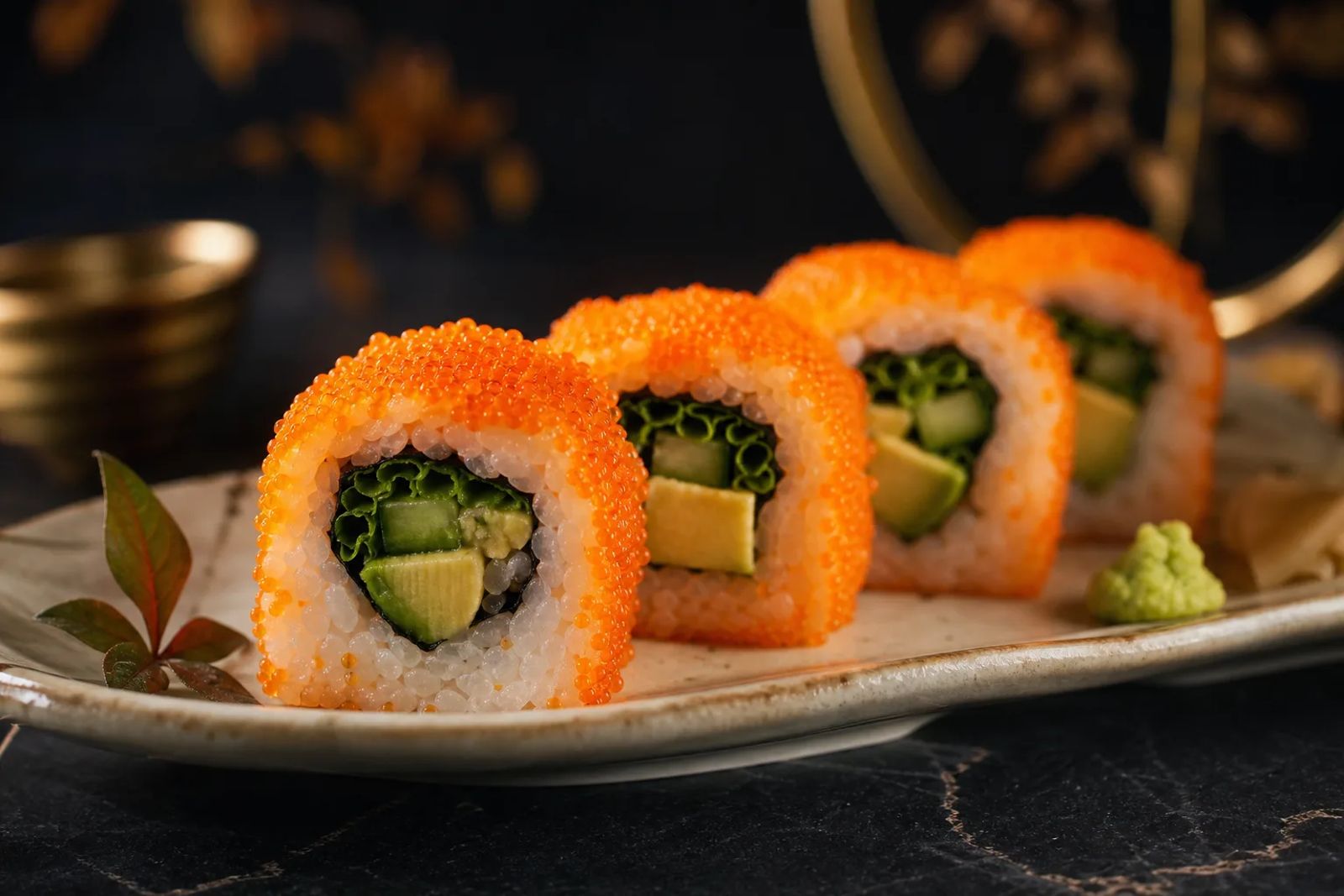
Tobiko and masago add small beads of crunch to sushi and poke: press them onto the rice outside an inside-out roll, spoon them into a nori cup, or scatter them over a bowl just before eating. At home, the useful distinction is between preparing the rice and fillings safely and adding ready-to-eat roe at the end.
Choosing tobiko and masago
Tobiko is flying fish roe, meaning eggs, described in our guide to flying fish roe. Masago is roe from capelin, a small marine fish; see capelin roe.
The Japanese Bar describes both as crunchy and grainy: expect a fine scattering of beads rather than the larger burst of salmon roe.
Uwajimaya, a Japanese food retailer, describes masago as smaller than tobiko and tobiko as having a crunchy, popping texture. The Japanese Bar describes both as crunchy and grainy: expect a fine scattering of beads rather than the larger burst of salmon roe.
Check the ingredient list for the declared fish; colour and menu photographs cannot reliably identify the roe. For the wider distinction, read caviar compared with other roe; neither of these roes is sturgeon caviar.
Natural colour, added colour and flavour
Natural colour varies, and an orange appearance does not establish that prepared roe is uncoloured. Green, black and yellow versions are prepared presentations, not separate fish species; check the ingredients for colours and flavourings.
Namiko Hirasawa Chen, the Japanese author behind Just One Cookbook, uses yellow, yuzu-flavoured tobiko on California rolls. Choose by the ingredient list if you want citrus, wasabi-style seasoning or a particular colour; do not assume that green means only wasabi or black means only ink.
- EU and UK: Regulation (EU) No 1169/2011 requires the functional class, such as “colour”, followed by the additive's name or E number. Great Britain has its assimilated version; EU requirements apply in Northern Ireland. In the EU and Northern Ireland, Regulation (EC) No 1333/2008, Article 24 and Annex V, requires the warning “may have an adverse effect on activity and attention in children” for E102, E104, E110, E122, E124 and E129, subject to exemptions. Great Britain has an assimilated version of that regulation.
- US: FDA rules, including 21 CFR 101.22, require certified colours to be named individually, for example Blue 1. FDA's Red No. 3 revocation gives food manufacturers until 15 January 2027 to reformulate, so a November 2026 label needs that context.
- Japan: Under the Food Labelling Standards, colouring additives need both their colouring function and substance name. Look for 着色料, meaning colouring, followed by the colour names in brackets.
Three ways to use the roe
Inside-out rolls, or uramaki: The rice faces outwards, so it can hold a coating of roe. Maya Resorts' published California roll method spreads tobiko over the rice before turning the sheet over and enclosing the filling, a less awkward approach than trying to decorate every cut slice.
Gunkan: A strip of nori surrounds an oval mound of sushi rice, leaving a rim that holds loose roe. The Japanese Bar documents both tobiko and masago in this form; make these last rather than leaving filled nori standing while you prepare everything else.
Poke bowls: Add the roe as a finishing topping rather than crushing it into a heavily mixed sauce. Lee Kum Kee's published bowl finishes with masago; Hawaiian food writer Martha Cheng's Korean-inspired bowl uses tobiko.
Sushi rice is cooked short-grain rice seasoned with vinegar, sugar and salt; our sushi and hand-roll guide covers the basics. More dishes sit in roe recipes.
Poke is Hawaiian, not a sushi category
Bishop Museum traces poke to Native Hawaiian preparations of raw fish with paʻakai, sea salt, limu, edible seaweed, and ʻinamona, roasted kukui nut relish. Its account distinguishes that foundation from later introductions such as avocado.
The bowl below is a contemporary Korean-inspired adaptation, not a claim to reproduce that older preparation. For the Japanese side of these ingredients, see Japanese roe traditions.
Recipe: tobiko-coated inside-out roll
Adapted from Maya Resorts' California roll quantities and Namiko Hirasawa Chen's rolling technique. Prepare the sushi rice using the guidance above, rather than the resort booklet's seasoning formula.
Yield: one roll cut into 6 to 8 pieces. Roe: 20 g per roll, according to Maya Resorts.
Equipment: bamboo rolling mat, food-safe film, board, sharp knife, scales and a shallow plate.
Ingredients
- 80 g prepared sushi rice
- 20 g seasoned flying fish roe, tobiko
- 30 g salmon supplied for raw consumption with appropriate parasite controls
- 15 g avocado, sliced
- 20 g cucumber, cut into thin strips
- 5 g lettuce
- 10 g mayonnaise
- 1 nori sheet
Method
- Cover the mat with film. Lay down the nori and spread the rice over it in an even layer.
- Press the tobiko gently onto the rice, then turn the sheet over so the nori faces upwards.
- Arrange the salmon, avocado, cucumber and lettuce along the nori. Add the mayonnaise, then roll with gentle, even pressure.
- Cut into 6 to 8 pieces with a sharp, dampened knife and serve immediately.
Allergens: fish and egg; check the mayonnaise and seasoned roe for additional ingredients.
Recipe: Korean-inspired poke bowl with tobiko
Adapted from Martha Cheng's The Poke Cookbook, as reproduced by Hawaiian Electric. The original serves four and uses 60 ml tobiko in total, giving 15 ml per person.
Serves: 4. Have the rice cooked before assembling. Equipment: scales, measuring jug, mixing bowl, whisk, knife, board and four serving bowls.
Ingredients
- 454 g tuna supplied for raw consumption with appropriate parasite controls, diced
- About 960 ml cooked medium-grain white rice, the source's four US cups
- 1 head leaf lettuce, sliced
- 240 ml thinly sliced radish
- 2 nori sheets, crumbled
- 30 ml sesame seeds
- 60 ml seasoned flying fish roe, tobiko
- For the dressing: 120 ml gochujang, 60 ml toasted sesame oil, 45 ml rice vinegar, 30 ml honey, 15 ml soy sauce and 60 ml water
Method
- Whisk the dressing ingredients together until smooth. Keep it separate while arranging the bowls.
- Divide the rice between four bowls, then add lettuce, sprouts and tuna. Finish with nori, sesame seeds and tobiko.
- Serve the dressing alongside so each person can add it to taste. Assemble only when everyone is ready to eat.
Allergens: fish, sesame and soy; gochujang and soy sauce may contain wheat. Check both labels.
Raw fish, ready-to-eat roe and cooked rice
FDA advises pregnant women, children, older adults and immunocompromised people to avoid raw fish. Other readers should confirm supplier parasite controls. A freezing schedule for fish flesh is not automatically an instruction to refreeze a prepared tub of roe, and freezing does not replace hygienic handling.
- EU: Regulation (EC) No 853/2004 requires relevant raw fishery products to reach -20°C (-4°F) throughout for at least 24 hours, or -35°C (-31°F) for at least 15 hours, unless an exemption applies. Ireland's Food Safety Authority explains that the clock starts after all parts reach the required temperature.
- UK: Food Standards Scotland explains the same freezing schedules for food businesses, with specified exemptions. For home-cooked rice, the FSA advises cooling leftovers quickly, ideally within one hour, refrigerating and consuming within 24 hours.
- US: The FDA's 2026 Food Code is a model for local adoption, not automatically nationwide law. Its parasite schedules include -20°C (-4°F) for seven days, or specified -35°C (-31°F) treatments; it separately exempts fish eggs removed from the skein and rinsed. For food requiring temperature control, its general holding limits are 5°C (41°F) or below, or 57°C (135°F) or above. Commercial sushi-rice acidification needs a controlled process, not simply a splash of vinegar.
- Japan: MHLW recommends freezing against Anisakis at -20°C (-4°F) for at least 24 hours. This is public-health advice, not a claim that Japan has adopted the EU or US legal schedules.
- Australia: NSW Food Authority recommends the two-hour and four-hour rule: under two hours out of refrigeration, refrigerate or use; between two and four hours, use immediately; after four hours, discard. This is NSW guidance.
For these home recipes, cook rice for the meal and assemble promptly; apply the FSA leftover-rice advice if saving any separately. Keep roe refrigerated according to its producer's instructions, take out only what you need and return the container promptly; an attractive colour or pleasant smell cannot establish safety.
Sources
-
Uwajimaya. Flying Fish Eggs, Also Known As Tobiko. Undated reference entry. Source.
-
The Japanese Bar. Tobiko and Masago Sushi, Types, Sustainability, +. Published 16 February 2023. Source.
-
Namiko Hirasawa Chen, Just One Cookbook. California Roll カリフォルニアロール. Recipe updated 3 June 2025. Source.
-
Maya Resorts. California Roll and Nigiri, Japanese recipe booklet. March 2023 file edition. Source.
-
Martha Cheng, reproduced by Hawaiian Electric. Korean Poke Bowl, from The Poke Cookbook, Clarkson Potter. 2017; recipe featured on 3 May 2017. Source.
-
Lee Kum Kee Food Professional USA. Poke Bowl. Undated online recipe. Source.
-
Bishop Museum. The History of Poke in Hawaiʻi. Undated museum article. Source.
-
Food Standards Agency. Food additives. Government guidance. Source.
-
Food Standards Agency. Authorised Regulated Food and Feed Products for Great Britain: Tartrazine. Register entry updated 1 April 2025. Source.
-
US Food and Drug Administration. Food Ingredients and Colors. Consumer information booklet. Source.
-
US Food and Drug Administration. Final Rules and Final Orders: Food Additives and Color Additives, record for 90 FR 4628, FD&C Red No. 3. Orders published on 16 January 2025 and 5 August 2026; food compliance date 15 January 2027.
-
Osaka Prefectural Government. 加工食品の表示:添加物 [Processed food labelling: additives]. Updated 3 April 2025. Source.
-
Food Safety Authority of Ireland. Safe Production of Sushi. Food safety guidance. Source.
-
Food Standards Scotland. Freezing fish and fishery products. Food business guidance. Source.
-
Food Standards Agency. Home food fact checker. Government guidance updated 21 August 2026. Source.
-
US Food and Drug Administration. FDA Food Code 2026. 2026 edition, particularly sections 3-402.11 and 3-501.16 and Annex 6's sushi-rice acidification guidance. Source.
-
Japan Ministry of Health, Labour and Welfare. アニサキス食中毒に関するQ&A [Questions and answers about Anisakis food poisoning]. Public health guidance. Source.
-
NSW Food Authority. Sushi. Consumer food safety guidance. Source.
Last checked: November 2026