
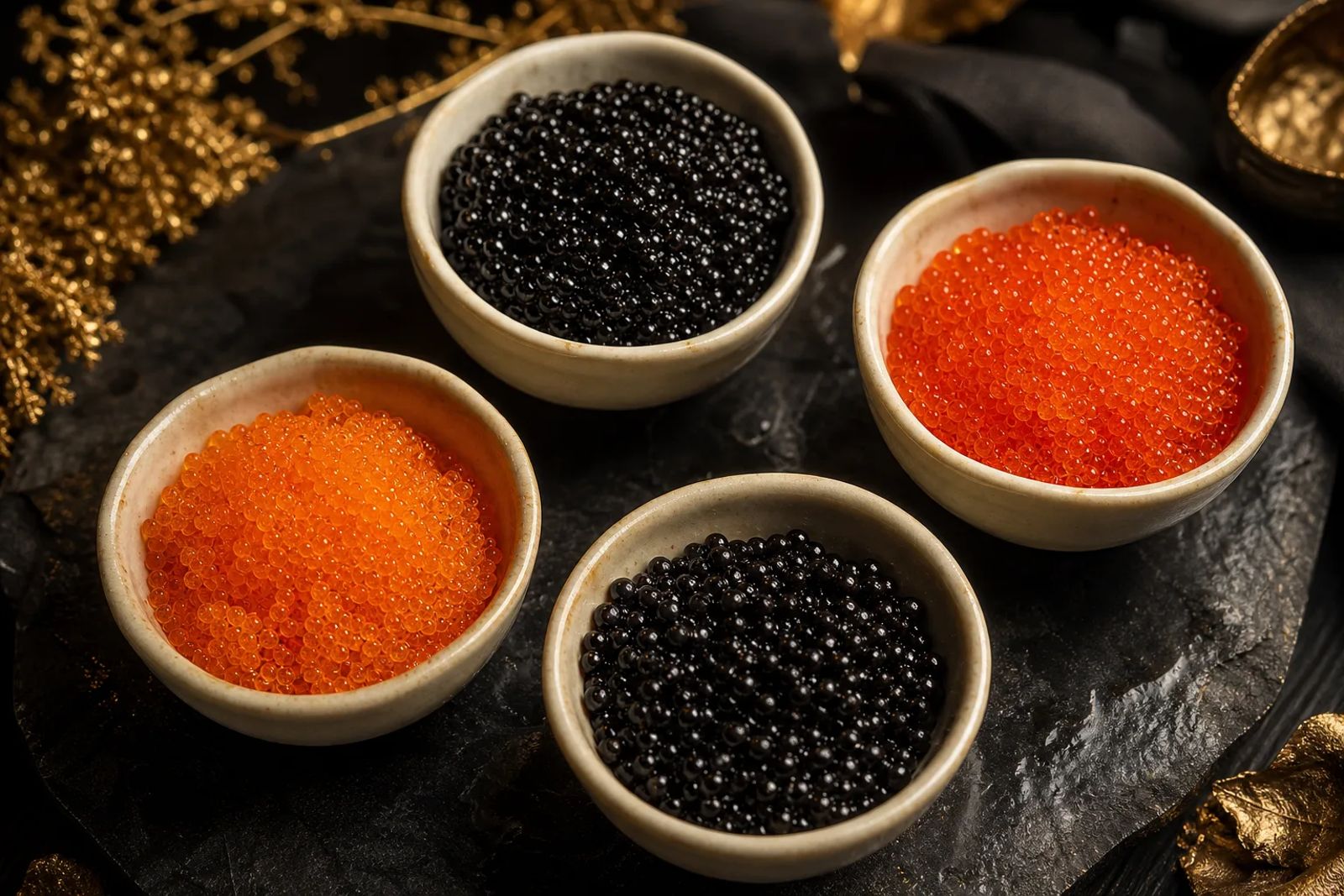
Sturgeon caviar, tobiko, masago and lumpfish roe are all fish eggs, but they come from different fish and are processed for different eating qualities. Tobiko is flying fish roe, masago is capelin roe, and lumpfish roe is a separate product whose familiar red or black colour is often added.
- Read the fish name and ingredients before judging by colour.
- Salt, sugar, seasonings and colours vary between products, even within one roe type.
- Customs classifications and the rules for naming food on a retail label are different things.
Caviar vs tobiko, masago and lumpfish roe at a glance
Roe means fish eggs. Sturgeons belong to the family Acipenseridae; flying fish belong to Exocoetidae, while capelin is Mallotus villosus and lumpfish is Cyclopterus lumpus.
| Roe | Fish | Bead diameter | Natural colour | Added colour |
|---|---|---|---|---|
| Sturgeon caviar | Acipenseridae | 2.4 to 3.0 mm, Siberian sturgeon example only | Grey, black, yellowish, brownish or greenish | Not needed for these natural shades |
| Tobiko | Flying fish, Exocoetidae | Approximately 1 to 2 mm | Kikkoman attributes redness to astaxanthin | Yes, in documented seasoned products |
| Masago | Capelin, Mallotus villosus | 0.9 to 1.0 mm in a Canadian biological account | Reddish in a Canadian spawning account | Yes, in documented orange and red products |
| Lumpfish roe | Cyclopterus lumpus | 1 to 2 mm in Polar Seafood's product description | Variable, including pink, orange and purple | Yes, in documented red and black products |
These are source-specific measurements, not identification limits. The sturgeon figure is one species example; the capelin figure describes biological eggs rather than a finished masago specification. A Danish research report gives lumpfish eggs as 2.2 to 2.6 mm, illustrating why biological measurements and supplier descriptions should not be treated as interchangeable.
For the broader comparison, start with caviar comparisons. The individual guides to tobiko, masago and lumpfish roe cover their processing in more detail.
What changes in the mouth?
Texture is usually the most useful culinary distinction. Kikkoman describes tobiko as popping, while Hokkai calls its flying fish roe crunchy, briny and lightly sweet, with an umami note. Those are attributed product descriptions, not a promise that every tobiko preparation tastes the same.
Masago should not be dismissed as having no crunch. The supplier's Masago Red specification describes crunchy texture and fish, sweet and salty flavours. Its smaller grains can produce a finer scattering across a mouthful, but the exact contrast with tobiko depends on the two preparations being compared.
Polar Seafood describes its lumpfish roe as firm and crisp, with a gentle pop and a mildly salted, slightly sweet flavour. Elsinore describes its own product as salty with a subtle pop. For sturgeon caviar, University of Florida extension authors describe a delicate flavour; there is no single flavour profile covering every species and preparation. For sturgeon caviar, firmness needs to be judged by the particular product, not by a universal expectation of a loud pop.
How to recognise them without guessing
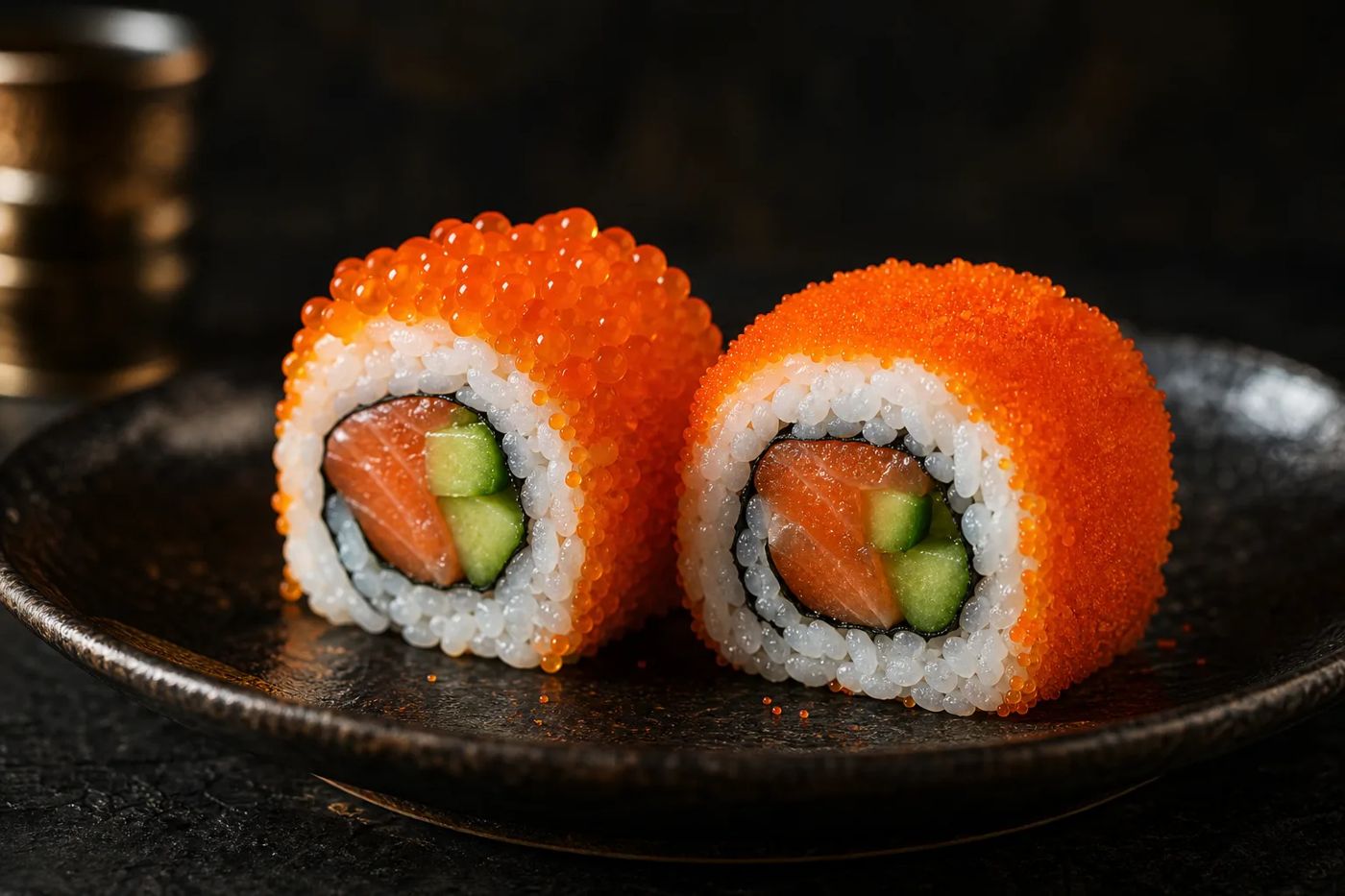
Tobiko generally looks coarser than masago: Hokkai explicitly describes it as slightly larger. At a sushi counter, that is a useful clue rather than proof, because both may be seasoned orange and the grains are small. Ask which fish supplied the roe if the menu leaves it unclear.
A black bead, by itself, identifies neither the fish nor the processing.
Black is particularly unhelpful when separating lumpfish roe from sturgeon caviar. Codex describes naturally grey to black sturgeon eggs, alongside yellowish, brownish and greenish shades; Royal Greenland's black lumpfish ingredient list names several added colours. A black bead, by itself, identifies neither the fish nor the processing.
On the pack, look for the fish name first, then read the entire ingredient list. Flying fish roe, capelin roe and Cyclopterus lumpus answer different questions from words such as orange, black or seasoned. Our guide to natural roe colours explains why appearance needs that context.
Salt, seasoning and added colour
These are prepared foods, not simply eggs with different pigments. Hokkai's tobiko lists sugar, salt, flavour enhancers, acidity regulators and colours E102 and E129. The Masago Red specification lists capelin roe, sugar, salt, mirin and colours E124 and E110. Royal Greenland's lumpfish products include stabilisers and sodium benzoate, E211.
Salt needs a product-specific comparison. Codex specifies 3 to 5 g salt per 100 g for sturgeon caviar; the supplier's Masago Red specification declares 5.5 g per 100 g, while Royal Greenland's lumpfish sheet declares 4.4 g. These are examples, not averages for each fish.
Tetsujin's Tobiko Gold sheet reports 426 mg sodium per 50 g. That is approximately 2.13 g salt equivalent per 100 g, calculated using sodium multiplied by 2.5. The same ingredient list contains soy sauce with soybean and wheat, so fish is not necessarily the only allergen to check.
What the names mean in different jurisdictions
Codex CXS 291-2010 is an international reference standard for salted roe of Acipenseridae, not a worldwide retail naming law. Its scope does not include tobiko, masago or lumpfish roe.
In the United States, FDA's nonbinding CPG 540.150 says unqualified caviar should mean salted sturgeon roe. Other salted roe may use caviar with the fish name in substantially equal type size and prominence. The guidance also calls for a prominent declaration of added colour and an ingredient list.
For customs, the EU's 2026 Combined Nomenclature separates caviar, 1604 31 00, from caviar substitutes, 1604 32 00. The UK tariff also distinguishes sturgeon caviar from caviar substitutes under heading 1604. Customs classifications do not decide what wording is acceptable on a supermarket label. EU consumer information must not mislead about a food's identity or composition under Regulation (EU) No 1169/2011.
In Great Britain, food descriptions must also be accurate and not misleading, with the food information rules operating through assimilated legislation. Northern Ireland generally follows the applicable EU food information and additives framework. For a reader, the practical test is straightforward: the name and ingredients should make the actual fish clear.
Additive permissions are separate again. EU Regulation (EC) No 1333/2008, category 09.3, permits specified colours in non-sturgeon roe under stated conditions, excluding sturgeon eggs from those colour entries. Great Britain now uses the FSA's official additive authorisations register; Northern Ireland applies EU additives law. An E number on an overseas pack is not universal permission.
US colour permissions sit in 21 CFR Parts 73 and 74, with conditions for each additive; FDA identifies Yellow No. 5 as E102 and Yellow No. 6 as E110. In Japan, the Consumer Affairs Agency requires food labelling in Japanese and administers additive authorisations under the Food Sanitation Act. Tobiko or masago on the front is not a substitute for reading that information.
Which roe suits the dish?
For sushi, tobiko and masago supply a scattering of small eggs rather than the larger individual beads in the Siberian sturgeon example above. Kikkoman identifies sushi topping as a main use of tobiko; Tetsujin's masago sheet suggests sushi rice and garnishing. Choose between them for the particular texture and seasoning you want.
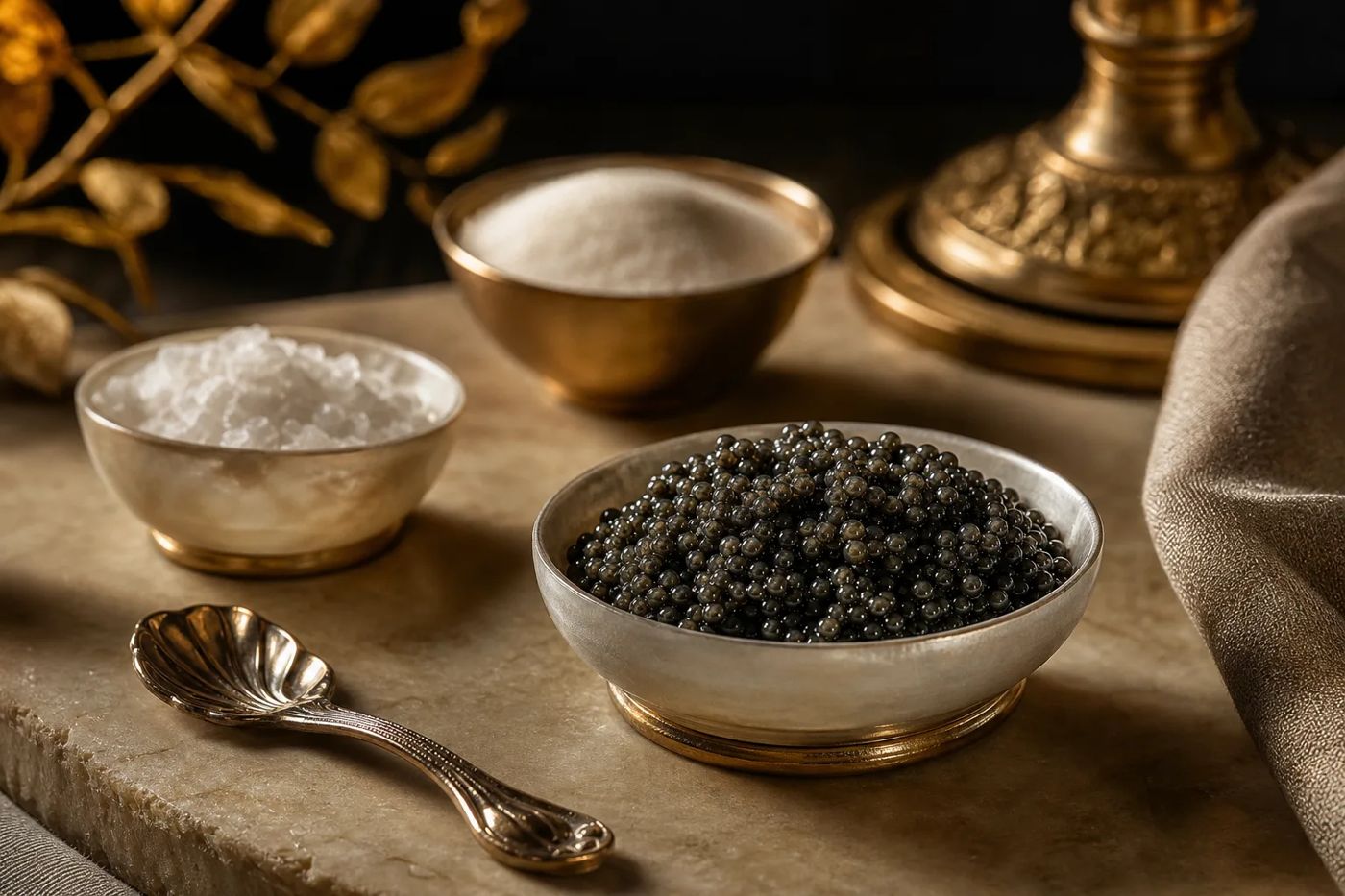
Blinis can carry sturgeon caviar or lumpfish roe; Elsinore specifically recommends its lumpfish roe with blinis or crackers. If your aim is to compare the roes themselves, keep the base plain and use separate small spoonfuls. That makes it easier to notice whether sweetness, acidity, salt or the egg membrane supplies the main impression.
With dyed lumpfish roe, consider the surface underneath. The Nibble's culinary glossary warns that colour can bleed into moist foods such as sour cream. For a clean-looking garnish, add it close to serving rather than leaving it sitting on a pale topping; the extent depends on the formulation.
For warm dishes, add sturgeon caviar off the heat unless following a recipe that deliberately heats it. Heat can alter egg proteins and texture, and caviar processing research documents changes in quality and flavour; a garnish and a controlled commercial pasteurisation process are different situations. Do not assume that a roe suitable for a cold sushi topping will keep exactly the same texture in a simmering sauce.
For storage, follow the pack's chilled or frozen instructions, thaw frozen roe under refrigeration, and observe its use-by date and opening limit. For more serving comparisons, see caviar substitutes compared.
Sources
-
Codex Alimentarius Commission. Standard for Sturgeon Caviar, CXS 291-2010, Codex register last modified 2026, sections 1, 2.2 and 7.1. Official standards register.
-
University of Florida, IFAS Extension. Chapman and Van Eenennaam, Sturgeon Aquaculture: Specialized Techniques: Determining the Stage of Sexual Maturity in Female Sturgeon for Artificial Spawning: The Egg Polarization Index or PI, FA153, reviewed August 2025. Publication record.
-
Kikkoman Corporation. Tobiko / Flying Fish Roe, culinary glossary, undated current page. Glossary entry.
-
Fisheries and Oceans Canada. A Biophysical Overview of Eastport, Bonavista Bay, November 2001, capelin section, printed page 96; and Capelin Northwest Atlantic Fisheries Organization Divisions 4RST, management-plan page. Biophysical report; management plan.
-
Danish Institute for Fisheries Research. Lightly Salted Lumpfish Roe: Composition, Spoilage, Safety and Preservation, report 46-97, 1997, chapter 3. Research report.
-
Polar Seafood. Lumpfish Roe, undated producer description.
-
Hokkai Suisan. Tobiko, undated producer and importer description, ingredients and serving information.
-
Innnes, specification host. Specification: Masago Red, Issue 1, composition, organoleptic and nutritional specifications. Specification.
-
Royal Greenland. Greenlandic Lumpfish Roe, Red / Black, undated product specification. Specification.
-
Elsinore Foods. Lumpfish Caviar (Chilled), undated producer information, ingredients, sensory description and serving instructions.
-
Tetsujin, distributed through Gourmet Foods International. Tobiko Gold Roe, SKU 47074, undated specification; and Masago Capelin Roe, SKU 850308, specification carrying a November 2025 timestamp. Tobiko specification; masago specification.
-
University of Florida, IFAS Extension. Chapman and Van Eenennaam, Technically Speaking, What Is Sturgeon Caviar?, FA194, reviewed February 2025. Extension publication.
-
US Food and Drug Administration. CPG Sec. 540.150: Caviar, Use of Term: Labeling, October 1989, nonbinding compliance guidance. FDA guidance.
-
European Commission. Commission Implementing Regulation (EU) 2025/1926, 22 September 2025, establishing the 2026 Combined Nomenclature, heading 1604. Official regulation.
-
UK Government. Food Labelling and Packaging: Overview and Food Labelling: Giving Food Information to Consumers, guidance. Overview; detailed guidance.
-
European Parliament and Council. Regulation (EC) No 1333/2008 on Food Additives, consolidated text of 5 October 2023, Annex II, category 09.3. Consolidated regulation.
-
Food Standards Agency. Guidance on Using the Register of Food Additive Authorisations, framework effective from 1 April 2025. Register guidance.
-
Food Standards Agency. Guidance for Local Authorities and District Councils on Grey Market Goods, section 9. Official guidance.
-
US Food and Drug Administration. Summary of Color Additives for Use in the United States in Foods, Drugs, Cosmetics, and Medical Devices, 21 CFR Parts 73 and 74. FDA summary.
-
Consumer Affairs Agency, Japan. Food Labelling and Food Additives, guidance. Labelling guidance; additives guidance.
-
The Nibble. Caviar Glossary: Lumpfish Roe, culinary reference, undated current page. Glossary entry.
-
Trends in Food Science & Technology. Mechanisms of Formation, Deterioration, and Regulation of Quality in Caviar and Its Substitutes: Recent Advances and Future Trends, 2025, review article, thermal-processing discussion. Research article.
Last checked: November 2026