
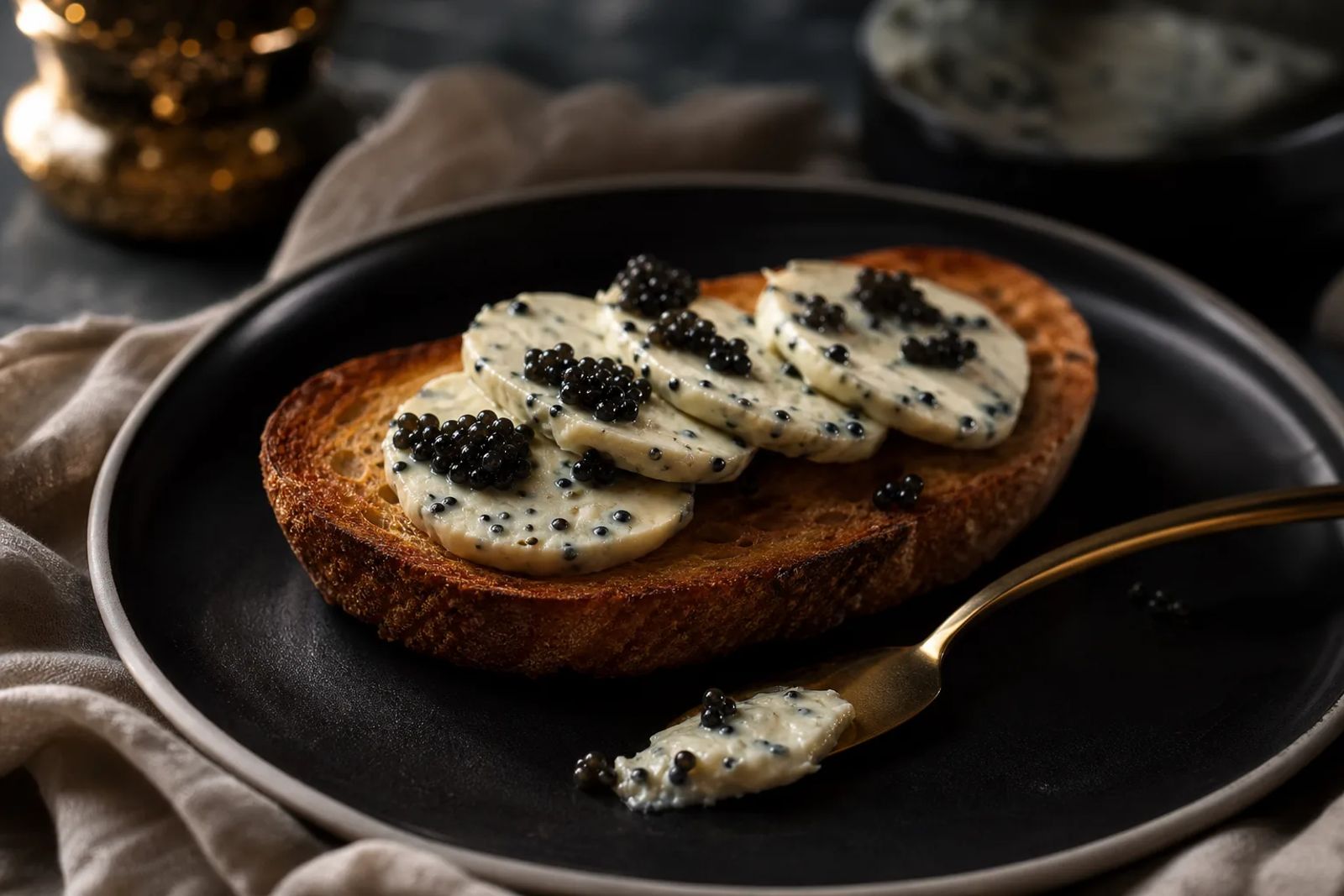
Leftover caviar is best used promptly, either spooned over a finished dish or folded gently into softened unsalted butter. Caviar butter spreads a small amount through several portions, but it is a way to serve the roe, not a preservation method or a fresh start for an opened tin.
Keep leftover caviar cold
Browne Trading recommends eating its opened caviar within 1 to 3 days; an archived US USDA FSIS storage chart gives two days for opened non-pasteurised caviar kept at 4°C (40°F). Follow the product's own shorter instructions and use-by date, and see opened caviar storage for the fuller explanation.
Before putting the tin away, gently level the remaining roe without pressing hard enough to break the beads. Browne Trading advises covering the surface with food-safe cling film to reduce air exposure; refit the lid, keep the tin upright and note when it was opened.
Use a clean spoon each time, and keep the tin away from raw fish or meat and their juices. Do not scrape food from guests' plates back into it: set aside the portion you want to keep before serving the rest.
At home, follow any colder temperature specified on the label. The national guidance below concerns refrigeration, not a suggested temperature for eating the butter.
In the UK, FSA household guidance for England, Wales and Northern Ireland recommends a fridge between 0 and 5°C (32 to 41°F). US FDA advice is 4°C (40°F) or below; EU EFSA advice is below 5°C (41°F), while France's ANSES recommends 0 to 4°C (32 to 39°F), and FSANZ consumer advice for Australia and New Zealand says 5°C (41°F) or colder.
Caviar butter recipe
This adaptation follows Lucy Vaserfirer's caviar butter from Flavored Butters, reproduced with permission by Food Republic. Her recipe uses one US stick of unsalted butter and half to one ounce of caviar; the metric version below uses the upper amount, with the species specified for clarity.
- Preparation: 10 minutes, plus chilling until firm.
- Serves: 8, as in the source recipe.
- Caviar per person: 28 g divided by 8, or 3.5 g.
- Equipment: scales, bowl, flexible spatula, baking parchment and a covered container.
- Allergens: fish and milk.
Ingredients
- 113 g unsalted butter, softened but not melted.
- 28 g (about 1 oz) salted, unpasteurised Siberian sturgeon caviar (Acipenser baerii), kept refrigerated until needed.
This is approximately one part caviar to four parts butter by weight. Vaserfirer's original recipe allows either black caviar or salmon roe.
Method
- Work the softened butter in the bowl with the spatula until it is smooth and easy to spread. Do this before taking the caviar out of the fridge.
- Add the cold caviar and fold gently, lifting the butter over the beads rather than beating or crushing them. Stop when the caviar is distributed through the butter.
- Spoon onto baking parchment and shape into a short log, using the paper to guide it. Wrap, cover and refrigerate promptly at 4°C (40°F) or below, following any colder instruction on the caviar label.
- According to Vaserfirer, chill until firm enough to slice. For spreading, soften only the portion you are about to serve, leaving the rest refrigerated.
For a smaller leftover, scale both ingredients together rather than making the full batch. For example, 7 g caviar with about 28 g butter follows the same rounded ratio; this is arithmetic scaling, not a separately tested recipe.
How long will the butter keep?
Make only enough for the meal you are planning, chill it promptly until serving, and do not treat mixing as permission to keep older caviar longer.
Before mixing, decide what you will put it on and prepare that dish first. If you have more caviar than the planned meal needs, leave the unused portion covered in its original tin, with its opening date still visible, rather than turning everything into butter.
Can caviar butter be frozen?
Codex CXS 291-2010, section 2.3, says freezing and frozen storage are “not permitted unless the deterioration of quality is avoided”. That is a conditional quality provision for sturgeon caviar, not a blanket ban on freezing and not a validated method for freezing homemade caviar butter.
The archived USDA chart advises against freezing caviar, rather than providing a freezer life. Following the USDA chart's advice against freezing caviar, prepare this butter for fresh service; the separate guide to freezing caviar explains the ingredient question in more detail.
Ways to use caviar butter
Vaserfirer suggests bread or toasted bagels, soft-boiled eggs and baked potatoes. My practical preference for a small leftover is toast or a split potato: both let you portion the butter precisely, without needing to make another sauce or a large dish.
For fish and finishing sauces, James Martin's turbot with beurre blanc provides the useful model. He removes the reduced sauce from the heat before whisking in butter and adding the caviar, then serves it with the fish.
To use your compound butter along those lines, add a small piece to the plated, cooked fish, or gently swirl it into a finished sauce off the heat. This is an adaptation of his finishing technique, not his sauce recipe: do not replace every gram of sauce butter with caviar butter and assume the seasoning will balance.
Keep it out of the frying pan and do not use it to baste fish while it cooks. Fold gently to retain recognisable beads. Heat can firm the eggs and damage their delicate texture.
Small amounts need not become butter
Sometimes the simplest use is the better one. Before mixing anything, consider these serving suggestions, which use the caviar as a finish rather than an ingredient that needs cooking.
- Scrambled eggs: cook and plate the eggs, then spoon the caviar on top. The scrambled eggs with caviar guide covers the dish; keep a little patch of roe together rather than stirring a few beads invisibly through the whole plate.
- Pasta: finish the pasta and its sauce first, take it off the heat, and divide between plates before adding the roe. For a very small amount, put it on the top of each portion rather than trying to distribute it throughout a saucepan.
- Potatoes: split a cooked potato, or arrange cooked small potatoes on a plate, then add the caviar at the table. Choose this instead of making compound butter when you want to keep the last spoonful separate and clearly visible.
These are portioning suggestions, not additional tested recipes with prescribed quantities. For more ways to judge where a small spoonful belongs, see caviar as a finishing seasoning, or browse the caviar recipes hub for a complete dish.
When to throw it away
Discard caviar that has exceeded its labelled use-by date or opening instructions, or whose refrigeration history you cannot trust. The FSA, covering England, Wales and Northern Ireland, warns that a normal smell is not a safety test for foods carrying a use-by date; do not taste a suspect spoonful to check it.
Visible mould or an abnormal, unpleasant smell is a reason to stop, not an invitation to disguise the roe in butter.
For time out of refrigeration, US FDA and USDA FSIS guidance says perishable foods should not sit out for more than two hours, reduced to one hour above 32°C (90°F). Preparation and serving both count towards the time you need to track, so repeatedly returning the tin to the fridge is not a way to erase earlier time on the table.
FSANZ's Australian food-business guidance uses a different, cumulative rule for potentially hazardous food between 5 and 60°C (41 and 140°F): under two hours, refrigerate or use; from two hours to less than four hours, use immediately without refrigerating again; at four hours or more, discard. For leftovers you intend to save, the relevant decision is whether they can go back into refrigeration, not simply whether they can still be eaten immediately.
Visible mould or an abnormal, unpleasant smell is a reason to stop, not an invitation to disguise the roe in butter. For the fuller distinction between deterioration and safety, read caviar spoilage and when to discard it.
Sources
- Lucy Vaserfirer, Food Republic: Lush Life: Caviar Butter Recipe, updated 19 October 2015. Recipe reproduced with permission from Flavored Butters.
- Browne Trading Company: How to Store Caviar, 12 December 2023.
- USDA Food Safety and Inspection Service: Mail Order Food Safety, revised January 2008, held by the US Government Publishing Office. Storage chart compiled with the FDA Outreach and Information Center.
- Food Standards Agency, GOV.UK: How to chill, freeze and defrost food safely, published 18 December 2017, Applies to England, Northern Ireland and Wales.
- US Food and Drug Administration: Refrigerator Thermometers: Cold Facts about Food Safety, live consumer guidance, retrieved November 2026.
- European Food Safety Authority: Proper food handling, Safe2Eat consumer guidance.
- ANSES: Food hygiene in the home, English language factsheet.
- Food Standards Australia New Zealand: Food safety basics, live consumer guidance, retrieved November 2026.
- James Martin: Pan Fried Turbot and Beurre Blanc Caviar Sauce, Online recipe.
- Food Standards Agency, GOV.UK: Home food fact checker, updated 21 August 2026. Applies to England, Northern Ireland and Wales.
- USDA Food Safety and Inspection Service: How do I handle leftovers safely?, updated 20 December 2024.
- Food Standards Australia New Zealand: 2-hour / 4-hour rule, Guidance for food businesses.
Separately from household guidance, Codex specifies +2 to +4°C for caviar during packaging, storage and retail, and 0 to −4°C for wholesale storage and transport.
Last checked: November 2026